Pectus Carinatum: Understanding Symptoms, Causes, and Modern Correction Options

Updated: 3 days ago
Medically reviewed by Dr. Baraa Alnahhal, MD · Last reviewed: October 2026
Pectus carinatum, often called “pigeon chest,” is a condition where the breastbone protrudes outward. While typically asymptomatic, it can cause chest pain and affect self-esteem. Diagnosis relies on physical exams and X-rays. Treatment options include non-surgical bracing for children and surgical procedures for severe cases. The long-term prognosis is excellent, with no impact on life expectancy.
Quick Answer: What is Pectus Carinatum?
Pectus carinatum, often called pigeon chest, is a chest wall condition in which the breastbone protrudes abnormally because the cartilage connecting the ribs to the sternum grows excessively. It is usually present at birth but often becomes more noticeable during adolescent growth spurts. Treatment focuses on correcting the chest's appearance with specialized bracing or surgery. [1]
What the research says
Bracing worked for about 9 in 10 children in a large Canadian series. A retrospective study followed 373 children who started bracing at a chest wall center; outcomes could be assessed in 241 (170 with a pressure-guided, orthotist-adjusted brace and 71 with a simpler self-adjustable brace). Bracing succeeded in 217 (90%), success was similar for the two brace types (89% vs 93%), active bracing lasted about 5.4 months in both groups, and most of the 24 failures (17) were due to non-compliance. The simpler brace cost less overall (Emil et al., Eur J Pediatr Surg, 2026).
Wearing the brace consistently was the strongest predictor of success. In 612 patients under 20 treated in the Scottish National Chest Wall Service, with wear time tracked by sensors built into the brace, 34.8% had full resolution and a further 11.9% were resolved to the patient’s satisfaction. Wear-time adherence was most strongly linked to success (p < 0.001), followed by chest wall flexibility and patient motivation (Dargie et al., J Pediatr Surg, 2026).
Most braced adolescents saw improvement, but some had setbacks. In a survey from Boston Children’s Hospital, 35 of the 49 braced patients who answered (71.4%) reported an improved chest appearance. About 23% of respondents said the deformity returned after bracing ended, and 31.4% of those who braced reported complications such as discomfort or pain (McArthur et al., J Surg Res, 2026).
Research summaries are based on article abstracts retrieved from PubMed.

What are the types of pectus carinatum?
Medical professionals classify this condition based on which part of the sternum is most affected. The most common form is chondrogladiolar, where the lower or main portion of the breastbone protrudes. In contrast, chondromanubrial pectus carinatum involves the upper section of the sternum sticking out [1].
Beyond these primary categories, the condition may be symmetric, affecting both sides of the chest equally, or asymmetric, where only one side protrudes. In some asymmetric cases, the other side of the chest may even appear depressed or rotated [1].
Feature | Chondrogladiolar | Chondromanubrial |
Prevalence | Most common type | Less common |
Primary Area | Lower/main sternum | Upper sternum |
Symmetry | Often symmetric | Can be symmetric or rotated |
Growth Impact | Becomes prominent in teens | Present from birth/early childhood |
What are the symptoms and possible causes of pectus carinatum?
For many individuals, pectus carinatum does not cause significant physical symptoms. However, some may experience localized chest pain, particularly during specific physical activities or when resting in certain positions. Beyond physical discomfort, the condition can lead to secondary issues such as poor posture and chronic back pain [1].
The exact cause remains unknown, though it is widely believed to be a disorder of the cartilage that joins the ribs to the breastbone. While a specific genetic marker has not yet been identified, approximately one-third of individuals with the condition have a family history of chest wall issues. It is also frequently associated with other conditions like scoliosis, Marfan syndrome, and asthma [1].
How is pectus carinatum diagnosed?
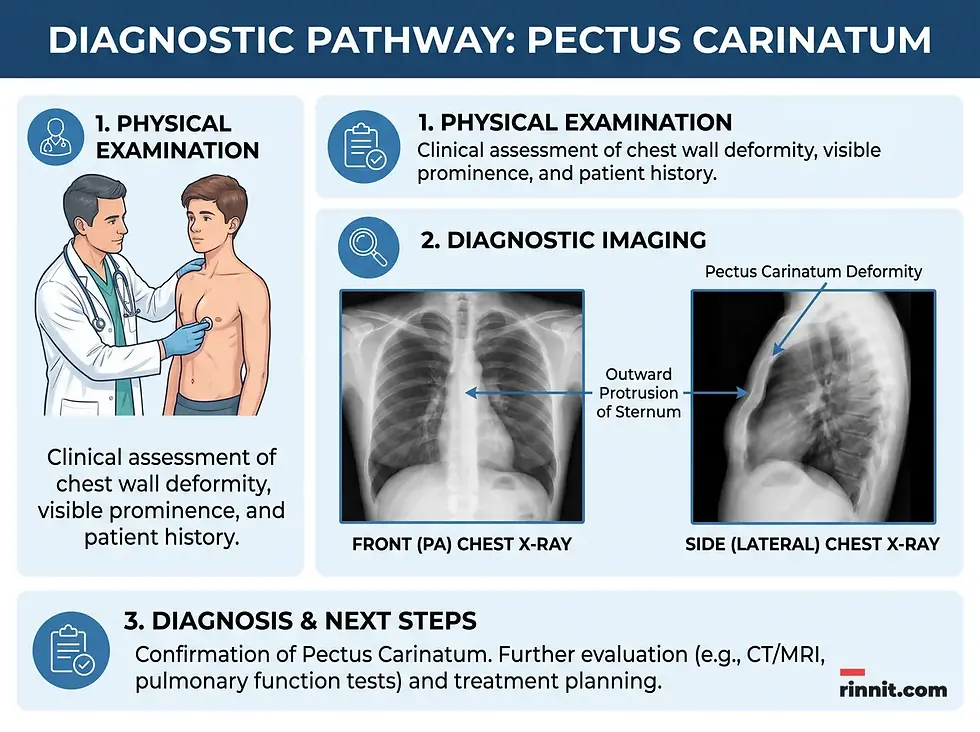
Diagnosis begins with a comprehensive medical history and a thorough physical examination. During this exam, healthcare providers check the degree of protrusion and assess the patient for related conditions like scoliosis. This initial evaluation is crucial for determining the most appropriate management strategy [1].
Imaging tests are the primary tools used to confirm the diagnosis and plan treatment. A chest X-ray, taken from both the front and the side, is the standard diagnostic test. In more complex cases or when planning for surgery, providers may order a Computed Tomography (CT) scan or Magnetic Resonance Imaging (MRI) to get a detailed view of the chest wall structure [1].
How is pectus carinatum treated and corrected?
Treatment is generally recommended for individuals who experience physical discomfort or significant self-esteem issues. The two primary paths are non-surgical bracing and surgical intervention. Bracing is highly effective for children and adolescents whose chest walls are still flexible, using consistent pressure to gradually move the sternum back into place [1].
For severe cases or for those who have finished growing, surgical options like the Ravitch procedure may be necessary. This involves removing the affected cartilage and repositioning the sternum, often securing it with sutures or specialized plates. Modern minimally invasive techniques, similar to the Nuss procedure, use a metal bar to depress the sternum, which is typically removed after a year or more [1].

What are the long-term outlook and recovery for pectus carinatum?
The prognosis for individuals with pectus carinatum is exceptionally positive. The condition does not affect life expectancy, and most people can live a full, active life without limitations. Those who undergo treatment—whether through bracing or surgery—generally report high levels of satisfaction with both the physical and cosmetic results [1].
Recovery from surgery typically involves a short hospital stay of one to five days, followed by several weeks of restricted activity. Regular follow-up appointments are essential to monitor healing and ensure the best possible outcome. Most individuals return to their normal daily routines within a few weeks of the procedure [1].
Conclusion
Pectus carinatum is a manageable condition that, while physically distinct, does not pose a threat to overall health or longevity. With modern advancements in bracing technology and surgical techniques, effective correction is more accessible than ever. Addressing the condition can lead to significant improvements in both physical comfort and emotional well-being.
When should you see a doctor about pectus carinatum?
If you or your child are experiencing symptoms or self-consciousness related to a protruding breastbone, consult with a healthcare professional to explore the best correction options for your specific needs.
Frequently Asked Questions
What is the “pigeon chest” condition?
Pectus carinatum, or “pigeon chest,” is a condition where the breastbone sticks out more than normal due to overgrowth of the cartilage connecting the ribs to the sternum.
At what age does pectus carinatum usually appear?
While the condition is present at birth, it most frequently becomes noticeable during the rapid growth spurts of the teenage years.
Is pectus carinatum a dangerous medical condition?
No, it is not considered dangerous and does not impact life expectancy. For most, it is primarily a cosmetic concern or a source of mild discomfort.
Can pectus carinatum be treated without surgery?
Yes, specialized chest bracing is a highly effective non-surgical treatment, especially for children and teens with flexible chest walls.
How long must a chest brace be worn?
Braces are typically worn for up to 24 hours a day for a period ranging from six months to several years, depending on the severity.
What causes the breastbone to protrude?
The exact cause is unknown, but it is believed to be a disorder of the cartilage. Family history plays a role in about 33% of cases.
Are there different types of pectus carinatum?
Yes, the two main types are chondrogladiolar (lower sternum protrusion) and chondromanubrial (upper sternum protrusion).
Does pectus carinatum cause chest pain?
Some individuals experience chest pain during certain activities or positions, though many have no physical symptoms at all.
What are the risks of surgical correction?
Surgical risks include bleeding, infection, fluid around the lungs, or the support bars moving out of place, though procedures are generally safe.
Can I still play sports with pectus carinatum?
Most people can live a normal life and participate in sports unless they experience significant discomfort or are in the early stages of post-surgical recovery.
Related Resources
External resource for deeper reading:
Related Reading
Pec Implants: Surgery, Recovery and Results explains pec implant surgery.
References
Cleveland Clinic. Pectus Carinatum. Cleveland Clinic Health Library. Last updated August 11, 2023. https://my.clevelandclinic.org/health/diseases/15790-pectus-carinatum
Emil S, Gibert Y, Lew D, et al. Dynamic Compression System versus Self-Adjustable Bracing for Pectus Carinatum: Clinical Outcomes and Cost Comparison. Eur J Pediatr Surg. 2026;36(5):378-384. PMID: 42302847. DOI: 10.1055/a-2887-9645
Dargie D, Johnstone A, Davis C. Non-operative treatment of pectus carinatum: Fifteen years of outcomes and predictors from a national paediatric service. J Pediatr Surg. 2026;61(9):163252. PMID: 42336266. DOI: 10.1016/j.jpedsurg.2026.163252
McArthur M, Lee SL, Chiu MZ, et al. Bracing for Success: Long-term Patient-reported Outcomes of Bracing Therapy for Pectus Carinatum. J Surg Res. 2026;326:183-188. PMID: 42419066. DOI: 10.1016/j.jss.2026.06.033
Medical disclaimer
This article is for informational purposes only and is not a substitute for professional medical advice, diagnosis, or treatment. Always seek the advice of your physician or other qualified health provider with any questions you may have about a medical condition.



Comments