Biliary Drainage: Types, Procedure, Risks and Recovery

Updated: Oct 31
Written and medically reviewed by Dr. Baraa Alnahhal, MD · Last reviewed: October 2026 · How we review
Quick Answer: What is a biliary drain?
A biliary drain is a thin, flexible tube with small side holes that restores bile flow when a bile duct is blocked or narrowed. It is placed either through the skin and liver (PTBD) or through the mouth with an endoscope. Most people go home the same or next day; fever or new yellowing needs prompt care. [1]
What the research says
Metal stents block less often than plastic stents in cancer-related blockages. A meta-analysis of 19 studies (1,989 patients) found metal stents had lower long-term blockage rates (odds ratio 0.38), fewer treatment failures (7% vs 13%) and less bile duct infection (8% vs 21%). Death rates at 30 days were similar. (Sawas et al., Gastrointestinal Endoscopy, 2015)
Through-the-skin and endoscopic drainage work about equally well, with different risk profiles. Across 17 studies (2,353 PTBD and 8,178 endoscopic patients), success rates, overall complications and 30-day deaths did not differ. PTBD carried a lower risk of pancreatitis (OR 0.14) and bile duct infection (OR 0.52) but a higher risk of bleeding (OR 1.78). (Rizzo et al., In Vivo, 2020)
When the first endoscopic attempt fails, ultrasound-guided drainage may mean fewer repeat procedures. Standard endoscopic drainage fails in 5% to 10% of cases. In 24 studies comparing the next options, ultrasound-guided endoscopic drainage matched PTBD for technical success, had fewer adverse events (OR 0.41), far fewer repeat procedures (OR 0.20) and about 4.9 fewer days in hospital. (Giri et al., Surgical Laparoscopy, Endoscopy & Percutaneous Techniques, 2023)
Key takeaways
A biliary drain restores bile flow when a bile duct is blocked.
A blockage can cause yellow skin and eyes (jaundice) and widespread itching.
The drain may empty into your intestine, into a bag outside your body, or both.
You will need someone to drive you home after the procedure.
Fever, drain-site changes or new yellowing of the skin need prompt medical attention.
What is a biliary drain?
A biliary drain is a thin, flexible tube with several small side holes that is placed past a blocked bile duct so bile can flow again. [1]
Your liver makes bile, a fluid that helps you digest food. Bile travels through the bile duct into your small intestine.
When something blocks that duct, bile backs up into the liver. Doctors call this cholestasis.
The drain lets bile flow into the small intestine, into a bag outside your body, or both.

What are the signs that bile is backed up?
Backed-up bile causes jaundice, a yellow tint to the skin and the whites of the eyes, and widespread itching. [1]
Sign | What it looks like |
Jaundice | Yellow tint to the skin and the whites of the eyes |
Itching | Widespread itchiness across the body |
Why would you need a biliary drain?
The most common reason for a biliary drain is a blockage or narrowing (called a stricture) of a bile duct, which slows or stops bile flow from the liver. [1]
Cause | Examples |
Inflammation | Pancreatitis; primary sclerosing cholangitis (long-term bile duct inflammation that causes scarring) |
Cancer | |
Enlarged lymph nodes | Swollen lymph nodes near the pancreas or liver, usually from cancer |
Gallstones | Stones in the gallbladder or inside a bile duct (choledocholithiasis); see gallstone pancreatitis |
Parasitic infections | Ascaris lumbricoides, Clonorchis sinensis (Chinese liver fluke), Fasciola hepatica |
Surgical injury | Damage to a bile duct during surgery |
What are the types of biliary drainage?
The two main types of biliary drainage are percutaneous transhepatic biliary drainage (PTBD) and endoscopic biliary drainage (EBD), and your care team chooses based on the cause of the blockage and your needs. [1]
Percutaneous transhepatic biliary drainage (PTBD)
"Percutaneous" means through the skin. The tube goes through the skin of your abdomen, through your liver, into the bile duct and on into the start of the small intestine (duodenum).
Bile drains through the tube into a bag outside your body and also into your intestine. Doctors use fluoroscopy, a live X-ray, to see the blocked duct and guide the tube.
Endoscopic biliary drainage (EBD)
An endoscope, a flexible tube with a light on the end, is passed through your mouth and down your digestive tract to the bile duct. A thin tube (catheter) is then guided through the scope into the blocked duct.
This can be done with ultrasound guidance (endoscopic ultrasound-guided drainage) or with ERCP (endoscopic retrograde cholangiopancreatography).
Bile can leave the body in two ways:
External: a tube runs out through the nose (endoscopic nasobiliary drainage, or ENBD).
Internal: a stent is placed so bile drains from the liver straight into the intestine.
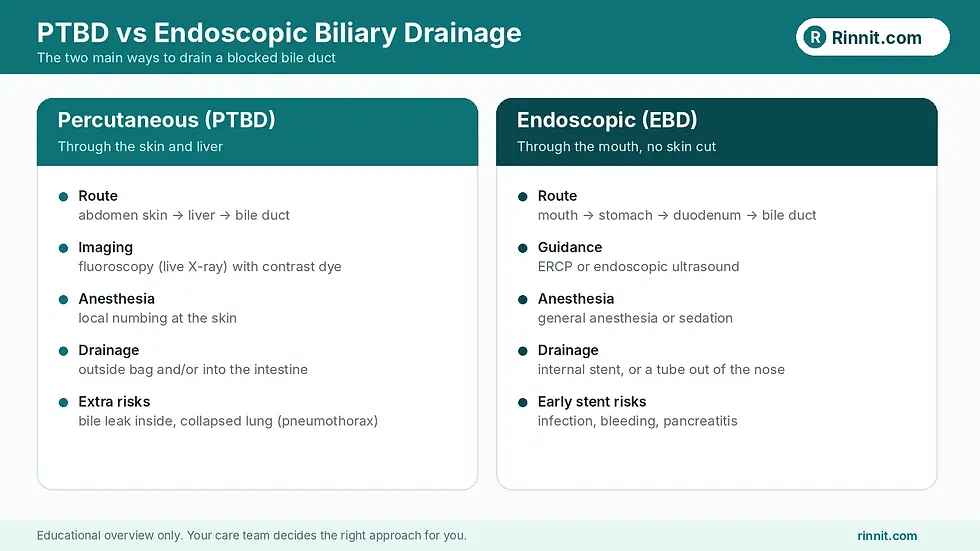
PTBD vs EBD at a glance
Feature | PTBD | EBD |
Entry point | Skin of the abdomen, through the liver | Mouth, through the digestive tract |
Guidance | Fluoroscopy (live X-ray) with contrast dye | ERCP or endoscopic ultrasound |
Anesthesia | Local numbing at the skin | General anesthesia or sedation, plus throat spray |
Where bile goes | Outside bag and into the intestine | Internal stent, or a tube out of the nose into a bag |
Bag care | Emptied several times a day | Emptied several times a day if external |
Biliary stenting
Depending on the cause of the blockage, your provider may place a permanent stent across the narrowed area. This may be done a few days after the first drainage procedure. [2]
How do you prepare for biliary drainage?
Preparation for biliary drainage usually means fasting for at least six hours, reporting allergies and medicines, asking about blood thinners and arranging a ride home. [1] Always follow your own care team's instructions. In general:
Fasting: do not eat, drink or smoke for at least six hours beforehand. Clear liquids such as water may be allowed; your provider will tell you when to stop.
Allergies: report any allergies, especially past reactions to IV contrast dye or anesthesia. If you are getting a stent, mention allergies to medical-grade plastics or metals.
Medicines: share an updated list of your medicines and supplements.
Blood thinners: ask whether to pause blood thinners such as aspirin or warfarin.
Pregnancy: tell your provider if you are or could be pregnant.
Transport: arrange for someone to drive you home, because of the anesthesia.
What happens during biliary drainage?
During biliary drainage, a tube is placed into the blocked bile duct either through the skin under local numbing (PTBD) or through the mouth under general anesthesia or sedation (EBD). [1]
PTBD step by step
The skin on your abdomen is cleaned with antiseptic and numbed with local anesthetic.
A thin needle is passed through the skin into a bile duct in the liver.
Contrast dye is injected so the bile ducts and liver show up on X-ray.
Once the blocked duct is found, the drain is placed into it. A small tube usually sticks out from the skin.
The outside end is connected to a drainage bag, which needs emptying several times a day.
Later, you may be able to remove the bag and cap the tube. If so, you will flush the drain daily with a small amount of normal saline (sterile salt water), as instructed.
EBD step by step
You receive general anesthesia or sedation.
Your throat is numbed with an anesthetic spray.
The endoscope is passed through your mouth, esophagus and stomach to the duodenum.
A catheter is slid through the scope to the blocked bile duct.
The duct is drained. For internal drainage, a stent is placed. For external drainage, a tube runs from the bile duct out through the nose to a collection bag, which needs emptying several times a day.
What happens after biliary drainage?
Biliary drainage is usually an outpatient procedure, and most people go home the same day or the next day. [1]
You will rest in an observation area for a few hours so the team can check for side effects. If you go home with a catheter and bag, a nurse will teach you how to empty the bag and change the dressing.

How do you care for a biliary drain at home?
Home care for a biliary drain means replacing lost fluid, resting, protecting the tube, avoiding heavy lifting and keeping the tube out of standing water. [1]
Area | What to do |
Fluids | Replace the fluid lost in your drainage bag with an equal amount of electrolyte drinks, as your provider advises |
Rest | Rest well. A responsible adult should stay with you the first night |
Sleeping position | Avoid lying on the same side as the tube so it does not twist |
Activity | Return to normal activities 24 hours after the procedure |
Lifting | Do not lift more than 10 pounds (about 4.5 kg) unless told otherwise |
Medicines | Keep taking prescribed medicines unless your provider says otherwise |
Water | Shower after 48 hours. Do not swim or soak in water while the tube is in place |
What are the risks of biliary drainage?
Biliary drainage risks include tube problems or removal, discomfort, electrolyte imbalance, infection and bleeding, with extra risks for PTBD and for stents. [1] Your care team will explain which signs to watch for.
Risks of both drainage types
Risk | Notes |
Tube removal | Pulling the tube out, accidentally or on purpose |
Tube problems | Dislodging, twisting or collapse of the tube |
Discomfort | Pain or discomfort at or around the tube |
Electrolyte imbalance | Caused by loss of bile |
Infection | Preventive antibiotics are usually given when the drain is placed |
Bleeding | May sometimes need a blood transfusion |
Extra risks with PTBD
Bile leaking around the catheter inside the body.
Pneumothorax: air collecting around the lungs.
Risks with biliary stents
Timing | Possible complications |
Early | Infection, bleeding, pancreatitis |
Later | Blockage from tissue growing around the stent or from sludge; the stent moving out of place (migration) |
When should you call your doctor about a biliary drain?
Call your doctor about a biliary drain right away if you notice signs of infection or a problem with the drain or your bile flow. [1]
Get medical care right away for signs of infection:
Increased pain, swelling, warmth or skin color change near the drain site.
Pus or fluid leaking from the drain site.
Fever.
Also contact your provider if:
Your skin or the whites of your eyes turn yellow, or the yellowing gets worse.
The color or smell of the bile drainage changes suddenly.
The tube is coming loose at the drain site.
You have new or worsening belly pain.
You are vomiting.
You cannot pass stool or gas.
A blocked drain can let bile back up again, which raises the risk of a bile duct infection. Learn more in our guide to cholangitis.
Conclusion
A biliary drain is a practical way to restore bile flow when a duct is blocked by stones, inflammation, scarring or a tumor. The two main routes, through the skin (PTBD) or through the mouth (endoscopic), each have their own steps and risks, and your care team will choose the one that fits your situation.
Recovery is usually quick. Most people are home within a day and back to normal activities after 24 hours. The most important part of home care is knowing the warning signs and acting on them early.
Have questions about your bile ducts, liver or gallbladder? Explore more clear, doctor-reviewed guides on Rinnit.com, starting with our overview of gallbladder disease. Save this page so you have the warning-sign checklist on hand.
Frequently asked questions
What is the difference between a biliary drain and a biliary stent?
A biliary drain is a thin tube that lets bile flow past a blockage, sometimes into a bag outside the body. A biliary stent sits inside the body across the narrowed area so bile drains directly into the intestine. A stent may be placed a couple of days after the first drainage procedure.
Is biliary drainage painful?
PTBD is done with local numbing at the skin, and endoscopic drainage is done under general anesthesia or sedation. Discomfort or pain afterward is a known side effect, so tell your care team if pain increases.
How long does it take to recover from a biliary drain procedure?
Most people go home the same day or the next day. You can usually return to normal activities after 24 hours and shower after 48 hours.
Can I shower with a biliary drain?
Yes, after 48 hours. Do not swim or soak in water while the tube is in place.
How often do I empty a biliary drainage bag?
The bag needs emptying several times a day. A nurse will show you how before you go home.
Why do I need to drink electrolyte drinks with a drain?
Losing bile into the bag can upset your body's electrolyte balance. Replacing the lost fluid with an equal amount of electrolyte drinks helps prevent this.
Can the drainage bag be removed?
Sometimes. Your provider may let you remove the outside bag and cap the tube. You would then flush the drain daily with a small amount of sterile saline.
Can I drive home after the procedure?
No. Because of the anesthesia, you need someone else to drive you home.
What are the warning signs of a problem with my drain?
Fever, pain or swelling at the drain site, pus or leaking fluid, new yellowing of the skin or eyes, a sudden change in bile color or smell, a loose tube, new belly pain, vomiting, or being unable to pass stool or gas.
What conditions cause a blocked bile duct?
Common causes include gallstones, pancreatitis, primary sclerosing cholangitis, cancers of the pancreas, bile duct, gallbladder or liver, enlarged lymph nodes, certain parasitic infections and injury during surgery.
Related reading on Rinnit.com
References
Cleveland Clinic. Biliary Drainage: What To Expect. Cleveland Clinic. Last updated November 17, 2023. https://my.clevelandclinic.org/health/treatments/17763-biliary-stent
University Hospitals Plymouth NHS Trust. Percutaneous Transhepatic Cholangiogram (PTC). University Hospitals Plymouth NHS Trust Patient Information Leaflets. Issued November 2024. https://www.plymouthhospitals.nhs.uk/display-pil/pil-percutaneous-transhepatic-cholangiogram-ptc-7941
Sawas T, Al Halabi S, Parsi MA, Vargo JJ. Self-expandable metal stents versus plastic stents for malignant biliary obstruction: a meta-analysis. Gastrointestinal Endoscopy. 2015;82(2):256-267.e7. PMID: 25982849. https://doi.org/10.1016/j.gie.2015.03.1980
Rizzo A, Ricci AD, Frega G, et al. How to choose between percutaneous transhepatic and endoscopic biliary drainage in malignant obstructive jaundice: an updated systematic review and meta-analysis. In Vivo. 2020;34(4):1701-1714. PMID: 32606139. https://doi.org/10.21873/invivo.11964
Giri S, Seth V, Afzalpurkar S, et al. Endoscopic ultrasound-guided versus percutaneous transhepatic biliary drainage after failed ERCP: a systematic review and meta-analysis. Surgical Laparoscopy, Endoscopy & Percutaneous Techniques. 2023;33(4):411-419. PMID: 37314182. https://doi.org/10.1097/SLE.0000000000001192
Medical disclaimer
This article is for general education and does not replace advice from your own healthcare provider.



Comments