Bile: The Essential Digestive Fluid for Fat Absorption

Updated: 3 days ago
Medically reviewed by Dr. Baraa Alnahhal, MD · Last reviewed: October 2026
Quick Answer
Bile, also known as gall, is a thick, greenish-yellow fluid made by the liver that plays a central role in digesting fats. [4] The liver produces approximately 800 to 1,000 milliliters daily, stored in the gallbladder until needed. [4] Bile salts break fat into smaller particles for absorption, and bile also eliminates waste such as bilirubin. [4]
What the research says
Bile acids drive fat digestion and absorption. A review of bile acid physiology explains that bile acids are made from cholesterol in the liver, concentrated in the gallbladder during fasting, and released into the intestine in response to dietary fat, where they regulate the digestion and absorption of cholesterol, triglycerides and fat-soluble vitamins. This is a narrative review, so it reports mechanisms rather than pooled numbers (PubMed: Di Ciaula et al., Ann Hepatol, 2017 [1]).
Excess body weight is causally linked to gallstones. A Mendelian randomization study using UK Biobank (10,520 cases and 350,674 non-cases) and FinnGen (11,675 cases and 121,348 non-cases) found 63% higher odds of gallstone disease per one standard deviation increase in body mass index (OR 1.63; 95% CI 1.49 to 1.79) and 81% higher odds per one standard deviation increase in waist circumference (OR 1.81; 95% CI 1.60 to 2.05). The study also supported independent causal roles for type 2 diabetes and smoking (PubMed: Yuan et al., Clin Gastroenterol Hepatol, 2022 [2]).
Gallstones and fatty liver disease often occur together. A meta-analysis of 12 observational studies (9 cross-sectional, 1 case-control, 2 cohort) found that people with gallstone disease had higher odds of nonalcoholic fatty liver disease (pooled OR 1.55; 95% CI 1.31 to 1.82), and the association held in cohort studies alone (OR 1.33; 95% CI 1.14 to 1.55). The authors noted that studies of the underlying mechanism are still needed (PubMed: Jaruvongvanich et al., Dig Dis Sci, 2016 [3]).
What roles does bile play in human health?
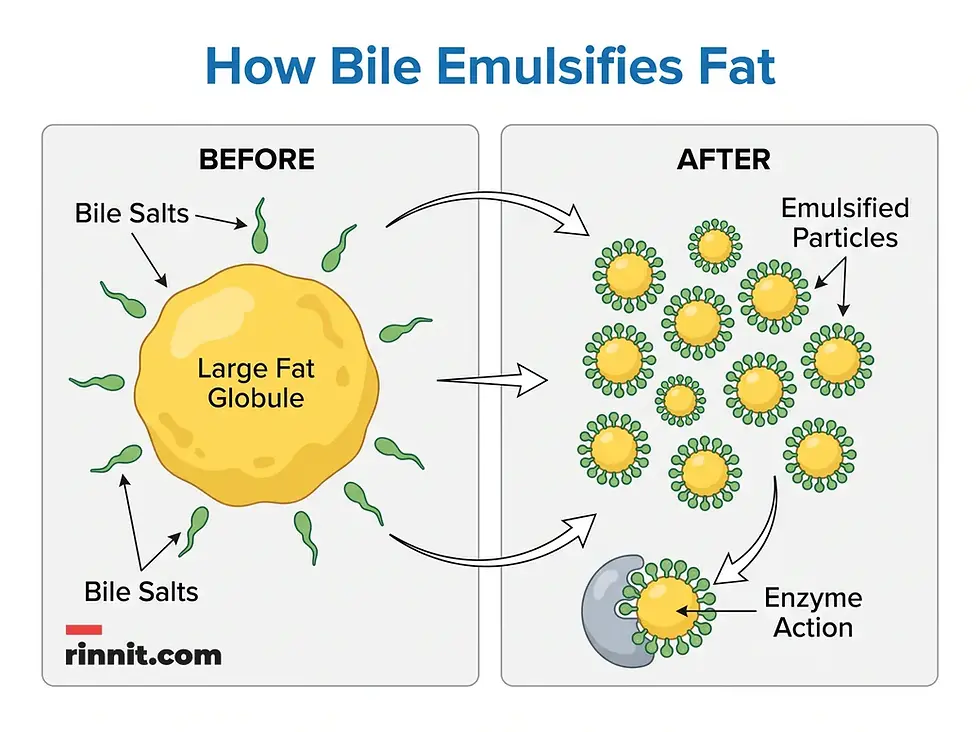
Bile is far more than just a digestive aid; it is a multi-functional fluid that supports both nutrient uptake and detoxification. When you consume a meal containing fat, hormones signal the gallbladder to release bile into the duodenum, the first part of the small intestine. [4]
The primary functions of bile include:
Fat Emulsification: Bile salts mix with dietary fats to break large globules into tiny particles, significantly increasing the surface area for digestive enzymes to act upon.
Nutrient Absorption: By breaking down fats, bile makes it possible for the bloodstream to absorb fatty acids and fat-soluble vitamins, which the body uses for energy. [1] [4]
Waste Elimination: Bile acts as a transport vehicle for bilirubin—a byproduct of red blood cell breakdown—carrying it from the liver to the intestines for excretion. [4]
What is bile made of, and where is it stored?

The production and storage of bile are highly regulated processes involving the liver and the biliary tree.
Component | Role in the Body |
Bile Salts | The most critical component; these acids are responsible for breaking down fats [4] |
Water | Provides the fluid base for the transport of all other bile components |
Cholesterol | A lipid compound that is both a part of bile and regulated by its secretion |
Bilirubin | A waste product that gives bile its characteristic yellowish-green color |
Phospholipids | Complex fats that assist in the emulsification process |
The liver produces between 800 and 1,000 milliliters of bile every day, which is then stored in the gallbladder, a pear-shaped organ that typically holds 30 to 80 milliliters of the fluid until it is needed for digestion. [4]
What are common bile conditions and their symptoms?

Problems arise when the production or flow of bile is obstructed, often leading to significant discomfort and systemic issues.
Gallstones: Hardened deposits of cholesterol or bilirubin that form in the gallbladder and can block bile ducts. [4]
Cholecystitis: Inflammation of the gallbladder, usually caused by gallstones preventing bile from exiting the organ. [4]
Jaundice: A yellowing of the skin and eyes that occurs when bilirubin builds up in the blood due to a bile duct blockage. [4]
Biliary Colic: Sharp or dull pain in the upper right abdomen that often intensifies after eating fatty meals.
Other signs of biliary distress include nausea, vomiting, indigestion, fever, and changes in bowel habits, such as clay-colored stools. [4]
How can you keep your bile and biliary system healthy?
Keeping your bile and biliary system healthy is essential for overall digestive well-being. Healthcare providers recommend maintaining a healthy weight through gradual weight loss, as obesity is a major risk factor for gallstones. [2] [4] Additionally, a diet high in fiber and low in unhealthy fats can help regulate cholesterol levels and promote smooth digestion. [4]
If symptoms of biliary distress occur, diagnostic tests such as liver function panels or an Endoscopic Retrograde Cholangiopancreatography (ERCP) may be used to identify and treat blockages without the need for major surgery. [4]
Conclusion
Bile is an unsung hero of the digestive system, performing the complex task of fat emulsification while simultaneously helping the body rid itself of cellular waste. While it is easy to take this yellowish-green fluid for granted, its absence or obstruction can lead to severe health complications. By prioritizing a balanced diet and monitoring for symptoms of abdominal pain or jaundice, you can ensure that your biliary system continues to support your health effectively.
Feeling bloated or experiencing sharp pain after fatty meals? These could be early warning signs of bile-related issues. Consult a healthcare provider for a diagnostic evaluation to keep your digestive system on track.
Frequently Asked Questions
1. What is bile?
Bile is a thick, greenish-yellow digestive fluid produced by the liver and stored in the gallbladder. [4]
2. What is another name for bile?
Bile is also commonly referred to as gall. [4]
3. How much bile does the liver produce daily?
The liver produces approximately 800 to 1,000 milliliters of bile every day. [4]
4. What are the main components of bile?
Bile is made of water, bile salts, cholesterol, phospholipids, bilirubin, and various body salts. [4]
5. How does bile help with fat digestion?
Bile salts emulsify large fat globules into smaller particles, making it easier for enzymes to break them down. [4]
6. What is bilirubin and how is it related to bile?
Bilirubin is a waste product from red blood cell breakdown that bile carries out of the liver for elimination. [4]
7. What are gallstones?
Gallstones are hard deposits of cholesterol or bilirubin that can form in the gallbladder. [4]
8. What is jaundice?
Jaundice is the yellowing of the skin and eyes caused by a buildup of bilirubin, often due to a blocked bile duct. [4]
9. What is biliary colic?
Biliary colic is abdominal pain, often sharp or dull, that occurs when the biliary system is under pressure, typically after eating.
10. How can I keep my bile healthy?
Maintain a healthy weight, eat a high-fiber diet, and limit the intake of unhealthy fats. [4]
Related Reading
Understanding the Gallbladder: Storage and Digestion explains the organ that stores bile and releases it after meals.
Bile Duct: The Essential Transport System of the Biliary Tree describes the ducts that carry bile from the liver to the gut.
Bile Reflux: Symptoms, Causes, and Treatment covers bile backing up into the stomach and how it is treated.
Bilirubin Test: Normal Levels, High Bilirubin Causes and Newborn Jaundice explains the blood test for the yellow pigment found in bile.
References
Di Ciaula A, Garruti G, Lunardi Baccetto R, et al. Bile acid physiology. Ann Hepatol. 2017;16(Suppl 1):s4-s14. PMID 29080336. https://doi.org/10.5604/01.3001.0010.5493
Yuan S, Gill D, Giovannucci EL, et al. Obesity, type 2 diabetes, lifestyle factors, and risk of gallstone disease: a Mendelian randomization investigation. Clin Gastroenterol Hepatol. 2022;20(3):e529-e537. PMID 33418132. https://doi.org/10.1016/j.cgh.2020.12.034
Jaruvongvanich V, Sanguankeo A, Upala S. Significant association between gallstone disease and nonalcoholic fatty liver disease: a systematic review and meta-analysis. Dig Dis Sci. 2016;61(8):2389-2396. PMID 26993825. https://doi.org/10.1007/s10620-016-4125-2
Cleveland Clinic. Bile: What It Is, Where It's Made & What It Does. Cleveland Clinic. May 13, 2024. https://my.clevelandclinic.org/health/body/what-is-bile
Medical Disclaimer
This article is for informational purposes only and does not constitute medical advice. Always seek the advice of your physician or other qualified health provider with any questions you may have regarding a medical condition. Never disregard professional medical advice or delay in seeking it because of something you have read here.



Comments