What Is Cycloplegia? How Eye-Relaxing Drops Work, How Long They Last, and What to Expect

Updated: 6 days ago
Written and medically reviewed by Dr. Baraa Alnahhal, MD · Last reviewed: October 2026 · How we review
Quick Answer: What is cycloplegia?
Cycloplegia is a temporary paralysis of the eye's focusing muscles, caused by medicated eye drops. It blocks close-up focus and widens the pupil. Eye specialists use it for accurate eye exams, during eye surgery, and to treat lazy eye and some uveitis. Effects last from a few hours to about 12 days, depending on the drop. [1]
What the research says
Eye tests without cycloplegia tend to underestimate farsightedness. A 2025 meta-analysis of 54 studies (24 pooled) found that automated vision machines and photoscreeners used without cycloplegic drops read refractive error about 0.65 and 0.78 diopters lower than cycloplegic testing. The gap was largest in young children and farsighted eyes. (Roque et al., Advances in Ophthalmology Practice and Research, 2026)
Atropine drops work about as well as patching for moderate lazy eye. In a randomized trial of 419 children younger than 7, vision in the weaker eye improved by 3.16 lines with patching and 2.84 lines with atropine after 6 months, a difference the researchers judged clinically minor. (Pediatric Eye Disease Investigator Group, Archives of Ophthalmology, 2002)
Skin pigmentation affects how well cycloplegic drops work. In a randomized trial of 251 farsighted children, those with dark irises and medium or dark skin had more leftover focusing ability after drops. Combining cyclopentolate 1% with tropicamide 1% gave more accurate readings in these children. (van Minderhout et al., Acta Ophthalmologica, 2022)
Key takeaways
Cycloplegia temporarily relaxes the muscles that let your eye focus up close.
It comes from eye drops, and it also widens (dilates) your pupil.
It helps eye specialists measure your prescription accurately and treats lazy eye and some uveitis.
Expect light sensitivity, blurry near vision and sometimes a headache.
It is temporary, painless and noninvasive. Avoid driving until it wears off.
Rare serious reactions, like confusion, a fast heartbeat or seizures, need urgent medical care.
What is cycloplegia?
Cycloplegia is a temporary paralysis of the muscles inside your eyes that control focusing. It happens when medicated drops are placed on the surface of the eye.
Most people know it as "having your eyes dilated." The two effects are related but not identical: cycloplegia stops close-up focusing, while dilation widens the pupil. The drops that cause cycloplegia usually do both.
While it lasts, you can't focus on things up close, and your pupils can't narrow in bright light. [1]
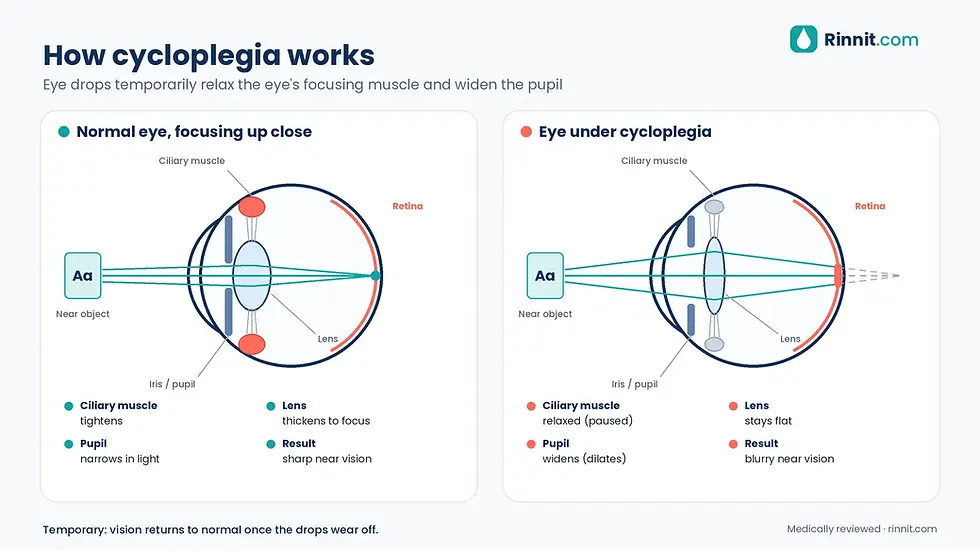
How does cycloplegia affect the eye's focus?
Cycloplegia switches off the eye's ability to change the shape of its lens. Normally, the lens is flexible.
A ring of tissue called the ciliary body holds muscles that reshape the lens. This shape change is called accommodation. It lets you focus on near things, like a book, a phone or a computer screen.
Accommodation is a reflex, so you can't control it. Sometimes this reflex gets in the way of an eye exam or makes certain conditions worse. That is where cycloplegia helps. [1]
For more on how focusing changes with age, see our guide to presbyopia.
When is cycloplegia used, and why?
Cycloplegia has three main uses: eye exams, eye surgery, and treating certain eye conditions. [1]
Use | What cycloplegia does |
Eye exams | Blocks the focusing reflex so the eye specialist can diagnose and measure refractive errors, such as farsightedness and astigmatism, accurately |
Eye surgery | Temporarily keeps the muscles inside the eye still during the operation |
Lazy eye (amblyopia) | Blurs the stronger eye on purpose so the weaker eye has to work harder and get stronger |
Some forms of uveitis | Rests the inflamed eye structures while they heal |
Learn more in our guides to lazy eye (amblyopia) and uveitis.
Can medicines other than eye drops cause cycloplegia?
Yes, cycloplegia can happen as a side effect of medicines that come in other forms. Several of the drugs that cause it are also used for other conditions.
The main example is scopolamine, an anti-nausea medicine found in motion sickness skin patches. If residue from the patch gets on your fingers and then into your eye, it can cause cycloplegia that lasts up to a couple of days.
That's why you should always wash your hands right after putting on a scopolamine patch. [1] Read more about motion sickness treatment and prevention.
What are the benefits of cycloplegia?
Cycloplegia is temporary, noninvasive, painless and flexible. [1]
It's temporary. Once the drops wear off, your eyes go back to normal with no lasting effects.
It's noninvasive. The medicine comes as eye drops, so it's easy to use.
It's painless. The drops themselves don't hurt. Bright light may feel uncomfortable because your pupils can't narrow, so many eye clinics give you sunglasses to wear afterward.
There are several options. Different drops cause cycloplegia. If you can't use one, there is usually another, and each lasts a different length of time.
What are the side effects of cycloplegia?
The most common side effects of cycloplegia come from the pupil widening at the same time. In eye exams, having both effects is often useful. [1]
Type | Possible side effects |
From the wider pupil | Light sensitivity, trouble reading books, papers and screens up close, headaches |
On the eye surface | Brief, mild stinging or burning, eye redness, eye irritation |
Medicine-specific | Vary by drop; some longer-acting drops may cause more severe side effects |
Your eye specialist is the best person to tell you which side effects are most likely with your specific drop.
How long does cycloplegia last?
Cycloplegia lasts anywhere from a few hours to about 12 days, depending on the drop used. Longer-acting drops help when eye structures need time to heal, or when the goal is to blur one eye so the other gets stronger, as in lazy eye treatment. [1]
Eye drop | How long the effect lasts |
Phenylephrine (widens pupil only; not cycloplegic) | Up to 6 hours |
Tropicamide | 6 to 24 hours |
Cyclopentolate | Up to 24 hours |
Homatropine | 1 to 3 days |
Scopolamine | 3 to 7 days |
Atropine | 7 to 12 days |

How should you take care of yourself after cycloplegia?
The best way to care for yourself after cycloplegia is to take it easy until the drops wear off. Side effects usually aren't severe, but they can make simple tasks harder, especially reading or screen work. [1]
Don't drive until your vision returns. Light sensitivity and poor near focus make driving less safe.
Wear sunglasses outdoors or in bright rooms.
Plan lighter work. Reading, screens and close-up hobbies may be hard for a while.
Ask your eye specialist which activities are fine and which should wait.
When in doubt, wait it out. It's better to pause an activity than risk an injury from poor vision.

When should you call a doctor about cycloplegia side effects?
Call your eye specialist or get medical care right away if you notice a serious reaction after cycloplegic drops. Severe eye pain, a red eye, halos around lights, or nausea and vomiting after the drops can mean acute angle-closure glaucoma and need emergency care. These reactions are less likely with the most commonly used drops. [1]
Warning signs include:
Behavior changes
Changes in heart rate, especially a fast heart rate (tachycardia)
Confusion
Low blood pressure
Seizures
Breathing too slowly or too shallowly (respiratory depression)
Cycloplegia at a glance
Question | Short answer |
What is it? | Temporary paralysis of the eye's focusing muscles |
What causes it? | Medicated eye drops (or medicine residue, such as from a scopolamine patch) |
Main uses | Eye exams, eye surgery, lazy eye, some uveitis |
Common side effects | Light sensitivity, blurry near vision, headache, mild stinging |
How long it lasts | Hours to about 12 days, depending on the drop |
Can I drive? | Best to wait until it wears off |
Is it permanent? | No, vision returns to how it was before |
Conclusion
Cycloplegia can feel inconvenient, but it is one of the most useful tools in eye care. It makes eye exams and prescriptions more accurate, and it helps treat conditions like lazy eye and uveitis.
Most important, it is temporary. Your sight returns to what it was once the drops wear off. If you have questions about your specific drops or want to reduce side effects, talk to your eye specialist.
Keep learning with Rinnit.com. Bookmark this guide to bring to your next eye appointment, and explore our plain-language eye health guides on lazy eye, farsightedness, uveitis and more, all medically reviewed and backed by research.
FAQ
Is cycloplegia the same as having your eyes dilated?
Not exactly. Cycloplegia stops your eye from focusing up close, while dilation widens the pupil. The drops that cause cycloplegia usually cause both, which is why people often use the terms together.
Do cycloplegic eye drops hurt?
No. The drops themselves are painless, though you may feel brief, mild stinging. Bright light can feel uncomfortable because your pupils can't narrow.
Can I drive after cycloplegic eye drops?
It's best not to. Cycloplegia makes your eyes sensitive to light and unable to focus up close, which makes driving less safe. Arrange a ride if you can.
How long will my vision be blurry after eye drops?
It depends on the drop. Tropicamide lasts 6 to 24 hours and cyclopentolate up to 24 hours, while atropine can last 7 to 12 days. Ask your eye specialist which drop you received.
Why should I wash my hands after applying a motion sickness patch?
Scopolamine patches contain a medicine that causes cycloplegia. Residue on your fingers can get into your eye and blur your near vision for up to a couple of days.
Is cycloplegia permanent?
No. Cycloplegia is temporary. Once the medicine wears off, your eyes return to normal without lasting effects.
Why do eye doctors use cycloplegic drops for children?
Children's focusing muscles are strong enough to hide farsightedness or other vision problems. Cycloplegic drops relax these muscles so the eye doctor can measure the true prescription.
Can I read or use my phone after cycloplegic eye drops?
Close-up vision is often blurry until the drops wear off, so reading and screens may be hard. Making text larger and wearing sunglasses outdoors can help.
What are the common side effects of cycloplegic eye drops?
Common side effects include light sensitivity, blurry near vision, brief stinging and sometimes a headache. Get medical care right away for confusion, a fast heartbeat, severe eye pain or vomiting.
Are cycloplegic drops used to treat lazy eye?
Yes. Atropine drops can blur vision in the stronger eye, which makes the brain use the weaker eye more. This can work about as well as wearing an eye patch for moderate lazy eye.
Related Reading
Eye Exam: What Happens, Tests Included and How Often to Go explains what happens during a complete eye exam.
Lazy Eye (Amblyopia): Symptoms, Causes, Treatment & Complete Guide covers lazy eye signs and treatments like patching and atropine.
Uveitis: Symptoms, Causes, and Treatment — What Eye Inflammation Means for Your Vision explains eye inflammation and how it is treated.
Eye Drops: Types, Uses, Risks and How to Use Them Safely describes common eye drop types and how to use them safely.
References
Cleveland Clinic. Cycloplegia: What It Is, Risks, Benefits & Recovery. Cleveland Clinic. Last updated February 14, 2025. https://my.clevelandclinic.org/health/treatments/cycloplegia
Roque A, Nunes AF, Nascimento H, et al. Instrument-based, non-cycloplegic versus cycloplegic refraction in pediatric and young adult populations (≤25 years): A systematic review and meta-analysis. Adv Ophthalmol Pract Res. 2026;6(1):56-67. PMID 41647053. https://doi.org/10.1016/j.aopr.2025.11.004
Pediatric Eye Disease Investigator Group. A randomized trial of atropine vs. patching for treatment of moderate amblyopia in children. Arch Ophthalmol. 2002;120(3):268-278. PMID 11879129. https://doi.org/10.1001/archopht.120.3.268
van Minderhout HM, Joosse MV, Grootendorst DC, et al. Eye colour and skin pigmentation as significant factors for refractive outcome and residual accommodation in hypermetropic children: a randomized clinical trial using cyclopentolate 1% and tropicamide 1%. Acta Ophthalmol. 2022;100(4):454-461. PMID 34672100. https://doi.org/10.1111/aos.15016
Kaur K, Gurnani B. Cycloplegic and Noncycloplegic Refraction. StatPearls. Last updated June 11, 2023. https://www.ncbi.nlm.nih.gov/books/NBK580522/
Medical disclaimer
This article is for general education and does not replace advice from your eye specialist or doctor. Always follow the instructions you were given with your eye drops, and seek medical care for any symptoms that worry you.



Comments