Motion Sickness: Symptoms, Causes, Treatment and Prevention

Updated: 1 day ago
Medically reviewed by Dr. Baraa Alnahhal, MD · Last reviewed: October 2026
Quick Answer: What is motion sickness?
Motion sickness is a condition caused by conflicting messages about movement from the eyes, inner ear, muscles and joints, leading to nausea, sweating or headache. It can occur during travel or screen-based experiences and is more likely in children ages 2 to 12. Symptoms usually go away after the motion stops; see a provider for persistent vomiting or dehydration. [1]

What the research says
Antihistamines modestly reduce the chance of motion sickness in susceptible adults. A Cochrane review of 9 randomized trials (658 participants, ages 16–55) found that under natural travel conditions 40% of people taking antihistamines were symptom-free versus 25% on placebo (RR 1.81, 95% CI 1.23–2.66; 3 studies, 240 participants; moderate-certainty evidence). Sedation was more likely with antihistamines (66% vs 44%; low-certainty), no trials assessed treating existing symptoms, and children were not clearly studied (Karrim et al., Cochrane Database Syst Rev, 2022). [2]
Scopolamine lowered reported nausea compared with placebo. A meta-analysis of 20 randomized trials (753 participants) found a relative risk of 0.35 (95% CI 0.24–0.52) for reported nausea with scopolamine versus placebo. There was no clear difference in head movement time (mean difference 2.02; 95% CI −1.2 to 5.25), and the authors called for more trials on that outcome. These are pooled results, not advice about what any one person should use (Zhang et al., Acta Otolaryngol, 2024). [3]
Scopolamine works better than placebo for prevention. A Cochrane review of 14 trials (1,025 people) found scopolamine prevented symptoms better than placebo and was about as effective as antihistamines; no trials tested it once symptoms had started (Spinks and Wasiak, Cochrane Database Syst Rev, 2011). [4]
What does motion sickness feel like?
Symptoms may build gradually or appear all at once. The experience can involve the stomach, balance, breathing, skin and mood rather than nausea alone.
Possible symptom | How it may appear |
A sense of unsteadiness or spinning. | |
Fatigue | Feeling unusually tired or drained. |
Headache | Pain or pressure in the head. |
Irritability | Feeling more short-tempered or uncomfortable than usual. |
Nausea or vomiting | An unsettled stomach, with or without vomiting. |
Rapid breathing | Breathing quickly or feeling a need to gulp air. |
Increased salivation | Producing more saliva than usual. |
Sweating | Sweating, particularly a cold sweat. |
These symptoms can overlap with other health concerns. A symptom list can help you describe what happened, but it cannot determine the cause of symptoms on its own.
Why does motion sickness happen?
The brain continuously combines information from several parts of the body to interpret movement. The eyes may detect the world moving past, while the inner ear and nerve endings in muscles and joints may signal that the body is sitting still. When those messages conflict, the brain may not process them smoothly, and nausea or sweating can result. [1]
This is why a person can feel sick while sitting inside a moving vehicle even when they are not actively moving their body. The same general sensory mismatch can occur in some video games and immersive virtual-reality experiences.

What are common motion sickness triggers?
Motion sickness can occur whenever the brain receives confusing information about movement. Common settings include amusement-park rides, vehicles, airplanes and boats. Video games and immersive virtual-reality games can also trigger a form of virtual motion sickness. [1]
Setting | Why it may be relevant |
Car, bus or train | The body may be carried along while the person remains seated. |
Airplane | Travel movement can create a mismatch between visual and body signals. |
Boat or cruise ship | The body may respond to movement while the surroundings offer limited visual stability. |
Amusement-park ride | Rapid or unusual movement can challenge the brain’s motion signals. |
Video game or immersive virtual reality | The eyes may perceive movement that the body is not physically making. |
The same activity may affect one person and not another. A pattern of symptoms across particular settings can be useful to share with a healthcare provider.
Who is more likely to experience it?
Motion sickness is more likely to affect children ages 2 to 12 than adults. Other factors associated with a higher likelihood include a family history of motion sickness, certain inner-ear disorders, menstrual periods, migraine headaches, Parkinson’s disease and pregnancy. [1]
These factors do not establish that a person has motion sickness, and they do not predict how severe an episode will be. They are context to discuss with a healthcare provider when symptoms are recurring, unusual or difficult to manage.
How is motion sickness diagnosed?
Motion sickness has no specific test, so a healthcare provider relies on your symptoms, a physical examination and an ear check. A healthcare provider may ask what symptoms occurred and when they began, perform a physical examination and check the ears. [1]
Before an appointment, it may help to note the activity, the type of movement, the timing of symptoms, how long they lasted and whether symptoms continued after the motion stopped. This is a practical way to organize the history you share; it is not a substitute for an examination.
What helps when motion sickness symptoms begin?
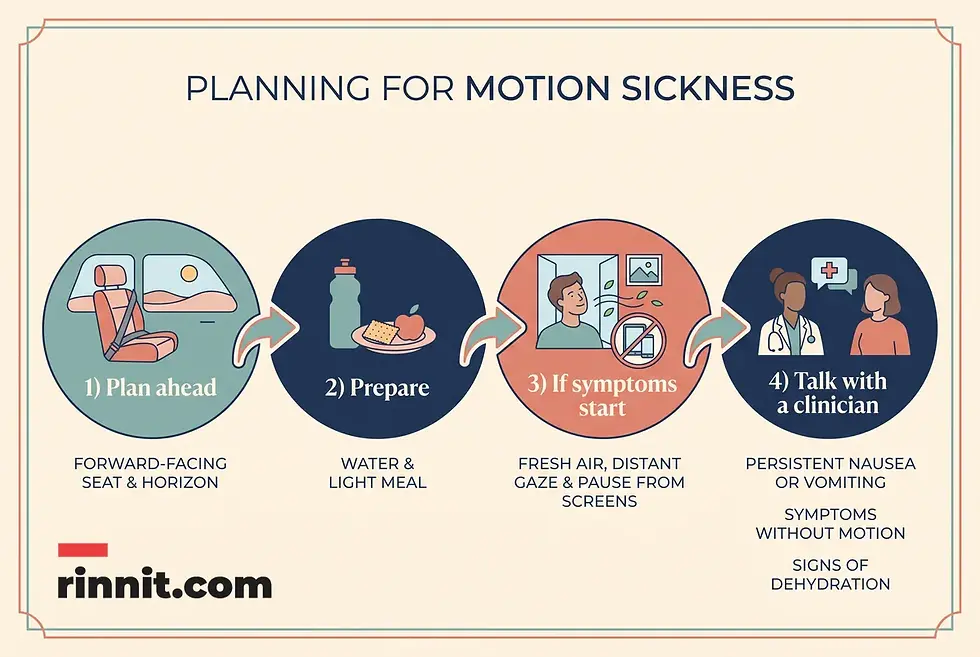
Motion sickness symptoms may not disappear immediately, but several measures may help a person feel better. If you are in a vehicle, fresh air from an open window may help; on a plane, directing a cool-air vent toward you may be useful. [1]
Redirecting your gaze can also help. Put away a book, phone or tablet and look at distant objects or the horizon. If possible, lean the seat back and close your eyes. [1]
Some people find that sipping ginger tea or ginger ale, or having peppermint or ginger candy, settles the stomach or makes them feel better. Special glasses or bracelets have not been shown to work in published medical research, although some people report that they ease symptoms. [1]
If nausea or other symptoms begin during a video game or immersive virtual-reality experience, step away from the game. Do not continue an activity that is making you feel worse.
Medication conversations
Some over-the-counter antihistamines may help prevent motion-sickness symptoms and ease them. Formulations that cause drowsiness may be the ones that help, while nondrowsy formulas may not. Scopolamine patches or oral pills may also be used to prevent nausea and vomiting; patches are for adult use and can cause dry mouth.
Dimenhydrinate is an example of an antihistamine that may prevent motion sickness. A scopolamine patch is placed behind the ear at least four hours before traveling; after three days, it is removed and a new one is applied. [1]
Medication choice depends on a person’s age, health conditions, other medicines and the type of travel or activity. Ask a qualified healthcare provider or pharmacist what is appropriate for you, and follow the product or prescription directions. Do not use this article to choose a medication or dose.
How can you plan ahead to reduce motion sickness?
Motion sickness may not be completely avoidable, but planning can reduce the chance of severe symptoms. When traveling, choose a position that lets you face forward when possible. The following seating suggestions can help you plan. [1]
Travel type | Suggested position |
Boat | Sit in the middle of the boat on the upper deck. |
Bus | Choose a window seat. |
Car | Sit in the front passenger seat. |
Cruise ship | Choose a cabin toward the front or middle, preferably on a lower level closer to the water when possible. |
Plane | Sit in the wing section. |
Train | Choose a forward-facing window seat. |
Before a journey, an empty stomach is not a guaranteed solution. Drink plenty of water, eat a light meal with low-fat and bland starchy foods, and avoid smoking or alcoholic beverages that may upset the stomach. [1]
What complications can occur?
Motion sickness generally does not cause serious health problems. In some cases, nausea and vomiting continue even after the person is no longer riding in a vehicle or otherwise in motion. Excessive vomiting can lead to dehydration and low blood pressure. [1]
The concern is not simply that an episode feels unpleasant. Ongoing vomiting can affect hydration and blood pressure, so persistent symptoms deserve medical attention rather than repeated self-treatment.
When should you talk with a healthcare provider about motion sickness?
Contact a healthcare provider about chronic or persistent nausea or vomiting, symptoms that occur when you are not involved in a moving activity, or signs of dehydration. [1]
Seek guidance sooner if episodes are recurring, interfere with travel or daily activities, or raise questions about medication safety. A clinician can review the symptom pattern, examine you and discuss prevention options that fit your circumstances.
What is the outlook for motion sickness?
For most people, motion-sickness symptoms go away after leaving the plane or boat or getting out of the car. If symptoms continue after motion stops, happen without a moving activity or include signs of dehydration, talk with a healthcare provider. [1]
Conclusion
Motion sickness is a sensory-conflict problem that can turn travel, rides or immersive screen experiences into an uncomfortable event. Recognizing the pattern, choosing a forward-facing position, looking toward the horizon, using fresh air and taking a break from a triggering game may help ease an episode.
If nausea or vomiting is persistent, occurs without motion or comes with signs of dehydration, arrange a healthcare conversation. For more clear, practical health explainers, explore Rinnit.com’s health library and bring questions about recurring symptoms to a qualified clinician.
Frequently Asked Questions
Is motion sickness the same as nausea?
No. Nausea is one possible symptom of motion sickness. Motion sickness can also involve dizziness, fatigue, headache, irritability, rapid breathing, increased salivation and sweating. [1]
Can motion sickness happen while playing a video game?
Yes. Video games and immersive virtual-reality games can create a form of virtual motion sickness when visual information about movement conflicts with the body’s signals. [1]
Does motion sickness only happen on boats?
No. It can occur in cars, buses, trains, airplanes and boats, as well as on amusement-park rides and during some screen-based experiences. [1]
Is an empty stomach the best way to prevent motion sickness?
Not necessarily. An empty stomach does not guarantee that nausea will not occur. Drinking plenty of water, eating a light meal with low-fat and bland starchy foods, and avoiding smoking or alcoholic beverages that may upset the stomach are suggested before a journey. [1]
Do motion-sickness glasses or bracelets work?
Published medical research has not shown that special glasses or bracelets work, although some people report that they ease symptoms. [1]
Why might sitting in a particular place help?
Sitting where you can face forward, or in the locations suggested for different types of travel, may reduce the chance of severe symptoms. These planning choices cannot guarantee prevention.
When is motion sickness a reason to seek care?
Talk with a healthcare provider about chronic or persistent nausea or vomiting, symptoms that happen without a moving activity, or signs of dehydration. [1]
What medicines help prevent motion sickness?
Some over-the-counter antihistamines can help, and drowsy formulas may work better than nondrowsy ones. Prescription scopolamine patches are an option for adults. Ask a pharmacist or provider which choice is safe for you.
Can young children get motion sickness?
Yes. It is most common in children ages 2 to 12. Having them look out the front window, avoid screens and books, and take breaks can help, but ask their provider before giving any medicine.
Does ginger help motion sickness?
Some people find ginger helpful, but studies show mixed results. Ginger in food is generally safe; check with a provider before taking ginger supplements if you are pregnant or take blood thinners.
Related Reading
Vestibular System: The Science of Balance and Spatial Orientation explains how the inner ear and brain sense motion and balance.
Antihistamines: Types, Uses and Side Effects describes the allergy medicines also used to prevent motion sickness.
Vestibular Migraine: Symptoms, Causes, and Management covers migraine-related dizziness, which is linked to motion sensitivity.
Dizziness and Vertigo: Symptoms, Causes & Treatment Guide reviews causes of dizziness and vertigo and when to get checked.
References
Cleveland Clinic. Motion Sickness: What It Is, Causes, Symptoms & Treatment. Cleveland Clinic. Last updated April 8, 2024. https://my.clevelandclinic.org/health/diseases/12782-motion-sickness
Karrim N, Byrne R, Magula N, et al. Antihistamines for motion sickness. Cochrane Database Syst Rev. 2022;10(10):CD012715. PMID 36250781. https://doi.org/10.1002/14651858.CD012715.pub2
Zhang YX, Niu XY, Xiao ZY, et al. Scopolamine for patients with motion sickness: a systematic review and meta-analysis with trial sequential analysis. Acta Otolaryngol. 2024;144(7-8):429-438. PMID 39225593. https://doi.org/10.1080/00016489.2024.2397556
Spinks A, Wasiak J. Scopolamine (hyoscine) for preventing and treating motion sickness. Cochrane Database Syst Rev. 2011;2011(6):CD002851. PMID 21678338. https://doi.org/10.1002/14651858.CD002851.pub4
Disclaimer
This article is for general educational purposes and is not a substitute for professional medical advice, diagnosis or treatment. Always seek the advice of a qualified healthcare professional with any questions about a medical condition or treatment.



Comments