Urine Protein Test: Normal Range, How It's Done and What High Protein Means

Updated: 2 days ago
Written and medically reviewed by Dr. Baraa Alnahhal, MD · Last reviewed: November 2026 · How we review
Quick Answer: What is a urine protein test?
A urine protein test measures how much protein is in the urine. A higher level, called proteinuria, can be a sign that the kidneys aren't working well. The normal amount is less than 150 milligrams per day. High protein can be temporary, from dehydration, exercise or a UTI, or point to kidney disease. [1]
What the research says
A single spot urine sample can flag significant protein in pregnancy. A meta-analysis of 20 studies with 2,978 pregnancies in women with suspected preeclampsia found that the spot protein-to-creatinine ratio detected significant proteinuria with sensitivities of 65% to 89% and specificities of 63% to 87%, with the best cutoff around 0.30 to 0.35. No cutoff reached above 80% for both. (Morris et al., BMJ, 2012) [2]
Even small amounts of albumin in urine are linked with higher risk of death. In a meta-analysis of 105,872 people from 14 general population studies, the risk of death rose steadily with the urine albumin-to-creatinine ratio. A ratio of 10 mg/g or more was an independent predictor of death. (Matsushita et al., The Lancet, 2010) [3]
Key takeaways
A urine protein test measures how much protein is in your pee; healthy kidneys release very little. [1]
The normal range is less than 150 milligrams of protein per day; more than that is called proteinuria. [1]
You may give one sample in a cup or collect pee over 24 hours at home. [1]
Dehydration, UTIs, strenuous exercise, contrast dye and some medicines can raise results. [1]
High protein can be temporary or a sign of kidney disease, heart failure, autoimmune disease or multiple myeloma. [1]
You usually don't need to fast before the test. [1]
What is a urine protein test?
A urine protein test measures how much protein is in your pee. Everyone has trace amounts of protein in their urine. But a significant amount, a condition called proteinuria, could mean your kidneys aren't working as they should. [1]
The medical names for urine protein tests include the urine albumin-to-creatinine ratio (UACR) and the protein-to-creatinine ratio. [1]
Why is a urine protein test done?
Providers may run a urine protein test as part of a routine urinalysis, or to: [1]
See if you have a urinary tract infection (UTI)
Screen for kidney disease in people with certain conditions, such as diabetes
Diagnose preeclampsia during pregnancy
Check whether kidney disease treatment is working
You might need a one-time test, or your provider may ask you to collect urine samples over 24 hours at home. You can also buy at-home urine protein tests at most pharmacies. [1]
How do you prepare for a urine protein test?
Unless your provider tells you otherwise, you don't need to fast before the test. Your provider will tell you whether you need any special preparation. Some factors can skew the results, including: [1]
Factor | Why it matters |
Urinary tract infection (UTI) | Can raise protein in your pee |
Dehydration | Can make protein levels look higher |
Contrast dye used in some imaging | Can affect the result |
Strenuous exercise | Can temporarily raise protein in your pee |
Certain medicines | Can change protein levels |
Blood in your pee | Less common causes include kidney stones or past prostate surgery |
Sources: [1]
How is the urine sample collected?

You pee into a sterile specimen cup in a private bathroom. The test is noninvasive and painless. Your provider gives you the cup and some antimicrobial wipes. Then you: [1]
Wash your hands with soap and water.
Take the lid off the specimen cup.
Clean your genitals with the wipes, focusing on the skin around your urethra (where pee comes out).
Pee into the toilet for a few seconds.
Stop the flow midstream and place the cup under you.
Pee into the cup until you collect about 2 ounces, using the line on the cup as a guide.
Stop the flow and move the cup away.
Finish peeing into the toilet.
Put the lid on the cup and return it to your provider.
Collecting urine at home over 24 hours
If you need to collect urine at home, your provider gives you several specimen containers and wipes. Follow the same steps each time you need to pee, and keep all samples in the refrigerator until you return them. [1]
What happens after the test?
Your provider sends your sample to a lab. A technician tests your urine with a dipstick that has a color-changing indicator, which shows the level of protein in your pee. It usually takes a couple of days to get results, depending on the lab, and your provider will go over them with you. [1]
What is the normal range for protein in urine?

The normal range for protein in your pee is less than 150 milligrams per day. Anything above that means you have proteinuria, or high levels of protein in your pee. These values can vary slightly between laboratories. [1]
Result | What it means |
Less than 150 mg per day | Normal |
More than 150 mg per day | Proteinuria (high protein in urine) |
Sources: [1]
What causes high protein in urine?
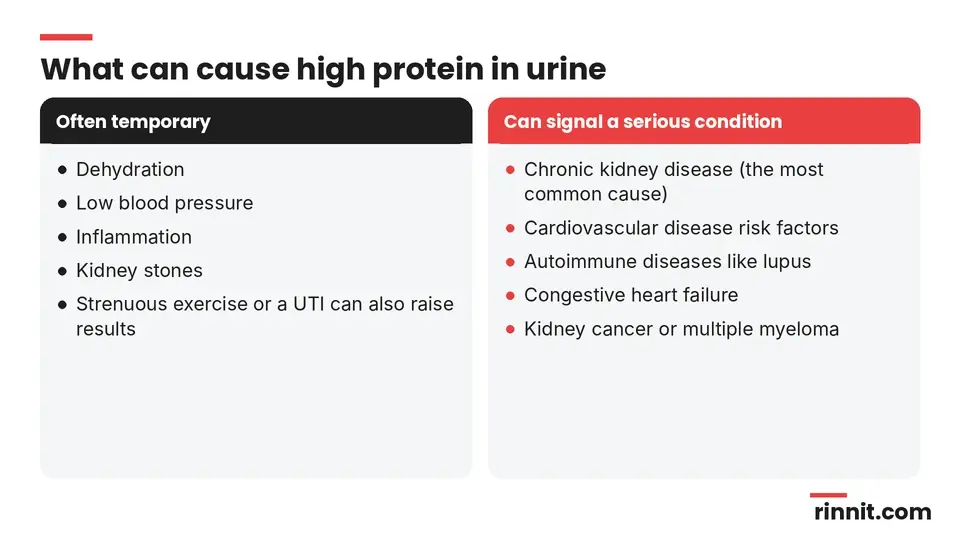
A urine protein test can't tell you which condition you have, but it can point your provider in the right direction. Some causes are temporary, like: [1]
Dehydration
Low blood pressure (hypotension)
Inflammation
Kidney stones
Sometimes, high protein in your pee points to a more serious condition, including: [1]
Chronic kidney disease
Risk factors for cardiovascular disease
Certain autoimmune diseases, like lupus and Goodpasture syndrome
Congestive heart failure
Kidney cancer
Multiple myeloma
The most common cause of high protein in urine is kidney disease. [1]
What happens if your results are high?
If you have high levels of protein in your urine, your provider may do a physical exam or order more lab tests to confirm or rule out certain conditions. Once they know the cause, they'll talk with you about treatment options. If an at-home test shows an abnormal result, try not to worry: there are many possible causes, and not all of them are serious. [1]
When should you call your doctor?
Tell your provider if you have new or worsening symptoms, such as: [1]
Swelling (edema) in your face, belly, ankles or feet
Foamy pee
Shortness of breath
Fatigue
Nausea and vomiting
Muscle cramps, especially at night
Peeing more than usual
Puffiness around your eyes
Loss of appetite
Questions to ask your provider
Do I need a single sample or a 24-hour collection?
Should I avoid exercise or any medicines before the test?
What was my protein level, and is it in the normal range?
Could a temporary factor have raised my result?
Do I need more kidney tests?
Conclusion
A urine protein test is a simple, painless way to learn how well your kidneys are working. A result under 150 milligrams per day is normal, while higher levels, called proteinuria, can come from short-term causes like dehydration or exercise, or from conditions such as kidney disease, diabetes or preeclampsia.
Collect your sample carefully, follow any instructions about medicines or exercise, and talk with your provider about what your result means and whether you need more tests.
Keep learning: Read our guides to the urine albumin-creatinine ratio (UACR), urine specific gravity, the BUN test and the creatinine clearance test.
FAQ
What is a urine protein test?
It's a test that measures how much protein is in your pee to check how well your kidneys are working. [1]
What is the normal range for protein in urine?
Less than 150 milligrams per day. Higher levels mean proteinuria. [1]
What is the most common cause of protein in urine?
Kidney disease is the most common cause, but dehydration, UTIs and strenuous exercise can also raise protein. [1]
Do I need to fast before a urine protein test?
Usually not, unless your provider tells you otherwise. [1]
How is a urine sample for protein collected?
You clean the area around your urethra, start peeing into the toilet, then catch about 2 ounces midstream in a sterile cup. [1]
What is a 24-hour urine protein test?
You collect all your pee over 24 hours at home in containers kept in the refrigerator and return them to your provider. [1]
Does menstruation affect a urine protein test?
Studies suggest your period has no effect on urine protein results if the sample is collected properly. [1]
Can I test for protein in urine at home?
Yes. At-home kits are sold at most pharmacies and give accurate results if you follow the instructions carefully. [1]
How long do urine protein test results take?
It usually takes a couple of days, depending on the lab. [1]
What symptoms can come with protein in urine?
Swelling in the face, belly, ankles or feet, foamy pee, fatigue, puffy eyes, muscle cramps and loss of appetite. [1]
Related Reading
Learn more in our guide to Orthostatic Proteinuria (Postural Proteinuria): Symptoms, Causes, Diagnosis, and Management — What You Need to Know.
Learn more in our guide to Nephrotic Syndrome: Symptoms, Causes, and Treatment Guide.
Learn more in our guide to Chronic Kidney Disease: What It Is, Its 5 Stages, Causes, and How It's Treated.
Learn more in our guide to Diabetic Nephropathy (Diabetic Kidney Disease): Symptoms, Causes, Diagnosis & Treatment — Complete Guide.
Learn more in our guide to Preeclampsia: Symptoms, Causes & What Helps — A Complete Guide.
Learn more in our guide to Lupus Nephritis: Complete Guide to Symptoms, Causes, Diagnosis, and Treatment.
References
Cleveland Clinic. Urine Test for Protein: What It Is, Purpose, Procedure & Results. Cleveland Clinic. Last updated December 29, 2023. https://my.clevelandclinic.org/health/diagnostics/12983-urine-protein-test
Morris RK, Riley RD, Doug M, et al. Diagnostic accuracy of spot urinary protein and albumin to creatinine ratios for detection of significant proteinuria or adverse pregnancy outcome in patients with suspected pre-eclampsia: systematic review and meta-analysis. BMJ. 2012;345:e4342. PMID 22777026. https://doi.org/10.1136/bmj.e4342
Chronic Kidney Disease Prognosis Consortium; Matsushita K, van der Velde M, Astor BC, et al. Association of estimated glomerular filtration rate and albuminuria with all-cause and cardiovascular mortality in general population cohorts: a collaborative meta-analysis. Lancet. 2010;375(9731):2073-2081. PMID 20483451. https://doi.org/10.1016/S0140-6736(10)60674-5
Medical disclaimer
This article is for general education only and does not replace advice from a qualified healthcare professional. Talk to your doctor about your own diagnosis and treatment, and seek emergency care right away for severe or sudden symptoms.



Comments