Tumor Lysis Syndrome: A Critical Guide to Cancer Treatment Complications

Updated: 2 days ago
Medically reviewed by Dr. Baraa Alnahhal, MD | Last reviewed: October 7, 2026
Quick Answer: What is tumor lysis syndrome (TLS)?
Tumor lysis syndrome (TLS) is a serious complication of cancer treatment in which many cancer cells die quickly and release uric acid, potassium and phosphate into the blood [1], overwhelming the kidneys and disturbing heart rhythm. It usually develops during treatment or within 12 to 72 hours afterward [1]. Treatment relies on IV fluids and medicines [1].
What the research says
Uric acid-lowering medicine works on the lab value, but the proof of better outcomes is limited. A Cochrane review of seven trials in children (471 treated, 603 controls) found that urate oxidase (rasburicase) lowered uric acid, but the evidence was very low to low quality and it was unclear whether it reduced clinical TLS, kidney failure or death (Cheuk et al., Cochrane Database of Systematic Reviews, 2017) [2].
TLS is not limited to blood cancers. A systematic review of 33 patients with colorectal cancer and TLS found that 94% had stage IV disease, all patients with available data had acute kidney injury and high uric acid, hyperphosphatemia occurred in 82%, hyperkalemia in 74% and hypocalcemia in 52%. TLS-related mortality was 59% (de Matos et al., Journal of Gastrointestinal Cancer, 2026) [3].
Diagnosis and emergency care follow a set approach. An emergency medicine review notes that TLS is diagnosed using the Cairo-Bishop classification, can occur in leukemia, lymphoma, solid tumors and with immune checkpoint inhibitors, and is treated with fluid resuscitation, correction of electrolyte problems, rasburicase and sometimes hemodialysis (Molyneux et al., American Journal of Emergency Medicine, 2025) [4].
How does tumor lysis syndrome develop?
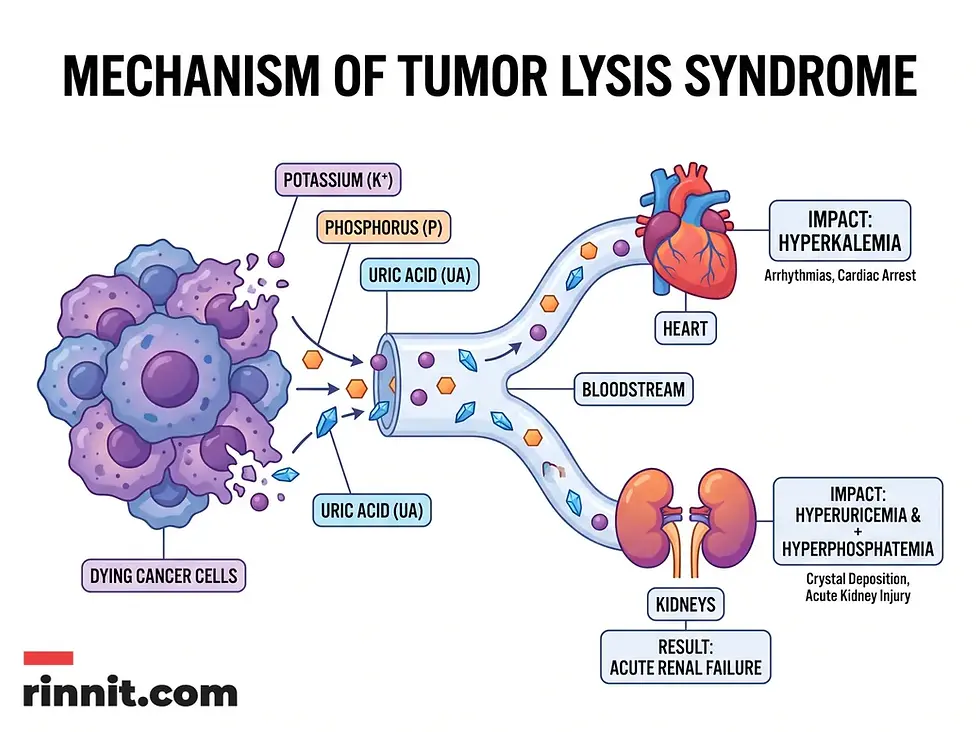
TLS is a paradox in cancer care: a sign that treatment is working can lead to a dangerous crisis. When chemotherapy, targeted therapy, immunotherapy or steroids kill a large number of cancer cells in a short time [1], the contents of those cells spill into the blood. Uric acid, potassium and phosphorus can then exceed what the kidneys can filter.
The chemical changes can be severe. High uric acid can form crystals in the kidneys and injure them. High potassium can disturb the heart's electrical signals and cause cardiac arrest [1]. High phosphate binds calcium, so calcium falls, which can cause muscle cramps, seizures and heart rhythm problems. This chain of events usually happens during treatment or within 12 to 72 hours afterward [1].
Metabolic Change | Physical Impact |
Hyperuricemia (high uric acid) | Can crystallize in the kidneys and cause acute kidney injury or failure [1]. |
Hyperkalemia (high potassium) | Affects the heart's rhythm and can lead to cardiac arrest [1]. |
Hyperphosphatemia (high phosphate) | Adds to kidney injury and upsets the body's mineral balance. |
Hypocalcemia (low calcium) | Can cause muscle cramps, seizures and heart rhythm problems. |
High uric acid is also the cause of gout; our guide on a low-purine diet for gout explains how uric acid behaves in the body. High phosphate is the focus of our article on phosphate binders.
What are the symptoms and risk factors of tumor lysis syndrome?
TLS is an emergency, so recognizing early signs matters, especially if you are recovering at home. Symptoms can start subtly and then progress quickly. They include nausea and vomiting, shortness of breath, muscle cramps, weakness and passing less urine [1]. More serious signs include an irregular heartbeat, fainting, low blood pressure and seizures [1], and these need emergency care. Passing very little or no urine is described in our article on anuria.
Not every person with cancer has the same risk. TLS most often affects people with fast-growing cancers, such as acute lymphoblastic leukemia, acute myeloid leukemia, aggressive non-Hodgkin lymphoma, small cell lung cancer and testicular cancer [1]. Risk is also higher if you are dehydrated before treatment, have kidney problems, have a high white blood cell count or have a high level of uric acid at baseline [1]. Learn more about these cancers in our guides to leukemia and non-Hodgkin's lymphoma.
Risk Category | Contributing Factors |
Cancer Type | Acute lymphoblastic leukemia, acute myeloid leukemia, aggressive non-Hodgkin lymphoma, small cell lung cancer, testicular cancer [1]. |
Pre-existing Health | Dehydration, high white blood cell count, high baseline uric acid and existing kidney problems [1]. |
Treatment Type | Chemotherapy most often, and also steroids, targeted therapy and immunotherapy [1]. |
Tumor Burden | A large amount of cancer in the body at the start of treatment [1]. |

How is tumor lysis syndrome diagnosed?
Providers diagnose TLS with blood tests that measure uric acid, phosphorus, potassium and calcium [1]. They also check kidney function, test the urine and use an electrocardiogram (ECG) to look at the heart rhythm [1]. Blood tests are repeated often during the highest-risk period.
How is tumor lysis syndrome managed, treated and prevented?
The main goal is to prevent TLS [1]. Before treatment, your care team assesses your risk and may start preventive measures for high-risk people, such as intensive IV hydration to flush the kidneys. Medicines such as allopurinol or rasburicase lower uric acid levels or break it down [1].
If TLS develops, treatment becomes more intensive. It can include diuretics to increase urine output [1] and treatment of the electrolyte changes. If the kidneys are badly damaged, dialysis may be needed to filter the blood [1]; see our guide to hemodialysis access with an AV fistula. Throughout, blood tests, ECG monitoring and urine checks track whether levels return to a safe range.
Essential Treatment Strategies
Intensive hydration: large amounts of IV fluids [1] to protect the kidneys and clear toxins.
Targeted medicines: allopurinol and rasburicase [1] to manage uric acid and other chemical changes.
Continuous monitoring: frequent blood work and heart rhythm checks during the high-risk window.
Kidney support: diuretics, or dialysis if kidney function falls [1].

Conclusion and Outlook
Tumor lysis syndrome is a serious but often preventable complication of effective cancer treatment. The risk of kidney failure and cardiac problems is real, but early risk assessment, prevention and close monitoring help many people get through it safely. Survival is possible with prompt treatment. Open communication with your oncology team is the best protection.
Next Steps
If you are in cancer treatment and notice a sudden drop in urination, muscle cramps, shortness of breath, fainting or an irregular heartbeat, seek emergency care immediately. Early treatment is the most effective way to prevent serious complications.
Frequently Asked Questions
What is tumor lysis syndrome?
Tumor lysis syndrome (TLS) is a medical emergency in which dying cancer cells release their contents into the bloodstream faster than the body can clear them.
What causes TLS?
Chemotherapy is the most common trigger. Steroids, targeted therapy and immunotherapy can also cause it by killing cancer cells quickly.
When does TLS usually happen?
TLS may develop during cancer treatment or within about 12 to 72 hours afterward.
Is TLS a sign that treatment is working?
TLS happens because many cancer cells are dying quickly, so it can follow effective treatment. It is still dangerous and needs urgent care.
What are the most common symptoms?
Nausea, vomiting, shortness of breath, muscle cramps, weakness and passing less urine are common. Irregular heartbeat, fainting and seizures can also occur.
How does TLS affect the heart?
High potassium can disturb the heart's rhythm and may cause an irregular heartbeat or cardiac arrest.
How does TLS affect the kidneys?
High uric acid and phosphate can overwhelm the kidneys and cause acute kidney injury, including kidney failure.
Who is at the highest risk?
People with fast-growing cancers such as acute lymphoblastic leukemia, acute myeloid leukemia, aggressive non-Hodgkin lymphoma, small cell lung cancer or testicular cancer, and people who are dehydrated or have kidney problems.
Can TLS be prevented?
Often, yes. Care teams assess your risk before treatment and use IV fluids and medicines such as allopurinol or rasburicase in people at higher risk. Rasburicase is not given to people with G6PD deficiency because it can cause severe breakdown of red blood cells, so tell your team if you have this condition.
What medicines are used for TLS?
Providers may use allopurinol or rasburicase, along with IV fluids, to manage uric acid, and treat the other chemical changes directly.
What is tumor burden?
Tumor burden is the total amount of cancer in the body. A higher burden raises the risk of TLS.
Is dialysis needed for TLS?
Only in severe cases, when the kidneys can no longer filter the blood well enough.
How is TLS diagnosed?
Providers check blood levels of uric acid, phosphorus, potassium and calcium, test the urine and kidney function, and use an ECG to look at the heart rhythm.
Can you survive tumor lysis syndrome?
Yes, survival is possible with prompt treatment, but TLS remains a life-threatening emergency.
What should I do if I think I have TLS?
Go to an emergency room right away, especially if you are recovering from cancer treatment at home.
Related Reading
Hyperkalemia (High Blood Potassium): A Complete Guide to Causes, Symptoms, and Treatment explains high blood potassium and why it affects the heart.
Hyperuricemia (High Uric Acid Level): Causes, Symptoms, and Treatments covers high uric acid levels and how they are lowered.
Understanding Hyperphosphatemia (High Phosphorus) explains high blood phosphorus and how it is treated.
Acute Kidney Injury: What Causes Sudden Kidney Failure, and How It Is Treated describes sudden kidney failure and how it is treated.
Sources
Cleveland Clinic. Tumor Lysis Syndrome. Cleveland Clinic. Last updated October 6, 2025. https://my.clevelandclinic.org/health/diseases/22854-tumor-lysis-syndrome
Cheuk DK, Chiang AK, Chan GC, Ha SY. Urate oxidase for the prevention and treatment of tumour lysis syndrome in children with cancer. Cochrane Database Syst Rev. 2017;3(3):CD006945. PMID 28272834. https://doi.org/10.1002/14651858.CD006945.pub4
de Matos UMA, Tan WY, Forbes V. Tumor lysis syndrome in colorectal cancer: a systematic review of literature. J Gastrointest Cancer. 2026;57(1):80. PMID 41893976. https://doi.org/10.1007/s12029-026-01451-9
Molyneux K, Beck-Esmay J, Koyfman A, Long B. High risk and low incidence diseases: tumor lysis syndrome. Am J Emerg Med. 2025;98:283-288. PMID 40939243. https://doi.org/10.1016/j.ajem.2025.08.067
Medical disclaimer
This information is for educational purposes only and does not constitute medical advice. Always seek the guidance of a qualified healthcare provider about cancer treatment complications or symptoms.



Comments