Tripod Position: How to Do It and Why It Eases Breathing

Updated: 6 days ago
Written and medically reviewed by Dr. Baraa Alnahhal, MD · Last reviewed: October 2026 · How we review
Quick Answer: What is the tripod position?
The tripod position is a breathing position in which you lean your chest slightly forward and support your upper body with your hands, arms or a table. It lets the chest expand and brings in extra breathing muscles. Relief is temporary, so the cause still needs treatment, and severe breathing trouble needs emergency care. [1]
What the research says
Leaning forward while seated lowered breathing-muscle effort in COPD. In 16 people with COPD tested in 8 positions, sitting leaning forward, with or without the arms on a table, produced lower diaphragm and neck-muscle activation than every other position; lying flat produced the highest. (Topcuoglu et al., Respiratory Care, 2024) [3]
Bracing the arms reduced breathlessness in older adults with COPD. In 16 people with stable COPD (median age 81), standing with the arms braced raised lung volume and lowered breathlessness scores and expiratory airflow limitation, compared with standing upright or leaning forward without arm support. (Ogino et al., Respiratory Care, 2015) [4]
People with advanced COPD often choose a supported posture for relief. In 16 patients with advanced COPD, 25% named sitting forward with the arms on the knees as their most comfortable posture. Comfortable postures reduced the total work of breathing and the nerve drive to the diaphragm, compared with the least comfortable ones (mostly lying flat). (Elbehairy et al., European Respiratory Journal, 2026) [5]
Key takeaways
The tripod position means leaning slightly forward and resting your weight on your hands, arms or a table.
It is also called the orthopneic position, and respiratory therapists often teach it in pulmonary rehabilitation.
You can do it in a chair, in bed or standing.
It can ease breathlessness from asthma attacks, COPD flare-ups, heart failure, pneumonia and other conditions.
It is a short-term comfort measure, not a treatment for the cause.
If you often need it, see your doctor. If you are struggling to breathe, get emergency help.

What is the tripod position?
The tripod position is a body position that makes breathing easier by leaning your chest slightly forward while supporting yourself with your hands, arms or a table. [1]
Its medical name is the orthopneic position. Respiratory therapists often teach it during pulmonary rehabilitation, especially to people living with chronic obstructive pulmonary disease (COPD). [1]
Many people find it on their own. If you have ever leaned on your knees to catch your breath after running, you have used a version of it.
It works well alongside other breathing techniques taught in rehab, such as pursed-lip breathing. To learn how a full program fits together, see our guide to pulmonary rehabilitation.
What are the tripod position variations?
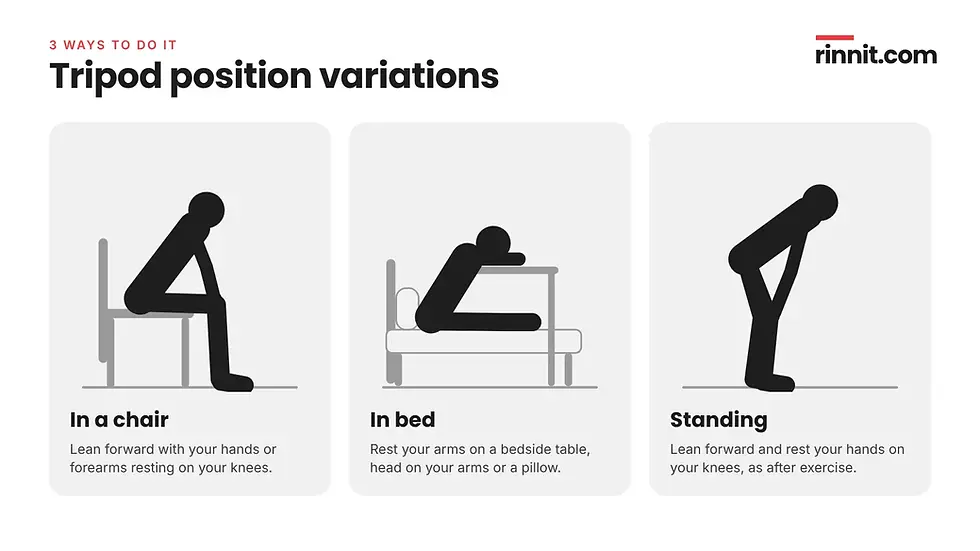
The tripod position has three common variations: sitting in a chair, sitting in bed with a table, and standing. Each one keeps the same two ingredients: a slight forward lean and support for your arms. [1]
Variation | How to do it | Where it helps most |
In a chair | Sit and lean forward, resting your hands or forearms on your knees | At home, at work, in a waiting room |
In bed | Sit up in bed with your arms on a bedside table; rest your head on your arms or on pillows | At night or when you are unwell and resting |
Standing | Lean forward and place your hands on your knees | After activity, such as climbing stairs or exercise |
How do you get into the tripod position?
You get into the tripod position by sitting down, planting your feet, leaning your chest slightly forward and resting your arms on your knees or a table. Follow these five steps for the seated version: [1]
Sit down. Use a chair or the edge of your bed.
Plant your feet. Keep both feet flat on the floor.
Lean forward. Tip your chest slightly forward.
Support your arms. Rest your hands or forearms on your knees or on a table.
Relax. Let your neck and shoulders loosen.
Stay in the position until your breathing settles. If it does not settle, treat it as a warning sign (see the table further down).

Which conditions can the tripod position help with?
The tripod position can partly relieve shortness of breath caused by lung, airway and heart conditions. It eases the symptom only; the condition behind it still needs diagnosis and treatment. [1]
Condition | Learn more on Rinnit |
Asthma attack | |
Congestive heart failure | |
COPD flare-up | |
Epiglottitis | |
Interstitial lung disease | |
Pneumonia or other respiratory infections | |
Pulmonary edema | |
Pulmonary hypertension |
Some of these, such as epiglottitis and pulmonary edema, can become life-threatening quickly. Needing to lean forward to breathe with any of them is a reason to seek care, not to wait it out.
How does the tripod position make breathing easier?
The tripod position makes breathing easier by giving your chest more room to expand, bringing extra breathing muscles into play and possibly reducing fluid in the heart and lungs. Together, these lower the work of breathing. [1]
What changes | Why it helps |
Your chest can expand more | More room for your lungs to fill with each breath |
Extra breathing muscles join in | Supported arms let muscles of the chest, neck and shoulders help pull air in |
Fluid in the heart and lungs may ease | Less fluid can make each breath less of a struggle |
Overall result | Lower work of breathing |
Body position matters for lung function in general. A systematic review of 43 studies found that, in most healthy people and in people with lung, heart, neuromuscular disease or obesity, lung-function values were higher in more upright positions. [2]
Does the tripod position have side effects?
The main side effect of the tripod position is skin change: leaning on the same spots often can leave dark or thickened skin on the legs, such as the thighs, and on the elbows. [1][6]
This change is sometimes called thinker's sign or Dahl's sign. It is not harmful on its own. [1]
It is still worth noticing. These patches suggest that someone leans forward to breathe very often, which can mean their breathing problem needs a closer look. [1]
When should you see a doctor about needing the tripod position?
You should see a doctor if you often need the tripod position to catch your breath, and get emergency help if you are struggling to breathe. [1]
Situation | What to do |
You often need this position to relieve shortness of breath | Book an appointment with your doctor |
You are short of breath and do not know why | Contact a doctor right away; some serious conditions cause breathlessness when lying down |
You are having severe difficulty breathing | Call your local emergency number (911 in the US) or go to the nearest emergency department |
Conclusion
The tripod position is a simple, free way to make breathing a little easier. Lean slightly forward, rest your arms on your knees or a table, and relax your shoulders. You can do it in a chair, in bed or standing.
Remember what it is and what it is not. It eases the feeling of breathlessness for a while. It does not fix asthma, COPD, heart failure or any other cause. If you rely on it often, that is useful information for your doctor.
Bring this to your next appointment. Save or print this guide and tell your doctor how often you need to lean forward to breathe. Then explore our guides to pursed-lip breathing and pulmonary rehabilitation to build a fuller breathing toolkit. For short, clear health explainers, follow Rinnit on YouTube and Instagram.
FAQ
What is the tripod position?
The tripod position is a way to ease shortness of breath by leaning your chest slightly forward and supporting yourself with your hands, arms or a table. Its medical name is the orthopneic position.
Why is it called the orthopneic position?
The tripod position is called the orthopneic position in medical settings, and respiratory therapists often teach it under that name in pulmonary rehabilitation, especially for people with COPD.
How do I do the tripod position?
The tripod position is done by sitting in a chair or on the edge of a bed with your feet flat, leaning your chest slightly forward and resting your hands or forearms on your knees or a table. Then relax your neck and shoulders.
Why does the tripod position help you breathe?
The tripod position helps you breathe because it lets your chest expand more, brings extra breathing muscles into use and may reduce fluid in the heart and lungs. Together, these lower the work of breathing.
Which conditions is the tripod position used for?
The tripod position is used to ease breathlessness from asthma attacks, COPD flare-ups, congestive heart failure, epiglottitis, interstitial lung disease, pneumonia and other respiratory infections, pulmonary edema and pulmonary hypertension.
Can the tripod position cure shortness of breath?
The tripod position cannot cure shortness of breath. It gives temporary, partial relief, and the condition causing the breathlessness still needs medical treatment.
What is thinker's sign?
Thinker's sign, also called Dahl's sign, is darkened or thickened skin on the legs or elbows from leaning forward often. It is not harmful, but it can signal frequent breathlessness that should be checked by a doctor.
When is needing the tripod position an emergency?
Needing the tripod position is an emergency when you are having serious difficulty breathing. Call your local emergency number or go to the nearest emergency department straight away.
Is the tripod position a sign of COPD?
Leaning forward in the tripod position is common in COPD and other conditions that make breathing hard, but it is not a diagnosis on its own. See a provider if you often need to sit this way to breathe.
Why might a child sit in the tripod position?
A child with severe airway swelling, such as from epiglottitis, may lean forward in the tripod position to keep the airway open. This is an emergency, so call 911 and do not force the child to lie down.
Related Reading
What Is Chronic Obstructive Pulmonary Disease (COPD)? Symptoms, Causes, Stages, and Treatment explains COPD, a common cause of needing the tripod position.
Pursed-Lip Breathing: Techniques for Improved Lung Function describes a simple breathing technique that eases shortness of breath.
Asthma Attack: Symptoms, Triggers, Warning Signs & Emergency Treatment — Complete Guide covers asthma attack warning signs and when to get emergency care.
Acute Heart Failure: A Sudden, Life-Threatening Pump Emergency — Symptoms, Treatment, and Outlook explains sudden heart failure, which can cause severe breathlessness.
References
Cleveland Clinic. Tripod Position: Orthopneic, Purpose & How It Works. Cleveland Clinic. Last updated May 1, 2025. https://my.clevelandclinic.org/health/treatments/tripod-position
Katz S, Arish N, Rokach A, et al. The effect of body position on pulmonary function: a systematic review. BMC Pulm Med. 2018;18(1):159. PMID 30305051. https://doi.org/10.1186/s12890-018-0723-4
Topcuoglu C, Tutun Yumin E, Saglam M, et al. Neural Respiratory Drive During Different Dyspnea Relief Positions and Breathing Exercises in Individuals With COPD. Respir Care. 2024;69(9):1129-1137. PMID 38744480. https://doi.org/10.4187/respcare.11790
Ogino T, Mase K, Nozoe M, et al. Effects of Arm Bracing on Expiratory Flow Limitation and Lung Volume in Elderly COPD Subjects. Respir Care. 2015;60(9):1282-1287. PMID 26306736. https://doi.org/10.4187/respcare.03945
Elbehairy AF, Faisal A, McIsaac H, et al. Postural relief of dyspnoea is associated with improved neuromechanical coupling in patients with advanced COPD. Eur Respir J. 2026;68(2):2501348. PMID 41956700. https://doi.org/10.1183/13993003.01348-2025
Grandjean R, Huber LC. Thinker's sign. Cleve Clin J Med. 2019;86(7):439. PMID 31291184. https://doi.org/10.3949/ccjm.86a.19036
Medical disclaimer
This article is for general education and does not replace advice, diagnosis or treatment from a qualified healthcare professional. If you are having trouble breathing, call your local emergency number or seek urgent medical care.



Comments