Tourniquet: What It Is, When to Use One, and How to Apply It Safely

Updated: 6 days ago
Written and medically reviewed by Dr. Baraa Alnahhal, MD · Last reviewed: October 2026 · How we review
Quick Answer: What is a tourniquet?
A tourniquet is a device that applies enough pressure around an arm or leg to stop blood flow past that point. Outside hospitals, it is used right away for life-threatening limb bleeding, or when firm direct pressure cannot control severe bleeding. Place it on bare skin at least 2 inches above the wound, note the time, and call emergency services. [1]
What the research says
Tourniquets applied before hospital arrival are linked to fewer deaths. A pooled analysis of 7 studies with 4,095 civilian patients with limb blood-vessel injuries found that tourniquet use before reaching the hospital roughly halved the odds of death (odds ratio 0.48), without a significant rise in amputation (odds ratio 0.85). The certainty of this evidence was rated very low. (Ko et al., World Journal of Emergency Surgery, 2024) [2]
Civilian tourniquet use was tied to about six-fold higher odds of survival. In 1,026 patients with limb blood-vessel injuries across 11 major trauma centers, the 181 people who received a tourniquet before hospital had an adjusted odds of survival 5.86 times higher, and delayed amputation rates were the same in both groups (1.1% vs 1.1%). (Teixeira et al., Journal of the American College of Surgeons, 2018) [3]
Nobody survived when a needed tourniquet was not used. Among 2,838 people with major limb trauma, those who received tourniquets had an 87% survival rate, versus 0% for the 5 people who needed one but did not get it. No amputations resulted solely from tourniquet use, and 1.7% had temporary nerve weakness. (Kragh et al., Annals of Surgery, 2009) [4]
Key takeaways
A tourniquet stops blood flow past the point where it is tied on an arm or leg. [1]
For life-threatening arm or leg bleeding, apply a tourniquet right away if you have one; otherwise press hard on the wound. [1]
Place it on bare skin, as close to the wound as possible, but at least 2 inches (5 cm) above it. [1]
Tighten it until the bleeding stops. This hurts, and that is expected. [1]
Write down the time and make sure medical professionals know it is there. [1]
Under ordinary conditions, a tourniquet can stay on for up to about two hours without permanent damage. [1]
What is a tourniquet?
A tourniquet is a device that squeezes an arm or leg hard enough to stop blood from flowing past that point. [1]
In hospitals, tourniquets are a routine part of care during some surgeries. [1]
Outside a medical setting, the picture is different. A tourniquet is an emergency tool for severe bleeding, and it is used only in extreme situations. [1]
Tourniquets are also less common in real emergencies than TV shows and movies suggest. [1]
When should you use a tourniquet?
You should use a tourniquet for life-threatening bleeding from an arm or leg, or when severe bleeding cannot be controlled with direct pressure. [1]
Direct pressure comes first for most bleeding, but not when limb bleeding is life-threatening and a tourniquet is at hand. Most bleeding stops with firm, steady pressure on the wound. [1]
A tourniquet becomes an option in situations like these: [1]
Situation | Why a tourniquet may be needed |
Bleeding that won't stop | Direct pressure has failed to control it |
Bleeding from several places | You cannot press on every wound at once |
A wound you can't press on | Its position or type makes direct pressure impossible |
An amputation | A limb or part of a limb has been cut off |
First responders may also use tourniquets during mass-casualty events, or to free their hands for other urgent care, such as CPR. [1] Police officers who reached injured people before ambulances have used commercial tourniquets to keep critically injured patients alive until trauma care. [6]
Severe blood loss can quickly lead to hypovolemic shock, a life-threatening emergency. Read more about hemorrhage and emergency care.
What should you try before a tourniquet?
For bleeding that is not life-threatening, direct pressure and wound packing usually work; for life-threatening limb bleeding, do not delay a tourniquet to try other steps. [1]
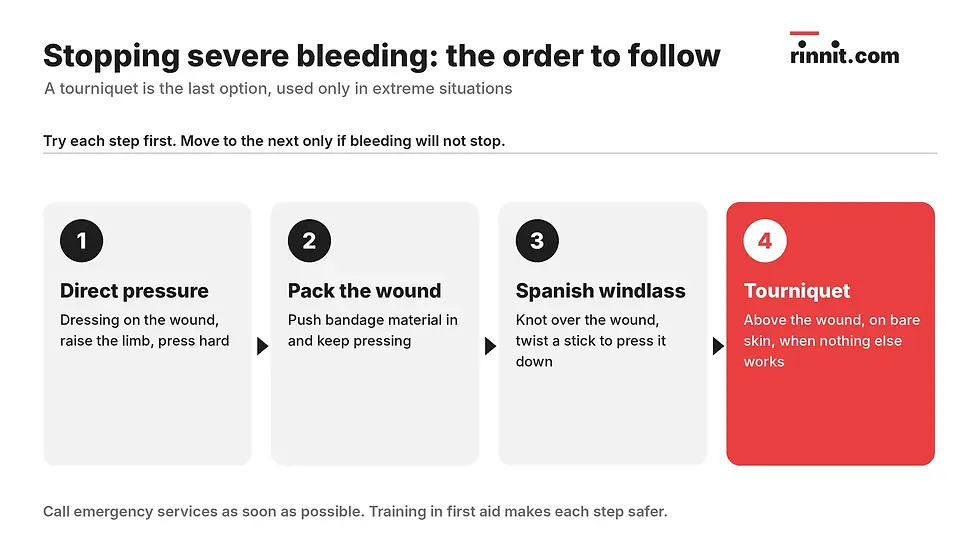
Move to the next step only if the bleeding will not stop.
1. Apply direct pressure
Place a dressing, bandage or clean cloth over the wound. Raise the injured limb and press down firmly on the wound. [1]
2. Pack the wound
Push gauze or bandage material into the wound and keep pressing firmly. [1]
3. Use the Spanish windlass technique
The Spanish windlass uses a bandage and a stick to press directly on the wound: [1]
Tie a bandage around the limb with the knot directly over the wound.
Slide a sturdy object, like a stick or rod, under the knot.
Turn the object so the looped bandage presses down on the wound.
Once the bleeding stops, tie another knot over the stick to hold it in place.
4. Apply a tourniquet
If these steps do not quickly stop the bleeding, or the bleeding is life-threatening, apply a tourniquet without delay. [1]
How do you apply a tourniquet?
You apply a tourniquet on bare skin above the wound, then tighten it until the bleeding stops. [1]
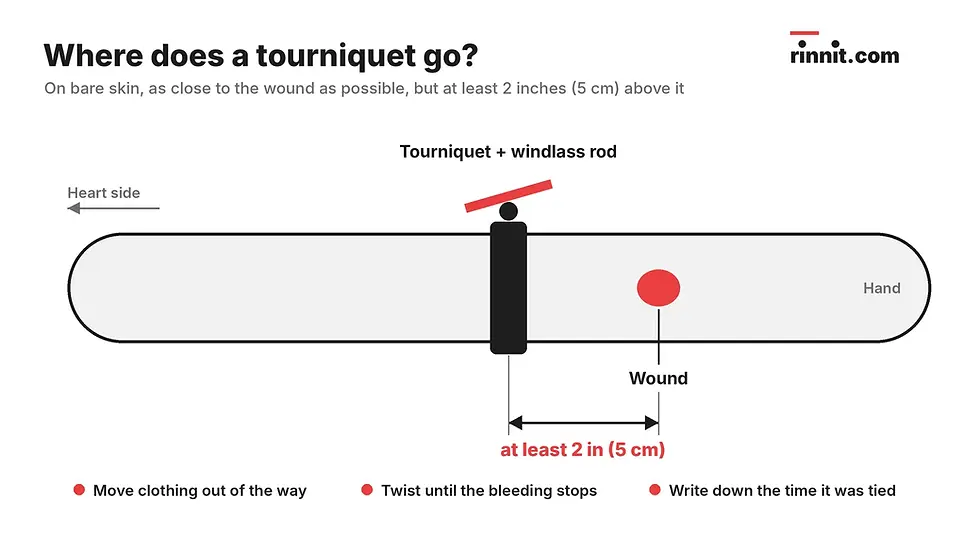
Follow these steps: [1]
Expose the skin. Move or remove clothing so the tourniquet sits directly on bare skin.
Position it correctly. Place it as close to the wound as possible, but at least 2 inches (5 cm) above it, on the side closer to the heart.
Tighten it. Twist the tightening object until the bleeding stops.
Lock it. Tie a knot over the tightening object so it cannot unwind.
Note the time. Write down the exact time you tied the final knot.
Get help. Call emergency services if no one has yet, and tell responders a tourniquet is in place.
Tourniquets are painful for the injured person. That pain is a sign the tourniquet is tight enough to work. [1]
What can you use as a tourniquet?
The best tourniquet is a manufactured one made for the purpose. [1]
If you have to improvise, some materials work far better than others: [1]
Material | Does it work? |
Manufactured tourniquet | Best option |
Half-inch medical latex tubing | Best improvised option |
Stockings or hosiery | Can work in a pinch |
Non-elastic fabric or cloth | Can be used to improvise |
Belts, wires, cables | Don't use — unlikely to work |

How long can a tourniquet stay on?
A tourniquet can stay on for up to about two hours without permanent damage under ordinary conditions. [1]
Even so, a tourniquet should be as temporary as possible. Medical professionals should remove it or replace it with proper care as soon as they can. [1]
That is why noting the time matters. The care team needs to know how long blood flow has been cut off.
What are the risks of using a tourniquet?
The main risk of a tourniquet is ischemia, which is tissue damage caused by a lack of blood flow. [1]
When ischemia lasts too long, the damage can become permanent. In severe cases, the limb may need to be amputated. [1] Learn more about ischemia and restricted blood flow.
The research is reassuring when tourniquets are used correctly. In one large study, no amputations resulted solely from tourniquet use. [4] Over a decade of military care, tourniquet use rose almost tenfold, and survival rose for injuries that tourniquets could treat. [5]
Related reading: compartment syndrome and residual limb pain after amputation.
How can you learn to use a tourniquet safely?
You can learn to use a tourniquet safely in a first aid class taught by certified instructors. [1]
Practice with a tourniquet only under professional supervision. Many low-cost or free courses teach correct tourniquet use. [1]
Training builds the confidence to act fast. It also covers the steps that come before a tourniquet, like direct pressure and wound packing. For broader emergency skills, see our guides to shock first aid and choking first aid.
Tourniquet at a glance
Question | Answer |
What is it? | A device that stops blood flow past a point on a limb [1] |
When is it used? | Severe limb bleeding that direct pressure cannot control [1] |
What comes first? | Direct pressure for most bleeding; a tourniquet right away for life-threatening limb bleeding [1] |
Where does it go? | On bare skin, at least 2 in (5 cm) above the wound [1] |
How tight? | Until the bleeding stops [1] |
How long? | Up to about 2 hours under ordinary conditions [1] |
Main risk | Ischemia, which can lead to amputation if prolonged [1] |
Conclusion
A tourniquet can save a life when an arm or leg is bleeding heavily and nothing else works. Use it early for life-threatening limb bleeding. For other bleeding, start with firm direct pressure and wound packing. If you need a tourniquet, place it on bare skin at least 2 inches above the wound, tighten it until the bleeding stops, and note the time. Then get emergency care as fast as possible.
If someone is bleeding heavily right now, call your local emergency number immediately.
Keep learning with Rinnit. Explore our plain-language emergency guides, starting with hemorrhage and critical blood loss, internal bleeding, and hypovolemic shock, so you know what to do before an emergency happens.
FAQ
What is a tourniquet used for?
A tourniquet is used to stop life-threatening bleeding from an arm or leg by cutting off blood flow past the point where it is applied. Medical teams also use tourniquets routinely during some surgeries.
Should a tourniquet be the first thing you try for bleeding?
A tourniquet is the first thing to use for life-threatening bleeding from an arm or leg if you have one. For less severe bleeding, firm direct pressure and wound packing usually work, and a tourniquet is used if they fail.
Where should you place a tourniquet?
A tourniquet goes directly on bare skin, as close to the wound as possible but at least 2 inches (5 cm) above it. Move or remove any clothing in the way first.
How tight should a tourniquet be?
A tourniquet should be tightened until the bleeding stops. The pressure needed to do that is painful for the injured person, and that pain is expected.
How long can a tourniquet stay on?
A tourniquet can stay on for up to about two hours without permanent damage under ordinary conditions. It should still be as temporary as possible, so emergency medical care is always needed.
Can you use a belt as a tourniquet?
A belt is not a good tourniquet, and neither are wires or cables, because they are unlikely to work. Half-inch medical latex tubing is the best improvised option, and stockings or non-elastic cloth can work in a pinch.
What should you do after applying a tourniquet?
After applying a tourniquet, write down the time you tied the final knot and call emergency services if no one has. Make sure the medical professionals who take over know a tourniquet is in place.
Is it safe to practice using a tourniquet?
Practicing with a tourniquet is safe only under professional supervision, such as in a first aid class taught by certified instructors. Many low-cost or free courses teach correct tourniquet use.
Does a tourniquet hurt?
Yes. A tourniquet that is tight enough to stop bleeding is usually very painful. Do not loosen it for comfort, because the bleeding can start again.
Should you loosen or remove a tourniquet yourself?
No. Once a tourniquet is on, leave it in place until emergency medical staff take over. Removing it too early can restart dangerous bleeding.
Related Reading
Hemorrhage: Understanding Critical Blood Loss and Emergency Care explains severe blood loss and the emergency care it needs.
Essential Shock First Aid: Immediate Actions and Lifesaving Steps covers how to spot and respond to shock after major bleeding.
First Aid Essentials: Life-Saving Skills and Techniques describes basic first aid steps and supplies to keep on hand.
Puncture Wounds: Understanding Risks, Treatment, and Emergency Care explains how to care for deep wounds and when to seek help.
References
Cleveland Clinic. Tourniquet Definition & Uses. Cleveland Clinic. Last updated June 12, 2025. https://my.clevelandclinic.org/health/treatments/tourniquet
Ko YC, Tsai TY, Wu CK, et al. Effectiveness and safety of tourniquet utilization for civilian vascular extremity trauma in the pre-hospital settings: a systematic review and meta-analysis. World J Emerg Surg. 2024;19(1):10. PMID 38504263. https://doi.org/10.1186/s13017-024-00536-9
Teixeira PGR, Brown CVR, Emigh B, et al. Civilian Prehospital Tourniquet Use Is Associated with Improved Survival in Patients with Peripheral Vascular Injury. J Am Coll Surg. 2018;226(5):769-776.e1. PMID 29605726. https://doi.org/10.1016/j.jamcollsurg.2018.01.047
Kragh JF Jr, Walters TJ, Baer DG, et al. Survival with emergency tourniquet use to stop bleeding in major limb trauma. Ann Surg. 2009;249(1):1-7. PMID 19106667. https://doi.org/10.1097/SLA.0b013e31818842ba
Kragh JF Jr, Dubick MA, Aden JK, et al. U.S. Military use of tourniquets from 2001 to 2010. Prehosp Emerg Care. 2015;19(2):184-190. PMID 25420089. https://doi.org/10.3109/10903127.2014.964892
Callaway DW, Robertson J, Sztajnkrycer MD. Law enforcement-applied tourniquets: a case series of life-saving interventions. Prehosp Emerg Care. 2015;19(2):320-327. PMID 25350269. https://doi.org/10.3109/10903127.2014.964893
Medical disclaimer
This article is for general educational purposes only and is not a substitute for professional medical advice, diagnosis, or treatment. In a bleeding emergency, call your local emergency number right away. Hands-on first aid training from a certified instructor is the best way to learn tourniquet use.



Comments