Tinel's Sign: What It Is, How the Test Works and What a Positive Result Means

Updated: 2 days ago
Written and medically reviewed by Dr. Baraa Alnahhal, MD · Last reviewed: November 2026 · How we review
Quick Answer: What is Tinel's sign?
Tinel's sign is a tingling or pins-and-needles feeling you get when a provider taps your skin over a nerve. A positive sign may mean the nerve is compressed or damaged at that spot, as in carpal tunnel, cubital tunnel or tarsal tunnel syndrome. The test is quick, painless and has no risks, and you know the result right away. [1]
What the research says
Tinel's sign is better at confirming carpal tunnel syndrome than ruling it out. Pooling 7 studies and 748 patients, the Tinel sign had a sensitivity of 45% and a specificity of 78%, so providers should combine it with other tests rather than rely on it alone. (Dabbagh et al., Physical Therapy, 2023) [2]
Provocative tests can guide treatment of nerve compression at the elbow. In 27 limbs chosen for surgery using Tinel's sign plus flexion-and-pressure testing, without nerve conduction studies, 26 had relief of symptoms after surgery. (Greenwald et al., Plastic and Reconstructive Surgery, 2006) [3]
Key takeaways
Tinel's sign is tingling you feel when a provider taps over a nerve. [1]
A positive sign may point to nerve compression or irritation where the tapping happens. [1]
It's used to check for carpal tunnel, cubital tunnel and tarsal tunnel syndromes. [1]
A negative test doesn't rule out nerve compression. [1]
There's no preparation and no risk, and results are immediate. [1]
What is Tinel's sign?
Tinel's sign is a tingling or "pins and needles" feeling you get when your healthcare provider taps your skin over a nerve. It may be a sign of nerve compression or damage at the spot being tapped. [1]
Testing for Tinel's sign helps your provider look for nerve damage or irritation at a specific site. Your provider may also call it the Hoffmann-Tinel sign, after physiologist Paul Hoffmann and neurologist Jules Tinel, who first described it in 1915. [1]
When do providers check for Tinel's sign?
Your provider may test for Tinel's sign if they're concerned about nerve damage or irritation at a specific site. Any healthcare provider looking for signs of nerve compression can perform it. [1]
Symptoms of nerve compression or damage include: [1]
Burning
Numbness
Pain
Tingling
Weakness
Which conditions can Tinel's sign help find?
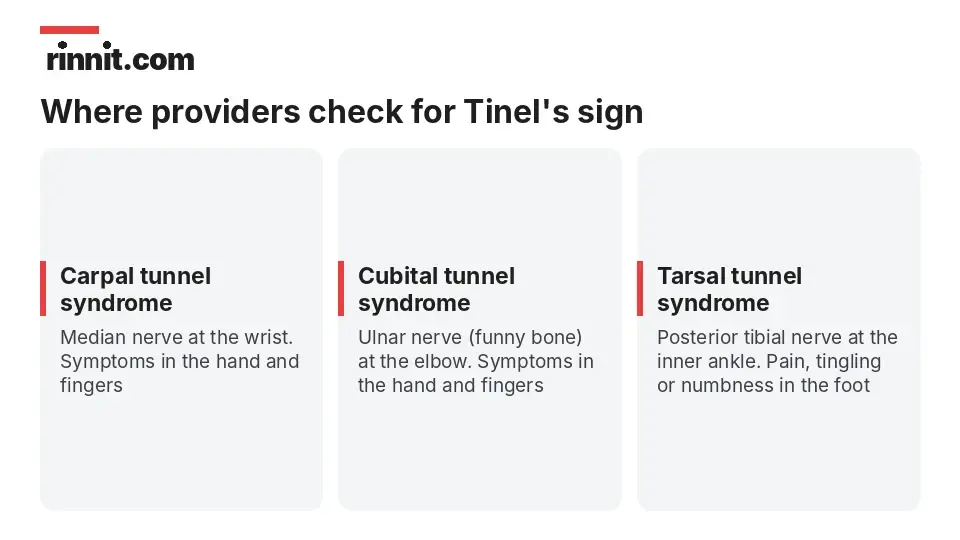
Providers tap over the nerve where compression is suspected.
Condition | Nerve and location | Where symptoms show up |
Carpal tunnel syndrome | Median nerve at the wrist | Hand and fingers |
Cubital tunnel syndrome | Ulnar nerve (the "funny bone") at the elbow | Hand and fingers |
Tarsal tunnel syndrome | Posterior tibial nerve along the inside of the ankle | Pain, tingling or numbness in the foot |
Sources: [1]
Read more in our guides to carpal tunnel syndrome, cubital tunnel syndrome and tarsal tunnel syndrome.
How is Tinel's sign tested?
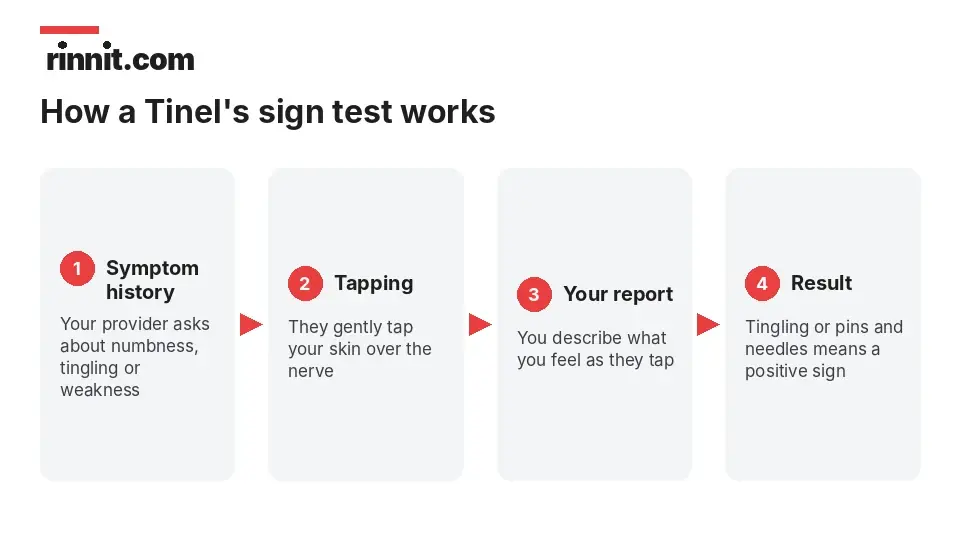
The test takes seconds, and you know the result right away.
There's nothing you need to do to prepare for the test. [1]
Your provider takes a full history of your symptoms, including any numbness, weakness or tingling.
As part of the physical exam, they tap your skin above the nerve.
They ask you to describe what you feel as they tap.
Sources: [1]
It's best to have a healthcare provider perform the test so the result can be interpreted correctly. [1]
What do Tinel's sign results mean?

A negative test doesn't rule out nerve compression.
Result | What you feel | What it may mean |
Positive | Tingling when your provider taps | Possible nerve damage or irritation at that site |
Negative | No tingling | Doesn't rule out nerve compression |
Sources: [1]
Results are immediate. You'll know right away whether you feel tingling, and your provider will discuss next steps. [1]
What happens after a Tinel's sign test?
Depending on your result and the rest of your history and exam, your provider may recommend more testing, such as: [1]
Are there any risks?
There aren't any risks linked to a Tinel's sign test. [1]
When should you call your provider?
Talk with your healthcare provider if you have signs of a damaged or irritated nerve, such as burning, numbness or weakness. [1]
Conclusion
A Tinel's sign test is a fast, simple way for your provider to check whether a nerve may be compressed or irritated. A positive result can point toward a diagnosis, but a negative result doesn't rule one out, so your provider may use other tests too. [1]
You don't need to live with numbness, pain or weakness. Talk to your provider about your symptoms and treatment options. [1]
Keep learning: Read our guide to carpal tunnel syndrome or our guide to ulnar nerve entrapment. For more background, see the NINDS page on carpal tunnel syndrome.
FAQ
What is Tinel's sign?
It is a tingling or pins-and-needles feeling when a provider taps your skin over a nerve.
What does a positive Tinel's sign mean?
It may mean the nerve is compressed, damaged or irritated where the provider tapped.
Does a negative Tinel's sign rule out nerve compression?
No. A negative test doesn't exclude nerve compression.
What conditions does Tinel's sign test for?
Mainly carpal tunnel, cubital tunnel and tarsal tunnel syndromes.
How is Tinel's sign tested?
Your provider taps your skin over the nerve and asks what you feel.
Do I need to prepare for a Tinel's sign test?
No preparation is needed.
Is the Tinel's sign test painful or risky?
No. It's a simple tapping test with no risks.
How long do results take?
Results are immediate.
What tests might come after Tinel's sign?
Your provider may order electromyography, an MRI or an X-ray.
Who named Tinel's sign?
It's named after Paul Hoffmann and Jules Tinel, who described it in 1915.
Related Reading
Carpal Tunnel Syndrome: Symptoms, Causes, Diagnosis and Treatment explains the most common condition Tinel's sign is used to check.
Cubital Tunnel Syndrome: Symptoms, Causes, Diagnosis, and Treatment covers compression of the ulnar nerve at the elbow.
Tarsal Tunnel Syndrome: Symptoms, Causes and Treatment describes nerve compression at the inner ankle.
Ulnar Nerve Entrapment: Symptoms, Causes, and Relief explains what happens when the funny-bone nerve gets pinched.
Peripheral Neuropathy: Symptoms, Causes, and Treatment Options Explained covers wider nerve damage that can cause similar symptoms.
References
Cleveland Clinic. Tinel’s Sign: What It Is, Procedure, Purpose & Results. Cleveland Clinic. Last updated April 1, 2022. https://my.clevelandclinic.org/health/diagnostics/22662-tinels-sign
Dabbagh A, MacDermid JC, Yong J, et al. Diagnostic Test Accuracy of Provocative Maneuvers for the Diagnosis of Carpal Tunnel Syndrome: A Systematic Review and Meta-Analysis. Phys Ther. 2023;103(6):pzad029. PMID 37366626. https://doi.org/10.1093/ptj/pzad029
Greenwald D, Blum LC, Adams D, et al. Effective surgical treatment of cubital tunnel syndrome based on provocative clinical testing without electrodiagnostics. Plast Reconstr Surg. 2006;117(5):87e-91e. PMID 16641701. https://doi.org/10.1097/01.prs.0000207298.00142.6a
Medical disclaimer
This article is for general education only and does not replace advice from a qualified healthcare professional. Talk to your doctor about your own diagnosis and treatment, and seek emergency care right away for severe or sudden symptoms.



Comments