The Complement System: Your Body's Essential Immune Cascade

Updated: 2 days ago
Medically reviewed by Dr. Baraa Alnahhal, MD · Last reviewed: October 2026
Quick Answer
The complement system is part of the immune system made of roughly 50 plasma proteins produced in the liver. [1] They circulate inactive until triggered by injury or pathogens. [1] Once activated, they initiate a chain reaction known as a “cascade,” that targets invaders, triggers inflammation, and removes damaged cells. [1] An overactive or deficient system can lead to autoimmune or inflammatory conditions.
What the research says
Repeated serious infections can point to an underlying immune defect, including complement deficiency. A systematic review of 6,022 children with primary invasive pneumococcal disease found a primary immunodeficiency in 1.3% to 10.5% of all children, in 26.4% of those older than 2 years, and in up to 66.7% of children with recurrent disease; antibody deficiency was the most common defect, followed by complement deficiency. (Butters et al., JAMA Pediatr, 2019) [2]
Missing late complement components sharply raises infection risk. A systematic review of C7 deficiency, with a new case report, notes that people with terminal-pathway complement deficiency have a 1,000- to 10,000-fold higher risk of infections and should be identified promptly so that vaccination can be offered. (Balduit et al., Front Immunol, 2023) [3]
Blocking the cascade can help in specific diseases. In a meta-analysis of clinical trials and real-life studies of complement inhibitors, the C5 inhibitor eculizumab reduced thrombotic events in paroxysmal nocturnal hemoglobinuria (odds ratio 0.07, 95% CI 0.03–0.19 in clinical trials) and prevented new episodes of antibody-mediated rejection in kidney transplant recipients (odds ratio 0.25, 95% CI 0.13–0.49). (Bernuy-Guevara et al., Biomedicines, 2020) [4]
The human immune system is a complex, multi-layered defense mechanism designed to protect the body from external threats. Among its most vital components is the complement system, a group of proteins that “complements” or enhances the ability of antibodies and phagocytic cells to clear pathogens. By serving as both a primary responder and a coordinator for other immune functions, the complement system ensures that the body remains resilient against illness and injury.
How does the complement system work?
The complement system operates through a highly regulated process to maintain health. Its primary functions include targeting foreign invaders, activating inflammatory responses to contain infections, and physically removing pathogens from the body. [1] Additionally, it plays a key role in cellular maintenance by identifying and cleaning up damaged cells to facilitate the healing process. [1]
The activation of these proteins is often described as a “cascade,” similar to a row of falling dominoes. [1] Proteins remain inactive in the bloodstream until a trigger—such as a bacterial invasion or a physical injury—turns them on. This trigger starts a sequential chain reaction where each activated protein performs its specific defensive task before activating the next protein in line.
Functional Role | Description |
|---|---|
Pathogen Targeting | Identifying and labeling bacteria and viruses for destruction. |
Inflammatory Response | Signaling the body to increase blood flow and immune activity at the site of injury. |
Cellular Cleanup | Assisting in the removal of dead or damaged cells to promote tissue repair. |
Cascade Activation | A sequential chain reaction that ensures a rapid and powerful immune response. |
What is the structure of the complement system?
The proteins that comprise the complement system are primarily synthesized in the liver. [1] From there, they are released into the blood and tissues, where they circulate continuously. [1] Although they are microscopic, these approximately 50 proteins are essential to the body’s defensive perimeter.
Because these proteins are distributed throughout the tissues and the circulatory system, they are ideally positioned to respond immediately to threats anywhere in the body. Their presence in both the blood and the tissues allows for a comprehensive surveillance network that bridges the gap between different parts of the immune system.
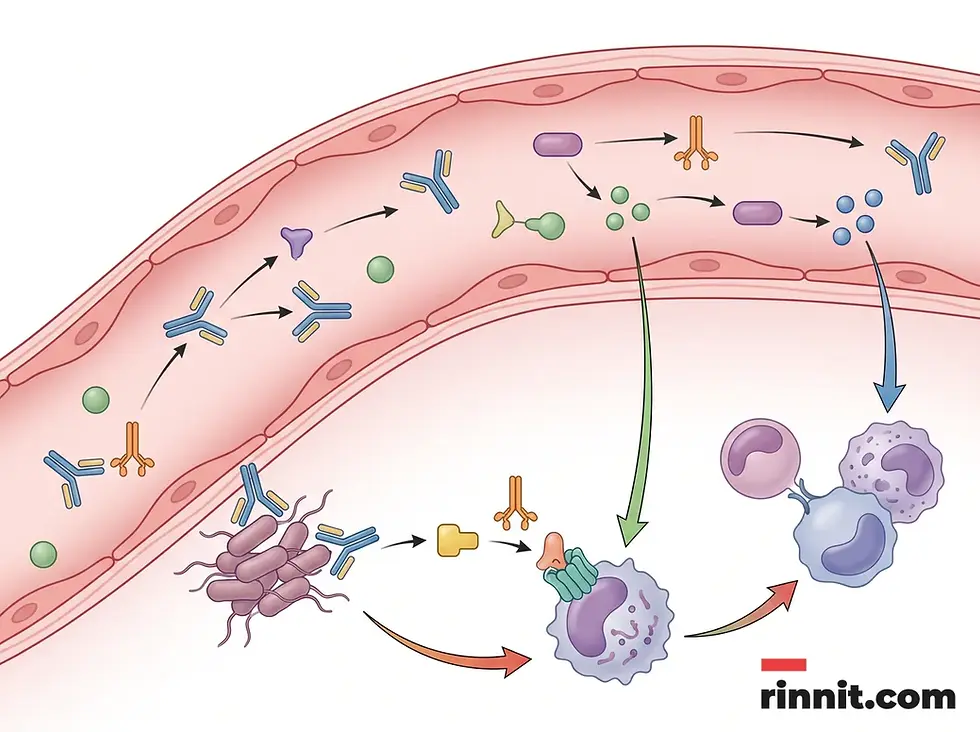
What conditions involve the complement system?
When the complement system functions correctly, it is a silent protector. However, issues can arise if the system is either underactive or overactive. A deficiency in complement proteins—which leaves a person immunocompromised—can leave the body vulnerable to frequent and potentially life-threatening infections, such as sepsis.
Conversely, a complement system that is too active or triggers too frequently can lead the body to attack its own healthy tissues. This overactivity is a contributing factor in several autoimmune and inflammatory conditions. [1]
Clinical State | Associated Risks | Common Symptoms |
|---|---|---|
Complement Deficiency | Increased risk of serious infections and sepsis. | Frequent infections, fatigue. |
System Overactivity | Autoimmune disorders, inflammatory damage. | Joint pain, persistent swelling. |
Specific conditions linked to complement system dysfunction include allergic asthma, certain types of anemia, kidney disease, macular degeneration, and rheumatoid arthritis. [1] Diagnostic tools like complement blood tests, complete blood counts (CBC), and antibody level checks are used to assess the health and activity levels of these proteins. [1]

How can you support a healthy complement system?
You cannot directly change how individual complement proteins work [1], but you can support the overall health of your immune system through consistent lifestyle choices. Maintaining a strong defensive system requires a holistic approach to physical wellbeing.
Avoid Injury: Injury is one of the triggers that switch the complement cascade on, so avoiding physical trauma gives it less to respond to.
Balanced Nutrition: A well-balanced diet supports your whole immune system.
Regular Exercise: Regular physical activity supports overall immune health.
Hygiene Practices: Good hygiene reduces the number of bacteria and viruses your immune system must manage.
Quality Sleep: Getting enough sleep supports overall immune health. [1]

Conclusion
The complement system is an indispensable ally in the body’s quest for health, providing a rapid and effective response to environmental threats. By understanding the mechanics of the complement cascade and recognizing the signs of dysfunction, individuals can work with healthcare providers to manage their immune health. Through proactive care and healthy lifestyle habits, it is possible to support the immune system as a whole and help the body stay well-defended.
Next Steps for Health
If you experience frequent infections, persistent joint pain, or unexplained fatigue, consult a healthcare provider to discuss an immune system evaluation. A complement blood test can provide valuable insights into how your proteins are functioning. For those already managing autoimmune or inflammatory conditions, your healthcare provider may use complement testing to help assess your condition and how well treatment is working.
Frequently Asked Questions
1. What is the complement system?
The complement system is a part of the immune system made of proteins that enhance the body’s ability to fight infection and heal.
2. How many proteins are in the complement system?
There are approximately 50 different plasma proteins that make up the system.
3. Where are complement proteins made?
Complement proteins are primarily produced in the liver.
4. What is a complement cascade?
A complement cascade is a sequential chain reaction where one protein activates the next to create a powerful immune response.
5. What triggers the complement system to turn on?
Triggers include physical injury or the presence of foreign invaders like bacteria and viruses.
6. What does the complement system do to invaders?
The complement system targets them for destruction, triggers inflammation, and helps remove them from the body.
7. How does it help with healing?
The complement system identifies and cleans up damaged or dead cells to facilitate tissue repair.
8. What is complement deficiency?
Complement deficiency is a condition where the body doesn’t have enough complement proteins or they don’t work correctly.
9. What are the risks of a weak complement system?
A weak system makes you immunocompromised and at higher risk for serious infections like sepsis.
10. Can the complement system be too active?
Yes, overactivity can lead the body to attack its own tissues, causing autoimmune or inflammatory diseases.
11. What are some conditions linked to this system?
Linked conditions include rheumatoid arthritis, kidney disease, macular degeneration, and allergic asthma.
12. What are common symptoms of complement issues?
Symptoms include frequent infections, joint pain, swelling, and fatigue.
13. How do doctors test the complement system?
A complement blood test measures the amount and function of these proteins in your blood.
14. What treatments are used for complement conditions?
Treatments may include antibiotics, immunosuppressive therapy, plasma transfusions, or vaccination, depending on the issue.
15. How can I keep my complement system healthy?
You can’t directly change how it works, but you can support your whole immune system with a balanced diet, exercise, good sleep, and good hygiene.
Related Reading
C3 Complement Blood Test: Normal Range and What Low or High C3 Means explains the blood test that measures complement C3 and what low or high levels mean.
C4 Complement Blood Test: Normal Range and What Low or High C4 Means explains the companion complement test and what low or high C4 means.
References
Cleveland Clinic. Complement System Function. Cleveland Clinic. Last updated June 28, 2022. https://my.clevelandclinic.org/health/body/23370-complement-system
Butters C, et al. Prevalence of Immunodeficiency in Children With Invasive Pneumococcal Disease in the Pneumococcal Vaccine Era: A Systematic Review. JAMA Pediatrics. 2019;173(11):1084-1094. PMID 31566672. https://doi.org/10.1001/jamapediatrics.2019.3203
Balduit A, et al. Genetic bases of C7 deficiency: systematic review and report of a novel deletion determining functional hemizygosity. Frontiers in Immunology. 2023;14:1192690. PMID 37304269. https://doi.org/10.3389/fimmu.2023.1192690
Bernuy-Guevara C, et al. The Inhibition of Complement System in Formal and Emerging Indications: Results from Parallel One-Stage Pairwise and Network Meta-Analyses of Clinical Trials and Real-Life Data Studies. Biomedicines. 2020;8(9):355. PMID 32948059. https://doi.org/10.3390/biomedicines8090355
Medical disclaimer
This article is for informational purposes only and does not constitute medical advice. Consult a healthcare professional for diagnosis and treatment.



Comments