C3 Complement Blood Test: Normal Range and What Low or High C3 Means

Updated: 2 days ago
Written and medically reviewed by Dr. Baraa Alnahhal, MD · Last reviewed: November 2026 · How we review
Quick Answer
The C3 complement blood test measures complement component 3 (C3), a protein in the complement system, part of the immune defense against infection. Providers order it to help diagnose and monitor lupus, certain kidney diseases, vasculitis and recurrent infections. The normal range is about 80–178 mg/dL. It's a simple blood draw, often done with C4.
What the research says
Low C3 in early pregnancy predicts lupus problems: a network meta-analysis of 532 pregnancies in women with lupus found that low or non-rising C3 and C4 in the first trimester were linked to disease flares, and pregnancies with a flare had more complications (60% vs 50.3%) (Radin M et al., Autoimmunity Reviews, 2023) [2]
Treatment can change what C3 tells you: in people with lupus treated with belimumab, C3 and C4 were not clearly related to disease activity, and low C3 was only borderline linked to moderate-to-severe flares, while anti-dsDNA antibodies remained linked to flares (Moreno-Torres V et al., Lupus Science & Medicine, 2026) [3]
Key takeaways
Measures C3, a key immune protein in the complement system.
Normal range: about 80–178 mg/dL (0.8–1.7 g/L); labs vary.
Low C3: active lupus, some kidney diseases, infections, liver disease or inherited deficiency.
High C3: recent infection or inflammation, among other causes.
No preparation; results in a few days to a week; often paired with C4.
What is C3?
The complement system is a group of blood proteins that help antibodies and white blood cells clear germs and damaged cells. C3 is the most plentiful and sits at the center of all three complement pathways. When the immune system is very active, as in some autoimmune diseases, complement proteins are used up faster than the liver can make them, and blood levels fall. Sources: [1]
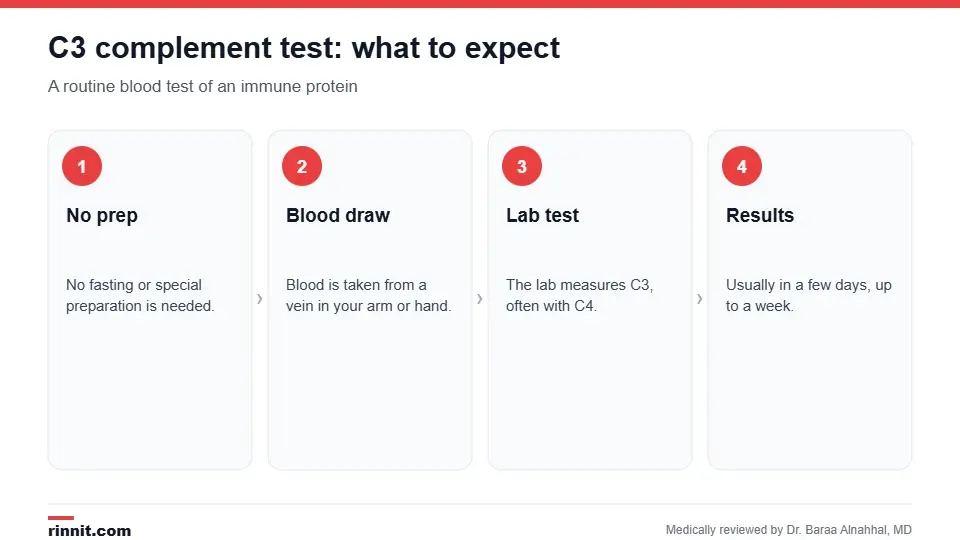
The C3 test is a routine blood draw.
Why is it done?
To help diagnose and monitor lupus, including lupus nephritis.
To evaluate glomerulonephritis, including C3 glomerulopathy.
To monitor vasculitis and other inflammatory conditions.
To look for a complement deficiency in people with frequent or unusual infections.
To check how well treatment is working.
When you have swelling (edema) or inflammation without a clear cause. Sources: [1]
How the test is done
A provider draws blood from a vein in your arm. You don't need to fast or prepare. The test takes a few minutes; you might have a little bruising afterward. Results usually come back within a few days to a week. Sources: [1]
What do the results mean?

Normal ranges vary slightly between labs.
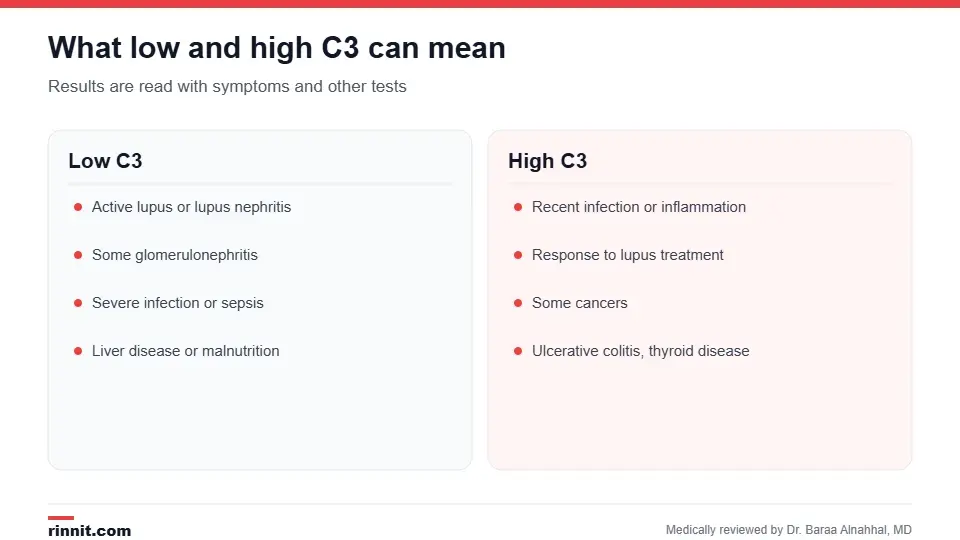
Causes of low and high C3 levels.
Result | Possible causes |
Low C3 | Lupus, rheumatoid arthritis, psoriatic arthritis, Crohn's disease, glomerulonephritis, inherited C3 deficiency, autoimmune hemolytic anemia, hepatitis, hereditary angioedema, serious infections or sepsis, malaria, chronic kidney disease, liver disease, malnutrition, transplant rejection |
High C3 | Recent infection, effective lupus treatment, heart attack, sarcoidosis, some cancers, thyroid disease, ulcerative colitis |
Sources: [1]
C3 is never interpreted alone. Your provider looks at it together with C4, symptoms, kidney tests, urine tests and antibody tests such as anti-dsDNA. In lupus, a falling C3 can signal a flare, and a rising C3 can show treatment is working, though some medicines change this relationship. Sources: [1, 2, 3]
C3 vs C4
C4 is another complement protein. Low C3 and C4 together often point to lupus or other immune-complex disease. Low C3 with normal C4 can suggest conditions such as C3 glomerulopathy or post-infection glomerulonephritis. Sources: [1]
Conclusion
The C3 test is a simple blood test that helps reveal how active your immune system is. It's most useful for lupus and kidney inflammation, where changing levels over time help guide treatment. Ask your provider how your result fits with your symptoms and other tests.
Keep learning: read about lupus and the complement system.
Frequently asked questions
What does a C3 test measure?
The level of complement component 3, an immune protein, in your blood.
What is a normal C3 level?
About 80–178 mg/dL (0.8–1.7 g/L), depending on the lab.
What does low C3 mean?
Often that complement is being used up by active lupus, kidney disease or infection.
What does high C3 mean?
It can reflect recent infection or inflammation, among other causes.
Do I need to fast?
No. No preparation is needed.
Why is C3 tested with C4?
Together they help narrow down the cause of immune or kidney problems.
Can C3 show a lupus flare?
A falling C3 can signal a flare, but it's interpreted with other tests.
How long do results take?
Usually a few days to a week.
Is the C3 test risky?
No. It's a routine blood draw.
Can C3 deficiency be inherited?
Yes. It's rare and can cause frequent infections.
Related Reading
Lupus: Symptoms, Causes & Treatment Guide the autoimmune disease most often monitored with C3.
Lupus Nephritis: Complete Guide to Symptoms, Causes, Diagnosis, and Treatment kidney inflammation from lupus.
The Complement System: Your Body's Essential Immune Cascade how the complement system works.
Glomerulonephritis: Why Your Kidney Filters Inflame, the 6 Warning Signs, and How Treatment Protects Your Kidneys kidney filter inflammation that can lower C3.
What Is Complement 3 Glomerulopathy (C3G)? Symptoms, Causes, Diagnosis, Treatment & Outlook a kidney disease caused by C3 overactivity.
C4 Complement Blood Test: Normal Range and What Low or High C4 Means explains the companion complement test and what low or high C4 means.
References
Cleveland Clinic. C3 Complement Blood Test: What It Is, Procedure & Results. Cleveland Clinic. Last updated October 24, 2024. https://my.clevelandclinic.org/health/diagnostics/22138-c3-complement-blood-test
Radin M, Cecchi I, Crisafulli F, et al. Complement levels during the first trimester predict disease flare and adverse pregnancy outcomes in systemic lupus erythematosus: a network meta-analysis on 532 pregnancies. Autoimmun Rev. 2023;22(12):103467. PMID 37852515. https://doi.org/10.1016/j.autrev.2023.103467
Moreno-Torres V, Royuela A, Policarpo-Torres G, et al. Impact of belimumab on the utility of serological markers for assessing systemic lupus erythematosus activity. Lupus Sci Med. 2026;13(2):e001980. PMID 42476625. https://doi.org/10.1136/lupus-2026-001980
Medical disclaimer
This article is for general education only and does not replace advice from a qualified healthcare professional. Talk to your doctor about your own diagnosis and treatment, and seek emergency care right away for severe or sudden symptoms.



Comments