C4 Complement Blood Test: Normal Range and What Low or High C4 Means

Updated: 2 days ago
Written and medically reviewed by Dr. Baraa Alnahhal, MD · Last reviewed: November 2026 · How we review
Quick Answer
The C4 complement blood test measures complement component 4 (C4), a protein that helps the immune system fight bacteria and viruses. It's ordered to help diagnose and monitor lupus and other autoimmune diseases and to look for hereditary angioedema. A typical normal range is 14–45 mg/dL. It's a simple blood draw, often done together with C3.
What the research says
Low C4 is a common clue to hereditary angioedema: in 185 people with genetically confirmed hereditary angioedema due to C1 inhibitor deficiency, C4 was low in 135 (about 73%), showing C4 is a useful first screen but can be normal, so C1 inhibitor testing is still needed (Charignon D et al., Molecular Immunology, 2017) [2]
C4 helps predict lupus problems in pregnancy: a network meta-analysis of 532 pregnancies in women with lupus found that low or non-rising C3 and C4 levels in the first trimester were linked to lupus flares and more pregnancy complications (Radin M et al., Autoimmunity Reviews, 2023) [3]
Key takeaways
Measures C4, an immune protein in the complement system.
Typical normal range: 14–45 mg/dL; labs vary.
Low C4: lupus and other autoimmune diseases, hereditary angioedema, hepatitis, cirrhosis, kidney disease, malnutrition.
High C4: recovery from infection, effective lupus treatment, ulcerative colitis, sarcoidosis, some cancers.
No preparation; results in a few days; usually interpreted with C3.
What is C4?
The complement system is a chain of proteins that helps antibodies and white blood cells destroy germs. C4 is part of the classical and lectin pathways, which are triggered when antibodies bind to targets. When immune complexes form constantly, as in active lupus, C4 is consumed faster than the liver can replace it, and blood levels drop. Sources: [1]
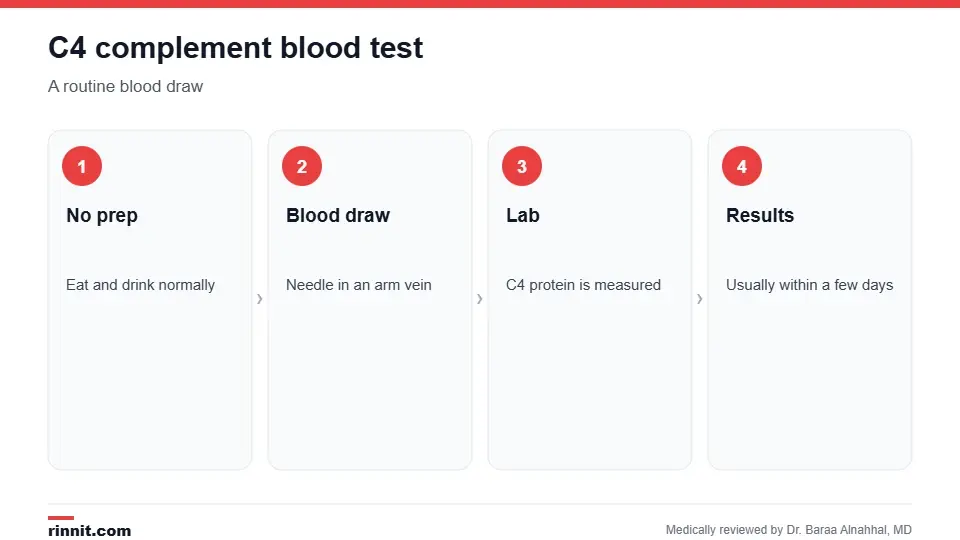
The C4 test is a routine blood draw.
Why is it done?
Signs of an autoimmune disease, such as lupus or rheumatoid arthritis.
Unexplained episodes of swelling under the skin, which can point to hereditary angioedema.
Frequent bacterial or fungal infections.
Muscle or joint pain, swelling or inflammation.
Monitoring whether treatment for an autoimmune disease is working, including lupus nephritis. Sources: [1]
How the test is done
No preparation is needed. A phlebotomist cleans your skin, places a band around your upper arm and draws blood from a vein into a tube. It takes a few minutes. You may have a small bruise. Results usually come back within a few days. Sources: [1]
What do the results mean?

Normal ranges vary slightly between labs.
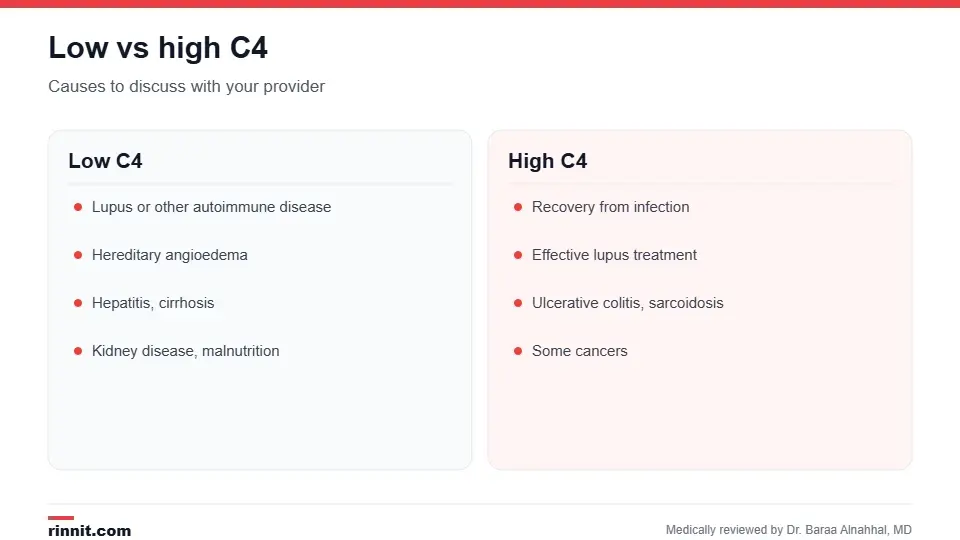
Causes of low and high C4.
Result | Possible causes |
Low C4 | Lupus or another autoimmune disease, or higher risk of one; recurring bacterial infections; autoimmune hemolytic anemia; hepatitis; hereditary angioedema; kidney disease; cirrhosis; malnutrition |
High C4 | Recovery from an infection or illness; effective treatment of an autoimmune disease; ulcerative colitis; sarcoidosis; certain cancers |
Sources: [1]
C4 and C3 together
C4 is usually ordered with the C3 complement blood test. Low C3 and C4 together suggest the classical pathway is being used up, as in active lupus or some forms of glomerulonephritis. Low C4 with normal C3 is typical of hereditary angioedema, which is then confirmed with C1 inhibitor tests. Your provider also considers antibody tests such as the ANA test. Sources: [1, 2, 3]
Risks
Blood draws are very safe. Rarely, they can cause bleeding, fainting or infection. Sources: [1]
Conclusion
The C4 test is a simple blood test that offers clues about immune activity, especially in lupus and hereditary angioedema. Levels are most useful alongside C3, other tests and your symptoms, and changes over time can show whether treatment is working.
Keep learning: read about the C3 complement blood test and lupus.
Frequently asked questions
What does a C4 test measure?
The amount of complement C4, an immune protein, in your blood.
What is a normal C4 level?
Typically 14–45 mg/dL, though labs vary.
What does low C4 mean?
It may point to lupus, hereditary angioedema, liver or kidney disease, or infections.
What does high C4 mean?
It can follow infection or inflammation, among other causes.
Do I need to fast?
No. No preparation is needed.
Why are C3 and C4 tested together?
The pattern of both helps narrow down the cause.
Can C4 diagnose lupus?
Not by itself, but low levels support the diagnosis and help track activity.
Is low C4 a sign of hereditary angioedema?
Often, yes; C1 inhibitor tests confirm it.
How long do results take?
Usually a few days.
Is the test risky?
No. It's a routine blood draw.
Related Reading
C3 Complement Blood Test: Normal Range and What Low or High C3 Means the companion complement test.
Lupus: Symptoms, Causes & Treatment Guide the autoimmune disease most often monitored with C4.
Hives and Angioedema: Symptoms, Causes, Treatment & Complete Guide swelling conditions including hereditary angioedema.
The Complement System: Your Body's Essential Immune Cascade how the complement system works.
Lupus Nephritis: Complete Guide to Symptoms, Causes, Diagnosis, and Treatment kidney inflammation from lupus.
References
Cleveland Clinic. C4 Complement Blood Test: What It Is, Procedure & Results. Cleveland Clinic. Last updated October 24, 2024. https://my.clevelandclinic.org/health/diagnostics/c4-complement-blood-test
Charignon D, Ghannam A, Ponard D, et al. Hereditary C1 inhibitor deficiency is associated with high spontaneous amidase activity. Mol Immunol. 2017;85:120-122. PMID 28222330. https://doi.org/10.1016/j.molimm.2017.01.028
Radin M, Cecchi I, Crisafulli F, et al. Complement levels during the first trimester predict disease flare and adverse pregnancy outcomes in systemic lupus erythematosus: a network meta-analysis on 532 pregnancies. Autoimmun Rev. 2023;22(12):103467. PMID 37852515. https://doi.org/10.1016/j.autrev.2023.103467
Medical disclaimer
This article is for general education only and does not replace advice from a qualified healthcare professional. Talk to your doctor about your own diagnosis and treatment, and seek emergency care right away for severe or sudden symptoms.



Comments