Tamoxifen: How It Works, Side Effects, and How Long You Take It

Updated: 6 days ago
Written and medically reviewed by Dr. Baraa Alnahhal, MD · Last reviewed: October 2026 · How we review
Quick Answer: What is tamoxifen?
Tamoxifen is a daily hormone therapy, taken as a pill or liquid, that blocks estrogen in breast tissue. It treats hormone receptor-positive breast cancer, lowers the chance of cancer returning or appearing in the other breast, and can help prevent breast cancer in high-risk people. Treatment usually lasts 5 to 10 years. [1][2]
What the research says
Five years of tamoxifen nearly halves early recurrence in ER-positive breast cancer. A patient-level analysis of 20 trials (21,457 women) found that in estrogen receptor-positive disease, recurrence rates fell by about 47% during the first 5 years, and breast cancer deaths fell by about a third over 15 years. Tamoxifen had little or no effect in ER-negative disease. (Early Breast Cancer Trialists' Collaborative Group et al., Lancet, 2011) [2]
Continuing to 10 years adds further protection, with a small rise in uterine cancer. In a trial of 6,846 women with ER-positive breast cancer, recurrence during years 5–14 was 21.4% with 10 years of tamoxifen versus 25.1% when stopping at 5 years, and breast cancer deaths were 12.2% versus 15.0%. Endometrial cancer risk rose from 1.6% to 3.1%. (Davies et al., Lancet, 2013) [3]
In prevention, tamoxifen-type medicines cut new breast cancers by 38%. Across 9 prevention trials (83,399 women), selective estrogen receptor modulators lowered breast cancer incidence by 38%; 42 women needed treatment to prevent one breast cancer in 10 years. Blood clot events were about 1.7 times more likely. (Cuzick et al., Lancet, 2013) [4]
Key takeaways
Tamoxifen treats and helps prevent hormone receptor-positive breast cancer, the type that needs estrogen or progesterone to grow. [1]
It is a hormone therapy, not chemotherapy. [1]
Most people take it once a day for at least 5 years, sometimes up to 10. [1]
Common side effects feel like menopause symptoms. Rare but serious risks include blood clots, stroke, cataracts, and uterine cancer. [1]
Tamoxifen can harm a developing baby, so nonhormonal birth control is needed during treatment and for 2 months after. [1]
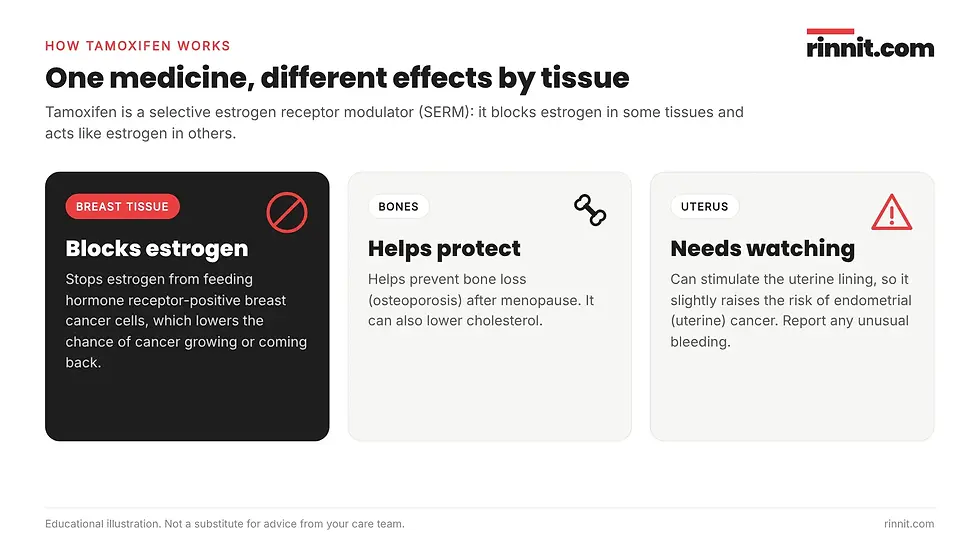
How does tamoxifen work?
Tamoxifen works by blocking estrogen from attaching to breast cancer cells, which slows or stops the growth of hormone receptor-positive tumors. [1]
It belongs to a drug class called selective estrogen receptor modulators (SERMs). "Selective" means it acts differently in different tissues. [1]
Who is tamoxifen prescribed for?
Tamoxifen is prescribed for people with hormone receptor-positive breast cancer and for people over 35 who have a high risk of developing breast cancer. [1]
Group | Why tamoxifen is used |
Diagnosed with hormone receptor-positive breast cancer | Lowers the chance of the cancer coming back |
After breast cancer in one breast | Lowers the chance of cancer in the other breast |
Diagnosed with ductal carcinoma in situ (DCIS) | Lowers the chance of invasive breast cancer |
High risk from family history or a BRCA gene change | Lowers the chance of a first breast cancer |
Hormone receptor-positive cancers include estrogen receptor-positive (ER+) breast cancer. Tamoxifen has little or no effect on ER-negative cancers. [2]
How much does tamoxifen lower breast cancer risk?
Tamoxifen lowers the risk of breast cancer coming back by roughly 30% to 50%, depending on the situation. [1]
Situation | Approximate risk reduction |
Cancer in the opposite breast | About 50% |
Recurrence before menopause | 30% to 50% |
Recurrence after menopause | 40% to 50% |
Invasive cancer after DCIS | Up to 50% |
First breast cancer in high-risk people | Up to 40% |
The benefit lasts beyond the years you take it. In large trials, breast cancer deaths stayed about one-third lower for 15 years after 5 years of treatment. [2]

How do you take tamoxifen?
Tamoxifen is taken by mouth once a day, ideally at the same time each day. [1]
Forms: a tablet or a liquid. [1]
Duration: usually at least 5 years, and sometimes up to 10. [1]
Switching: after about 5 years, some people move to a different hormone therapy, such as an aromatase inhibitor. [1]
Taking every dose matters. Stopping early or skipping doses can weaken the protection against recurrent breast cancer. [1]
What are the side effects of tamoxifen?
The most common side effects of tamoxifen are menopause-like symptoms, such as hot flashes, night sweats, and vaginal dryness. [1]
Common side effects | Rare but serious risks |
Hot flashes and night sweats | Blood clots, including deep vein thrombosis |
Vaginal dryness or discharge | |
Irregular or missed periods | Cataracts and other eye problems |
Weight gain or fluid retention (edema) | |
Leg swelling, nausea, skin rash | |
Fatigue, headaches, erectile dysfunction |
Many people notice side effects soon after the first dose. [1]
Serious risks are uncommon but real. In one large trial, women who continued tamoxifen to 10 years had a higher rate of pulmonary embolism and endometrial cancer than those who stopped at 5 years. [3]

Does tamoxifen have benefits beyond breast cancer?
Tamoxifen has two benefits beyond breast cancer: it helps prevent bone loss (osteoporosis) after menopause, and it lowers cholesterol. [1]
This bone effect matters because osteoporosis becomes more common after menopause. [1]
Is tamoxifen worth the risk?
Tamoxifen is worth the risk for most people who are prescribed it, but the balance depends on age, breast cancer risk, and the risk of side effects such as stroke, cataracts, or uterine cancer. [1]
In a study of 788 women without breast cancer who took tamoxifen for prevention, about 20% did not have enough evidence that the benefits outweighed the risks. [5] The same study found that 46% had stopped tamoxifen by 4.5 years. [5]
Your care team weighs these factors with you before starting.
Is tamoxifen safe during pregnancy?
Tamoxifen is not safe during pregnancy because it may cause birth defects. [1]
Which foods and drinks should you avoid while taking tamoxifen?
Grapefruit, tangerines, and alcohol may make tamoxifen less effective, so it is best to avoid them during treatment. [1]
Ask your pharmacist about any supplements or other medicines you take, too. Some antidepressants, such as paroxetine and fluoxetine, can make tamoxifen less effective, and tamoxifen can increase the effect of the blood thinner warfarin.
When should you call a doctor while taking tamoxifen?
Call your doctor right away if you have chest pain, shortness of breath, stroke signs, leg swelling, fever, or vomiting you can't control. Also report any unusual vaginal bleeding or discharge, or pain or pressure in the pelvis, which can be signs of uterine cancer. [1]
Warning sign | What to do |
Chest pain or shortness of breath | Call your local emergency number |
Slurred speech, blurred vision, or sudden numbness (stroke signs) | Call your local emergency number |
Swelling in the leg, ankle, or foot | Call your doctor right away |
Fever | Call your doctor |
Vomiting you can't control | Call your doctor |
Chest pain or stroke signs are an emergency. Call your local emergency number.
Tamoxifen at a glance
Topic | Key fact |
Drug type | Hormone therapy (SERM), not chemotherapy |
Used for | Hormone receptor-positive breast cancer and prevention in high-risk people |
How taken | By mouth, once daily (tablet or liquid) |
Usual length | At least 5 years, sometimes up to 10 |
Main side effects | Hot flashes, night sweats, vaginal dryness |
Serious risks | Blood clots, stroke, cataracts, uterine cancer |
Pregnancy | Avoid; use nonhormonal birth control until 2 months after stopping |
Time to leave the body | Active up to 2 weeks; about 3 months to clear fully |
Conclusion
Tamoxifen is one of the most widely used medicines for hormone receptor-positive breast cancer. It lowers the chance of cancer returning, protects the other breast, and can prevent cancer in high-risk people. [1][2]
Most side effects are manageable. Serious risks are rare, and knowing the warning signs keeps you safe. Taking it every day, for the full course, gives you the strongest protection.
Have questions about your treatment? Explore our breast cancer guides on rinnit.com, and bring this article to your next appointment to talk through your own benefits and risks with your care team.
FAQ
Is tamoxifen a chemotherapy drug?
Tamoxifen is not chemotherapy. Tamoxifen is a hormone therapy in the selective estrogen receptor modulator (SERM) class, although its preventive use is sometimes called "chemoprevention." [1]
How long do you take tamoxifen?
Tamoxifen is usually taken for at least 5 years and sometimes for up to 10 years. Some people switch to a different hormone therapy after about 5 years. [1]
When do tamoxifen side effects start?
Tamoxifen side effects often start soon after the first dose. Hot flashes and other menopause-like symptoms are the most common. [1]
Can you get pregnant while taking tamoxifen?
Pregnancy should be avoided while taking tamoxifen because the medicine may cause birth defects. Use nonhormonal birth control during treatment and for 2 months after your last dose. [1]
What should you avoid while taking tamoxifen?
Grapefruit, tangerines, and alcohol may reduce how well tamoxifen works. Check with your pharmacist before starting any new medicine or supplement. [1]
How long does tamoxifen stay in your body?
Tamoxifen stays active for up to 2 weeks after the last dose. The medicine can take about 3 months to leave the body completely. [1]
Is tamoxifen worth the risk?
Tamoxifen is worth the risk for most people it is prescribed for, but the balance depends on age, breast cancer risk, and the risk of side effects such as stroke or uterine cancer. Your care team weighs these factors with you. [1][5]
When should you get emergency care while taking tamoxifen?
Emergency care is needed for chest pain, shortness of breath, or stroke signs such as slurred speech, blurred vision, or sudden numbness. Call your local emergency number right away. [1]
Can men take tamoxifen?
Yes. Tamoxifen is also used to treat hormone receptor-positive breast cancer in men. Side effects in men can include hot flashes and a lower sex drive, so tell your oncologist about any changes.
What should I do if I miss a dose of tamoxifen?
Take the missed dose as soon as you remember, unless it is almost time for your next one. Do not take two doses at once to make up for it. Ask your pharmacist if you are unsure.
Related Reading
Hormone Therapy for Breast Cancer: Types, How It Works, and Side Effects compares tamoxifen with other hormone treatments for breast cancer.
Aromatase Inhibitors: Hormone Therapy for Breast Cancer explains how aromatase inhibitors lower estrogen after menopause.
Estrogen Receptor-Positive (ER+) Breast Cancer: What It Means, Symptoms, and How It's Treated explains what an ER-positive breast cancer diagnosis means for treatment.
Endometrial Cancer: Symptoms, Diagnosis, Treatment and Support covers the warning signs of uterine lining cancer and how it is treated.
References
Cleveland Clinic. Tamoxifen: Uses, Side Effects & Risks. Cleveland Clinic. Last updated January 20, 2023. https://my.clevelandclinic.org/health/treatments/9785-tamoxifen
Early Breast Cancer Trialists' Collaborative Group (EBCTCG); Davies C, Godwin J, Gray R, et al. Relevance of breast cancer hormone receptors and other factors to the efficacy of adjuvant tamoxifen: patient-level meta-analysis of randomised trials. Lancet. 2011;378(9793):771-784. PMID 21802721. https://doi.org/10.1016/S0140-6736(11)60993-8
Davies C, Pan H, Godwin J, et al. Long-term effects of continuing adjuvant tamoxifen to 10 years versus stopping at 5 years after diagnosis of oestrogen receptor-positive breast cancer: ATLAS, a randomised trial. Lancet. 2013;381(9869):805-816. PMID 23219286. https://doi.org/10.1016/S0140-6736(12)61963-1
Cuzick J, Sestak I, Bonanni B, et al. Selective oestrogen receptor modulators in prevention of breast cancer: an updated meta-analysis of individual participant data. Lancet. 2013;381(9880):1827-1834. PMID 23639488. https://doi.org/10.1016/S0140-6736(13)60140-3
Nichols HB, DeRoo LA, Scharf DR, et al. Risk-benefit profiles of women using tamoxifen for chemoprevention. J Natl Cancer Inst. 2015;107(1):dju354. PMID 25475563. https://doi.org/10.1093/jnci/dju354
Medical disclaimer
This article is for general education only and does not replace advice from your doctor or care team. Do not start, stop, or change tamoxifen without talking to your prescriber. If you have chest pain, trouble breathing, or signs of a stroke, call your local emergency number.



Comments