Hot Flashes: Symptoms, Causes & Treatment

Updated: 2 days ago
Medically reviewed by Dr. Baraa Alnahhal, MD · Last reviewed: September 2026
A hot flash is a sudden wave of warmth in the upper body — most often the face, neck and chest — often with sweating and flushed skin. Menopause is the most common cause, and episodes typically last 1 to 5 minutes. Most people have hot flashes daily and experience them for more than seven years on average. Treatment works best when started within 10 years of your last period or before age 60, and most people find relief through a mix of hormone therapy, nonhormone medicines, and simple lifestyle steps.
Quick Answer
What is a hot flash? A sudden feeling of warmth in the upper body — face, neck and chest — often with sweating, flushed skin, and a fast heartbeat.
What causes them? Changing hormone levels around menopause are the most common cause; lower estrogen can make the brain's temperature regulator overreact to small temperature changes.
How long does one last? Typically 1 to 5 minutes, but people often have them daily for more than seven years on average.
What are night sweats? Hot flashes that happen at night — they can wake you from sleep and lead to long-term sleep loss.
When should I see a doctor? When hot flashes affect your daily activities or your sleep — effective treatments are available.
What works best? Estrogen therapy is the most effective treatment, ideally started within 10 years of your last period or before age 60; nonhormone options also exist.
Do they go away? For most people, hot flashes fade slowly even without treatment, but this can take several years.
What Is a Hot Flash?
A hot flash is a sudden feeling of warmth in the upper body. It most often affects the face, neck and chest, and it can also cause sweating. Some people feel chilled afterward as the body loses heat.
When hot flashes happen at night, they are called night sweats. Night sweats can wake you from sleep and, over time, cause long-term sleep loss.
Menopause — the time when menstrual periods get less regular and then stop — is the most common cause. Hot flashes are the most common symptom of this change of life.

Hot Flashes Symptoms: 6 Signs to Watch For
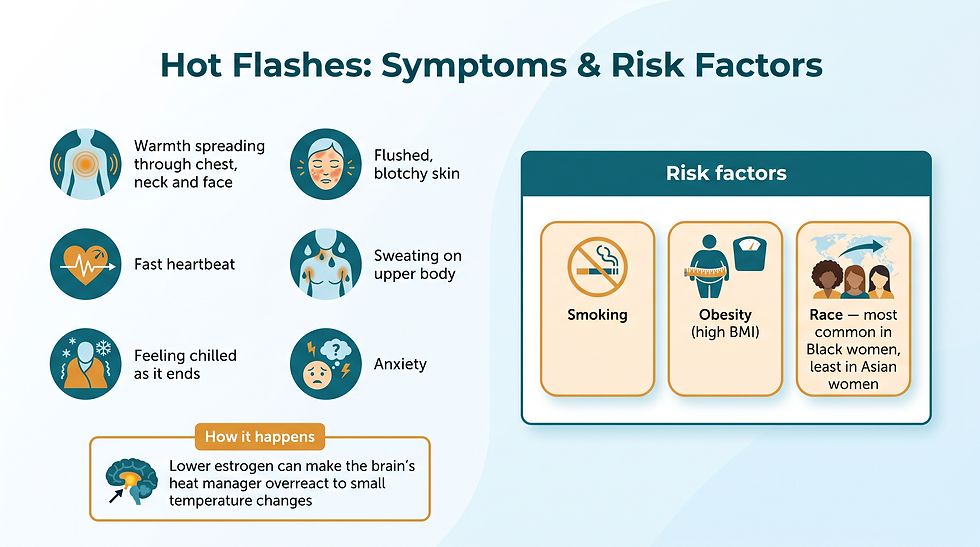
A single episode can involve several signs at once. The six reported symptoms include:
Symptom | What it feels or looks like |
Sudden warmth | A wave of warmth spreading through the chest, neck and face |
Flushed skin | Skin that looks flushed and blotchy |
Fast heartbeat | A racing or pounding heart during the episode |
Sweating | Mostly on the upper body |
Feeling chilled | Chills as the hot flash lets up and body heat is lost |
Anxiety | Feelings of not being at ease during the episode |
How Long Do Hot Flashes Last?
Frequency differs from person to person, but most people who have hot flashes have them daily. One episode may last 1 to 5 minutes.
On average, people who have hot flashes experience them for more than seven years. Some have them for more than 10 years.
Episodes can be mild, or strong enough to disrupt daily activities. They happen at any time of day or night. Nighttime episodes may wake you from sleep and cause long-term sleep loss.
Are Hot Flashes Dangerous?
Hot flashes themselves are not dangerous, but they carry real downstream effects. Research suggests that people who have hot flashes may have a higher risk of heart disease and greater bone loss than people who don't. That is another reason it is worth discussing persistent symptoms with a healthcare professional rather than just waiting them out.
Hot Flashes vs. Night Sweats: What's the Difference?
Feature | Hot flash | Night sweat |
Definition | Sudden upper-body warmth | A hot flash that happens at night |
When it occurs | Any time of day or night | During sleep |
Main impact | Disrupts daily activities | Wakes you from sleep; causes long-term sleep loss |
Underlying mechanism | Triggered by hormonal temperature dysregulation | Same |
When to See a Doctor for Hot Flashes
If hot flashes affect your daily activities or your sleep, talk to your healthcare professional about treatments. You do not have to wait until symptoms become unbearable.
What Causes Hot Flashes?
Changing hormone levels before, during and after menopause are the most common causes. It is not yet clear exactly how the hormonal changes produce hot flashes.
Most research points to this mechanism: lower estrogen levels cause the body's heat manager — the hypothalamus — to respond to slight changes in body temperature. When the hypothalamus thinks the body is too warm, it starts a chain of events in the form of a hot flash to cool the body down.
Rarely, something other than menopause causes hot flashes and night sweats. Other possible causes include:
Less common cause | Examples |
Medicine side effects | Certain prescription drugs can trigger flushing and sweating |
Thyroid problems | Thyroid disorders can affect temperature regulation |
Some cancers | Certain malignancies can cause flushing episodes |
Cancer treatment side effects | Treatments such as hormone-blocking therapy can trigger hot flashes |
Risk Factors: 3 Things That Raise Your Chances
Not everyone who goes through menopause has hot flashes. Factors that may raise the risk include:
Risk factor | How it contributes |
Smoking | People who smoke are more likely to get hot flashes |
Obesity | A high body mass index (BMI) is linked with having more hot flashes |
Race | More Black people report hot flashes during menopause than people of other races; Asian people report them least often |
Complications: Why Hot Flashes Are Worth Treating
Hot flashes can affect daily activities and quality of life. Beyond immediate discomfort, two longer-term associations deserve attention:
Complication | What the research suggests |
Sleep loss | Night sweats wake you from sleep; over time this can cause long-term sleep loss |
Heart disease | People with hot flashes may have a higher risk of heart disease than those without |
Bone loss | People with hot flashes may experience greater bone loss than those without |
How Are Hot Flashes Diagnosed?
A healthcare professional can most often diagnose hot flashes based on your symptoms alone. You might have blood tests to see whether your periods are stopping or to find other causes of your hot flashes.
Hot Flashes Treatment: What Actually Works?
The best way to relieve hot flashes is to take estrogen — but taking this hormone carries risks. If estrogen is right for you and you start it within 10 years of your last menstrual period or before age 60, the benefits can be greater than the risks.
Medicines such as antidepressants and anti-seizure medicines also might help ease hot flashes — but they don't work as well as hormones do. If hot flashes don't bother you much, you likely don't need treatment. For most people, hot flashes go away slowly even without treatment, but it can take several years.
Hormone Therapy
Estrogen is the main hormone prescribed to ease hot flashes. Most people who have had their uterus removed (a hysterectomy) can take estrogen alone. Those who still have a uterus most often need progesterone with estrogen — this protects against endometrial cancer (cancer of the lining of the uterus).
Guidelines suggest using the smallest dose of estrogen that manages symptoms. How long you use the treatment depends on how well it works and your personal risks. The goal is the best quality of life.
Some people have side effects from oral progesterone. For people who can't take progesterone by mouth, a mixed medicine of bazedoxifene with conjugated estrogens (Duavee) can also treat menopausal symptoms. Like progesterone, taking bazedoxifene with estrogen may guard against the higher endometrial cancer risk of estrogen alone, and it might also protect your bones.
Who should check before starting estrogen: If you have had — or are at risk of — breast or endometrial cancer, heart disease, stroke or blood clots, talk with your healthcare professional about whether estrogen therapy is safe for you.
Antidepressants
The U.S. Food and Drug Administration approves only one nonhormone treatment for hot flashes: a low-dose form of paroxetine (Brisdelle). Other antidepressants used to treat hot flashes include:
Medicine | Notes |
Venlafaxine (Effexor XR) | Used off-label to ease hot flashes |
Paroxetine (Paxil) | Standard-dose form used for hot flashes |
Citalopram (Celexa) | Used for hot flash relief |
Escitalopram (Lexapro) | Used for hot flash relief |
Antidepressants don't work as well as hormone therapy for strong hot flashes, but they can help people who can't use hormones. Possible side effects include nausea, trouble sleeping or feeling sleepy, weight gain, dry mouth, and trouble having sex.
Other Prescription Medicines
Medicine | What it is | Possible side effects |
Gabapentin (Neurontin, Gralise) | Antiseizure medicine that eases hot flashes | Drowsiness, dizziness, tiredness, edema |
Pregabalin (Lyrica) | Anti-seizure medicine that can ease hot flashes | Drowsiness, dizziness, trouble focusing, weight gain |
Oxybutynin (Oxytrol) | Pill or patch mostly used for overactive bladder | Dry mouth, dry eyes, nausea, constipation, dizziness |
Clonidine (Catapres-TTS 1, Nexiclon XR) | Pill or patch mostly used for high blood pressure | Dizziness, drowsiness, constipation, dry mouth |
Fezolinetant (Veozah) | Daily nonhormone pill that blocks a brain pathway managing body temperature | Belly pain, diarrhea, trouble sleeping, back pain, higher liver enzymes; not prescribed to people with liver disease |
Nerve Block Procedure
A procedure called a stellate ganglion block has shown promise for moderate to strong hot flashes. It involves injecting a numbing medicine into a nerve cluster in the neck. Side effects include pain and bruising at the injection site, and more research is needed.

Hot Flashes Self-Care: 5 Things That May Help
If your hot flashes are mild, you might try lifestyle changes. Experts no longer recommend most of these as primary treatment because studies don't fully prove they work — but they are also not harmful, and many people find real relief.
Self-care step | How to do it |
Keep cool | Dress in layers so you can remove clothing when warm; open windows or use a fan or air conditioner; lower the room temperature; sip a cold drink when a hot flash comes on |
Watch what you eat and drink | Hot and spicy foods, caffeine and alcohol can trigger hot flashes |
Practice mind-body therapies | Meditation, slow deep breathing, stress management and guided imagery may ease mild hot flashes — and improve sleep even if they don't |
Don't smoke | Smoking is linked to more hot flashes; quitting may ease them and lower heart disease, stroke and cancer risk |
Lose weight | If you're overweight or obese, losing weight might ease hot flashes for some people |
Mind-Body Approaches for Hot Flashes
Approach | What the evidence says |
Cognitive behavioral therapy (CBT) | Counseling works for easing how much hot flashes and night sweats bother you |
Hypnosis | May help both how often hot flashes occur and how bad they are |
Mindfulness meditation | Little proof it eases hot flashes, but might ease how much they bother you |
Acupuncture | Mixed results — some studies show less frequent and less severe hot flashes, others show no help |
Do Supplements Help Hot Flashes?
People think of dietary supplements as natural and harmless, but all supplements may have side effects, and they can affect medicines you take for other conditions. Talk with your doctor about any supplements you take.
Supplement | What the evidence says |
Plant estrogens (soy, red clover, flaxseed) | Studies most often found little or no help for menopause symptoms; research is ongoing |
Black cohosh | Mixed results; a rare possible link to liver damage |
Ginseng | Studies have not found it eases hot flashes |
Dong quai | Not found to work; combined with blood-thinning medicines, it may cause bleeding problems |
Vitamin E | Might ease mild hot flashes; high doses can raise bleeding risk |
Preparing for Your Appointment
For hot flashes, you'll likely start by seeing your main healthcare professional or a gynecologist. Before the visit, make a list of your symptoms (including how many hot flashes you have a day and how bad they are), all medicines, herbs, vitamins and supplements you take with their doses, and the questions you want to ask.
Conclusion: Hot Flashes Are Common — and Treatable
Hot flashes are the most common symptom of the menopausal transition: a sudden wave of warmth through the chest, neck and face that typically lasts 1 to 5 minutes and, for most people, recurs daily for more than seven years. The good news is that they are highly treatable. Estrogen therapy remains the most effective option, with a favorable risk-benefit profile when started within 10 years of your last period or before age 60, and a growing roster of nonhormone medicines, mind-body approaches, and simple self-care steps offer real relief for people who can't or won't take hormones. Because hot flashes are linked to sleep loss and potentially higher heart and bone risks, they are worth a conversation with a healthcare professional — not something to quietly endure.
If hot flashes are disrupting your day or your sleep, make an appointment with your healthcare professional or a gynecologist.
Frequently Asked Questions
What is a hot flash?
A hot flash is a sudden feeling of warmth in the upper body, most often affecting the face, neck and chest, often accompanied by sweating, flushed blotchy skin, a fast heartbeat, and sometimes chills as it fades.
What causes hot flashes?
Changing hormone levels before, during and after menopause are the most common cause. Lower estrogen can make the hypothalamus — the brain's temperature regulator — overreact to small temperature changes, triggering a hot flash to cool the body down.
How long do hot flashes last?
One episode typically lasts 1 to 5 minutes, but most people have them daily, and on average they persist for more than seven years — sometimes more than 10.
What are night sweats?
Night sweats are hot flashes that happen at night. They can wake you from sleep and, over time, lead to long-term sleep loss.
Why do I feel cold after a hot flash?
Sweating and heat loss during the episode can leave you feeling chilled as the hot flash lets up.
When should I see a doctor about hot flashes?
See a healthcare professional if hot flashes affect your daily activities or your sleep. They can confirm the cause and discuss treatment options.
What is the best treatment for hot flashes?
Estrogen therapy is the most effective treatment, especially when started within 10 years of your last menstrual period or before age 60. For people who can't use hormones, options include low-dose paroxetine, fezolinetant, certain antiseizure medicines, and mind-body approaches such as CBT and hypnosis.
Do hot flashes go away on their own?
For most people, hot flashes fade slowly even without treatment, but it can take several years.
Can lifestyle changes stop hot flashes?
Lifestyle steps — dressing in layers, staying cool, avoiding spicy food, caffeine and alcohol, quitting smoking, and losing weight — may ease mild hot flashes. They are not proven primary treatments, but they are safe and can help alongside medical options.
References
Hot flashes — Symptoms & causes (expert-reviewed content dated March 04, 2025)
Hot flashes — Diagnosis & treatment (expert-reviewed content dated March 04, 2025)
This article is for general information only and is not a substitute for professional medical advice. Seek care from a qualified healthcare professional for diagnosis and treatment decisions.
Comments