Talus Fracture: Symptoms, Types, Treatment and Recovery

Updated: 3 days ago
Medically reviewed by Dr. Baraa Alnahhal, MD · Last reviewed: October 2026
Quick Answer: What is a talus fracture?
A talus fracture is a break in the main bone connecting the foot to the leg at the ankle. It can be a severe injury that affects walking, weight-bearing and ankle motion. Most fractures result from high-impact injuries, and many require surgery to restore alignment. [1]
What the research says
Osteonecrosis is common after talar neck fractures and rises with displacement. A meta-analysis found an overall osteonecrosis rate of 31.2%. By Hawkins type I to IV, the rates were 9.8%, 27.4%, 53.4% and 48.0%. Subtalar arthritis occurred in 49% overall and in 81% of studies with more than two years of follow-up (Dodd and Lefaivre, J Orthop Trauma, 2015). [2]
Restoring the bone’s position matters. A meta-analysis of surgically treated displaced talar neck fractures found an avascular necrosis rate of 27.9% and a post-traumatic osteoarthritis rate of 40.0%. Poor functional scores were linked to poor fracture reduction, not to the surgical approach or fixation method, and open fracture-dislocations carried a higher risk of complications (Giordano et al., Injury, 2021). [3]
Children’s talus fractures carry risks too. A systematic review of 31 studies (143 children) found an overall avascular necrosis rate of 15.4% and a union rate of 96.5%. All cases of nonunion occurred in children older than 12 years (Waseem et al., Injury, 2022). [4]

A talus fracture is a break in the talus, a bone that connects your foot to your leg and helps form the ankle joint. Because the talus transfers weight and supports ankle and foot movement, a fracture can cause significant loss of motion and function. [1]
Talus fractures commonly occur after high-impact injuries such as car or motorcycle accidents, falls from significant heights or sports injuries. Treatment depends on the type and severity of the fracture; many talus fractures require surgery, and recovery can take months. [1]
If you have severe ankle pain and swelling after an injury, cannot put weight on your foot, have difficulty walking or notice bruising, tenderness or fracture blisters, seek prompt medical evaluation. A talus fracture is different from a more common broken ankle, although the two can occur together.
What is the talus?
The talus is a bone in the foot that connects the ankle to the leg. It joins the tibia and fibula, the lower-leg bones, to form the ankle joint. This joint allows the foot to move up and down. [1]
The talus sits above the heel bone, called the calcaneus, and forms the subtalar joint. This joint allows the foot to move from side to side. The talus also transfers weight across the ankle and is mostly covered in cartilage, the slippery material that lets bones move smoothly against one another. [1]
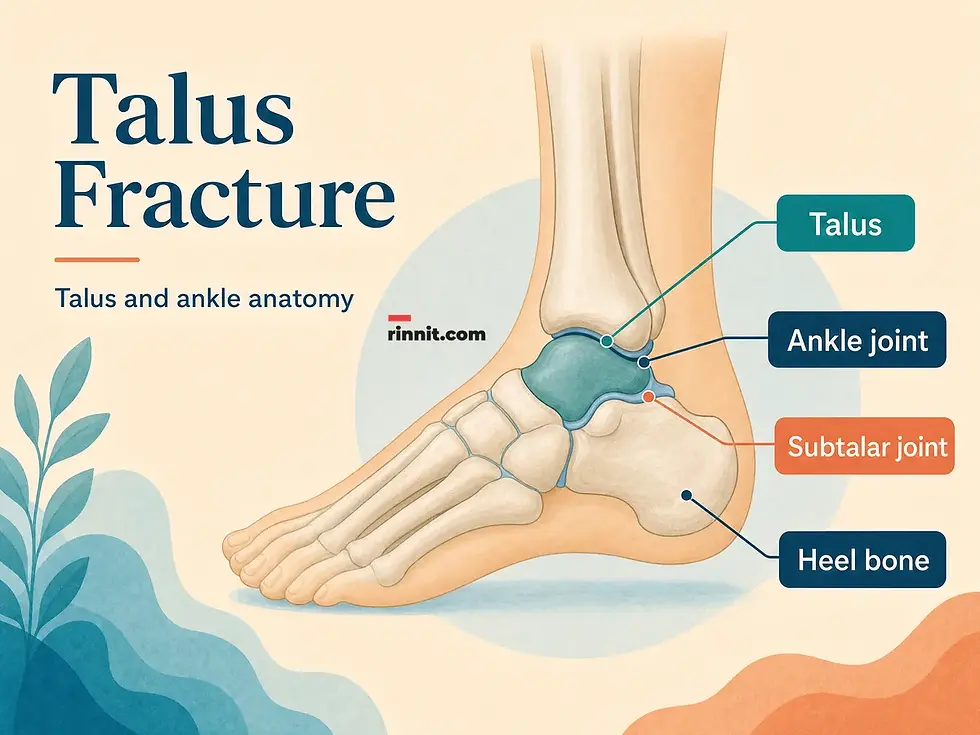
Structure or role | Plain-language explanation |
Talus | Foot bone that connects the ankle to the leg |
Ankle joint | Formed by the talus, tibia and fibula; supports up-and-down foot movement |
Subtalar joint | Formed by the talus and heel bone; supports side-to-side movement |
Weight transfer | The talus helps carry weight across the ankle |
Cartilage covering | Helps bones move smoothly against one another |
What are the types of talus fractures?
The talus can break in different places and in different ways. The type of fracture helps the care team understand the injury and choose treatment.
Type | Description |
Neck fracture | A break in the middle section of the talus, between the body and head; the most common type |
Lateral process fracture | A break on the outside of the talus when the ankle is forced outward; commonly seen in snowboarders and sometimes called a snowboarder fracture |
Avulsion fracture | A small part of the talus pulls away where it is attached to a ligament or tendon |
Stress fracture | A small crack caused by overuse or repeated stress |
How are talus fractures classified?
Providers also classify talus fractures by how far the bone or broken pieces have moved from their normal position.
Classification | Meaning |
Minimally displaced or stable | The bone is only slightly out of place and the broken ends still line up correctly or almost correctly |
Displaced | The bone breaks and the pieces move out of their normal position |
Open or compound | The bone breaks through the skin, and surrounding muscles, tendons and ligaments may also be affected (see our guide to compound fractures) |
What are the symptoms of a talus fracture?
The most common symptoms are severe ankle pain and swelling. Other symptoms may include difficulty walking, inability to put weight on the foot, bruising, tenderness and fracture blisters, which are fluid-filled blisters on the skin. [1]
Symptom | What it may mean |
Severe ankle pain | A common symptom after a talus fracture |
Swelling | Swelling around the injured ankle and foot |
Difficulty walking | Trouble moving normally after the injury |
Inability to bear weight | The foot cannot support body weight |
Bruising | Discoloration after the injury |
Tenderness | Pain when the injured area is touched |
Fracture blisters | Fluid-filled blisters on the skin |
A talus fracture can cause a significant loss of ankle and foot function. Do not try to determine the fracture type or walk on the foot based only on symptoms. A qualified provider needs to evaluate the injury.
What causes a talus fracture?
Talus fractures most commonly result from high-energy injuries. Causes include car or motorcycle accidents, falls from significant heights and sports injuries. Many snowboarders fracture the talus. [1]
A twisting ankle can also cause small chips to break off the edges of the talus. [1]
Cause or mechanism | Examples |
High-impact accident | Car or motorcycle accident |
Fall | Fall from a significant height |
Sports injury | Snowboarding and other sports injuries |
Twisting injury | Small chips breaking from the edges of the talus |
How is a talus fracture diagnosed?
A healthcare provider examines the ankle and foot for swelling, bruises and cuts. They may ask you to move your toes to check for nerve damage and check the pulses in your foot to assess blood supply. They may also check for fluid building up in the leg muscles, a condition called compartment syndrome, and examine you for other injuries related to the accident. [1]
Imaging tests help show the location and severity of the fracture. An X-ray can show whether the talus is broken, whether fragments are in place and how many fragments there are. A CT scan can show the severity of the injury in cross-sectional images. [1]
Diagnostic step | What it assesses |
Physical exam | Swelling, bruising, cuts and other injuries |
Toe movement | Possible nerve damage |
Foot pulses | Blood supply to the foot |
Compartment check | Fluid buildup in leg muscles |
X-ray | Break, fragment position and number of fragments |
CT scan | Injury severity using cross-sectional images |
What is the treatment for a talus fracture?
Treatment depends on the fracture type and injury severity. The foot and ankle are first placed in a splint to limit movement. If the fracture is stable and the joints are well-aligned, surgery may not be necessary. [1]
Casting and rehabilitation
A cast holds the bones in the foot and ankle together while they heal. A cast is typically worn for six to eight weeks, with minimal pressure on the foot. After the cast is removed, exercises may help restore foot and ankle strength and function. [1]
Surgery
Most talus fractures are treated with ankle surgery because they result from high-energy force. When bones are out of place, a foot and ankle surgeon resets them. [1]
If the talus is broken into several pieces, a surgeon may perform open reduction and internal fixation, or ORIF. In ORIF, the bone fragments are put back into place and held with a metal plate and/or screws while the bone heals. [1]
If swelling is too great, a surgeon may first use an external fixator. Large pins hold the bones in place, and bars outside the skin connect the pins. After swelling decreases, the surgeon may attempt ORIF. [1]

What complications can occur?
An untreated talus fracture or a fracture that does not heal correctly can cause complications. [1]
Complication | What it means |
Posttraumatic arthritis | Cartilage injury and uneven cartilage can lead to joint wear and arthritis |
Malunion | The fractured bone heals in an abnormal position, which can cause long-term walking problems |
Nonunion | The fractured bone does not heal after an extended period |
Avascular necrosis or osteonecrosis | A fracture interrupts blood supply; bone cells die and the bone may collapse (see avascular necrosis) |
What is talus fracture recovery like?
After surgery, pain may occur, and a provider may prescribe medication. Medications may include opioids, nonsteroidal anti-inflammatory drugs and local anesthetics. [1]
After the bone heals, rehabilitation or physical therapy may improve ankle function. Exercises can help restore range of motion, stability and strength. When walking starts again, a special boot or cane may be needed. Full weight-bearing may not be allowed for a few months, and follow-up X-rays help confirm that the bone has healed properly. [1]
Recovery stage | What may happen |
Early protection | Splint or cast keeps the foot and ankle from moving |
Healing period | Weight-bearing is restricted, often for weeks or months |
Walking transition | A special boot or cane may be used |
Rehabilitation | Exercises or physical therapy help restore motion, stability and strength |
Follow-up | X-rays check whether the bone has healed properly |
How long does a talus fracture take to heal?
Cast time varies with the complexity of the injury. A cast is typically worn for six to eight weeks for stable, well-aligned fractures. For more complex injuries, a cast or splint may be needed for eight to 12 weeks or more, and in some cases for three months or longer. More severe injuries may require longer immobilization. [1]
Pain, stiffness and swelling may persist even after the bone heals. Many people return to normal activities after their provider gives clearance. [1]
When can you return to work?
Return to work depends on the severity of the injury and the type of job. Most people do not return to work for at least two weeks. If a job requires standing all day, returning may take up to a year. [1]
Can you walk on a talus fracture?
A talus fracture can be severe and can significantly affect ankle and foot motion, walking and weight-bearing. Whether and when you can walk depends on the fracture type and the treatment plan. A cast or splint is commonly used, and full weight-bearing may be restricted for a few months. Follow your provider’s instructions rather than testing the foot yourself.
What does a talus fracture feel like?
Talus fractures are often described as extremely painful high-impact injuries. Severe ankle pain, swelling, bruising, tenderness, difficulty walking and inability to bear weight are common symptoms.
When should you seek medical care?
Seek prompt medical evaluation after a significant injury if you have severe ankle pain, swelling, difficulty walking, inability to bear weight, bruising, tenderness or fracture blisters. A suspected talus fracture should be examined and imaged by a qualified provider.
Conclusion: A talus fracture needs prompt evaluation and careful recovery
A talus fracture is a break in the ankle bone that connects the foot and leg and supports ankle, subtalar and weight-bearing function. It usually follows a high-impact injury but can also result from sports injuries, twisting or repeated stress. [1]
Symptoms can include severe pain, swelling, bruising, tenderness, difficulty walking and inability to bear weight. Diagnosis may include a physical exam, X-ray and CT scan. Stable, well-aligned fractures may be treated with immobilization and rehabilitation, while many fractures require surgery to restore alignment. [1]
Recovery can involve weeks or months in a cast or splint, restricted weight-bearing, follow-up X-rays, a boot or cane and physical therapy. If you may have a talus fracture, seek prompt medical evaluation rather than walking on the injured foot. Rinnit.com is here to make complex health information easier to understand. [1]
Frequently Asked Questions
What is a talus fracture?
A talus fracture is a break in the talus, the foot bone that connects the ankle to the leg. It can affect ankle motion, foot function and weight-bearing.
What causes most talus fractures?
Most occur after high-energy injuries such as car or motorcycle accidents and falls from significant heights. Sports injuries and twisting injuries can also cause fractures.
What are the main symptoms?
Severe ankle pain and swelling are common. Difficulty walking, inability to bear weight, bruising, tenderness and fracture blisters may also occur.
Can a talus fracture heal without surgery?
Some stable, well-aligned fractures may not require surgery and may be treated with a splint, cast and rehabilitation. Most talus fractures require surgery to restore alignment because of the high-energy force involved.
How long will I wear a cast?
Depending on the fracture’s complexity, a cast may be needed for six to eight weeks, eight to 12 weeks or more, or three months or more in some cases. Your provider determines the appropriate duration.
Can you walk with a broken talus?
Walking and weight-bearing may be restricted for a few months. Whether you can walk depends on the fracture type and treatment plan. Follow your provider’s instructions.
What is ORIF?
Open reduction and internal fixation, or ORIF, is a surgery in which bone fragments are put back in place and held with a metal plate and/or screws while the bone heals.
What complications can a talus fracture cause?
Complications can include posttraumatic arthritis, malunion, nonunion and avascular necrosis or osteonecrosis.
When can I return to work?
Most people do not return to work for at least two weeks. If a job involves standing all day, returning may take up to a year, depending on the injury and job.
When should I seek care?
Seek prompt care after an injury if you have severe ankle pain or swelling, difficulty walking, inability to bear weight, bruising, tenderness or fracture blisters.
References
Cleveland Clinic. Talus Fractures: Types, Symptoms, Treatment & Recovery. Cleveland Clinic. Updated October 19, 2021. https://my.clevelandclinic.org/health/diseases/22154-talus-fracture
Dodd A, Lefaivre KA. Outcomes of Talar Neck Fractures: A Systematic Review and Meta-analysis. J Orthop Trauma. 2015;29(5):210-215. PMID 25635362. https://doi.org/10.1097/BOT.0000000000000297
Giordano V, Liberal BR, Rivas D, et al. Surgical management of displaced talus neck fractures: single vs double approach, screw fixation alone vs screw and plating fixation-systematic review and meta-analysis. Injury. 2021;52(Suppl 3):S89-S96. PMID 34088463. https://doi.org/10.1016/j.injury.2021.01.047
Waseem S, Nayar SK, Vemulapalli K. Paediatric talus fractures: A guide to management based on a review of the literature. Injury. 2022;53(3):1029-1037. PMID 34972563. https://doi.org/10.1016/j.injury.2021.12.024
Medical disclaimer
This article is for general educational purposes and is not a substitute for professional medical advice, diagnosis or treatment. Always seek the advice of a qualified healthcare professional with any questions about a medical condition or treatment.



Comments