Sinus Surgery: Types, Procedure and Recovery

Updated: 2 days ago
Written and medically reviewed by Dr. Baraa Alnahhal, MD · Last reviewed: November 2026 · How we review
Quick Answer
Sinus surgery treats ongoing sinus problems such as chronic sinusitis, fungal sinusitis and nasal polyps when medicine doesn't work. The most common type is functional endoscopic sinus surgery (FESS), which uses a thin camera to remove blockages. Balloon sinuplasty and Caldwell-Luc surgery are other types. Serious complications are rare.
What the research says
Sinus surgery improved all major symptoms: a meta-analysis of 21 studies with 2,070 patients found every major symptom improved about 14 months after endoscopic sinus surgery, with nasal blockage improving most and sense of smell and headache improving least (Chester AC et al., Otolaryngology–Head and Neck Surgery, 2009) [2]
Symptom scores fell by more than half: in a national audit of 2,573 patients, average SNOT-22 symptom scores fell from 41.5 to 18.3 in people with polyps and from 44.4 to 14.1 in people without polyps 3 months after sinus surgery (Abdalla S et al., Clinical Otolaryngology, 2012) [3]
Key takeaways
Sinus surgery treats chronic sinusitis and nasal polyps when medicine fails.
FESS is the most common type.
Balloon sinuplasty widens the sinus with a small balloon.
Don't blow your nose or lift more than 10 pounds for a while afterward.
Serious complications are rare.
What is sinus surgery?
Your paranasal sinuses are air-filled spaces in your face. When they stay blocked or inflamed, sinus surgery can open them so mucus drains. It may cure or ease severe symptoms. Sources: [1]
Why it's done
Surgery is usually recommended when medicine doesn't help chronic sinusitis, fungal sinusitis or nasal polyps with swelling. Sources: [1]
Types of sinus surgery

FESS is the most common sinus surgery.
Type | How it works | Best for |
A thin camera guides removal of tissue, bone or polyps | The most common option | |
A small balloon is inflated to widen the sinus | Widening blocked sinuses | |
Caldwell-Luc | An opening is made into the sinus behind the cheek | When other treatments fail |
Turbinate reduction is a different procedure. Sources: [1]
What happens during surgery
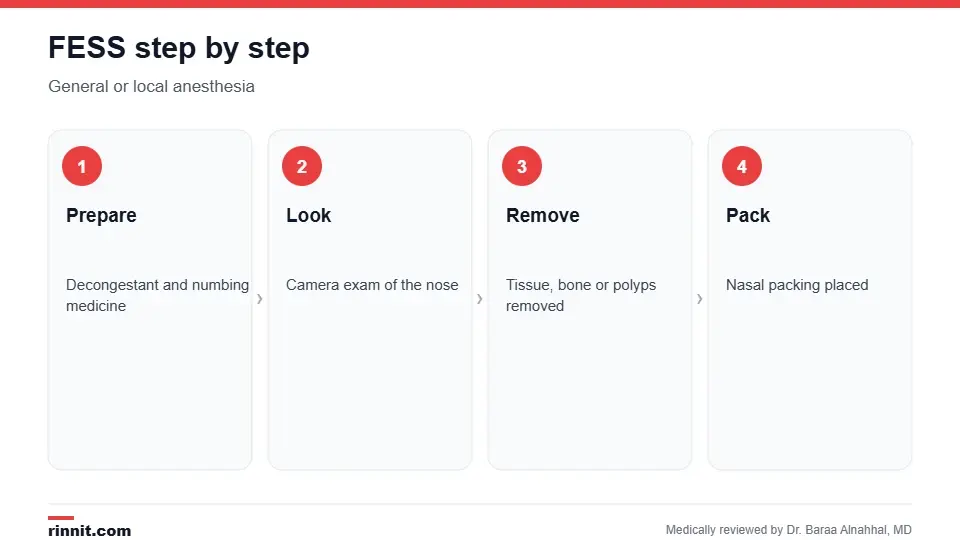
You may have general or local anesthesia.
Type | Steps |
FESS | Decongestant, camera exam and numbing injection; diseased tissue, bone or polyps removed with an endoscope; nasal packing placed |
Balloon sinuplasty | Local anesthetic; an endoscope and catheter guide the balloon; it's slowly inflated, then removed |
Caldwell-Luc | General anesthesia; a cut in the upper gum; damaged tissue and bone removed; closed with stitches |
Sources: [1]
Risks
Risk | Notes |
Heavy bleeding | Rare |
Tearing eyes | Rare |
Cerebrospinal fluid leak | Rare; may raise the risk of meningitis |
Vision loss or double vision | Very rare |
Facial numbness | From nerve damage in Caldwell-Luc |
Infection | Facial swelling, fever, pus from the nose |
Scarring or returning symptoms | Possible |
Sources: [1]
Recovery
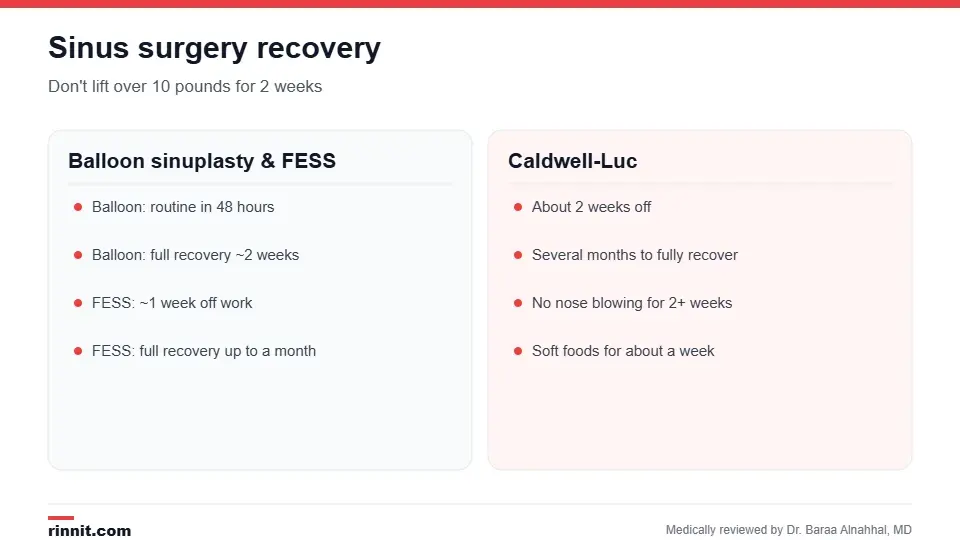
Don't lift more than 10 pounds for at least two weeks.
Type | Back to routine | Full recovery | Nose blowing |
Balloon sinuplasty | Within 48 hours | About two weeks | Possibly after two days, with approval |
FESS | About a week off work | Up to a month | After seven days |
Caldwell-Luc | Possibly two weeks off | Several months | After at least two weeks |
Sneeze with your mouth open, and expect bloody mucus.
Rinse with saline; see nasal irrigation.
Sleep with your head raised.
Avoid strenuous activity, and don't lift more than 10 pounds for at least two weeks.
Use ice packs for pain and swelling. Sources: [1]
Results
FESS and balloon sinuplasty often ease symptoms and give long-term relief. Caldwell-Luc may help when other treatments fail. Sources: [1, 2, 3]
When to call your provider
Bleeding heavier than expected.
Pain that medicine doesn't relieve. Get emergency care for vision changes, swelling around the eye, a severe headache with a stiff neck, or clear watery fluid dripping from your nose.
A fever. Sources: [1]
Conclusion
Sinus surgery can bring lasting relief when chronic sinus problems don't respond to medicine. Following your aftercare plan, especially avoiding nose blowing and heavy lifting, helps you heal well.
Keep learning: read about chronic sinusitis and FESS.
Frequently asked questions
What is sinus surgery?
Surgery that opens blocked sinuses or removes polyps and diseased tissue.
When is sinus surgery needed?
When medicine doesn't help chronic sinusitis or nasal polyps.
What is the most common sinus surgery?
Functional endoscopic sinus surgery (FESS).
What is balloon sinuplasty?
A procedure that widens the sinus with a small balloon.
Is sinus surgery painful?
You'll have anesthesia; ice packs and medicine help afterward.
How long is recovery?
From about two weeks to several months, depending on the type.
When can I blow my nose?
After about seven days for FESS, with your provider's approval.
When can I return to work?
About a week after FESS.
Are there risks?
Serious complications are rare.
Does sinus surgery work?
Studies show symptoms improve significantly after surgery.
Related Reading
Chronic Sinusitis (Chronic Rhinosinusitis): Symptoms, Causes, and Treatment the most common reason for sinus surgery.
Nasal Polyps: Complete Guide to Symptoms, Causes, and Treatment growths that sinus surgery can remove.
Balloon Sinuplasty: What It Is, How It Works, and What Recovery Looks Like a less invasive sinus procedure.
Nasal Irrigation: A Guide to Rinsing Your Sinuses rinsing your sinuses after surgery.
References
Cleveland Clinic. Sinus Surgery: Types, Procedure & Recovery. Cleveland Clinic. Last updated July 29, 2026. https://my.clevelandclinic.org/health/treatments/15854-sinus-surgery-overview
Chester AC, Antisdel JL, Sindwani R. Symptom-specific outcomes of endoscopic sinus surgery: a systematic review. Otolaryngol Head Neck Surg. 2009;140(5):633-639. PMID 19393402. https://doi.org/10.1016/j.otohns.2008.12.048
Abdalla S, Alreefy H, Hopkins C. Prevalence of sinonasal outcome test (SNOT-22) symptoms in patients undergoing surgery for chronic rhinosinusitis in the England and Wales National prospective audit. Clin Otolaryngol. 2012;37(4):276-282. PMID 22776038. https://doi.org/10.1111/j.1749-4486.2012.02527.x
Medical disclaimer
This article is for general education only and does not replace advice from a qualified healthcare professional. Talk to your doctor about your own diagnosis and treatment, and seek emergency care right away for severe or sudden symptoms.



Comments