Balloon Sinuplasty: What It Is, How It Works, and What Recovery Looks Like

Updated: 6 days ago
Written and medically reviewed by Dr. Baraa Alnahhal, MD · Last reviewed: October 2026 · How we review
Quick Answer: What is balloon sinuplasty?
Balloon sinuplasty is a minimally invasive treatment for chronic sinusitis in which a doctor inflates a tiny balloon inside a blocked sinus opening to widen it so trapped mucus can drain. It involves no cuts, is usually considered after 12 weeks of symptoms despite medicine, and most people recover within one to two weeks. [1]
What the research says
Results can last for years. In 110 people with chronic sinusitis followed for about four years after balloon sinuplasty, average symptom scores dropped from about 50 to 7 in people without nasal polyps and from about 52 to 10 in people with polyps. Scan and scope findings also improved at every check-up (Castro et al., Am J Otolaryngol, 2021).
Symptom relief is similar to standard sinus surgery. A review of 18 studies (7 pooled, including 4 randomized trials) found the difference in symptom improvement between balloon dilation and endoscopic sinus surgery was 0.435—below the 0.8 threshold considered clinically meaningful. The authors note high-quality evidence is still limited (Sinha et al., Ann Otol Rhinol Laryngol, 2023).
Fewer complications than conventional surgery. A pooled analysis of 11 studies found balloon dilation had about 71% lower odds of complications after the procedure (odds ratio 0.29) compared with conventional endoscopic surgery, with no significant difference in symptom scores at 3 and 6 months (Zhang et al., Lin Chuang Er Bi Yan Hou Tou Jing Wai Ke Za Zhi, 2020).
Key takeaways
Balloon sinuplasty widens blocked sinus openings with a small balloon—nothing is cut away.
It's for chronic sinusitis (symptoms over 12 weeks) that hasn't improved with medicine.
A CT scan is needed first to confirm it's the right treatment.
Recovery is usually 1–2 weeks, with 24–48 hours of rest at first.
Complications are uncommon, but symptoms can return.

How balloon sinuplasty opens a blocked sinus. Image: Rinnit.com
What is balloon sinuplasty?
Balloon sinuplasty is a procedure that reopens blocked sinus passages by inflating a tiny balloon inside the sinus opening.
Your sinuses are air-filled spaces behind your face. They drain mucus through small openings into your nose. When those openings swell or narrow, mucus gets trapped—and you get congestion, a runny nose, facial pressure, and pain that won't quit.
A doctor gently inserts a tiny balloon into the sinus cavity and inflates it. As the balloon expands, it widens the sinus opening, making it easier for built-up mucus to drain.
Doctors have used this technique since 2005. It has become more popular because it can be done in a regular medical office, not just a hospital. For a clinical overview, see the balloon sinuplasty overview (StatPearls).
What conditions does balloon sinuplasty treat?
Balloon sinuplasty treats chronic sinusitis—sinus inflammation that sticks around. Millions of people live with it.
Typical symptoms include:
A runny nose that won't stop
Nasal congestion that makes breathing hard
Facial pain or pressure
Most people get relief from medical treatment, including antibiotics. When symptoms last more than 12 weeks despite treatment, a doctor may suggest balloon sinuplasty or endoscopic sinus surgery.
Balloon sinuplasty vs. endoscopic sinus surgery
Some people with chronic sinus symptoms can have balloon sinuplasty instead of endoscopic sinus surgery (ESS). Both treat sinusitis without cuts in or around the nose.
Balloon sinuplasty | Endoscopic sinus surgery | |
Treats | Chronic sinusitis | Chronic sinusitis |
Cuts in or around the nose | None | None |
Where it's done | Hospital operating room or medical office | Ask your doctor |
Recovery | May be faster | Compare with your doctor |
Pain afterward | May be less | Compare with your doctor |
If symptoms return | Repeat balloon sinuplasty or switch to ESS | Ask your doctor |
Who is a good candidate for balloon sinuplasty?
A good candidate for balloon sinuplasty has chronic sinusitis lasting longer than 12 weeks that medicines haven't improved, with a CT scan confirming the procedure is appropriate.
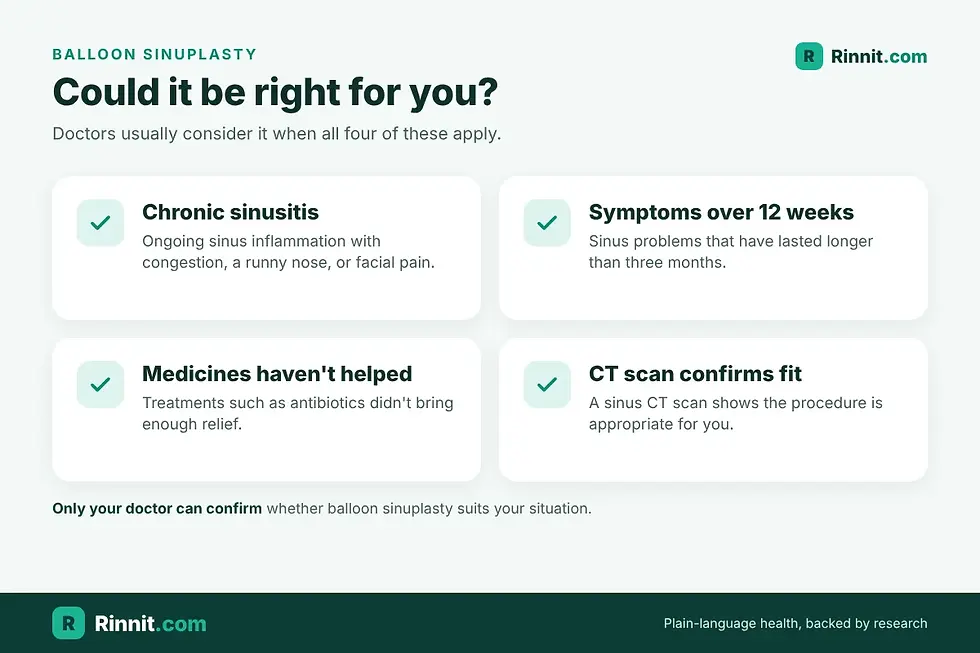
Could balloon sinuplasty be right for you? Image: Rinnit.com
You may be a candidate if:
You have chronic sinusitis
Your symptoms have lasted longer than 12 weeks
Medicines haven't improved your symptoms
A CT scan confirms balloon sinuplasty is appropriate for your sinuses
Only your doctor can confirm whether this procedure fits your situation. Expert guidance is summarized in the clinical consensus on balloon dilation.
What happens before balloon sinuplasty?
Before balloon sinuplasty, your doctor will order a CT (computed tomography) scan of your sinuses. This confirms the procedure is a good fit for your condition and shows exactly which passages are blocked.
You'll also want to arrange a ride. Most doctors recommend having someone drive you to and from your appointment.
What happens during balloon sinuplasty?
During balloon sinuplasty, you get either general anesthesia or conscious sedation, and your doctor guides a small balloon into your sinuses and inflates it to unblock them. Conscious sedation blocks pain but lets you stay awake.
The steps depend on where it's done.
In the operating room
You'll lie on an operating table. Your doctor will:
Put a topical decongestant in your nose to control bleeding.
Inject a local anesthetic into some of the tissue lining your nose.
Use an endoscope—a thin tube with a light on the end—to guide a catheter into your nostril.
Use the catheter to guide a small balloon into your sinuses.
Inflate the balloon slowly to gently unblock the sinuses.
Deflate and remove the balloon, repeating if needed.
In the doctor's office
You'll sit in a reclining exam chair. Your doctor will:
Apply a topical decongestant in your nose.
Apply an anesthetic spray, then place thick cotton pads soaked in more anesthetic inside your nose. The nasal lining absorbs it quickly.
Remove the pads and inject a local anesthetic into some of the nasal lining.
Use an endoscope to guide a catheter into your nose.
Guide a small balloon into your sinuses with the catheter.
Inflate the balloon to unblock the sinuses.
Deflate and remove the balloon, repeating if necessary.
Operating room | Doctor's office | |
Position | Lying on an operating table | Sitting in a reclining exam chair |
Numbing | General anesthesia or sedation + local injection | Sedation + anesthetic spray, soaked cotton pads, and local injection |
Core steps | Decongestant → endoscope & catheter → inflate → deflate | Same core steps |
Is balloon sinuplasty painful?
Balloon sinuplasty is usually not painful; most people say they feel pressure in the nose during the procedure, not pain.
Afterward, some discomfort in the nose is common. Over-the-counter pain relievers may help. Your doctor will tell you which medicines to use and which to avoid after the procedure.
What is recovery from balloon sinuplasty like?
Recovery from balloon sinuplasty usually means 24 to 48 hours of rest at home, with most people back to their normal routine within one to two weeks.

Balloon sinuplasty recovery timeline and follow-up visits. Image: Rinnit.com
You'll stay at the hospital or office until you feel comfortable going home. Then plan to rest at home for 24 to 48 hours.
To help your recovery, your doctor may advise you to:
Avoid blowing your nose for 24 to 48 hours
Rinse your nostrils with a nasal spray
Sleep with your head raised if you feel congested
Avoid strenuous activity for the first week
Within one to two weeks, most people are well on the way to a full recovery and back to their normal routine.
Timeframe | What to expect |
Same day | Go home once comfortable; someone drives you |
First 24–48 hours | Rest at home; don't blow your nose; some bloody drainage is normal |
First week | No strenuous activity; rinse with nasal spray; sleep with head raised if congested |
Weeks 1–2 | Most people return to their usual routine |
Follow-up visits
Your doctor may schedule check-ups like this:
When | What happens |
1 week after | Follow-up visit + nasal endoscopy |
3 months after | Follow-up visit + nasal endoscopy |
1 year after | Follow-up visit + nasal endoscopy + overall nose health check |
What are the benefits of balloon sinuplasty?
Balloon sinuplasty is minimally invasive, safe and long-lasting, and it may offer a faster recovery with less pain than sinus surgery.
Minimally invasive — no cuts in or around the nose
Safe — few people report complications
Long-lasting results — studies show the benefits hold up over time
Faster recovery — may be quicker than sinus surgery
Less pain afterward — compared with sinus surgery
Flexible setting — can be done in a medical office or hospital
What are the risks of balloon sinuplasty?
Complications of balloon sinuplasty are uncommon, but they can include a cerebrospinal fluid leak, damage near the eye, a reaction to anesthesia, bleeding and infection.
Possible complication | What it means |
Cerebrospinal fluid (CSF) leak | Your sinuses sit close to your brain, which is surrounded by this fluid |
Damage near the eye | Injury to the area around the eye |
Reaction to anesthesia | A response to the numbing or sedation medicine |
Bleeding | More bleeding than the expected light drainage |
Infection | An infection after the procedure |
Your symptoms might also come back. If they do, you may need another balloon sinuplasty or a different treatment, such as endoscopic sinus surgery.
When should you call your doctor after balloon sinuplasty?
Call your doctor after balloon sinuplasty if your nose bleeds heavily and you can't stop it. Get care right away for vision changes, swelling or bruising around the eye, clear watery drainage from the nose, a severe headache, a stiff neck or fever. Some bloody drainage from the nose is normal.
Call your doctor if:
Your nose bleeds heavily and you can't stop it
You notice any other symptom your doctor told you to watch for
Before you go home, ask your doctor which warning signs could point to a complication.
Conclusion
Living with a nose that won't stop running, congestion so bad you can barely breathe, or facial pain that won't ease is exhausting. If medicines haven't worked and your symptoms have lasted more than 12 weeks, balloon sinuplasty may help.
It's minimally invasive, involves no cuts, and most people recover within one to two weeks. Your doctor—guided by a CT scan—can tell you whether it's right for you.
Next step: Save or print this guide and bring it to your next ENT appointment. Use the FAQ below as your question list, and explore more plain-language, research-backed guides in the Rinnit.com Health Library.
Frequently Asked Questions
What is balloon sinuplasty?
A minimally invasive treatment for chronic sinusitis. A doctor inflates a tiny balloon inside a blocked sinus opening to widen it so trapped mucus can drain.
Is balloon sinuplasty surgery?
It's a procedure done without any cuts in or around the nose. It can be performed in a doctor's office or a hospital operating room.
Does balloon sinuplasty hurt?
Usually not. Most people feel pressure in the nose during the procedure. Mild discomfort afterward can often be eased with over-the-counter pain relievers your doctor approves.
How long does it take to recover from balloon sinuplasty?
Most people rest at home for 24 to 48 hours and are back to their normal routine within one to two weeks. Avoid strenuous activity for the first week.
Am I awake during balloon sinuplasty?
You may be. You'll get either general anesthesia (asleep) or conscious sedation, which blocks pain while you stay awake.
Can I blow my nose after balloon sinuplasty?
Avoid blowing your nose for 24 to 48 hours after the procedure.
Is bleeding normal after balloon sinuplasty?
Some bloody drainage is normal. Call your doctor if the bleeding is heavy and you can't control it.
How is balloon sinuplasty different from endoscopic sinus surgery?
Both treat chronic sinusitis without facial cuts. Balloon sinuplasty widens the sinus openings with a balloon and may offer a faster recovery with less pain afterward.
Do I need a CT scan before balloon sinuplasty?
Yes. A CT scan confirms the procedure is appropriate for your condition.
Can sinus symptoms come back after balloon sinuplasty?
Yes, they can. If they do, you may need a repeat balloon sinuplasty or another treatment such as endoscopic sinus surgery.
What are the risks of balloon sinuplasty?
Complications are uncommon but can include cerebrospinal fluid leaks, damage near the eye, a reaction to anesthesia, bleeding, and infection.
Related Reading
Sinus Surgery: Types, Procedure and Recovery explains the types of sinus surgery and recovery.
References
Cleveland Clinic. Balloon Sinuplasty: Procedure & Recovery. Cleveland Clinic. Last updated December 20, 2024. https://my.clevelandclinic.org/health/treatments/21977-balloon-sinuplasty
Castro A, Furtado M, Rego Â, et al. Long term outcomes of balloon sinuplasty for the treatment of chronic rhinosinusitis with and without nasal polyps. American Journal of Otolaryngology. 2021;42(1):102825. PMID: 33202329. https://doi.org/10.1016/j.amjoto.2020.102825
Sinha P, Tharakan T, Payne S, et al. Balloon sinus dilation versus functional endoscopic sinus surgery for chronic rhinosinusitis: systematic review and meta-analysis. Annals of Otology, Rhinology & Laryngology. 2023;132(5):578-588. PMID: 35703383. https://doi.org/10.1177/00034894221104939
Zhang J, Li Y, Han Z, et al. Sinus balloon dilation for treatment of chronic sinusitis: a systematic review and meta-analysis [in Chinese]. Lin Chuang Er Bi Yan Hou Tou Jing Wai Ke Za Zhi. 2020;34(5):406-410;416. PMID: 32791608. https://doi.org/10.13201/j.issn.2096-7993.2020.05.005
Piccirillo JF, Payne SC, Rosenfeld RM, et al. Clinical consensus statement: balloon dilation of the sinuses. Otolaryngology–Head and Neck Surgery. 2018;158(2):203-214. PMID: 29389303. https://doi.org/10.1177/0194599817750086
Lofgren DH, Shermetaro C. Balloon Sinuplasty. In: StatPearls [Internet]. Treasure Island (FL): StatPearls Publishing; updated July 24, 2023. PMID: 31536277. https://pubmed.ncbi.nlm.nih.gov/31536277/
Medical disclaimer
This article is for general education and does not replace advice from your own doctor. Always seek the advice of your doctor or another qualified health provider with any questions about a medical condition or treatment.



Comments