Scrotoplasty: Surgical Solutions for Scrotal and Penile Conditions

Updated: 3 days ago
Medically reviewed by Dr. Baraa Alnahhal, MD · Last reviewed: October 2026
Quick Answer: What is scrotoplasty?
Scrotoplasty is surgery that treats conditions affecting the scrotum or creates a new scrotum. [1] It is used for buried or webbed penis, to repair a scrotum damaged by trauma or severe infection such as Fournier's gangrene and for cosmetic reasons such as lifting a sagging scrotum. [1] The surgeon removes excess skin and tissue and closes the incision with dissolvable stitches. [1]
What the research says
Buried penis surgery improves function and satisfaction, but complications are common. In a retrospective study of 46 patients who had adult acquired buried penis surgery (median follow-up 46 months), complications occurred in 32.6% (13.3% of those were severe), the recurrence rate was 21.7%, the median increase in stretched penile length was 2 cm, and urinary and sexual function improved significantly. Patient satisfaction was 90.3% (Falcone et al., Life (Basel), 2024 [2]).
Frailty raises the risk of complications after complex reconstruction. In a study of 103 patients (median BMI 43) who had complex buried penis reconstruction, half had complications, mostly minor (wound dehiscence 31%, infection 30%), and 3.9% needed revision for a poor outcome. Frail patients had more complications (71% vs 41%) and were about 6 times more likely to have one (odds ratio 6.41) (Staniorski et al., J Urol, 2023 [3]).
What is scrotoplasty surgery?
Children and adults can have scrotoplasty. [1] Some people are born with conditions that affect the scrotum, others develop them later in life, and some choose to change the scrotum for personal reasons. [1] The goal is to restore or improve the shape and function of the area. Scrotoplasty can also be part of gender-affirming surgery to create a new scrotum, which involves different steps and is not covered in this guide (see our overview of phalloplasty).
Why is scrotoplasty surgery performed?
Condition | Description | Impact |
|---|---|---|
Buried penis | Difficulty urinating, leaking urine, and emotional distress. | |
Webbed penis | A sail of skin connects the scrotum to the shaft of the penis (penoscrotal webbing). [1] | Can affect sexual function and penetrative intercourse. [1] |
Fournier's gangrene | A sometimes life-threatening bacterial infection that can kill the skin around the penis and scrotum. [1] | Usually needs multiple surgeries, and scrotoplasty can help repair the scrotum. [1] |
Trauma or injury | Damage to the scrotum from an injury. | Scrotoplasty can repair the damage. [1] |
Sagging or enlarged scrotum | Natural sagging with age as muscle tone is lost, or a large scrotum. [1] | Discomfort during sex, exercise, or other physical activities, or cosmetic dissatisfaction. [1] |
For related conditions, see our guides to scrotal lymphedema, genital lymphedema, obesity, and congenital urological anomalies.

How do you prepare for scrotoplasty, and how is it performed?
Your provider will explain how to prepare for scrotoplasty, which includes medication, fasting and transportation steps before surgery. Adults having scrotoplasty should:
Avoid certain medications: Stop medicines that can raise your bleeding risk, such as aspirin and other blood thinners and nonsteroidal anti-inflammatory drugs (NSAIDs), a few days to a week before surgery. [1] Tell your provider about all medications and supplements you take.
Avoid food and drink: Your surgeon may ask you to stop eating and drinking eight to twelve hours before surgery to avoid anesthesia problems. [1]
Arrange a ride: Have someone drive you home, since you will be taking pain medicine and feeling the effects of anesthesia. [1]
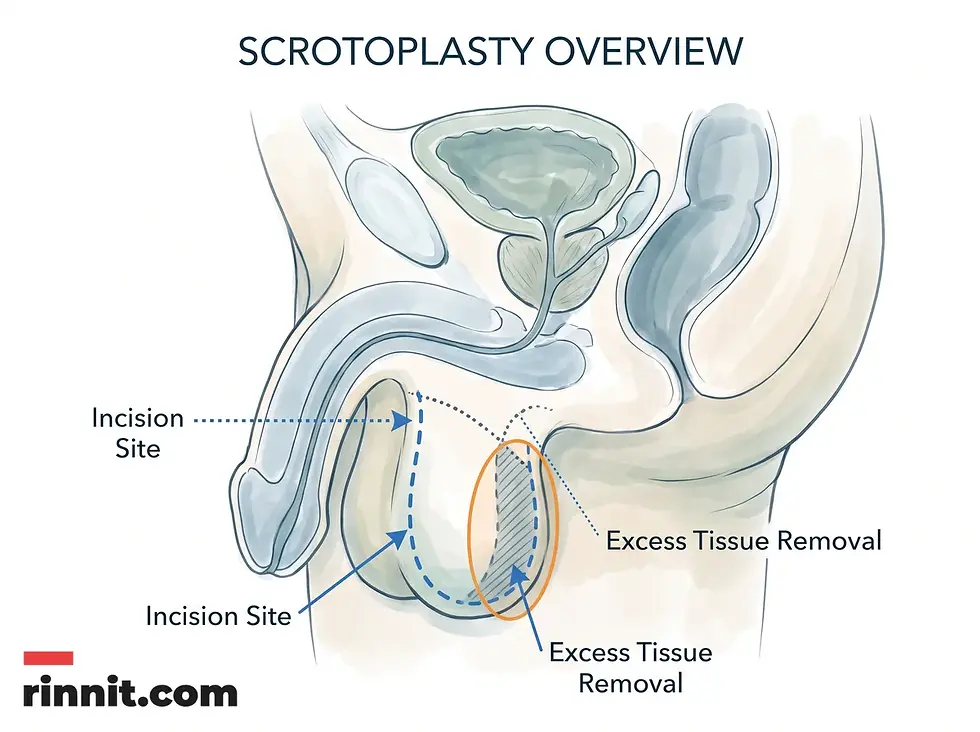
The steps vary with your situation and anatomy, but a scrotoplasty for buried penis or a sagging scrotum may go like this:
Anesthesia: General anesthesia (you are unconscious) or local anesthesia (the scrotum is numbed and you are awake). [1]
Incision: The surgeon makes a cut near where the penis and scrotum meet. [1]
Reconstruction: Excess skin and tissue connecting the skin and penis are removed, and the skin that connects the scrotum to the base of the penis may be tightened. [1]
Closure: The incision is closed with dissolvable stitches, and a drain may be left in the scrotum to minimize swelling. [1]
Scrotoplasty takes at least one hour. [1] You should not feel pain during the procedure, but expect some soreness and discomfort during recovery.
What is recovery and postoperative care like after scrotoplasty?
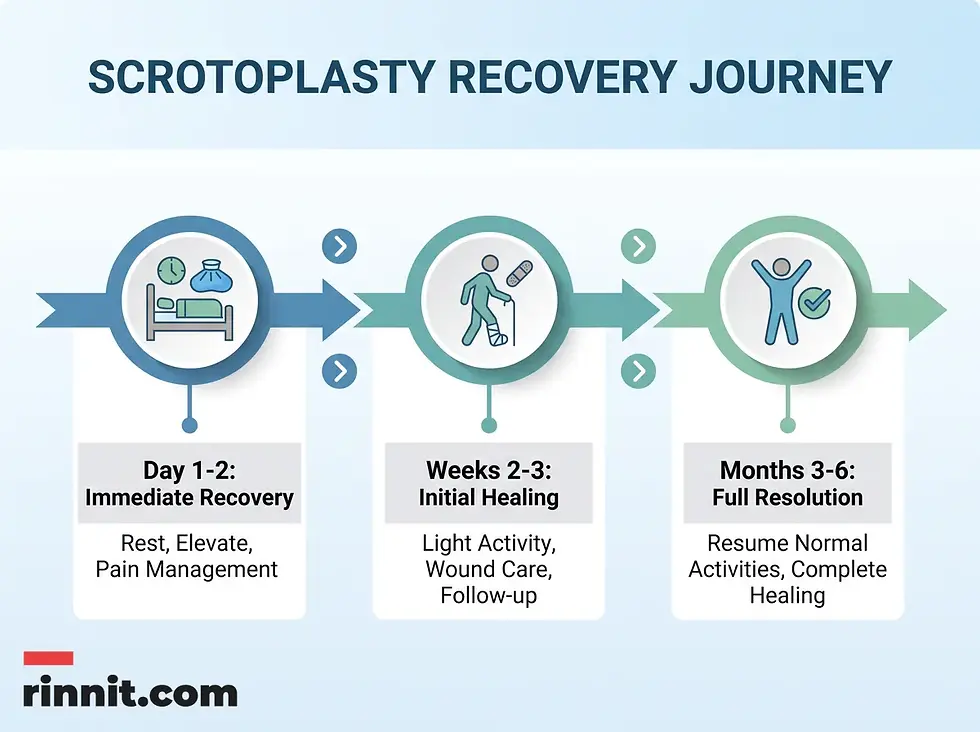
Scrotoplasty is typically an outpatient surgery, so you can go home the same day. [1] Surgery for buried penis that takes longer may require a hospital stay. [1] Your surgeon will schedule a follow-up within a few weeks. [1]
Stage | What to Expect |
|---|---|
First days | Some pain for a few days. Cold compresses and over-the-counter pain relievers usually help, and your provider may prescribe pain medicine. [1] |
First weeks | Swelling may last for weeks. Avoid sexual activity for at least two to three weeks [1] and follow your surgeon's aftercare instructions. |
Following months | Scrotal swelling can continue for several months, with mild testicular pain. [1] |
You may wear a support garment such as a jockstrap to stop your scrotum from shifting. [1] After buried penis surgery you may need a catheter (a thin tube that drains urine from your bladder) for several weeks while your genitals heal. [1]
What are the risks and benefits of scrotoplasty?
Possible risks include:
Allergic reaction to anesthesia.
Bleeding, bruising, and swelling.
Damage to the urinary tract.
Infection.
Nerve injury.
Painful intercourse.
Scarring or cosmetic issues. [1]
Benefits mainly affect quality of life and emotional well-being. People may feel more comfortable and confident with the look of their scrotum, which can lead to more satisfaction in sexual relationships. For buried penis, scrotoplasty may significantly improve urination. [1]
When should you call your healthcare provider after scrotoplasty?
Call your healthcare provider after scrotoplasty if you have chest pain, trouble or pain urinating, fever, nausea, shortness of breath or signs of infection.
Chest pain or heart rhythm changes.
Difficulty peeing, painful urination, or blood in your pee.
Fever.
Nausea and vomiting.
Shortness of breath.
Signs of infection, such as oozing and discoloration, at the surgical site or catheter. [1]
Most insurance providers, Medicare, and Medicaid cover scrotoplasty for medical conditions like buried penis, but usually not cosmetic surgery such as a scrotal lift. [1]
Conclusion
Scrotoplasty can treat a range of scrotal and penile conditions, from buried penis and webbed penis to injuries and infections. When surgery is warranted, the benefits to urinary function, comfort, and self-confidence typically outweigh the risks. Understanding preparation, recovery, and possible complications helps you make an informed decision with your surgical team.
What are the next steps if you are considering scrotoplasty?
If you or your child have discomfort, urinary difficulties, or concerns about the appearance of the scrotal area, talk with a urologist or reconstructive surgeon. A thorough evaluation can show whether scrotoplasty is right for you and what outcome to expect. Bring a list of your medications and supplements to your visit.
Frequently Asked Questions
Is scrotoplasty major surgery?
Scrotoplasty is a specialized procedure. It is typically outpatient, so you go home the same day, but surgery for buried penis that takes longer may need a hospital stay.
How long does the pain last?
You can expect some pain for a few days after surgery. Swelling may last for weeks. Cold compresses and over-the-counter pain relievers usually help, and your provider may prescribe pain medicine.
Will I have scars?
Scarring or cosmetic issues are possible risks. Your surgeon can explain where incisions will be made and what to expect.
Can scrotoplasty improve my sex life?
Scrotoplasty may. Webbed penis can affect sexual function, and feeling happy with how your scrotum looks can lead to more satisfaction in sexual relationships. You will need to avoid sexual activity for at least two to three weeks after surgery.
When can I return to work?
It depends on the extent of your surgery and your job. Ask your surgeon for a timeline based on your situation.
Is scrotoplasty covered by insurance?
Most insurance providers, Medicare, and Medicaid cover scrotoplasty to treat medical conditions such as buried penis. They usually do not cover cosmetic procedures such as a scrotal lift.
Does the surgery affect fertility?
Ask your surgeon how your specific procedure may affect fertility before you decide on surgery.
What are dissolvable stitches?
Stitches your body absorbs over time. Surgeons use them to close the incision so they do not need to be removed.
Why is a jockstrap needed after surgery?
A support garment such as a jockstrap stops the scrotum from shifting while it heals.
Can children have scrotoplasty?
Yes. Both children and adults can have scrotoplasty. In children, buried penis can be a congenital condition.
What is buried penis?
A condition in which the penis is hidden under the skin of the scrotum, thigh, or abdomen. In adults it is commonly related to obesity or lymphedema.
How long will the swelling last?
Swelling may last for weeks, and scrotal swelling can continue for several months, sometimes with mild testicular pain.
Are there risks of nerve damage?
Nerve injuries are one of the listed risks of scrotoplasty. Discuss all risks with your surgeon.
What if a drain is placed?
A drain may be left in the scrotum to minimize swelling. Your surgeon will tell you how to care for it and when it will be removed.
What are the signs of infection after surgery?
Fever, oozing, and discoloration at the surgical site or catheter. Also call your provider for difficulty peeing, painful urination, blood in your pee, chest pain, shortness of breath, or nausea and vomiting.
How do I prepare for scrotoplasty?
Tell your provider about all medications and supplements you take, and stop medicines that raise bleeding risk, including blood thinners, aspirin and NSAIDs, a few days to a week before surgery [1]. You may be asked not to eat or drink for 8 to 12 hours beforehand, and you should follow your provider's specific instructions on what to do and avoid [1]. Arrange for someone to drive you home, because you will be on pain medicine and recovering from either general anesthesia or local anesthesia that numbs the scrotum while you stay awake [1].
When should I call my doctor after scrotoplasty?
What anesthesia is used for scrotoplasty?
Scrotoplasty is done under either general anesthesia, so you are unconscious, or local anesthesia, which numbs the scrotum while you stay awake [1]. Your healthcare team makes sure you are comfortable and feel no pain during the procedure, but expect some soreness and discomfort while you recover [1]. Because you will be feeling the effects of anesthesia and taking pain medicine afterward, arrange for someone to drive you home [1].
Related Reading
References
Cleveland Clinic. Scrotoplasty. Cleveland Clinic. December 13, 2023. https://my.clevelandclinic.org/health/procedures/16476-scrotoplasty
Falcone M, Plamadeala N, Cirigliano L, et al. The outcomes of adult acquired buried penis surgical reconstruction. Life (Basel). 2024;14(10):1321. PMID 39459621. https://doi.org/10.3390/life14101321
Staniorski CJ, Myrga JM, Vasan RV, et al. Surgical outcomes and prediction of complications following high-complexity buried penis reconstruction. J Urol. 2023;210(5):782-790. PMID 37586110. https://doi.org/10.1097/JU.0000000000003669
Medical Disclaimer
This article is for informational purposes only and does not constitute medical advice. Always seek the advice of a qualified healthcare professional with any questions regarding a medical condition or surgical procedure. Never disregard professional medical advice or delay in seeking it because of something you have read in this article.



Comments