Buried Penis: What It Is, Why It Happens, and How It's Treated

Updated: 3 days ago
Medically reviewed by Dr. Baraa Alnahhal, MD · Last reviewed: October 2026
Quick answer
A buried penis is a typical-sized penis concealed by folds of skin and body fat, not a small penis [1]. It is most common in infants and toddlers, with causes including congenital skin attachments and obesity [1]. It can make peeing and cleaning difficult [1]. It often improves on its own in children [1], and surgery is a last resort.
What the research says
According to PubMed:
Reconstruction for adult-acquired buried penis succeeds in most cases. A narrative review reported an over 85% rate of successful reconstruction in many surgical series, and noted that the condition adds to the risk of penile cancer, urethral strictures, and mood disorders, while repair can improve quality of life. (Staniorski & Rusilko, Transl Androl Urol, 2021 [7]).
The evidence on the best surgical technique is still thin. A critical survey of adult-acquired hidden penis in obese patients found only 7 studies covering 119 patients; just 1 was high quality, 2 were moderate, and 4 were low quality, which made building a clinical practice guideline difficult. (Cavayero et al., J Am Osteopath Assoc, 2015 [2]).
In children, the tissue that holds the penis in looks different under the microscope. In a study of 40 children (13 with buried penis, 14 with hypospadias, and 13 circumcision controls), the dartos fascia in buried penis had significantly more thick collagen fibers and thick smooth muscle fibers (both p < 0.001), more thick convoluted nerve fibers (p = 0.004), and less fat (p < 0.001), which may explain why the penis is drawn inward. (Fawzy & Hadidi, Front Pediatr, 2025 [5]).
Study details are from PubMed abstracts.
What Is a Buried Penis?
A buried penis is a condition in which your penis is typical in size and shape, but body tissues and folds of skin hide it [1]. The penis is not small — it is simply concealed [1]. You can expose it by pressing the surrounding tissue or skin down to "push it out."
The tissue that hides the penis can include abdominal (lower belly) fat, the fatty pad surrounding the penis called the mons pubis, fatty tissue in the upper thighs, fatty tissue in the scrotum, and inverted skin attachments at the base of the penis [1].
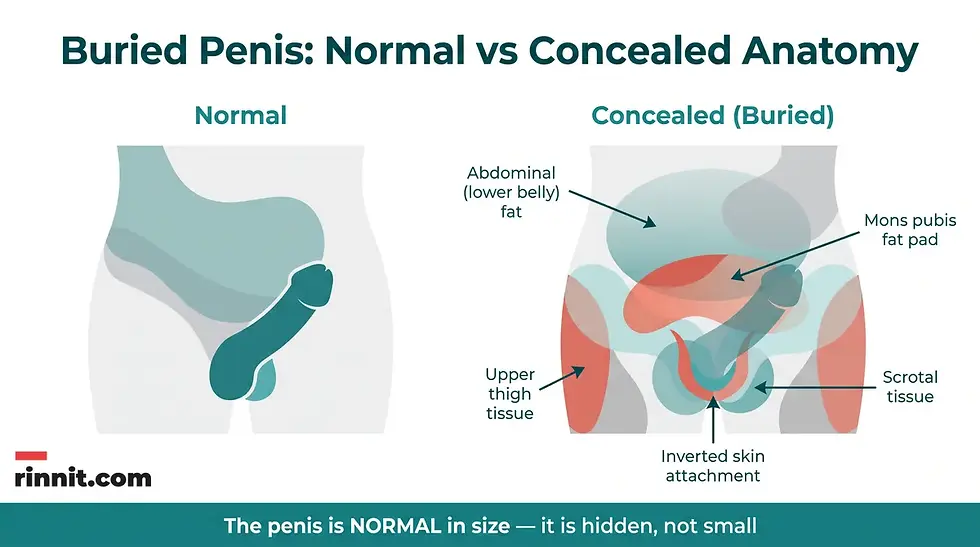
This condition may be present at birth (congenital) or develop later in life (adult-acquired buried penis) [1]. It goes by other names, including buried penile syndrome, hidden penis, and concealed penis [1]. The good news for families: most babies and children who have a buried penis at birth will see their penis's appearance improve as they get older [1].
Who Does Buried Penis Affect?
Buried penis can affect anyone with a penis at any age. However, it is most common in infants and toddlers [1]. The condition is not common overall, and healthcare providers and researchers do not know exactly how common it is in adults [1]. There does appear to be a connection between buried penis and rising rates of a body mass index (BMI) greater than 30, meaning obesity [1]. One study reported that about 4% of newborns in Japan are affected [1].
Who is affected | Key facts |
Infants and toddlers | Most common age group; appearance usually improves with age |
Adults | Linked to BMI over 30; prevalence unknown |
All people with a penis | Can occur at any age, congenital or acquired |
What Are the Symptoms of a Buried Penis?
Buried penis usually does not cause any symptoms [1]. The primary issue is simply that the penis does not stick out and seems tucked into the tissues around it. You can often expose the buried penis by pressing the surrounding tissue or skin downward.
Sometimes the condition leads to difficulty with peeing or keeping the penis clean [1]. If a lot of inflammation or scar tissue forms around the surrounding tissues, the penis can become "trapped" so it cannot be exposed at all. That trapping can lead to pain, odor, and infections [1].
What Causes Buried Penis?
Five main factors can cause or contribute to buried penis.
Cause | How it hides the penis |
Congenital differences | The skin at the base of the penis attaches differently, so it inverts at rest rather than staying exposed [1] |
Class III obesity (BMI over 40) | |
Genital lymphedema | |
Circumcision problems | Removing too much or not enough foreskin lets the penis drop back into the surrounding fatty area [1] |
Hidradenitis suppurativa |

What Are the Complications of Buried Penis?
When the penis stays hidden, four areas of life can be affected.
Trouble urinating. You may inadvertently dribble urine on your scrotum, thighs, or clothes. It can be difficult to pee at all because scar tissue blocks the penis, and in some cases you may not be able to pee while standing up [1].
Difficulty cleaning the penis. It can be hard to clean and thoroughly dry the area. This can cause skin rash, skin infections, and urinary tract infections (UTIs) [1].
Difficulty with sexual intercourse. You may be unable to get an erection. If you do get an erection, you may not be able to penetrate [1].
Pain and irritation. You may have a persistent ache, or pain may occur during an erection. There is also an association between lichen sclerosus — a condition that makes the skin on and around the penis thin, discolored, and irritated — and buried penis [1] [4].
How does buried penis affect mental health?
Buried penis can impact your mental health in both psychosocial ways (how other people influence your thoughts and emotions) and psychological ways (how you think about yourself or behave). The condition may cause low self-esteem, anxiety, depression, and stress [1].
How Is Buried Penis Diagnosed?
In most cases, a healthcare provider can diagnose a buried penis by reviewing your medical history and conducting a physical examination [1]. No specialized testing is usually required.
How Is Buried Penis Treated?
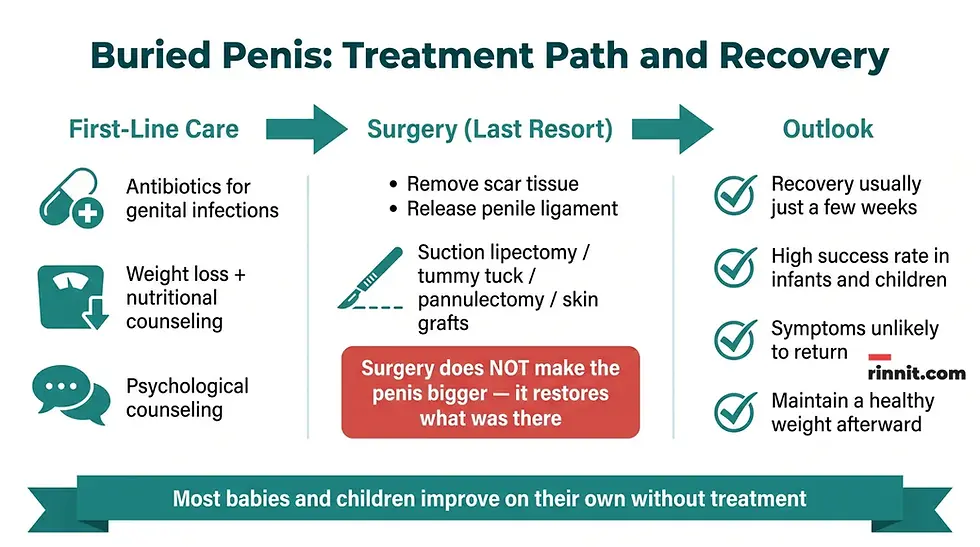
Buried penis can be difficult to treat, and the treatment depends on the underlying cause [1] [6]. In infants and children, it often goes away on its own without treatment [1].
What are the first-line treatments?
Medications. A healthcare provider may prescribe antibiotics to treat an infection in your genital region [1].
Weight loss. A provider will usually encourage weight loss and nutritional counseling before surgery. Weight loss alone may cure buried penis [1]. If it does not completely fix the condition, it can reduce the chances of complications during treatment [1].
Psychological counseling. Psychotherapy (counseling or talk therapy) can help address depression, sexual dysfunction, and low self-esteem [1].
When is surgery needed?
In severe cases, a provider may recommend surgery. Surgeons may remove scar tissue, detach the ligament that attaches the base of the penis to the pubic bone, and attach internal sutures (stitches) under the skin of the penis to its base [1].
Other surgical techniques may include:
Surgical technique | What it does |
Suction lipectomy | Removes fat tissue above the penis or scrotum through tiny incisions using surgical suction catheters [1] |
Abdominoplasty (tummy tuck) | Removes excess fat and skin from the abdominal area |
Pannulectomy | Removes the apron of excess skin (pannus) hanging below the belly button |
Escutcheonectomy | Removes the fat pad above the pubic area |
Skin grafts | Covers areas of the penis where skin coverage is lacking |
Circumcision revision | Corrects the penis dropping back into the fatty area when a circumcision is the cause [1] |
Does buried penis surgery make the penis bigger?
No. Surgery for buried penis does not make your penis larger or longer [1]. It restores what was already there.
How Soon After Treatment Will I Feel Better?
Recovery after buried penis treatment depends on the type of treatment you receive. A healthcare provider can give you a better idea of what to expect.
What Can I Expect if I Have Buried Penis?
With proper treatment, the outlook for a buried penis is good [1]. For infants and children, surgery has a high success rate [1]. The recovery time is usually just a few weeks, and buried penis symptoms are unlikely to come back [1]. If you have an adult-acquired buried penis, it is important to maintain a healthy weight for you after treatment.
Can a Buried Penis Be Prevented?
A buried penis present at birth cannot be prevented [1], while adult-acquired buried penis may be prevented by maintaining a healthy weight. Most babies do not require any treatment [1]. If a healthcare provider notes buried penis at birth, you may need to delay circumcision [1], and a pediatric urologist may need to perform the circumcision.
You can help prevent adult-acquired buried penis by maintaining a healthy weight for you. This may include:
Being physically active: aiming for at least 150 minutes of moderate-intensity aerobic exercise each week — about 30 minutes five days a week — plus two strength-training sessions [1].
Eating a heart-healthy diet: rich in fruits, vegetables, whole grains, lean meats, and low- or nonfat dairy, with alcohol and sweets in moderation [1].
Managing stress: through activity, journaling, yoga, meditation, or deep breathing [1].
Getting enough sleep: seven to nine hours per night as an adult [1].
Talk to a healthcare provider or a registered dietitian to learn more about how to safely adopt or maintain an active lifestyle.
When Should I See a Healthcare Provider?
Talk to a healthcare provider if you have a buried penis, especially if it prevents you from comfortably peeing, affects your ability to clean or dry the area, causes UTIs, or affects sexual functioning [1].
What questions should I ask a healthcare provider?
Questions you may want to ask your healthcare provider include:
How will you diagnose a buried penis?
How do I make myself comfortable if I have a buried penis?
What treatment do you recommend?
What is the recovery time?
When can I expect to see the results from your recommended treatment?
Can you recommend a counselor or dietitian?
Are there any other resources or support groups available for people who have buried penis?
Conclusion: An Open Conversation, A Good Outlook
Buried penis is an uncommon but very treatable condition in which a normally sized penis is hidden by surrounding skin and fat. In most children it improves on its own, and in adults the combination of weight loss, counseling, and — when needed — surgery delivers a good outlook with a recovery of just a few weeks. One thing matters most: do not let embarrassment keep you from talking to a healthcare provider. It is not a moral failure, and help is available.
Want more clear, trustworthy health guidance? Explore our complete library of human-readable medical guides at Rinnit.com.
Frequently asked questions
What is a buried penis?
A buried penis is a condition in which a penis of typical size and shape is hidden by surrounding skin, folds, and fatty tissue — not a small penis.
Is a buried penis present at birth or does it develop later?
Both. It may be congenital (present at birth) or adult-acquired, developing later in life due to conditions such as class III obesity or lymphedema.
Who is most likely to get a buried penis?
Anyone with a penis at any age, but it is most common in infants and toddlers.
What hides the penis in this condition?
Abdominal fat, the mons pubis fat pad, fatty tissue in the upper thighs and scrotum, and inverted skin attachments at the base of the penis.
What causes a buried penis?
Congenital skin attachments, class III obesity (BMI over 40), genital lymphedema, circumcision problems, and hidradenitis suppurativa.
Does buried penis cause pain?
Usually not on its own. Pain typically appears when inflammation or scar tissue traps the penis, or as a persistent ache associated with the condition.
Can it cause urinary problems?
Yes. It can cause dribbling urine on the scrotum, thighs, or clothes, difficulty peeing, and in some cases the inability to pee while standing.
Does it lead to infections?
It can. Difficulty cleaning and drying the area can cause skin rash, skin infections, and urinary tract infections.
Does a buried penis affect sex?
It can. You may be unable to get an erection, and if you do, you may not be able to penetrate.
Does it affect mental health?
Yes. It can cause low self-esteem, anxiety, depression, and stress through psychosocial and psychological effects.
How is it diagnosed?
In most cases through a medical history review and a physical examination.
What are the first-line treatments?
Antibiotics for infections, weight loss with nutritional counseling, and psychological counseling.
Can weight loss cure it?
Weight loss alone may cure buried penis; if it does not fully resolve the condition, it reduces the chance of complications during treatment.
What surgeries are used?
Scar tissue removal, ligament release, internal sutures, suction lipectomy, tummy tuck, pannulectomy, escutcheonectomy, skin grafts, and circumcision revision.
Does surgery make the penis bigger?
No. Surgery restores the normal penis that was already there; it does not enlarge it.
Related reading
This article is for general informational purposes only and is not a substitute for professional medical advice, diagnosis, or treatment. Always seek the advice of your physician or qualified health provider with any questions you may have regarding a medical condition. Never disregard professional medical advice or delay in seeking it because of something you have read here. If you think you may have a medical emergency, call your doctor or 911 immediately.
References
Cleveland Clinic. Buried or Hidden Penis: Causes, Symptoms & Treatment. Cleveland Clinic. Last updated September 3, 2024. https://my.clevelandclinic.org/health/diseases/16291-buried-penis
Cavayero CT, et al. Adult-acquired hidden penis in obese patients: a critical survey of the literature. J Am Osteopath Assoc. 2015;115(3):150-6. PMID 25722361. https://doi.org/10.7556/jaoa.2015.028
Chin TW. Buried penis. Formosan Journal of Surgery. 2016;49(4):133-135. https://doi.org/10.1016/j.fjs.2016.03.004
Cohen PR. Adult Acquired Buried Penis: A Hidden Problem in Obese Men. Cureus. 2021;13(2):e13067. PMID 33680609. https://doi.org/10.7759/cureus.13067
Fawzy M, et al. Buried penis; what buried the penis? Front Pediatr. 2025;13:1590147. PMID 40530185. https://doi.org/10.3389/fped.2025.1590147
Ho TS, et al. Evaluation and management of adult acquired buried penis. Transl Androl Urol. 2018;7(4):618-627. PMID 30211051. https://doi.org/10.21037/tau.2018.05.06
Staniorski CJ, et al. The concealed morbidity of buried penis: a narrative review of our progress in understanding adult-acquired buried penis as a surgical condition. Transl Androl Urol. 2021;10(6):2536-2543. PMID 34295741. https://doi.org/10.21037/tau-20-1232



Comments