Saliva: Functions, Composition, Salivary Glands and Common Problems

Updated: 2 days ago
Medically reviewed by Dr. Baraa Alnahhal, MD · Last reviewed: October 2026
Quick Answer: What is saliva?
Saliva, sometimes called spit, is a watery fluid that salivary glands release into the mouth. It is mostly water but also contains proteins and other substances that support oral and overall health. It supports moisture, chewing, swallowing, early digestion, oral defense, tooth protection, pH balance, tissue repair and taste. [1]
Question | Short answer |
What does saliva do? | It supports moisture, chewing, swallowing, early digestion, oral defense, tooth protection, pH balance, tissue repair and taste. |
Where does it come from? | Three major pairs of salivary glands and hundreds of minor salivary glands. Ducts release it into the mouth. |
What does thick saliva mean? | Thick or sticky saliva can happen when there is less water in it than usual; mucus may also contribute. Dehydration, smoking and chronic allergies are common contributors. |
When should changes be checked? | Persistent dry mouth or excess saliva, or long-term thick saliva, should be discussed with a healthcare professional. |

What the research says
Dry mouth affects roughly one in five older adults. A systematic review and meta-analysis of 37 studies with more than 1.6 million participants aged 50 and older found a pooled prevalence of xerostomia (the feeling of dry mouth) of 21% (95% CI 19%–23%). Measured salivary gland hypofunction was less common, at about 12%–13% depending on the collection method, with wide ranges and high variability between studies (Kamnoedboon et al., Gerodontology, 2026). [2]
Sparing the salivary glands during radiation lowers the risk of dry mouth. A systematic review of 51 publications on preventing cancer-therapy-related dry mouth found that eight randomized trials of tissue-sparing radiation techniques showed a significantly lower prevalence of xerostomia, although the effect on measured gland function was unclear. Evidence for other preventive options, such as vitamin E or amifostine, was insufficient (Mercadante et al., Support Care Cancer, 2025). [3]
The radiation dose to the glands drives the damage. A systematic review of 184 articles found that salivary gland hypofunction and dry mouth after head and neck radiotherapy depend on the cumulative radiation dose to the gland tissue. Other cancer treatments also reduced saliva, usually less severely, and with chemotherapy and immunotherapy the effect was temporary (Jensen et al., Support Care Cancer, 2010). [4]
What is saliva?
Saliva, sometimes called spit, is a watery liquid released into the mouth by salivary glands. It is mostly water, but it also contains proteins, electrolytes and other substances that support oral and overall health. [1]
Saliva is easy to overlook because it works continuously. It moistens surfaces, prepares food for swallowing, participates in the first stage of digestion and helps protect teeth and mouth tissues.
What are the functions of saliva?
Saliva has several related jobs. Together, they support eating, speaking, swallowing, oral comfort, tooth health and the mouth’s local defenses. [1]
Function | How saliva helps |
Moisture and comfort | Keeps the mouth and throat moist and helps prevent mucous membranes from sticking together. |
Lubrication | Forms a lubricating barrier over mouth tissues and helps protect them from harmful substances and injury. |
Chewing and swallowing | Moistens food and turns it into a bolus, making its passage through the throat and esophagus smoother. |
Early digestion | Contains amylase, an enzyme that helps break down starches. |
Oral defense | Contains lysozyme, which can disintegrate many bacteria and help prevent overgrowth of oral microbial populations. |
Tooth protection | Helps wash away food debris, dilute acids and limit calcium loss from teeth. |
Mouth pH | Helps maintain a mouth pH range of 6.0 to 7.5 and rebalance pH after eating. |
Tissue repair | Contains proteins and growth factors that can support oral tissue regeneration and wound healing. |
Taste | Moistens dry foods so taste buds can detect flavor. |
Saliva and chewing or swallowing
Saliva moistens food and helps form it into a small ball called a bolus. This makes chewing and swallowing easier and helps food move through the throat and esophagus toward the stomach. [1]
A persistent lack of moisture can therefore affect more than comfort. It may contribute to trouble with swallowing or speech and can make dentures harder to wear. See our guide to dysphagia (trouble swallowing). [1]
Saliva and digestion
Saliva begins digestion with amylase, an enzyme that helps break down starches in food. The digestive process continues as food travels through the digestive tract. [1]
Saliva and tooth protection
Saliva helps protect teeth in several ways. Calcium hydroxyapatite helps prevent calcium loss from teeth, while saliva washes away food debris and dilutes acidic foods. These actions help reduce the risk of cavities and gum disease (see gum disease treatment). [1]
Saliva and taste
Taste buds need moisture to detect the flavors of dry foods. Saliva supplies that moisture, so reduced salivation can affect how food feels and tastes. Related: hypogeusia, a diminished sense of taste. [1]
Where does saliva come from?
Salivary glands produce saliva and release it into the mouth through ducts, or small openings. There are three major pairs of salivary glands, plus hundreds of minor salivary glands. [1]
Salivary gland | Location and description |
Parotid glands | In front of the ears; their saliva enters the mouth through ducts near the upper molars. They are the largest salivary glands. |
Sublingual glands | Below either side of the tongue, under the floor of the mouth. |
Submandibular glands | Below the jaw; their saliva enters the mouth from under the tongue. |
Minor salivary glands | Hundreds of smaller glands that contribute the remaining share of saliva. |
The three major gland pairs contribute about 90% of total saliva secretions. Minor glands contribute the remaining 10%. Most adults produce about 0.5 to 1.5 liters, or approximately 2 to 6.3 cups, of saliva per day. For gland problems, see our guides to salivary gland stones and salivary gland tumors. [1]
How is salivation controlled?
The autonomic nervous system mainly controls salivation. It manages automatic body functions that do not require conscious thought, including processes that continue during waking and sleeping. [1]
The sympathetic and parasympathetic divisions affect saliva differently. Sympathetic stimulation produces more viscous, or thicker, saliva and helps explain why stress or anxiety can be associated with a dry-mouth feeling. Parasympathetic stimulation produces more watery saliva that supports chewing and swallowing. [1]
Parasympathetic stimulation has a more significant and longer-lasting effect on salivation than sympathetic stimulation. [1]
Everyday factors that can change saliva flow
Sour foods generally increase saliva production because their acid content prompts extra saliva that can dilute acid. Thinking about food, especially appealing food, can also cause salivation. Salivary glands are more active during the day, while flow decreases considerably at night in a process researchers think is related to circadian rhythm. [1]
What is saliva made of?
Saliva is approximately 99% water and 1% proteins, electrolytes and other substances. Researchers have identified more than 1,000 proteins in saliva, although only around 10% are present in high abundance. [1]
Saliva component | Role or description |
Amylase | An enzyme that helps digest carbohydrates, including starches. |
Proline-rich peptides | A large family of salivary proteins; some bind to a substance and form a protective film called a pellicle on teeth. |
Host-defense peptides | Participate in the body’s responses to infection and inflammation. |
Mucins | Large proteins that lubricate the tongue and gums and form a barrier against harmful bacteria, fungi and viruses. |
Secretory IgA | An antibody that binds pathogens and harmless commensal microbes and supports local defense. |
Electrolytes and other substances | Saliva also contains glucose, urea, cortisol, sex hormones and substances specific to blood type. |

Can saliva be used for testing?
Healthcare professionals can use saliva samples for several tests. Saliva can be used to detect cortisol levels, substance use through drug tests, viruses such as HIV and other kinds of infections. [1]
A saliva test is interpreted in the context of the specific test, symptoms and clinical question. This article does not interpret an individual result.
Saliva sample may be used to assess | Example |
Hormone-related substances | Cortisol levels. |
Substance exposure | Drug testing. |
Viral infection | Viruses such as HIV. |
Other infection | Some other kinds of infections. |
What is hyposalivation or dry mouth?
Hyposalivation means the salivary glands do not produce enough saliva. It is also called salivary-gland hypofunction and leads to dry mouth, or xerostomia. Learn more in our guides to dry mouth and artificial saliva. [1]
Low saliva can contribute to bad breath, mouth or throat discomfort, oral-hygiene problems such as cavities and tooth decay, other mouth diseases, difficulty wearing dentures, and trouble with speech and swallowing. [1]
Possible effect of low saliva | Why it matters |
Bad breath | Reduced moisture can contribute to oral discomfort and odor concerns. |
Mouth or throat discomfort | Saliva normally provides moisture and lubrication. |
Cavities and tooth decay | Saliva helps wash away debris, dilute acids and protect against calcium loss. |
Other oral disease | Saliva supports local defenses and oral tissue health. |
Denture problems | Reduced lubrication can make dentures harder to wear. |
Speech or swallowing trouble | Moisture helps oral movement and food transit. |
What can cause low saliva?
Causes include dehydration; autoimmune conditions such as Sjögren’s syndrome, lupus and rheumatoid arthritis; viral infections such as HIV and hepatitis C; poorly managed diabetes with persistently high blood sugar and dehydration; Alzheimer disease; hypertension; some medications; and radiation therapy, especially for head and neck cancer. [1]
More than 500 medications can cause dry mouth. Examples include antianxiety medicines and antidepressants, anticholinergics, antihistamines, decongestants, some pain medicines, certain blood-pressure medicines such as beta-blockers, chemotherapy medicines and some Parkinson disease medicines. [1]
Do not stop or change a prescribed medication based on this article. Medication-related dry mouth should be discussed with the prescribing professional.
What is hypersalivation or excess saliva?
Hypersalivation, also called sialorrhea, happens when salivary glands make too much saliva and can lead to drooling. Excess saliva is not the only cause of drooling; weakness in certain mouth or throat muscles can also contribute, which is why babies drool. [1]
Severe or chronic drooling can cause angular cheilitis, a skin condition involving painful, cracked sores at the corners of the mouth. In extreme cases, excess saliva can lead to aspiration or choking, which can cause aspiration pneumonia. [1]
Certain medications, especially antipsychotic medicines, can contribute to hypersalivation; clozapine is one example. Conditions or situations that can contribute include untreated cavities, gastroesophageal reflux, nausea and pregnancy. [1]
Why is saliva thick or sticky?
Thick or sticky saliva happens when there is less water in it than usual. Mucus can mix with saliva and contribute to the sensation. Common contributors include dehydration, smoking and chronic allergies. [1]
The main way to address thick spit is to stay hydrated by drinking more water. Long-term thick saliva should be discussed with a healthcare professional because another factor may be involved. [1]
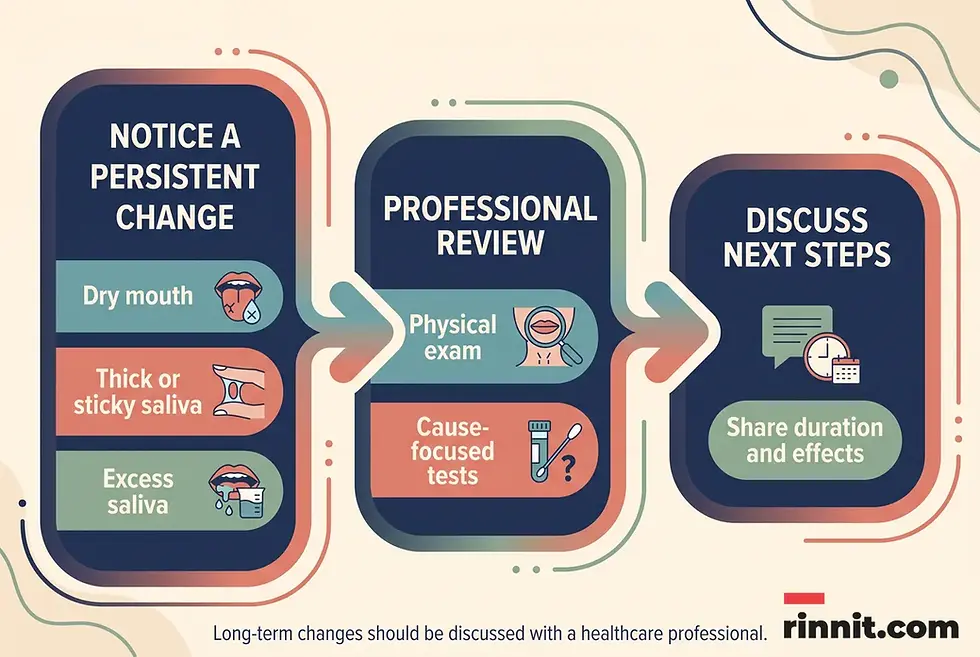
When should you see a healthcare professional about saliva?
See a healthcare professional if dry mouth or excess saliva is not going away. A professional can perform a physical examination and order tests to look for an underlying cause. Long-term thick or sticky saliva should also be discussed.
Possible effects of persistent saliva changes include mouth or throat discomfort, bad breath, cavities, tooth decay, trouble wearing dentures, speech or swallowing problems, angular cheilitis, and, in extreme drooling-related situations, aspiration or choking. [1]
Change or symptom | Professional discussion is appropriate when… |
Dry mouth | It persists, causes discomfort or affects speech, swallowing, teeth or dentures. |
Thick or sticky saliva | It continues long term or hydration does not resolve the concern. |
Excess saliva | It does not go away, causes persistent drooling or is associated with mouth or throat problems. |
Cracked mouth corners | Painful or recurrent sores suggest the need for assessment. |
Swallowing difficulty | It is new, persistent or associated with drooling or choking concerns. |
Conclusion: much more than moisture
Saliva is much more than moisture in the mouth. It supports chewing and swallowing, begins digestion, helps defend against some bacteria, protects teeth, helps balance mouth pH, supports oral tissue repair and makes taste possible. [1]
It comes from three major paired salivary glands and hundreds of minor glands, is controlled by the autonomic nervous system and is composed mostly of water plus proteins, electrolytes and other substances. [1]
Persistent dry mouth, thick saliva or excess saliva should not be self-diagnosed. Note how long the change has lasted, whether it affects eating, speaking, swallowing, teeth or dentures, and whether dehydration, smoking, allergies, medication or radiation therapy could be relevant. Share that information with a qualified healthcare professional. [1]
Frequently Asked Questions
Is saliva just water?
No. Saliva is approximately 99% water and 1% proteins, electrolytes and other substances. It contains many proteins, including amylase, proline-rich peptides, host-defense peptides, mucins and secretory IgA.
How much saliva do adults produce?
Most adults produce about 0.5 to 1.5 liters, or approximately 2 to 6.3 cups, of saliva per day.
What are the three major salivary glands?
The three major paired glands are the parotid glands in front of the ears, the sublingual glands below either side of the tongue and the submandibular glands below the jaw.
Why does saliva help digestion?
Saliva contains amylase, an enzyme that helps break down starches. It also moistens food and forms it into a bolus, making swallowing easier.
Does saliva protect teeth?
Yes. Saliva helps wash away food debris, dilute acidic foods, prevent calcium loss through calcium hydroxyapatite and reduce the risk of cavities and gum disease.
What does hyposalivation mean?
Hyposalivation means the salivary glands do not produce enough saliva. It leads to dry mouth, also called xerostomia.
What is hypersalivation?
Hypersalivation, or sialorrhea, means the salivary glands make too much saliva. It can lead to drooling, although drooling can also occur when certain mouth or throat muscles are weak.
What causes thick saliva?
Thick or sticky saliva can happen when there is less water in it than usual, and mucus may contribute. Dehydration, smoking and chronic allergies are common contributors.
Does stress cause dry mouth?
Sympathetic nervous-system stimulation produces more viscous saliva and helps explain why stress or anxiety may be associated with a dry-mouth feeling. Persistent dry mouth still warrants professional discussion.
Can saliva tests detect infections?
Saliva samples can be used for some tests that detect viruses such as HIV and other kinds of infections. The specific test and clinical context determine what a result means.
When should dry mouth be checked?
Persistent dry mouth should be discussed with a healthcare professional, particularly if it causes discomfort, bad breath, cavities or tooth decay, problems with dentures, or trouble with speech or swallowing.
When should excess saliva be checked?
See a healthcare professional if excess saliva is not going away. Severe or chronic drooling can lead to painful cracked sores at the mouth corners and, in extreme cases, aspiration or choking.
Related reading
Salivary Gland Scan (Parotid Scintigraphy): Uses and Results explains the nuclear scan that checks how well salivary glands work.
Dry Mouth: Symptoms, Causes, Diagnosis and Treatment — What You Need to Know
Salivary Gland Stones: Causes, Symptoms, and Removal Options
Salivary Gland Tumors: Complete Guide to Signs, Causes, Diagnosis, and Treatment
Cavities and Tooth Decay: Symptoms, Causes, Diagnosis and Treatment — What You Need to Know
Dysphagia (Trouble Swallowing): Symptoms, Causes, Diagnosis & Treatment — Complete Guide
Dehydration: Symptoms, Causes, Risk Groups & Treatment — Complete Guide
The Autonomic Nervous System: Understanding Your Body’s Automatic Controls
References
Cleveland Clinic. Saliva (Spit): What To Know. Cleveland Clinic. Updated October 17, 2023. https://my.clevelandclinic.org/health/body/saliva
Kamnoedboon P, Spyraki F, Thomson WM, et al. A Systematic Review and Meta-Analysis of the Global Prevalence of Dry Mouth in Older Adults. Gerodontology. 2026;43(3):383-402. PMID 42144904. https://doi.org/10.1111/ger.70076
Mercadante V, Smith DK, Abdalla-Aslan R, et al. A systematic review of salivary gland hypofunction and/or xerostomia induced by non-surgical cancer therapies: prevention strategies. Support Care Cancer. 2025;33(2):87. PMID 39792256. https://doi.org/10.1007/s00520-024-09113-x
Jensen SB, Pedersen AM, Vissink A, et al. A systematic review of salivary gland hypofunction and xerostomia induced by cancer therapies: prevalence, severity and impact on quality of life. Support Care Cancer. 2010;18(8):1039-1060. PMID 20237805. https://doi.org/10.1007/s00520-010-0827-8
Medical disclaimer
This article is for general educational purposes and is not a substitute for professional medical advice, diagnosis or treatment. Always seek the advice of a qualified healthcare professional with any questions about a medical condition or treatment.



Comments