Salivary Gland Tumors: Complete Guide to Signs, Causes, Diagnosis, and Treatment

Updated: 46 minutes ago
Medically reviewed by Dr. Baraa Alnahhal, MD · Last reviewed: September 2026
TL;DR
Salivary gland tumors are rare growths that form in the glands that make saliva, most often in the parotid gland near the jaw and ear. The good news is that most of these tumors are not cancer — of every five parotid gland tumors, on average only one is cancerous. Warning signs include a lump or swelling near the jaw, in the neck, or in the mouth, plus facial weakness, numbness, or pain. Diagnosis starts with a physical exam, imaging, and a needle biopsy. Surgery is usually the first treatment, and cancers may also need radiation, targeted therapy, or immunotherapy.
Quick Answer
What is a salivary gland tumor? A growth of cells that starts in one of the salivary glands — the glands that make saliva for digestion, mouth moisture, and healthy teeth. There are three pairs of major glands (parotid, submandibular, and sublingual) under and behind the jaw, plus many tiny glands in the lips, cheeks, mouth, and throat.
Is it cancer? Most are not. Most salivary gland tumors occur in the parotid gland, and of those, most are noncancerous. A doctor diagnoses the type through a needle biopsy and lab tests.
What should you do? See a doctor about any persistent lump or swelling near the jaw, in the neck, or in the mouth. An ear, nose, and throat specialist (ENT) can evaluate it, and most noncancerous tumors are treated with straightforward surgery.
What Are Salivary Gland Tumors?
Your salivary glands do quiet but essential work. Saliva aids digestion, keeps your mouth moist, and supports healthy teeth. You have three pairs of major salivary glands, all located under and behind the jaw, and each gland has a duct that delivers saliva into the mouth.
The largest pair, the parotid glands, sit near the jaw and ear. The submandibular glands sit under the jaw, and the sublingual glands sit under the tongue. Hundreds of tiny salivary glands also line the lips, the inside of the cheeks, and the rest of the mouth and throat.
Salivary gland tumors are growths of cells that start in these glands, and they are rare. Most of them occur in the parotid gland. Importantly, most parotid gland tumors are not cancer — on average, only one out of every five parotid gland tumors is cancerous.

The parotid gland near the jaw and ear, where most tumors form, plus the submandibular gland under the jaw, the sublingual gland under the tongue, and the tiny glands lining the lips, cheeks, mouth, and throat.
Tumors develop when cells acquire changes in their DNA. In healthy cells, DNA provides instructions for growing, multiplying, and dying on schedule. In tumor cells, the DNA changes give abnormal instructions: the cells multiply quickly and keep living when healthy cells would die. The result is too many cells, which form a mass.
Sometimes DNA changes turn cells into cancer cells. Cancer cells can invade and destroy healthy body tissue, and they can break away and spread to other parts of the body — this is called metastatic cancer.
The Six Warning Signs of a Salivary Gland Tumor
Salivary gland tumors usually announce themselves through one obvious sign: a lump or swelling near a gland. But they can also affect the nerves that run through the glands, especially the facial nerve, which is why facial symptoms matter.
Lump or swelling: A new lump on or near the jaw, or in the neck or mouth
Muscle weakness: Weakness on one side of the face
Numbness: Numbness in part of the face
Ongoing pain: Pain that does not go away near a salivary gland
Limited jaw movement: Trouble opening the mouth widely
Swallowing trouble: Trouble swallowing

Six warning signs of a salivary gland tumor: lump or swelling near the jaw, neck, or mouth, muscle weakness on one side of the face, facial numbness, and ongoing pain near a salivary gland.
Because the facial nerve controlling facial movement runs directly through the parotid gland, tumors in that area can press on or affect the nerve. That is why muscle weakness on one side of the face and facial numbness deserve prompt medical attention — they signal that a growth may be reaching structures beyond the gland itself.
What Causes Salivary Gland Tumors?
The cause of many salivary gland tumors is not known, and more research is needed. What is understood is the mechanism: tumors begin when cells develop changes in their DNA. These changes instruct the cells to multiply quickly and to keep living when healthy cells would normally die, producing an excess of cells that forms a tumor.
Some of these DNA changes turn cells into cancer cells that can invade nearby tissue and spread through the body. Doctors classify both noncancerous and cancerous salivary gland tumors by the type of cells involved, because knowing the cell type helps guide treatment decisions.
The Five Known Risk Factors
Older age: Most cases occur in older adults, though tumors can form at any age
Radiation exposure: Radiation treatments for cancer, especially to the head and neck
Smoking tobacco: Shown to increase the risk
Viral infections: Epstein-Barr virus, HIV, and HPV may raise risk
Workplace exposure: Rubber manufacturing and nickel industries
Types of Salivary Gland Tumors
Doctors classify salivary gland tumors by the type of cells involved. This classification matters because it helps determine the right treatment. There are several recognized noncancerous types and at least ten recognized cancerous types.
Noncancerous (Benign) Tumor Types
Pleomorphic adenoma: The most common noncancerous salivary gland tumor
Basal cell adenoma: A less common benign growth
Canalicular adenoma: A benign tumor with a distinctive gland pattern
Oncocytoma: A benign tumor made of granular cells
Warthin tumor: A benign tumor linked to smoking
Cancerous (Malignant) Tumor Types
Acinic cell carcinoma: Cancer of the saliva-producing cells
Adenocarcinoma: Cancer of the gland-forming cells
Adenoid cystic carcinoma: A slow-growing but invasive cancer
Clear cell carcinoma: A cancer with pale-looking cells
Malignant mixed tumor: A cancer that has changed from a benign tumor
Mucoepidermoid carcinoma: The most common salivary gland cancer
Oncocytic carcinoma: A malignant tumor of granular cells
Polymorphous low-grade adenocarcinoma: A cancer that grows slowly in minor glands
Salivary duct carcinoma: An aggressive cancer resembling breast duct cancer
Squamous cell carcinoma: A cancer of the flat cells lining ducts
Mucoepidermoid carcinoma is the most common of the salivary gland cancers, and pleomorphic adenoma is the most common noncancerous type. If a biopsy shows cancer, the specific type and stage determine which treatments come next.
How Salivary Gland Tumors Are Diagnosed
Diagnosis usually begins with a physical exam. A healthcare professional feels your jaw, neck, and throat for lumps or swelling. From there, imaging and a biopsy establish exactly what the growth is and whether it is cancer.
Physical exam: Location and feel of the lump in the jaw, neck, and throat
MRI: Detailed images showing the tumor's location and size
CT scan: Cross-sectional images of the tumor and surrounding structures
PET scan: Shows how active the tissue is and helps find spread
Needle biopsy: Fine-needle aspiration or core needle biopsy draws a sample of suspicious cells; lab tests identify the cell type and whether the tumor is cancerous
If the tumor is cancerous, staging tests look for spread to lymph nodes or other parts of the body, using CT, MRI, and PET scans.
Salivary gland cancer is staged from 0 to 4. Stage 0 means the tumor is small and confined to the gland. Higher stages mean the tumor is larger and grows deeper into the gland and surrounding areas, such as the facial nerve. Stage 4 means the cancer has spread beyond the gland to neck lymph nodes or distant parts of the body.
Treatment: Surgery First, Then More If Needed
Treatment for salivary gland tumors is usually surgery to remove the tumor. If the tumor is cancerous, additional treatments may follow. The plan depends on the tumor's type, size, stage, and location.
The Surgical Options
Surgery is more complex around the salivary glands than many realize, because important nerves run in and around the glands. The facial nerve controlling facial movement runs directly through the parotid gland, so removing tumors there requires working around or underneath these nerves.
Removing part of the affected gland: Small tumors in easy-to-access spots; the tumor and a small margin of healthy tissue are removed
Removing the entire gland: Larger tumors; nearby structures such as facial nerves, ducts, facial bones, or skin may also be removed
Removing neck lymph nodes: Done when cancer has a risk of spreading; removed nodes are tested
Reconstructive surgery: Repairs the area after removal of bone, skin, or nerves to improve chewing, swallowing, speech, breathing, and facial movement, using transfers of skin, tissue, bone, or nerves from other parts of the body
Facial nerve injury is the main surgical risk. The nerve may be stretched during surgery, which can cause a loss of facial movement — but muscle movement often improves over time. Rarely, the nerve must be cut to remove all the tumor, and surgeons can repair it using nerves taken from other areas of the body.
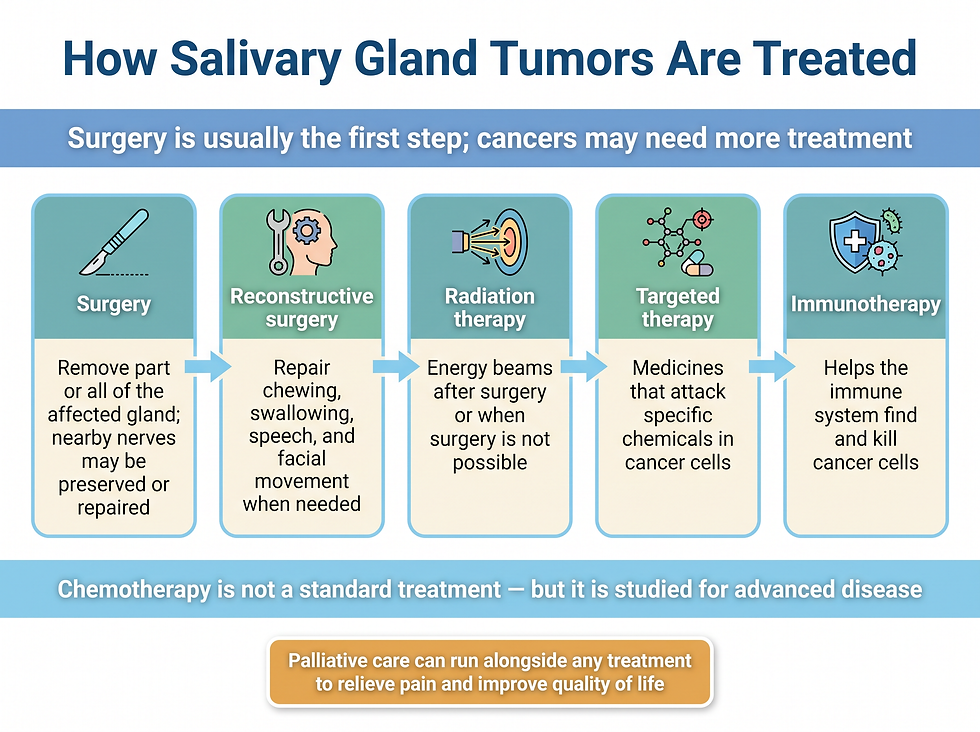
The salivary gland tumor treatment pathway: surgery as the first step, reconstructive surgery when needed, then radiation, targeted therapy, or immunotherapy for cancers, with chemotherapy not a standard treatment.
Radiation, Targeted Therapy, and Immunotherapy
Radiation therapy uses powerful energy beams, such as X-rays and protons, most often delivered by an external machine that moves around you as you lie on a table. It is commonly used after surgery to kill any remaining cancer cells. If surgery is not possible — because the tumor is very large or in a risky location — radiation may be used alone or combined with chemotherapy.
Targeted therapy uses medicines that attack specific chemicals in cancer cells. Blocking those chemicals causes the cancer cells to die. It is used when cancer cannot be removed with surgery, for advanced cancers that have spread, and for cancer that comes back. Some targeted medicines only work if the cancer cells carry certain DNA changes, so cells may be tested in a lab first.
Immunotherapy uses medicines that help your immune system find and kill cancer cells. Cancer cells often hide from the immune system; immunotherapy helps immune cells detect them. It is used for cancer that cannot be removed with surgery, for advanced or spread cancer, and for cancer that has returned after treatment.
Chemotherapy uses strong medicines to kill cancer cells. It is not currently a standard treatment for salivary gland cancer, but researchers are studying it. It may be offered for advanced disease, sometimes combined with radiation.
Palliative care is specialized care that relieves pain and other symptoms of serious illness and improves quality of life. It can be given at the same time as surgery, chemotherapy, and radiation — and studies show it can help people feel better and live longer.
Coping with Dry Mouth After Treatment
Radiation to the head and neck area can cause dry mouth, and dry mouth makes eating, swallowing, and speaking difficult while raising the risk of mouth infections, cavities, and tooth problems. These habits help relieve it:
Avoid acidic or spicy foods and drinks: Reduces irritation of a dry mouth
Avoid caffeine and alcohol: Both dry the mouth further
Brush gently several times daily with a soft brush: Prevents cavities; tell your provider if brushing is too sensitive
Choose moist foods: Moisten dry foods with sauces, gravies, broth, butter, or milk
Keep the mouth moistened: Sip water or use sugarless candies and gum
Rinse with warm salt water after meals: Keeps the mouth clean and comfortable
If dry mouth becomes severe, tell your provider — treatments are available, and a dietitian referral can help you find easier-to-eat foods. Complementary approaches such as acupuncture, exercise, guided imagery, hypnosis, massage, and relaxation techniques cannot cure cancer, but they can help relieve fatigue and symptoms; ask your team whether they are safe for you.
Preparing for Your Appointment
If a salivary gland tumor is suspected, you will likely be referred to an ear, nose, and throat specialist, called an ENT or otolaryngologist. Because appointments can be brief, preparation makes a real difference.
Write down every symptom you are experiencing, including any that may seem unrelated. List all medicines, vitamins, and supplements with doses, and bring a family member or friend — it is hard to remember everything said in an appointment, and a companion often catches what you miss.
Questions worth asking your team, ranked by importance: Where is the tumor located, and how large is it? Is the tumor cancerous? What type is it? Has it spread beyond the gland? Will I need more tests? What are my treatment options and their side effects? Can my tumor be cured? Will treatment affect eating, speaking, or my appearance? Should I see a specialist, and will insurance cover it?
Your doctor will likely ask you too: when symptoms began, whether they are continuous or occasional, how severe they are, and what improves or worsens them.
Conclusion and Next Steps
If you have noticed a lump or swelling near your jaw, in your neck, or inside your mouth — or any facial weakness, numbness, or pain near a salivary gland — the right next step is simple: see a doctor. Salivary gland tumors are rare, most of them are not cancer, and even the cancerous ones have a clear treatment path that usually begins with surgery.
Your appointment-prep checklist: write down every symptom, list all medicines and supplements, bring a companion, and bring the eight questions above. Early evaluation means earlier answers and, if treatment is needed, more options.
Frequently Asked Questions
1. What is a salivary gland tumor?
A salivary gland tumor is a growth of cells that begins in one of the glands that make saliva. There are three pairs of major salivary glands — the parotid, submandibular, and sublingual glands — located under and behind the jaw, plus many tiny glands in the lips, cheeks, mouth, and throat. Most salivary gland tumors occur in the parotid gland, and most of those are not cancer.
2. Is a salivary gland tumor cancer?
Not usually. Of every five parotid gland tumors, on average only one is cancerous. Only a needle biopsy with lab testing can determine whether a tumor is cancerous, which type it is, and whether it needs more than surgery.
3. What are the signs of a salivary gland tumor?
The most common sign is a lump or swelling on or near the jaw, in the neck, or in the mouth. Other warning signs include muscle weakness on one side of the face, numbness in part of the face, ongoing pain near a salivary gland, trouble opening the mouth widely, and trouble swallowing.
4. What causes salivary gland tumors?
The exact cause of many salivary gland tumors is not known. What is known is that they begin when cells develop changes in their DNA that make them multiply quickly and keep living when healthy cells would die. Risk factors include older age, radiation exposure to the head and neck, smoking tobacco, certain viral infections (Epstein-Barr virus, HIV, HPV), and workplace exposure in rubber manufacturing or nickel industries.
5. What are the types of salivary gland cancer?
There are at least ten recognized cancerous types, including mucoepidermoid carcinoma (the most common), adenoid cystic carcinoma, acinic cell carcinoma, adenocarcinoma, salivary duct carcinoma, and squamous cell carcinoma. Doctors classify the tumor by the type of cells involved, which helps determine the treatment.
6. How is a salivary gland tumor diagnosed?
Diagnosis starts with a physical exam of the jaw, neck, and throat. Imaging — MRI, CT, and sometimes PET scans — shows the tumor's location and size. A needle biopsy (fine-needle aspiration or core needle biopsy) draws a sample of cells, and lab tests identify the cell type and whether the tumor is cancerous. If it is cancer, staging tests check for spread, and the cancer is staged from 0 to 4.
7. How is salivary gland cancer treated?
Treatment usually starts with surgery to remove the tumor — sometimes part of the gland, sometimes the entire gland, occasionally with nearby lymph nodes or structures. Cancers may also need radiation therapy, targeted therapy, or immunotherapy. Chemotherapy is not currently a standard treatment for salivary gland cancer but is studied for advanced disease. Palliative care can run alongside any treatment to relieve pain and improve quality of life.
8. Can salivary gland cancer come back?
Salivary gland cancers can return after treatment, which is why follow-up care is important. Targeted therapy and immunotherapy are options for cancer that comes back. Ask your team about your specific recurrence risk based on the tumor type and stage.
Trusted External Sources
References
Medical Disclaimer
This article is for general educational purposes only and is not a substitute for professional medical advice, diagnosis, or treatment. Always seek the advice of a qualified healthcare provider with any questions about a medical condition. Never disregard professional medical advice or delay seeking care because of something you have read here. If you notice a new lump near your jaw, in your neck, or in your mouth, schedule an evaluation with a healthcare professional.
Comments