Salivary Gland Scan (Parotid Scintigraphy): Uses and Results

Updated: 2 days ago
Written and medically reviewed by Dr. Baraa Alnahhal, MD · Last reviewed: November 2026 · How we review
Quick Answer
A salivary gland scan, also called parotid scintigraphy, is a nuclear medicine test that shows how well the salivary glands make and release saliva. A radioactive tracer is injected into a vein, and a camera takes pictures. It helps evaluate dry mouth, swelling, blockages or stones. It takes an hour and is painless.
What the research says
Visual reading is sensitive but not specific: in 145 people evaluated for Sjögren's syndrome, visual review of salivary gland scans had 88.2% sensitivity but only 48.6% specificity (Kim HA et al., Nuklearmedizin, 2014) [2]
It works best with other tests: in 237 people with dry mouth, salivary scan measurements had low accuracy on their own for diagnosing Sjögren's syndrome, so results should be combined with other findings (Nadal M et al., Oral Diseases, 2018) [3]
Key takeaways
A salivary gland scan shows how well your glands make and release saliva.
A tracer is injected and pictures are taken for up to about an hour.
Sour lemon is given to stimulate saliva during the scan.
It helps evaluate dry mouth, swelling, blockages and Sjögren's syndrome.
Flush the toilet right away and wash your hands well for 24 hours afterward.
What is a salivary gland scan?
You have three main pairs of salivary glands: the parotid glands in front of your ears, and the submandibular and sublingual glands under your jaw and tongue. A salivary gland scan tracks a tracer as the glands absorb it and then release it into your mouth with saliva. It shows function, while ultrasound, CT or MRI show structure. Sources: [1]
Why it's done

The scan shows how well each gland works.
Dry mouth (xerostomia).
Swelling or pain around the mouth, jaw or ears, such as parotitis.
Signs of a blockage, such as salivary gland stones.
Possible cysts or growths.
Supporting a diagnosis of Sjögren's syndrome. Sources: [1]
How to prepare
Remove jewelry from your face, head and neck.
Tell your provider about food allergies, especially to lemon or citrus.
Tell your provider if you're pregnant, might be pregnant or are breastfeeding.
Tell your provider about any past reaction to a tracer. Sources: [1]
What happens during the test
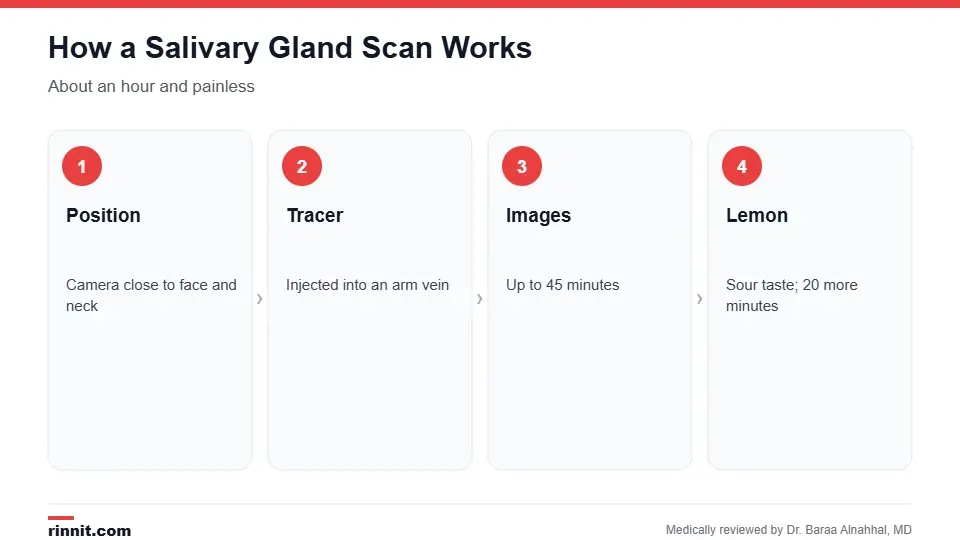
The scan is painless.
You lie on a table with the camera close to your face and neck.
A small amount of tracer is injected into a vein, usually in your arm.
Pictures are taken for up to 45 minutes as the glands absorb the tracer.
You're given lemon juice or sour candy to stimulate saliva.
More pictures are taken for up to 20 minutes to see how saliva is released. Sources: [1]
Risks and aftercare
The radiation dose is low and usually leaves your body within a day. Avoid or delay the test if you're pregnant or have had a reaction to a tracer. If you're breastfeeding, avoid nursing for 1 to 2 days, using formula or pumped milk stored beforehand. For 24 hours, flush the toilet right after using it and wash your hands well, since small amounts of tracer pass in urine and stool. Sources: [1]
What the results mean

Your provider explains what the pattern means.
Finding | What it may suggest |
Tracer flows normally | Healthy glands |
Tracer can't move through the glands | Sjögren's syndrome |
Slow or uneven flow | A cyst, stone or growth |
Fast flow | Parotitis (gland inflammation) |
A radiologist reviews the images and sends a report to your provider. Next steps may include treatment, a referral to a specialist or tests such as a biopsy. Scan results are combined with other findings, since the scan alone isn't specific enough to diagnose Sjögren's. Sources: [1, 2, 3]
Conclusion
A salivary gland scan shows how well your salivary glands work, helping explain dry mouth, swelling and other gland problems. It's simple and low risk, and the results guide your care team toward the right next steps.
Keep learning: read about salivary gland stones and nuclear medicine imaging.
Frequently asked questions
What is a salivary gland scan?
A nuclear medicine test that shows how well your salivary glands work.
What is parotid scintigraphy?
Another name for a salivary gland scan.
Why is lemon used?
To stimulate your glands to release saliva during the scan.
Does the scan hurt?
No. Only the injection may pinch.
How long does it take?
About an hour.
Is the radiation safe?
Yes. The dose is low and leaves your body within about a day.
Can I breastfeed afterward?
Wait 1 to 2 days and use stored milk or formula.
Can this scan diagnose Sjögren's syndrome?
It can support the diagnosis, along with other tests.
Do I need to do anything after the scan?
Flush right away and wash your hands well for 24 hours.
Who reads the results?
A radiologist, who sends a report to your provider.
Related Reading
Salivary Gland Stones: Causes, Symptoms, and Removal Options a common cause of gland blockage.
Salivary Gland Tumors: Complete Guide to Signs, Causes, Diagnosis, and Treatment growths that can affect the glands.
Parotitis: Understanding Parotid Gland Swelling inflammation of the parotid gland.
Nuclear Medicine Imaging: How Tracer Scans Work, Safety and Results an overview of tracer-based scans.
Saliva: Functions, Composition, Salivary Glands and Common Problems how saliva and the glands work.
References
Cleveland Clinic. Salivary Gland Scan (Parotid Scintigraphy). Cleveland Clinic. Last updated June 13, 2024. https://my.clevelandclinic.org/health/diagnostics/salivary-gland-scan
Kim HA, Yoon SH, Yoon JK, et al. Salivary gland scintigraphy in Sjögren's syndrome: comparison of the diagnostic performance of visual and semiquantitative analysis. Nuklearmedizin. 2014;53(4):139-145. PMID 24569818. https://doi.org/10.3413/Nukmed-0630-13-10
Nadal M, Levy M, Bakhsh A, et al. Salivary scintigraphy for Sjögren's syndrome in patients with xerostomia: a retrospective study. Oral Diseases. 2018;24(4):552-560. PMID 29117464. https://doi.org/10.1111/odi.12802
Medical disclaimer
This article is for general education only and does not replace advice from a qualified healthcare professional. Talk to your doctor about your own diagnosis and treatment, and seek emergency care right away for severe or sudden symptoms.



Comments