Peripheral IV (PIVC): Uses, Placement and Risks

Updated: 2 days ago
Written and medically reviewed by Dr. Baraa Alnahhal, MD · Last reviewed: November 2026 · How we review
Quick Answer
A peripheral IV (peripheral intravenous catheter) is a thin, flexible tube placed into a vein, usually in the back of the hand, inner elbow or foot. It's the most common IV device in healthcare and is used to give fluids, medicines, blood transfusions and liquid nutrition, and to draw blood. It's usually replaced every 72 to 96 hours.
What the research says
Removing IVs only when needed was just as safe: a Cochrane review of 14 trials with 11,428 people found removing peripheral IVs only when clinically needed made little or no difference in bloodstream infection or death compared with routine replacement, and used fewer catheters (Charles KR et al., Cochrane Database of Systematic Reviews, 2026) [2]
Ultrasound helped place IVs in children: in a trial of 164 children, ultrasound-guided IV placement succeeded on the first try in 85.7% versus 32.5% with the standard technique (Kleidon TM et al., JAMA Pediatrics, 2025) [3]
Key takeaways
A peripheral IV is a thin tube placed into a vein.
It delivers fluids, medicines, blood and nutrition.
It's the most common IV device.
Placement usually takes under a minute.
It's usually replaced every 72 to 96 hours.
What is a peripheral IV?
It's also called a peripheral IV catheter, peripheral venous catheter or PIVC. More than 1 billion are used worldwide each year. In infants, the scalp may be used. Sources: [1]
What it's used for

It saves you from repeated needle sticks.
Drawing blood.
Medicines such as antibiotics.
Blood transfusions.
Liquid nutrition (parenteral nutrition). Sources: [1]
Peripheral IV vs. other IV lines
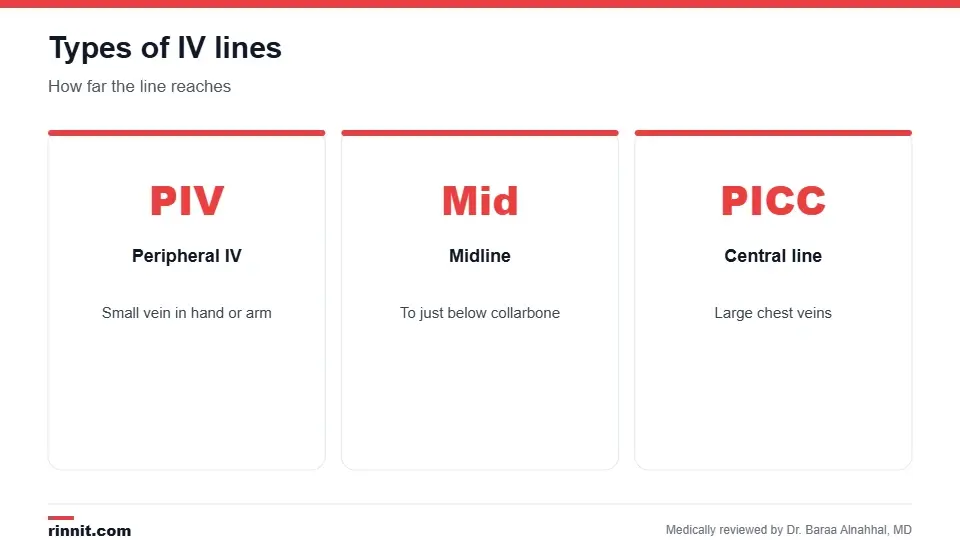
Peripheral IVs are safer, easier and less painful.
Type | Where it goes | Use |
Peripheral IV | A small vein in the hand, arm or foot | Short-term treatment |
Midline | Placed in the upper arm, with its tip near the armpit | Longer treatment |
PICC line | Large veins in the chest | Longer-term treatment |
Peripheral IVs are generally safer, easier to place and less painful than PICC lines. Learn about central lines. Sources: [1]
What happens during placement
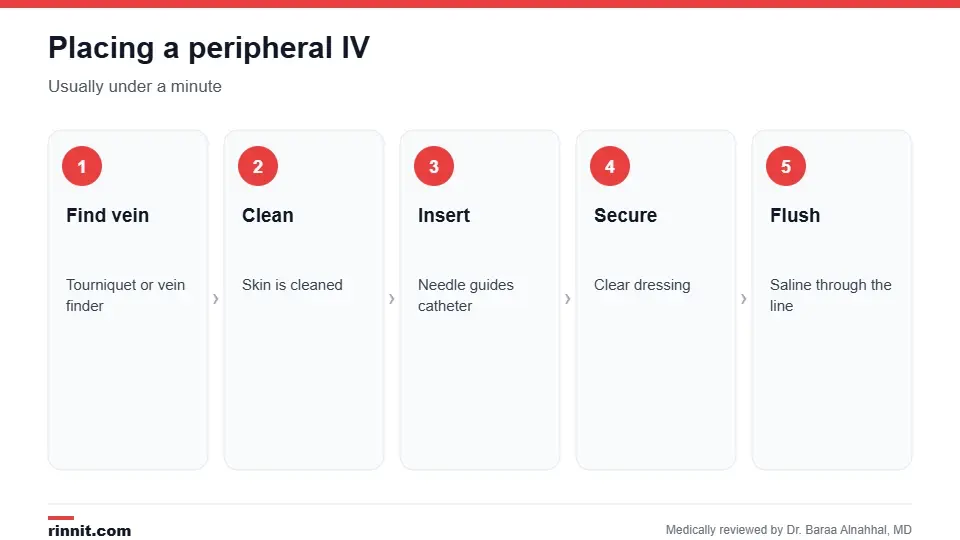
It usually takes under a minute.
Your identity is confirmed and your arm is rested comfortably.
The provider finds a vein, using a tourniquet or a vein-finding device.
A numbing cream may be used, especially for children.
The skin is cleaned, and a needle guides the catheter into the vein.
A clear dressing covers the site, and the line is flushed with saline. Sources: [1]
It usually takes under a minute, or up to 30 minutes if veins are hard to find or numbing cream is used. Sources: [1]
Risks
Discomfort or needing more than one try.
Bruising or bleeding.
Infection at the site or in the blood.
Blood clots or vein inflammation (phlebitis).
A blown vein.
Rarely, artery, vein or nerve damage. Sources: [1]
When placement is harder
First-try success is 65% to 86%, and placement is difficult in 8% to 23% of people. It can be harder with dehydration, small or hard-to-see veins, darker skin tones, scar tissue, diabetes, sickle cell disease, cancer treatment, or being underweight or having obesity. Ultrasound can help. Sources: [1, 3]
How long it stays in
A peripheral IV can stay in for several days, which avoids repeated needle sticks. Most hospitals replace them every 72 to 96 hours. Sources: [1, 2]
Conclusion
A peripheral IV is a quick, safe way to deliver fluids and medicines directly into your bloodstream. Ask your care team if you have any questions about your IV.
Keep learning: read about IV fluids and central lines.
Frequently asked questions
What is a peripheral IV?
A thin, flexible tube placed into a vein.
Where is it placed?
Usually the back of the hand, inner elbow or foot.
What is it used for?
Fluids, medicines, blood transfusions, nutrition and blood draws.
Does it hurt?
It can be uncomfortable; numbing cream may help.
How long does placement take?
Usually under a minute.
How long can it stay in?
Several days; most are replaced every 72 to 96 hours.
How is it different from a PICC line?
A PICC is longer and reaches large chest veins.
What are the risks?
Bruising, infection, phlebitis and, rarely, clots.
Why does it sometimes take more than one try?
Small, hidden or scarred veins can make placement harder.
Can ultrasound help?
Yes. Studies show it improves first-try success.
Related Reading
Non-Tunneled Central Venous Catheter: Uses, Placement and Care explains non-tunneled central venous catheters.
IV Fluids: A Comprehensive Guide to Intravenous Rehydration fluids given through an IV.
Central Venous Catheter (Central Line): Types, Procedure, Risks and Care central IV lines.
Tunneled Catheter: What It Is, How It's Placed, Risks and Care long-term IV catheters.
Understanding Parenteral Nutrition: A Guide to Intravenous Feeding nutrition through an IV.
References
Cleveland Clinic. Peripheral IV — Peripheral Intravenous Catheter (PIVC). Cleveland Clinic. Last updated April 27, 2023. https://my.clevelandclinic.org/health/treatments/24930-peripheral-iv
Charles KR, Schults JA, Marsh N, et al. Clinically indicated removal versus routine removal of peripheral venous catheters. Cochrane Database of Systematic Reviews. 2026;1(1):CD007798. PMID 41589916. https://doi.org/10.1002/14651858.CD007798.pub6
Kleidon TM, Schults JA, Royle RH, et al. First-attempt success in ultrasound-guided vs standard peripheral intravenous catheter insertion: the EPIC superiority randomized clinical trial. JAMA Pediatrics. 2025;179(3):255-263. PMID 39869351. https://doi.org/10.1001/jamapediatrics.2024.5581
Medical disclaimer
This article is for general education only and does not replace advice from a qualified healthcare professional. Talk to your doctor about your own diagnosis and treatment, and seek emergency care right away for severe or sudden symptoms.



Comments