Non-Tunneled Central Venous Catheter: Uses, Placement and Care

Updated: 2 days ago
Written and medically reviewed by Dr. Baraa Alnahhal, MD · Last reviewed: November 2026 · How we review
Quick Answer
A non-tunneled central venous catheter (CVC) is a tube placed directly into a large central vein in the neck, chest or groin and threaded toward the heart. It's used for IV medicines, fluids, nutrition, blood draws and dialysis. It's not meant for long-term use and has a higher infection risk than tunneled catheters.
What the research says
Ultrasound made neck central lines safer: a Cochrane review of 35 trials with 5,108 people found ultrasound guidance for jugular central lines cut total complications by 71%, accidental artery puncture by 72% and raised first-try success by 57% (Brass P et al., Cochrane Database of Systematic Reviews, 2015) [2]
The insertion site affected infection and clot risk: in a trial of 3,471 non-tunneled ICU catheters, bloodstream infection or clots occurred at 1.5 per 1,000 catheter-days with subclavian lines versus 3.6 for jugular and 4.6 for femoral lines, though subclavian lines caused more collapsed lungs (1.5% vs. 0.5%) (Parienti JJ et al., New England Journal of Medicine, 2015) [3]
Ultrasound also helped at the groin site: a Cochrane review found ultrasound made first-try femoral vein access 73% more likely (risk ratio 1.73, 3 trials, 224 people) (Brass P et al., Cochrane Database of Systematic Reviews, 2015) [4]
Key takeaways
A non-tunneled CVC goes directly into a large vein near the heart.
It's placed in the neck, chest or groin.
It's used for medicines, fluids, nutrition, blood draws and dialysis.
It's for short-term use in the hospital.
Infection and clots are the main risks.
What is a non-tunneled CVC?
It's a type of central line. "Non-tunneled" means it goes straight into the vein rather than running under the skin first, as a tunneled catheter does. It's stitched to the skin and works both ways, for giving treatments and drawing blood. Sources: [1]
What it's used for
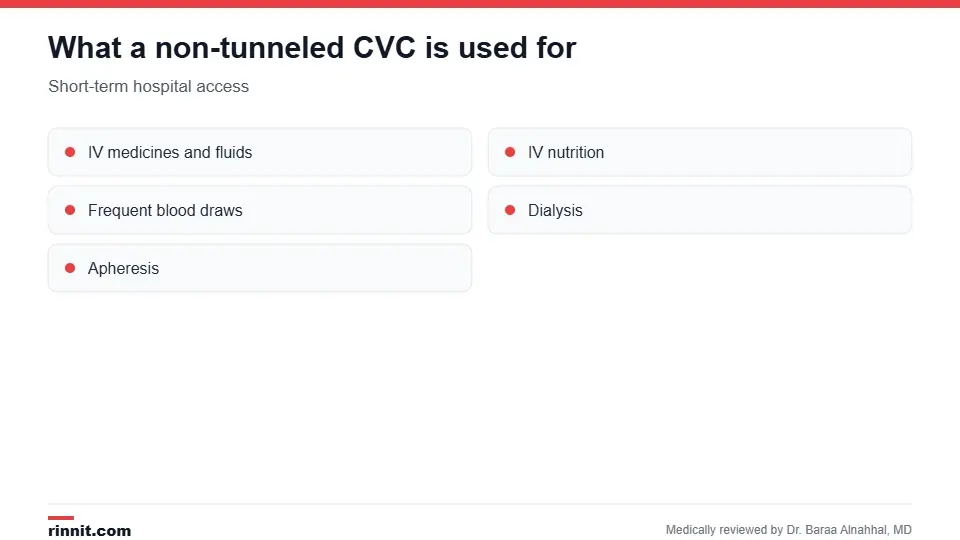
It saves you from repeated needle sticks.
IV medicines and fluids.
IV nutrition.
Frequent blood draws.
Dialysis and apheresis. Sources: [1]
Insertion sites

Ultrasound guidance makes placement safer.
Site | Location | Notes |
Internal jugular | Neck and upper chest | Ultrasound improves safety |
Subclavian | Near the collarbone | Lowest infection and clot rate; small collapsed-lung risk |
Femoral | Upper thigh or groin | Highest infection and clot rate |
Sources: [1, 2, 3]
How it's placed

Placement takes only a few moments.
The area is numbed with local anesthetic.
Ultrasound often helps locate the vein.
The catheter goes in directly through the skin or through a small incision.
It's threaded toward your heart.
It's stitched to your skin and covered. Sources: [1]
Caring for your line
Wash your hands before touching the catheter or area.
Check the bandage daily and report soiled or damaged dressings.
Don't pull, tug or snag the line.
Keep it dry, and only use approved cleaners.
In the hospital, only healthcare workers should handle it. Sources: [1]
Risks
Higher infection risk than tunneled catheters.
Blood clots.
Blockages.
Shifting, bending or kinking.
A small risk of puncturing an artery or lung during placement.
Rarely, an air bubble in the bloodstream (air embolism).
Leaking of fluid into surrounding tissue. Sources: [1, 3]
It's not meant for long-term use. Sources: [1]
Compared with other IV lines
A peripheral IV sits in a small arm vein for short-term use. A PICC line enters the arm and reaches the chest for longer use. A non-tunneled CVC is fastest for urgent central access. Sources: [1]
When to tell your care team
Pain, discoloration, swelling or stiffness at the site.
Fever, vomiting or feeling unwell.
A cracked or split line.
Any change in the catheter's position. Sources: [1]
Conclusion
A non-tunneled central line gives your care team fast, reliable access to a large vein during a hospital stay. Careful handling and daily checks help prevent infection.
Keep learning: read about central lines and tunneled catheters.
Frequently asked questions
What is a non-tunneled CVC?
A central line placed directly into a large vein near the heart.
Where is it placed?
The neck, chest or groin.
What is it used for?
Medicines, fluids, nutrition, blood draws and dialysis.
Does placement hurt?
The area is numbed first.
How long does placement take?
Only a few moments.
How long can it stay in?
It's meant for short-term use.
Is it different from a PICC line?
Yes. A PICC enters the arm; this goes directly into a central vein.
What are the risks?
Infection, clots, blockages and rare lung or artery puncture.
Which site is safest?
Subclavian lines had the lowest infection and clot rates in one trial.
Can I shower with it?
Keep it dry unless your team says otherwise.
Related Reading
Central Venous Catheter (Central Line): Types, Procedure, Risks and Care an overview of central lines.
Tunneled Catheter: What It Is, How It's Placed, Risks and Care longer-term catheters.
Understanding PICC Lines: A Guide to Peripherally Inserted Central Catheters arm-inserted central lines.
Peripheral IV (PIVC): Uses, Placement and Risks short-term arm IVs.
References
Cleveland Clinic. Non-Tunneled Central Venous Catheter (CVC). Cleveland Clinic. Last updated April 27, 2026. https://my.clevelandclinic.org/health/treatments/non-tunneled-cvc-catheter
Brass P, Hellmich M, Kolodziej L, et al. Ultrasound guidance versus anatomical landmarks for internal jugular vein catheterization. Cochrane Database of Systematic Reviews. 2015;1(1):CD006962. PMID 25575244. https://doi.org/10.1002/14651858.CD006962.pub2
Parienti JJ, Mongardon N, Mégarbane B, et al. Intravascular complications of central venous catheterization by insertion site. New England Journal of Medicine. 2015;373(13):1220-1229. PMID 26398070. https://doi.org/10.1056/NEJMoa1500964
Brass P, Hellmich M, Kolodziej L, et al. Ultrasound guidance versus anatomical landmarks for subclavian or femoral vein catheterization. Cochrane Database of Systematic Reviews. 2015;1(1):CD011447. PMID 25575245. https://doi.org/10.1002/14651858.CD011447
Medical disclaimer
This article is for general education only and does not replace advice from a qualified healthcare professional. Talk to your doctor about your own diagnosis and treatment, and seek emergency care right away for severe or sudden symptoms.



Comments