Hemodialysis: How It Works, Types, Risks, and What to Expect

Updated: 6 days ago
Written and medically reviewed by Dr. Baraa Alnahhal, MD · Last reviewed: October 2026 · How we review
Quick Answer: What is hemodialysis?
Hemodialysis is a treatment that does the work of failing kidneys by pumping blood through a machine filter (dialyzer) that removes waste and extra fluid, then returning the cleaned blood. It is used for late-stage chronic kidney disease or kidney failure. Most people have at least three sessions a week, each lasting three to four hours. [1]
What the research says
Dialyzing more often can protect the heart. In a 12-month randomized trial of 245 people, hemodialysis six times a week (an average of 5.2 sessions) instead of three lowered the combined risk of death or a thicker heart muscle by 39% (HR 0.61) and of death or worse physical health by 30% (HR 0.70). It also led to more procedures on the access site (HR 1.71). (FHN Trial Group, N Engl J Med, 2010) [2]
The type of access matters. In 62 cohort studies with 586,337 people, those dialyzing through a catheter had a 53% higher risk of death (RR 1.53), more than double the risk of fatal infection (RR 2.12) and a 38% higher risk of heart events (RR 1.38) than people with a fistula. These were observational studies with a high risk of bias. (Ravani et al., J Am Soc Nephrol, 2013) [3]
Hemodialysis and peritoneal dialysis show similar survival overall. A meta-analysis of 27 observational studies covering 1,033,362 people starting dialysis found no overall survival difference between peritoneal dialysis and in-center hemodialysis (HR 1.01, 95% CI 0.93–1.10), although results varied by age, region and access type. (Nardelli et al., BMC Nephrol, 2025) [4]
Key takeaways
Hemodialysis is the most common type of dialysis. A machine filters your blood through an artificial kidney and sends it back to your body. [1]
It is used for late-stage chronic kidney disease, kidney failure, or while waiting for a kidney transplant. [1]
In-center sessions usually happen at least three times a week and last three to four hours each; home hemodialysis offers more flexible schedules. [1]
A minor surgery to create a fistula or graft is done weeks or months before the first session. [1]
Low blood pressure, nausea, cramps and tiredness after sessions are common side effects. Fever, chills, or warmth or discoloration at the access site can mean infection. [1]
Average life expectancy on hemodialysis is five to 10 years, but some people have lived up to 30 years. [1]
What is hemodialysis?
Hemodialysis is a type of dialysis that filters your blood to remove waste products and extra fluid when your kidneys can no longer do it. [1] Healthy kidneys clean your blood and make urine. When they stop working properly, hemodialysis takes over that job. [1]
During hemodialysis (hee-moh-dahy-AL-uh-sis), a machine removes blood from your body, runs it through an artificial kidney called a dialyzer, and returns the cleaned blood to you. [1]
It is the most common type of dialysis. Most people who need dialysis receive hemodialysis. [1]
How does hemodialysis work?
Hemodialysis works by passing your blood through thousands of tiny mesh tubes inside the dialyzer, where waste and extra fluid move out of the blood into a cleaning fluid called dialysate. [1]

Blood leaves through one needle, is cleaned inside the dialyzer and returns through a second needle.
Who needs hemodialysis?
Hemodialysis is needed by people whose kidneys are so damaged that they can no longer clean the blood properly. [1] This usually happens in:
Late-stage chronic kidney disease (CKD) [1]
Kidney failure [1]
The waiting period before a kidney transplant [1]
Sometimes a sudden loss of kidney function, such as acute kidney injury, needs only temporary dialysis. It is stopped once the kidneys start working again. [1]
What are the types of hemodialysis?
The two main types of hemodialysis are in-center hemodialysis, done at a specialized facility, and home hemodialysis, done by you after training. [1] Your care team will recommend the type that suits you best. [1]
In-center hemodialysis is performed by a dialysis nurse or technician at a facility that specializes in this treatment. [1]
Home hemodialysis is learned over several weeks or months. Your care team teaches you how to run the treatment and fix common problems, and you then dialyze on your own schedule. [1] There are three types:
Type | Where | How often | Session length |
In-center hemodialysis | Dialysis facility | At least 3 times a week | 3 to 4 hours [1] |
Conventional home hemodialysis | Home | 3 times a week | At least 3 to 4 hours [1] |
Short daily home hemodialysis | Home | 5 to 7 days a week | About 2 hours [1] |
Nocturnal (overnight) home hemodialysis | Home, while you sleep | 4 to 6 days a week | 6 to 8 hours [1] |
Nocturnal home hemodialysis removes more waste from the blood, and you spend more hours each week on treatment than with the other types. [1]

In-center and conventional home schedules are similar; short daily and nocturnal home options trade session length for frequency.
How do you prepare for hemodialysis?
Preparing for hemodialysis starts weeks or even months before the first session with a minor surgery that creates easy access to your bloodstream. [1] If you will dialyze at home, training also happens during this time. [1]
Access type | What it is | When it is used |
A surgeon connects an artery directly to a vein in your arm | Planned, long-term access [1] | |
A soft, hollow tube joins the artery and vein | When the artery and vein are too short to connect directly [1] | |
Catheter | A temporary soft tube placed in a vein in the leg, chest or neck | When hemodialysis must start quickly [1] |
A fistula or graft makes the connection easier to reach during each session and helps blood flow in and out of your body faster. [1]
How do you care for your access?
Your care team will teach you to protect your access, because if it is damaged, you may no longer be able to use it for hemodialysis. [1] You will learn to:
What happens during a hemodialysis session?
During a hemodialysis session, a nurse or technician places two needles in your arm and connects them by soft tubing to the machine. [1] If you are trained in home hemodialysis, you may place the needles yourself. [1]
The hemodialysis machine then:
Removes blood through one needle
Circulates it through the many mesh tubes in the dialyzer
Moves waste and extra fluid into the dialysate
Returns the filtered blood through the second needle [1]
The machine checks your blood pressure regularly throughout the session. [1]
Is hemodialysis painful?
Hemodialysis itself should not cause pain, but you may feel a slight pinch when the needles go into your fistula or graft. [1] The needles are 15- or 16-gauge, larger than the needles used for blood tests:
Why does hemodialysis take so long?
Hemodialysis takes hours because it is only about 5% to 10% as effective as healthy kidneys, which filter around 150 quarts of blood every day, nonstop, even while you sleep. [1]
What happens after a hemodialysis session?
After a hemodialysis session, the needles are removed, pressure is applied to stop bleeding, and the access area is cleaned. You can then return to your everyday activities. [1]
Many people feel tired or unwell for a few hours after a session. Others report more energy with more frequent hemodialysis. [1] Most people begin to feel better a few weeks after starting treatment. [1] If you feel sick or tired after sessions, tell your care team; medicines or adjustments to your treatment can help. [1]
What are the benefits and risks of hemodialysis?
The main benefit of hemodialysis is that it does the work of your kidneys when they no longer can, preventing a toxic buildup in the blood called uremia, which is fatal without treatment. [1]
Benefits | Risks |
Filters out toxins, which helps many people feel better [1] | Infection of the fistula or graft [1] |
Sessions are usually only three times a week [1] | Scar tissue that blocks the access [1] |
Home dialysis lets you choose when and where to dialyze [1] | Blood clots in the fistula or graft that prevent dialysis [1] |
Overnight home dialysis supports a more consistent daily routine [1] | Rarely, a needle comes out or a tube disconnects [1] |
If a needle comes out or a tube disconnects, the machine alerts you or your care team and shuts off to protect you from blood loss until the problem is fixed. [1]
What are the side effects of hemodialysis?
Common side effects of hemodialysis include low blood pressure, nausea and muscle cramps. [1] The full list includes:
Low blood pressure
Nausea and vomiting
Dizziness and fainting
Chest pain and back pain
Headaches
Itchy skin
Muscle cramps
How long can you live on hemodialysis?
The average life expectancy on hemodialysis is five to 10 years, although some people have lived up to 30 years on treatment. [1] Your care team can give you a clearer picture based on your own health. [1]
Will you need hemodialysis for life? Hemodialysis cannot cure late-stage CKD or kidney failure, so unless you receive a kidney transplant, you will need it for the rest of your life. [1] A sudden kidney failure may only need temporary dialysis. [1]
What happens if you refuse or stop hemodialysis? Without hemodialysis, uremia develops and the kidneys eventually fail completely, which is fatal over time. A person with kidney failure may survive only a few days or weeks without it. [1] Stopping is a personal choice; talk it through with your care team, family and friends first. [1]
How can you make hemodialysis easier?
Simple habits such as dressing warmly, bringing something to do and working with a renal dietitian can make hemodialysis sessions easier to manage. [1]
Tip | Why it helps |
Wear warm clothes with loose sleeves | Many people feel chilly while blood is withdrawn and while sitting still for hours; loose sleeves give easy access to your fistula or graft [1] |
Bring something to do | Sessions can be boring; a laptop, phone, book, game, cards or paper and pencil help pass the time [1] |
Join a support group | Talking with people who understand can ease stress, anxiety, depression and isolation [1] |
Work with a renal dietitian | A kidney-focused diet plan can help you feel better between sessions and reduce side effects [1] |
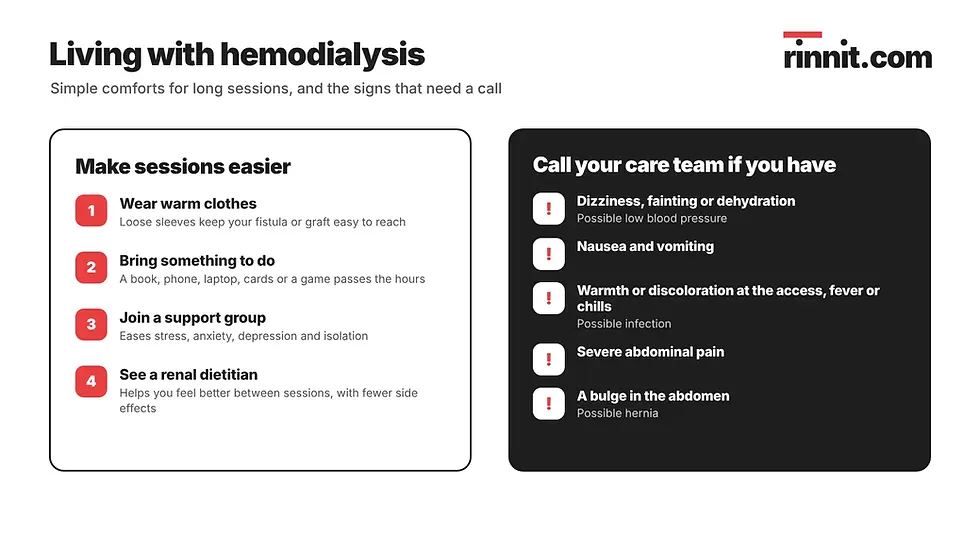
Small comforts make long sessions easier. Signs of infection or low blood pressure need a call to your care team.
When should you call a doctor during hemodialysis treatment?
Call your care team during hemodialysis treatment if you notice signs of low blood pressure, signs of infection at your access, or new pain or swelling in your abdomen. [1] Watch for:
Dizziness, fainting or dehydration (signs of low blood pressure)
Nausea and vomiting
Warmth or discoloration around your fistula or graft, fever or chills (signs of infection)
Severe abdominal pain
A bulge in your abdomen (hernia) [1]
What is the difference between hemodialysis and peritoneal dialysis?
Hemodialysis cleans your blood outside your body in a machine, while peritoneal dialysis cleans it inside your body using the lining of your abdomen as the filter. [1]
Feature | Hemodialysis | Peritoneal dialysis |
Where filtering happens | In a machine outside the body [1] | Inside the abdomen, through the peritoneal membrane [1] |
How it connects | Two needles in a fistula or graft, or a catheter [1] | A catheter attached to the abdominal lining [1] |
How waste leaves | Through dialysate in the dialyzer [1] | Solution absorbs waste and is drained into an empty bag after about 60 to 90 minutes [1] |
Overall survival | Similar in pooled studies of people starting dialysis [4] | Similar in pooled studies of people starting dialysis [4] |
Conclusion
Hemodialysis is a lifesaving treatment that steps in when your kidneys can no longer clean your blood. [1] It takes time, often several sessions a week, and it can feel like it controls your life. Those feelings are normal. [1] Remember that you are the most important person in charge of your care, and your care team is there to answer questions and support your choices. [1]
Keep learning with Rinnit: Compare your access options in our guides to the dialysis fistula and the dialysis graft, then explore the 5 stages of chronic kidney disease. Share this guide with a family member who is supporting you through dialysis, and bring it to your next appointment.
FAQ
What is hemodialysis?
Hemodialysis is a treatment that filters waste and extra fluid from your blood through a machine and an artificial kidney (dialyzer), then returns the cleaned blood to your body. It does the work of kidneys that have failed. [1]
How long does a hemodialysis session take?
An in-center hemodialysis session usually takes three to four hours, at least three times a week. Home options range from about two hours on short daily schedules to six to eight hours overnight. [1]
Is hemodialysis painful?
Hemodialysis itself should not hurt. You may feel a slight pinch when the two needles go into your fistula or graft, because they are larger than blood-test needles. [1]
Can I do hemodialysis at home?
Yes. After several weeks or months of training, many people perform home hemodialysis on their own schedule, using conventional, short daily or overnight (nocturnal) sessions. [1]
What are the side effects of hemodialysis?
Common side effects of hemodialysis include low blood pressure, nausea and vomiting, dizziness, muscle cramps, headaches, itchy skin and restless legs. Many people also feel tired for a few hours after a session. [1]
How long can you live on hemodialysis?
The average life expectancy on hemodialysis is five to 10 years, but some people have lived up to 30 years. Your care team can estimate what to expect in your situation. [1]
Is hemodialysis permanent?
Hemodialysis is lifelong for late-stage CKD or kidney failure unless you receive a kidney transplant. Sudden kidney failure may need only temporary dialysis until the kidneys recover. [1]
When should I call my doctor while on hemodialysis?
Call your care team if you have dizziness, fainting, nausea or vomiting, fever or chills, warmth or discoloration around your fistula or graft, severe abdominal pain or a bulge in your abdomen. [1]
What is vascular access for hemodialysis?
Vascular access is the place where blood leaves and returns to your body during dialysis. It is usually a fistula or graft in the arm, or a catheter in a large vein when a quick option is needed.
Do I need a special diet on hemodialysis?
Most people need to limit fluid, salt, potassium and phosphorus, and many need more protein. A kidney dietitian will make a plan based on your blood tests.
Related Reading
Dialysis Fistula (AV Fistula): A Guide to Long-Term Hemodialysis Access explains how an AV fistula is made and cared for.
Peritoneal Dialysis: A Comprehensive Guide to Home-Based Kidney Filtration covers peritoneal dialysis, a home option that uses the belly lining.
Chronic Kidney Disease: What It Is, Its 5 Stages, Causes, and How It's Treated explains the stages of kidney disease and when dialysis is needed.
Kidney Transplant: Understanding the Procedure, Benefits, and Recovery describes kidney transplant surgery, benefits and recovery.
References
Cleveland Clinic. Hemodialysis: Types, Results & How It Works. Cleveland Clinic. Last updated March 5, 2026. https://my.clevelandclinic.org/health/treatments/24472-hemodialysis
FHN Trial Group; Chertow GM, Levin NW, Beck GJ, et al. In-center hemodialysis six times per week versus three times per week. New England Journal of Medicine. 2010;363(24):2287-2300. PMID 21091062. https://doi.org/10.1056/NEJMoa1001593
Ravani P, Palmer SC, Oliver MJ, et al. Associations between hemodialysis access type and clinical outcomes: a systematic review. Journal of the American Society of Nephrology. 2013;24(3):465-473. PMID 23431075. https://doi.org/10.1681/ASN.2012070643
Nardelli L, Passerini M, Zubidat D, et al. Association of incident dialysis modality with patient survival: a systematic review and meta-analysis. BMC Nephrology. 2025;26(1):588. PMID 41137014. https://doi.org/10.1186/s12882-025-04530-4
Medical disclaimer
This article is for general education and does not replace advice from your own doctor or dialysis care team. Always follow the instructions you are given for your specific treatment, and seek medical help promptly if you notice any warning signs.



Comments