Music Therapy: What It Is, Types, Benefits and What to Expect

Updated: 6 days ago
Written and medically reviewed by Dr. Baraa Alnahhal, MD · Last reviewed: October 2026 · How we review
Quick Answer: What is music therapy?
Music therapy is a clinical treatment in which a qualified music therapist uses music, or elements like rhythm and harmony, within a therapeutic relationship to meet personal health goals such as lowering stress, easing anxiety or pain, and improving quality of life. Sessions may involve singing, playing, writing or listening to music, and no musical skill is needed. [1][2]
What the research says
Music therapy lowers stress. A meta-analysis of 47 studies with 2,747 participants found a medium-to-large overall effect on both physical and psychological stress-related outcomes (effect size 0.723). (de Witte et al., Health Psychology Review, 2022) [2]
It helps autistic children and young people. A review of 26 studies (1,165 participants) found music therapy raised the chance of overall improvement (risk ratio 1.22; 8 studies, 583 participants) and probably produced a large drop in total autism symptom severity (9 studies, 575 participants), without raising side effects. (Geretsegger et al., Cochrane Database of Systematic Reviews, 2022) [3]
It improves life with cancer. Across 19 trials with 1,548 patients, music therapy improved overall quality of life compared with standard care and lowered anxiety, depression and pain scores, with the best results seen after 1–2 months. (Li et al., Journal of Advanced Nursing, 2020) [4]
Key takeaways
Music therapy is a healthcare treatment, not just listening to music you like. A trained music therapist must plan and lead it. [1]
It helps children, teens and adults, and it can support mental, emotional, physical, social and cognitive health. [1]
It is usually a complementary therapy, meaning it works alongside medicines or other treatments, not instead of them. [1]
You do not need any musical talent to take part. [1]
It is safe and low risk, though music can sometimes bring up painful memories. [1]
How does music therapy work?
Music therapy works by using music inside a planned, goal-based relationship between you and a trained music therapist. [1] Before your first session, the therapist talks with you about your needs, your musical tastes and your life experiences. They then design each session around you. [1]
The therapist also checks your progress at each step. They may work with your other healthcare providers so your care stays coordinated. [1]
What you do in a session depends on your goals. You might sing, play an instrument or write music. You might also listen to music and talk about what it means to you. [1]
Is music therapy the same as listening to music?
Music therapy is not the same as listening to music to relax. [1] Relaxing music can calm you and lift your mood, but clinical music therapy needs a qualified music therapist who plans and leads each session within a therapeutic relationship. [1]
Music therapy | Therapeutic music | |
Who leads it | A qualified music therapist | Anyone; no therapist needed |
Goal | Specific, personal health goals | Relaxation or lifting your mood |
Planning | A tailored treatment plan for you | No formal plan |
Example | Therapist-led songwriting or directed listening | Calming music through headphones; a nurse playing music at the bedside |
Progress tracking | Yes, after each session | No |
Your music therapist can also show you how to use music in daily life, outside your sessions, to get extra benefits. [1]
Who can benefit from music therapy?
Music therapy can benefit people of all ages, including children, teenagers and adults, from all walks of life. [1] It can support five areas of your well-being: mental, emotional, physical, social and cognitive (thinking) health. [1]

For children, music therapy may support behavior, learning and emotions. Therapists design sessions to fit each child's needs. [1] If you are a parent, you can read more about anxiety in children and depression in children.
What conditions can music therapy help?
Music therapy can help manage a wide range of conditions, usually as part of a larger treatment plan. [1] Research shows benefits for people with the conditions below. [1]
Area | Conditions |
Brain and nerves | Dementia (including Parkinson's disease dementia), traumatic brain injury, stroke, Parkinson's disease |
Mental health | Mood disorders, anxiety disorders, substance use disorders |
Development and learning | Autism spectrum disorder, learning disabilities, developmental disabilities |
Physical health | Cancer, acute pain, chronic pain |
After a stroke, some people lose language skills (a condition called aphasia). A meta-analysis of 6 studies with 115 patients found music therapy improved everyday communication, repeating words and naming objects, though it did not improve understanding of speech. [5]
What are the types of music therapy?
Music therapy has two main types: active interventions, where you make music, and receptive interventions, where you listen to music. [1]
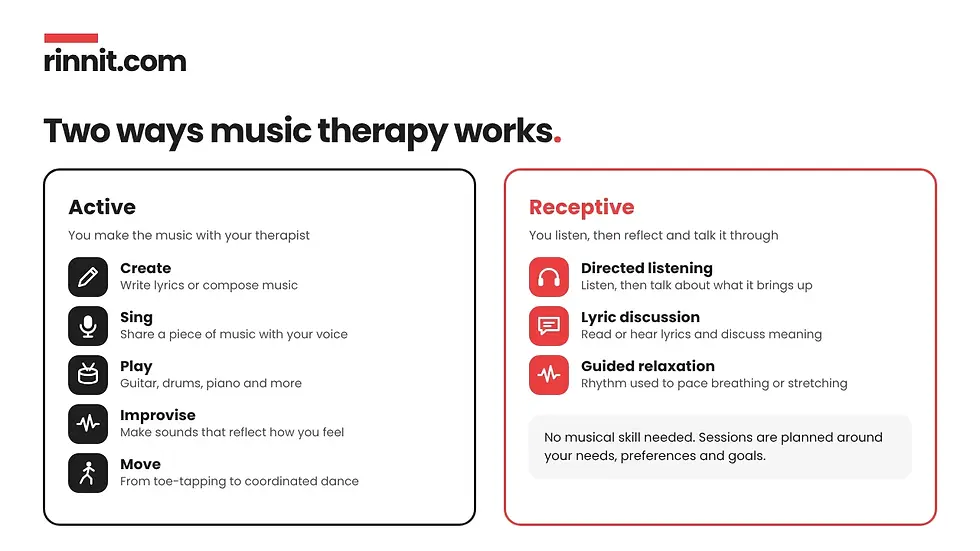
Type | What you do | Examples |
Active | You make music with your therapist | Singing, playing an instrument, writing songs, improvising |
Receptive | You listen to music your therapist plays or performs, then talk about it | Directed listening, discussing lyrics, music-guided breathing |
What happens during a music therapy session?
During a music therapy session, your therapist guides you in making music, listening to music, or both. [1] You may do one or more of these activities: [1]
Create music: compose music, write lyrics or make up music together.
Sing: use your voice to share a piece of music.
Play an instrument: such as guitar, drums or piano.
Improvise: make music and sounds with your therapist that reflect how you feel.
Move to music: from tapping your toes to a full, coordinated dance.
Listen to music: your therapist plays or performs music, then you talk about it to help process emotions or experiences. Music can also guide relaxed breathing or stretching.
Discuss lyrics: read or listen to song lyrics and talk about their meaning.
Sessions can happen one-on-one or in groups. [1]

What happens before and after music therapy?
Before music therapy starts, your music therapist assesses your needs and strengths. [1] You may talk about:
Emotional well-being and physical health
Social skills, communication and thinking skills
Movement and perceptual (sensing) skills
Your musical background, skills and preferences
Any history of trauma and things that trigger you
Together, you then set goals. The therapist plans experiences that fit your music tastes, age, developmental level, physical and thinking abilities, and trauma triggers. [1]
After each session, your therapist checks whether it met your goals and adapts the next sessions to your changing interests and needs. [1]
Where does music therapy take place?
Music therapy takes place in many settings, both outpatient and inpatient. [1] You may visit a clinic during the day, or a therapist may come to you while you are in a hospital or school. [1]
Healthcare settings | Community and other settings |
Hospitals (including at the bedside) | Schools |
Outpatient clinics | Nursing homes and senior centers |
Mental health centers | Homes for people with developmental disabilities |
Substance use treatment centers | Correctional facilities |
What are the benefits of music therapy?
The benefits of music therapy depend on the condition you are treating and your personal goals. [1] In general, research shows music therapy may: [1]
Area | Possible benefits |
Emotional | Help you relax, explore emotions, regulate mood, ease stress, reduce anxiety or depression |
Social and communication | Strengthen communication, improve speech and language, build social skills |
Personal growth | Boost self-confidence, build healthy coping skills, develop problem-solving |
Physical | Reduce how much pain you feel; improve coordination, motor skills and movement |
Overall | Improve quality of life |
What are the risks of music therapy?
Music therapy is safe and low risk, but music can sometimes trigger painful or unexpected memories. [1] To lower this risk, your therapist asks about your life experiences, including any trauma, before planning sessions. [1]
Sharing what you feel comfortable sharing helps your therapist tailor each session and make it a safe, comfortable experience. [1]
How many music therapy sessions do you need?
The number of music therapy sessions you need depends on your treatment goals. [1] You and your therapist decide together how many sessions you will have, how long each one lasts and how often you meet. [1]
When should you contact a healthcare provider?
You should contact your music therapist about your goals, how you feel during treatment, scheduling, or any questions you have. [1]
Contact your primary care doctor or other providers about the rest of your treatment plan, such as medicines and their side effects, or any new or changing symptoms. [1] Because music therapy is usually one part of a larger treatment plan, talk to your doctor before changing any other treatment. [1]
How do you become a music therapist?
To become a music therapist in the United States, you earn a bachelor's degree in music therapy and then pass a national certification exam. [1]
Step | What it involves |
1. Degree | A bachelor's degree in music therapy from an approved program. Classes include music, music therapy, psychology and biology. |
2. Clinical training | 1,200 hours of clinical training, including an internship in a healthcare or school setting. |
3. Certification | Pass the national exam from the Certification Board for Music Therapists to earn the MT-BC (Music Therapist-Board Certified) credential. |
4. Stay certified | Ongoing professional development. Some states also require a license. |
Board certification is voluntary, but many U.S. states require it to work legally as a music therapist. [1] The American Music Therapy Association lists approved programs. [1][6]
Conclusion
Music therapy is a real, goal-based healthcare treatment. A trained music therapist plans every session around you, and you do not need any musical skill to benefit. It can help with stress, mood, pain, communication and quality of life, and studies support its use in conditions such as autism and cancer. It works best as part of a wider treatment plan, not as a replacement for other care.
Thinking about music therapy for yourself or your child? Talk to your doctor or pediatrician about connecting with a board-certified music therapist. Then keep learning with our clear, doctor-reviewed guides on anxiety disorders, stroke and Parkinson's disease on Rinnit.com.
FAQ
What is music therapy?
Music therapy is a clinical treatment that uses music, or elements like rhythm and harmony, to reach health goals such as lowering stress or improving quality of life. A qualified music therapist plans and leads each session. [1]
Do you need musical talent for music therapy?
No, you do not need any musical skill or talent for music therapy. Your therapist learns about any musical background you have and designs sessions to fit you. [1]
Can children benefit from music therapy?
Yes, children and teenagers can benefit from music therapy. It may support a child's behavior, learning and emotions, and sessions are designed around each child's needs. [1]
What conditions can music therapy help with?
Music therapy can help people with dementia, stroke, traumatic brain injury, Parkinson's disease, cancer, autism, mood and anxiety disorders, learning and developmental disabilities, pain and substance use disorders. It is usually used alongside other treatments. [1]
Is music therapy safe?
Music therapy is safe and low risk. Music can sometimes trigger painful memories, so your therapist asks about your life experiences and any trauma before planning sessions. [1]
Is music therapy the same as listening to relaxing music?
No, music therapy is not the same as listening to relaxing music. Music therapy is a healthcare treatment planned and led by a qualified music therapist, while relaxing music needs no therapist or formal plan. [1]
How many music therapy sessions will I need?
The number of music therapy sessions depends on your goals. You and your therapist decide together how many sessions to have, how long they last and how often you meet. [1]
How do you become a music therapist?
In the United States, you earn a bachelor's degree in music therapy with 1,200 hours of clinical training, then pass a national exam to earn the MT-BC credential. Some states also require a license. [1]
Is music therapy covered by insurance?
Coverage varies. Some plans pay for music therapy when it is part of a medical or rehabilitation treatment plan, so check with your insurer and the therapist before you start.
Can music therapy help with pain?
Music therapy may help lower pain and anxiety, often alongside other treatments. It does not replace pain treatment your provider prescribes.
Related Reading
Occupational Therapy: What It Is, Who Needs It, and What to Expect explains how occupational therapy helps people manage everyday tasks.
Physical Therapy: Enhancing Mobility, Strength, and Recovery covers how physical therapy builds strength, mobility and recovery.
Anxiety Disorders: Symptoms, Types, Causes, Treatment & Complete Guide explains the types of anxiety disorders and proven treatments.
Aphasia Explained: Causes, Types, Symptoms, and How Speech Therapy Helps You Find Your Words Again explains language loss after brain injury and how therapy helps.
References
Cleveland Clinic. Music Therapy: Types & Benefits. Cleveland Clinic. Last updated July 18, 2023. https://my.clevelandclinic.org/health/treatments/8817-music-therapy
de Witte M, Pinho ADS, Stams GJ, et al. Music therapy for stress reduction: a systematic review and meta-analysis. Health Psychol Rev. 2022;16(1):134-159. PMID 33176590. https://doi.org/10.1080/17437199.2020.1846580
Geretsegger M, Fusar-Poli L, Elefant C, et al. Music therapy for autistic people. Cochrane Database Syst Rev. 2022;5(5):CD004381. PMID 35532041. https://doi.org/10.1002/14651858.CD004381.pub4
Li Y, Xing X, Shi X, et al. The effectiveness of music therapy for patients with cancer: A systematic review and meta-analysis. J Adv Nurs. 2020;76(5):1111-1123. PMID 32017183. https://doi.org/10.1111/jan.14313
Liu Q, Li W, Yin Y, et al. The effect of music therapy on language recovery in patients with aphasia after stroke: a systematic review and meta-analysis. Neurol Sci. 2022;43(2):863-872. PMID 34816318. https://doi.org/10.1007/s10072-021-05743-9
American Music Therapy Association. What Is Music Therapy? American Music Therapy Association. Accessed October 31, 2026. https://www.musictherapy.org/what-is-music-therapy/
Medical disclaimer
This article is for general education only and is not a substitute for professional medical advice, diagnosis or treatment. Always talk to a qualified healthcare professional about your own health and before starting or changing any treatment.



Comments