Parkinson's Disease Dementia: Symptoms, Causes, and Care

Updated: 3 days ago
Medically reviewed by Dr. Baraa Alnahhal, MD · Last reviewed: October 2026
Parkinson's disease dementia is a decline in thinking and reasoning skills that can develop after a Parkinson's disease diagnosis, typically years later. Common symptoms include impaired attention and difficulty interpreting visual information [1]. Certain medications and therapies can improve some symptoms, but they cannot stop or reverse the condition [1].
Quick Answer: What is Parkinson's disease dementia?
Parkinson's disease dementia is a decline in thinking and reasoning that develops at least one year, usually longer, after a Parkinson's diagnosis. It is linked to Lewy bodies, clumps of alpha-synuclein protein that spread to thinking areas of the brain. Age and years with Parkinson's are major risk factors. No treatment slows it, but some medications ease symptoms. [1]
What the research says
About one in four people with Parkinson's disease develop dementia. A systematic review and meta-analysis of 295 studies found a global pooled dementia frequency of 26.3%. Reported frequency varied with factors such as age 75 or older, Parkinson's disease duration of more than 10 years, and Hoehn & Yahr stage above 3 (Severiano E Sousa et al., J Neurol Sci, 2022).
Cholinesterase inhibitors may modestly ease hallucinations and delusions. A meta-analysis of placebo-controlled trials (individual data on 6,649 people from 17 trials, 5 of them in Parkinson's disease) found that treatment was associated with improvement in hallucinations (-0.08; 95% CI -0.13 to -0.03) and delusions (-0.14; 95% CI -0.26 to -0.01) in the Parkinson's disease subgroup, with small effect sizes (d'Angremont et al., JAMA Neurol, 2023).
No intervention has been proven to prevent dementia. A 2024 narrative review reports that no randomized clinical trial data conclusively confirm that interventions of any kind can prevent dementia, and that cholinesterase inhibitors and memantine may benefit people with dementia types that include Parkinson's disease dementia (Reuben et al., JAMA Intern Med, 2024).
Research summaries are based on article abstracts retrieved from PubMed.
What Is Parkinson's Disease Dementia?
Parkinson's disease is a neurodegenerative brain condition that mainly affects movement, causing tremors, slowed movements, and other issues. It can also affect the parts of the brain responsible for mental functions, and this is when dementia may develop [1]. Dementia is a decrease in mental function from a previously higher level that is severe enough to interfere with daily living [1].
People with Parkinson's disease typically go through a stage of mild cognitive impairment before developing dementia, but not everyone progresses. About 10% to 20% of people with Parkinson's disease have MCI during the entire course of their disease [1].
How Common Is It?
How often Parkinson's disease dementia occurs depends on age and how long you have had Parkinson's disease [1]:
Age group | Years with Parkinson's disease | Share with dementia |
|---|---|---|
60 to 75 years | 5 to 10 years | 16% to 20% |
60 to 75 years | 10 to 15 years | 20% to 30% |
Over 75 years | More than 15 years | 50% to 60% |
Source: Cleveland Clinic [1].
What are the symptoms of Parkinson's disease dementia?
Parkinson's disease dementia can affect people in many ways [1]:
Symptom category | Common signs |
|---|---|
Thinking and attention | Impaired attention (difficulty focusing), a decline in memory, and difficulty planning, starting, or completing simple tasks |
Vision and perception | Trouble interpreting visual information, such as difficulty spotting objects in a cluttered space |
Language and speech | Misnaming objects, difficulty understanding complex sentences, and muffled speech |
Mood and behavior | Depression, irritability, anxiety, and apathy (a lack of goal-directed behavior) |
Psychosis | Hallucinations (especially visual) and delusions (especially paranoid thinking) |
Source: Cleveland Clinic [1].
If you notice these symptoms in yourself or a loved one, see a healthcare provider [1].
What causes Parkinson's disease dementia and who is at risk?
A buildup of Lewy bodies (a protein called alpha-synuclein) causes Parkinson's disease by damaging nerve cells in the brain. The buildups typically first affect the basal ganglia, which control movement. Over time, Lewy bodies can spread to the parts of the brain that control cognitive functions, leading to dementia [1].

Medical illustration showing Lewy bodies spreading from the basal ganglia to the cognitive centers of the brain.
The most significant risk factors are increasing age and increasing years of having Parkinson's disease [1]. Studies show that these features of Parkinson's disease also raise the risk [1]:
Severe movement (motor) symptoms
Early problems with autonomic nervous system function, such as orthostatic hypotension (low blood pressure on standing) and loss of bladder control
Movement symptoms that affect both sides of the body (symmetrical)
Dopamine-related Parkinson's medications being less effective than expected
REM sleep behavior disorder
How is Parkinson's disease dementia diagnosed?
No test conclusively diagnoses Parkinson's disease dementia. Your healthcare provider will ask when your symptoms developed and how they have changed, and ask about your medical history, current medications, and family medical history. They may also order lab tests, imaging tests, and neuropsychological (thinking) tests to support the diagnosis [1].
Because Parkinson's disease dementia and Lewy body dementia have very similar symptoms and causes, providers use timing to tell them apart [1]:
Parkinson's disease dementia: dementia develops at least one year (usually several years) after the onset of Parkinson's movement symptoms.
Lewy body dementia: dementia develops before, at the same time as, or within one year of the onset of Parkinson's symptoms. In some cases, movement changes may not occur.
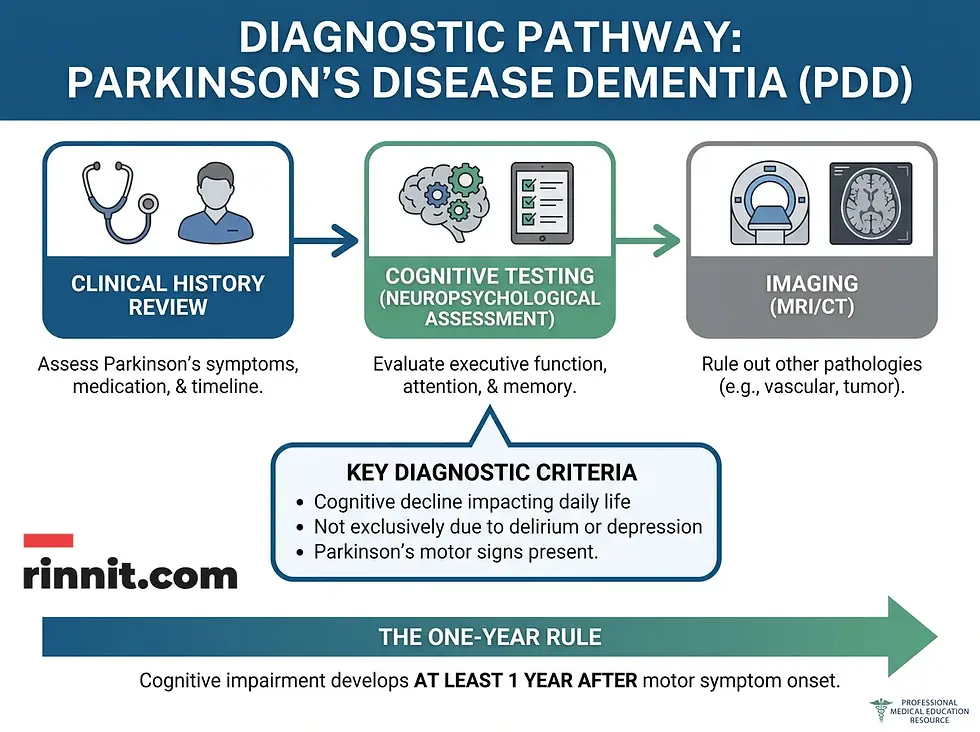
Diagnostic pathway for Parkinson's disease dementia, from clinical history review to cognitive testing and imaging.
How is Parkinson's disease dementia treated?
No current treatment can slow or stop the progression of Parkinson's disease dementia, though some therapies can ease symptoms. Medications and therapies may improve some symptoms [1]:
Cholinesterase inhibitors: donepezil (Aricept), rivastigmine (Exelon), and galantamine (Razadyne) may help with visual hallucinations and changes in thinking and behavior [1] [3].
SSRIs and SNRIs: these antidepressants may help with mood and anxiety symptoms [1].
Cognitive behavioral therapy (CBT): this talk therapy may help manage behavioral symptoms of dementia [1].
Your healthcare team will work with you to decide which options are best. Some medications can make dementia symptoms worse. For example, carbidopa-levodopa, the go-to medication for the movement symptoms of Parkinson's disease, can sometimes worsen hallucinations and confusion [1]. Ask your provider whether a clinical trial of new treatments is an option for you [1].

Management strategies for Parkinson's disease dementia: cognitive medications, mood support, and behavioral therapy.
What is the outlook for Parkinson's disease dementia, and can it be prevented?
Both Parkinson's disease and Parkinson's disease dementia worsen over time. Treatment can improve symptoms, but quality of life is often poor. The speed of progression varies widely from person to person, so your healthcare team can give you and your family a better idea of what to expect [1]. There is no standard staging tool for Parkinson's disease dementia, because it affects each person differently and progresses at different rates [1].
There is nothing you can do to prevent Parkinson's dementia from developing or to reduce your risk of it [1].
How can you support a loved one with Parkinson's disease dementia?
Beyond working with your loved one's healthcare team, these steps can help [1]:
Learn as much as you can about Parkinson's disease dementia so you feel prepared and can advocate for your loved one.
Simplify their living space. Decluttering can reduce confusion, and low-level nighttime lighting can reduce visual misperceptions.
Keep a structured routine. A predictable day-to-day routine can help people feel more comfortable.
Join a support group. Parkinson's disease support groups offer information, advice, and shared experience for patients and families.
When should you see a doctor about Parkinson's disease dementia?
If you or a loved one is experiencing new thinking, memory, or behavior changes after a Parkinson's disease diagnosis, see a healthcare provider, such as a neurologist, to discuss testing and management options [1].
What is the bottom line on Parkinson's disease dementia?
Parkinson's disease dementia is a decline in thinking skills that develops at least one year after Parkinson's disease is diagnosed. It cannot be prevented, slowed, or reversed, but medications such as cholinesterase inhibitors, antidepressants, and cognitive behavioral therapy can ease some symptoms. A multidisciplinary care team and a supportive routine at home can help maintain quality of life [1].
Frequently Asked Questions
How does Parkinson's disease dementia differ from Alzheimer's disease dementia?
Both involve cognitive decline, but Parkinson's disease dementia tends to bring more severe apathy and attention problems, while Alzheimer's disease dementia tends to cause earlier language difficulties and more trouble forming new memories [1].
Can Parkinson's movement medication affect dementia symptoms?
Yes. Carbidopa-levodopa, the main medicine for Parkinson's movement symptoms, can sometimes worsen hallucinations and confusion in Parkinson's disease dementia [1]. Talk with your healthcare team before changing any medicine.
Is Parkinson's disease dementia the same as Lewy body dementia?
Parkinson's disease dementia and Lewy body dementia are closely related and may be linked to the same abnormalities in how the brain processes alpha-synuclein. They are nearly indistinguishable except for the order in which symptoms develop [1].
Does everyone with Parkinson's disease develop dementia?
No. About 10% to 20% of people with Parkinson's disease have mild cognitive impairment that does not always progress to dementia [1]. A pooled analysis of 295 studies found dementia in about 26% of people with Parkinson's disease [2].
What is the one-year rule?
It is Parkinson's disease dementia if dementia starts at least one year (usually several years) after Parkinson's movement symptoms begin, and Lewy body dementia if it starts before, with, or within one year of them [1].
What kinds of hallucinations can happen?
Psychosis in Parkinson's disease dementia includes hallucinations, mostly visual, and delusions, often paranoid [1]. Cholinesterase inhibitors may ease visual hallucinations [1], and a meta-analysis found small improvements in hallucinations and delusions in Parkinson's disease [3].
What is apathy in Parkinson's disease dementia?
Apathy is a lack of goal-directed behavior. People with Parkinson's disease dementia tend to have more severe apathy than people with Alzheimer's disease dementia [1].
Can Parkinson's disease dementia be prevented?
Cleveland Clinic states there is no known way to prevent Parkinson's dementia or lower your risk of it [1]. A 2024 review also found no randomized trial data that conclusively confirm any intervention prevents dementia [4].
How can I help a loved one with Parkinson's disease dementia?
Work with their healthcare team, learn about the condition, declutter their living space, use low nighttime lighting, keep a structured routine, and consider joining a Parkinson's disease support group [1].
How common is Parkinson's disease dementia?
It depends on age and how long you have had Parkinson's disease. It affects 16% to 20% of people aged 60 to 75 with Parkinson's for 5 to 10 years, 20% to 30% of those with it for 10 to 15 years, and 50% to 60% of people over 75 with it for more than 15 years [1].
Related Resources
External resource for deeper reading:
Cleveland Clinic. Parkinson’s Disease Dementia. Cleveland Clinic. Medically reviewed; last updated July 8, 2024. https://my.clevelandclinic.org/health/diseases/parkinsons-dementia
References
Cleveland Clinic. Parkinson's Disease Dementia. Cleveland Clinic Health Library. Last updated July 8, 2024. https://my.clevelandclinic.org/health/diseases/parkinsons-dementia
Severiano E Sousa C, Alarcão J, Pavão Martins I, et al. Frequency of dementia in Parkinson's disease: a systematic review and meta-analysis. J Neurol Sci. 2022;432:120077. PMID: 34896923. DOI: 10.1016/j.jns.2021.120077
d'Angremont E, Begemann MJH, van Laar T, et al. Cholinesterase inhibitors for treatment of psychotic symptoms in Alzheimer disease and Parkinson disease: a meta-analysis. JAMA Neurol. 2023;80(8):813-823. PMID: 37358841. DOI: 10.1001/jamaneurol.2023.1835
Reuben DB, Kremen S, Maust DT. Dementia prevention and treatment: a narrative review. JAMA Intern Med. 2024;184(5):563-572. PMID: 38436963. DOI: 10.1001/jamainternmed.2023.8522
Medical disclaimer
This article is for informational purposes only and is not a substitute for professional medical advice, diagnosis, or treatment. Always seek the advice of your physician or other qualified health provider with any questions you may have about a medical condition.



Comments