How to Use Crutches Safely: Fitting, Walking, Sitting, and Stairs

Updated: 6 days ago
Written and medically reviewed by Dr. Baraa Alnahhal, MD · Last reviewed: October 2026 · How we review
Quick Answer: How do you use crutches properly?
Using underarm crutches properly means fitting them so the top sits two finger widths below your armpits and the handgrips sit near your hips, then carrying your weight through your hands, never your armpits. Move both crutches and the injured leg together, step through with the strong leg, follow your prescribed weight-bearing limit, and go slowly. [1]
What the research says
Crutch walking is real exercise. In 31 healthy adults walking non-weight-bearing on elbow crutches, level walking cost 4.57 METs and climbing a flight of 13 stairs cost 5.06 METs, with an average heart rate of about 117 beats per minute on the flat. (Moran et al., Gait & Posture, 2015) [2]
Verbal instructions alone often lead to overloading the injured leg. In a 30-person randomized trial with a 25 lb limit, people given verbal instructions put an average of 60.3 lb (about 40% of body weight) on the leg, versus 22.4 lb with real-time vibration feedback. (Fu et al., Orthopedics, 2014) [3]
Stairs are where weight limits slip most. Among 59 healthy volunteers trained with a bathroom scale to a 20 kg limit, only 36.6% of steps up and 39.1% of steps down stayed under it; continuous biofeedback raised this to 61.1% and 66.1%. (Merkle et al., Archives of Orthopaedic and Trauma Surgery, 2023) [4]
Key takeaways
Crutches are a mobility aid that let you move without putting full weight on a recovering leg, knee, or ankle. [1]
Fit matters: the crutch top sits two finger widths below the armpit, and the handgrips sit near the hips. [1]
Your weight always goes through the handgrips, not the armpit pads. [1]
Your care team sets how much weight your leg can take, from none at all to "as tolerated." [1]
On stairs, the strong leg leads going up, and the crutches and recovering leg lead going down. [1]
Keep using crutches for as long as you were told, even if you feel better early. [1]
What are crutches?
Crutches are a mobility aid that helps you stand, walk, and move without putting your full weight on a recovering leg, knee, or ankle. [1]
It's common to need crutches while you recover after an injury or surgery. [1] If your recovery involves a broken ankle, a broken foot, or a sprained ankle, our condition guides explain what to expect.
Your healthcare provider decides which kind of crutches you need, for how long, and shows you how to use them before you try at home. [1]
What types of crutches are there?
There are three main types of crutches: underarm (axillary), forearm, and gutter crutches. [1]

Type | Also called | How it supports you | Note |
Underarm | Axillary crutches | Padded top below the armpit, straight frame, handgrip | Most common |
Forearm | Elbow or Lofstrand crutches | Cuff around the back of the upper arm just above the elbow, plus a handgrip | Usually shorter than underarm |
Gutter | — | Forearm rests in a padded pocket on top of a pole, with a handgrip at the front | Less common |
Source: [1]
How much weight can you put on your leg with crutches?
How much weight you can put on your leg is set by your provider, surgeon, or physical therapist, and it describes how much pressure the recovering side can safely take. [1]
Instruction you may hear | What it means |
No weight bearing | No weight at all on the recovering leg, knee, or ankle |
Toe touch for balance only | Your toe can lightly touch the ground to steady yourself, with no real weight or pressure |
Partial weight bearing (e.g. 50% or 80%) | A guide, not an exact number of pounds or kilos: picture your normal step, then mentally reduce the pressure to match the percentage |
Weight bearing as tolerated | Full weight is allowed as long as there is no pain or other symptoms; don't push past your limits without approval |
Source: [1]
Holding a partial limit is harder than it sounds. In controlled studies, people trained in the usual ways regularly put more weight on the leg than intended, especially on stairs. [3][4] If your limit is strict, ask your physical therapist to check your technique.
How should crutches be adjusted?
Crutches should be adjusted to your height before first use, ideally with help from your healthcare provider or physical therapist. [1]

Height: most crutches have a sliding mechanism to make them longer or shorter. [1]
Underarm gap: the top of underarm crutches should sit two finger widths below your armpits. [1]
Handgrips: the grips should sit near your hips. [1]
Where your weight goes: always on your arms through the handgrips, never on the top pads under your arms. [1]
Why shouldn't you lean on the armpit pads?
Leaning on the armpit pads makes you less stable and can hurt your shoulders and the nerves and blood vessels under your arms. [1]
It also tires you out faster, because your shoulders end up carrying the load. [1] Crutch walking already takes considerable effort: one study measured non-weight-bearing crutch walking at 4.57 METs on level ground. [2]
How do you stand with crutches?
Standing with crutches means standing tall with the crutches slightly in front of you and slightly apart on each side, with your weight on the handgrips. [1]
Keep your weight off the underarm supports, and get balanced before you move. [1]
How do you sit down with crutches?
Sitting down with crutches is done slowly and with control, so you don't tip backward into the seat. [1]
How do you stand up from a chair with crutches?
Standing up from a chair with crutches depends on staying balanced and not letting momentum carry you too far. [1]
Scoot forward to the edge of the seat. [1]
Hold both crutches in the hand opposite your recovering leg. [1]
Put one hand on a crutch handgrip and the other on the seat, then push up, using your strong leg as much as possible. [1]
Respect your weight-bearing limit on the recovering leg. [1]
Find your balance before you walk away from the seat. [1]
How do you walk with crutches?
Walking with crutches means moving both crutches and the recovering leg forward together, then stepping through with the strong leg. [1]
Your surgeon may want you moving soon after surgery and may give you more specific instructions; follow those first. [1] If you wear a boot or cast, the steps are the same, as long as you stay within your weight limit. [1]
How do you walk with one crutch?
Walking with one crutch means holding the crutch on the side opposite your recovering leg and moving them forward together. [1]
How do you go up stairs on crutches?
Going up stairs on crutches means leading with your strong leg and following with the crutches and the recovering leg. [1]
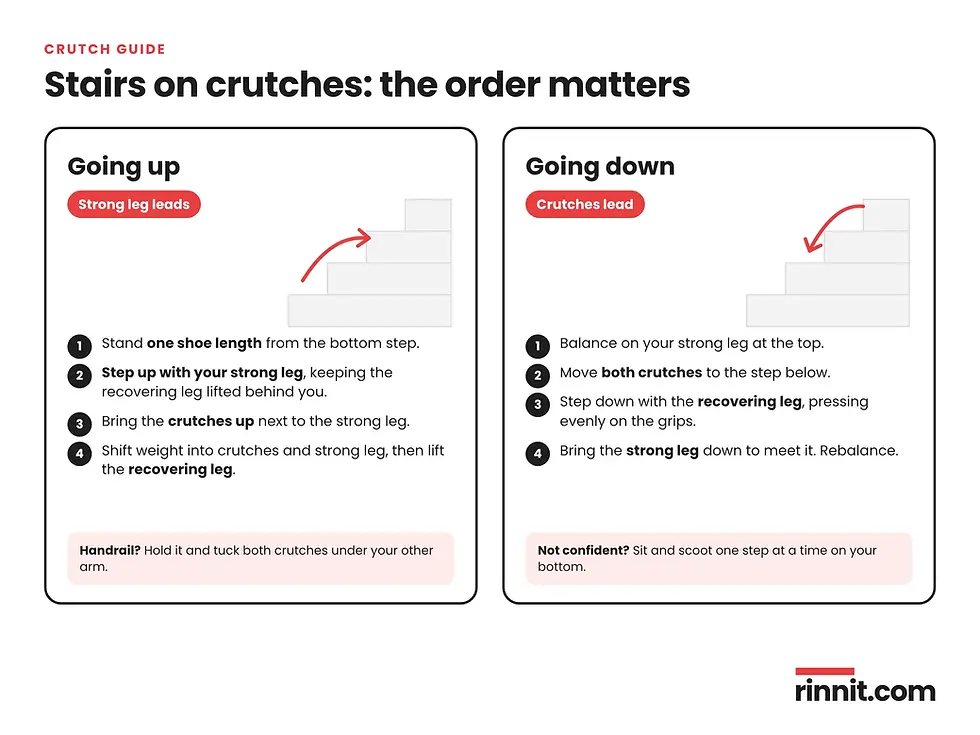
Go slowly, rebalance on each step, and have someone help you if you can. [1]
Method | Steps |
With a handrail | Stand a shoe length from the bottom step → balance on your strong leg and hold the rail → tuck both crutches under the arm not holding the rail → step up with the strong leg, keeping the recovering leg lifted and slightly behind → rebalance |
Without a handrail | Stand a shoe length from the bottom step → use the crutches to help you step up with the strong leg → rebalance, then bring the crutches up beside the strong leg → shift all your weight into the crutches and strong leg, then bring the recovering leg up |
Seated (bottom-hop) | Sit on the lowest step facing away from the stairs → hold the recovering leg out → hold the crutches in the hand opposite the recovering leg → push up with the strong leg and free hand → rest and rebalance before each step |
Source: [1]
Feeling unsafe on crutch stairs is normal; the seated method is a fully acceptable choice. [1]
How do you go down stairs on crutches?
Going down stairs on crutches means moving the crutches and recovering leg down first, then bringing the strong leg down to meet them. [1]
Going down is often harder than going up, so make sure your strong leg is safely on the lower step before you shift your weight. [1]
Method | Steps |
With a handrail | Balance at the top → hold the rail and balance on your strong leg → tuck both crutches under the other arm → step down with the strong leg, holding the recovering leg out in front → rebalance |
Without a handrail | Balance on your strong leg at the top → move both crutches to the step below → step down with the recovering leg to meet the crutches, pressing evenly on the grips → bring the strong leg down → rebalance |
Seated (scoot down) | Sit on the top step facing down → hold the recovering leg out in front → hold the crutches in the hand opposite the recovering leg → slide down one step using the strong leg and free hand to brace → rebalance before each step |
Source: [1]
What safety tips prevent falls on crutches?
The main safety rules for crutches are good equipment, clean tips, dry floors, a clutter-free home, and using them for the full time prescribed. [1]
Check | Why it matters |
Grooved rubber tips on the bottom | Gives grip on the floor |
Padding on the underarm supports and handgrips | Comfort and protection |
Remove stones, leaves, and debris from the tips after going outside | Debris can make you slip |
Take extra care on wet surfaces | Wet tips can be slippery |
Clear clutter at home and work | Prevents trips for you and others |
Keep using crutches as long as instructed | Stopping too soon can damage the surgery site or cause a new injury |
Source: [1]
When should you ask your care team for help?
You should ask your healthcare provider or physical therapist for help whenever your crutches feel uncomfortable, unsafe, or poorly fitted, or when you're unsure what your weight-bearing limit means. [1]
They can adjust your crutches, check that you're stable, and walk you through standing, sitting, walking, and stairs again. [1] Research shows people often overload the injured leg without realizing it, so a technique check is worth asking for. [3][4]
Conclusion
Using crutches well comes down to three habits: a correct fit, weight through the hands, and slow, balanced movement. Learn the right order for stairs, respect your weight-bearing instructions, and keep your path clear. Crutches feel awkward at first, but with practice they protect your healing leg and get you moving sooner.
Recovering from a leg injury? Explore our guides to a broken leg, an ACL tear, Achilles tendon rupture, knee replacement, and hip fracture for what to expect at every stage of recovery.
FAQ
How high should crutches be?
Underarm crutches should be set so the top sits two finger widths below your armpits and the handgrips sit near your hips. Ask your provider or physical therapist to help adjust them before first use. [1]
Should crutches go under your armpits?
Crutches should not press into your armpits. Your weight goes through your hands on the handgrips, because leaning on the armpit pads can hurt your shoulders and the nerves and blood vessels under your arms. [1]
Which leg goes first when walking with crutches?
The crutches and the recovering leg move forward first, at the same time. You then press evenly on both handgrips and step through with your strong leg. [1]
Which side do you hold one crutch on?
One crutch goes on the side opposite your recovering leg. Step forward with the recovering leg and the crutch together. [1]
How do you go up and down stairs on crutches?
Going up stairs on crutches, the strong leg leads; going down, the crutches and recovering leg lead. If you don't feel safe, you can sit and move one step at a time on your bottom. [1]
What does weight bearing as tolerated mean?
Weight bearing as tolerated means you can put your full weight on the leg as long as it doesn't cause pain or other symptoms. Don't push beyond that unless your provider says it's OK. [1]
Is walking on crutches tiring?
Walking on crutches is tiring for most people. In healthy adults, non-weight-bearing crutch walking measured about 4.57 METs on level ground and 5.06 METs on stairs. [2]
Can I stop using crutches when I feel better?
Stopping crutches early is not advised. Use them for as long as your provider tells you, because stopping too soon can damage a surgery site or cause another injury. [1]
How do you sit down with crutches?
Back up until your good leg touches the chair, move both crutches to one hand and reach back for the armrest or seat with your other hand. Lower yourself slowly while keeping your injured leg in front.
How can I prevent falls on crutches?
Clear rugs, cords and clutter from your path, keep floors dry and wear flat shoes with good grip. Take your time, especially on stairs and wet or uneven ground.
Related Reading
How to Use a Cane: Sizing, Walking, Stairs and Safety Tips explains how to choose, fit and walk safely with a cane.
How to Use a Walker Safely covers walker fitting, walking technique and fall prevention.
Broken Ankle: Symptoms, Causes, Treatment & Complete Guide explains how a broken ankle is treated and how it heals.
Sprained Ankle: Symptoms, Causes, Treatment & Complete Guide covers sprained ankle symptoms, home care and recovery.
References
Cleveland Clinic. Crutches: What They Are, Types & How To Use Properly. Cleveland Clinic. Last updated November 12, 2025. https://my.clevelandclinic.org/health/treatments/15543-how-to-use-crutches
Moran J, Murphy A, Murphy D, et al. The energy expenditure of non-weight bearing crutch walking on the level and ascending stairs. Gait & Posture. 2015;42(1):23-26. PMID 25891530. https://doi.org/10.1016/j.gaitpost.2014.10.024
Fu MC, DeLuke L, Buerba RA, et al. Haptic biofeedback for improving compliance with lower-extremity partial weight bearing. Orthopedics. 2014;37(11):e993-e998. PMID 25361376. https://doi.org/10.3928/01477447-20141023-56
Merkle TP, Hofmann N, Schmidt J, et al. Continuous real-time biofeedback in orthosis improves partial weight bearing on stairs. Archives of Orthopaedic and Trauma Surgery. 2023;143(9):5701-5706. PMID 37219597. https://doi.org/10.1007/s00402-023-04878-y
Disclaimer
This article is for general education and does not replace advice from your doctor, surgeon, or physical therapist. Follow the crutch type, fit, and weight-bearing instructions your care team gives you, and seek medical care if you fall, have new or worsening pain, or feel unsafe moving on crutches.



Comments