How to Use a Cane: Sizing, Walking, Stairs and Safety Tips

Updated: 3 days ago
Written and medically reviewed by Dr. Baraa Alnahhal, MD · Last reviewed: November 2026 · How we review
Quick Answer: How do you use a cane correctly?
To use a cane, hold it in the hand opposite your weaker leg, set the handle level with the crease of your wrist so your elbow bends 20 degrees, and move the cane forward with your weaker leg. Then step through with your stronger leg. On stairs, lead with the stronger leg going up and the weaker leg going down. [1]
What the research says
Daily cane use eased knee osteoarthritis pain within two months. In a randomized trial of 64 adults with knee osteoarthritis, people who used a cane every day for 2 months had less pain and better function than people who did not. Walking took more energy in the first month, but by the second month this extra effort had faded as people adapted. (Jones et al., Annals of the Rheumatic Diseases, 2012) [2]
A cane helps symptoms but may not change the joint itself. In a 3-month randomized trial of 79 adults with knee osteoarthritis on the inner side of the knee, using a cane whenever walking (about 2.3 hours a day on average) did not shrink bone marrow lesions seen on MRI compared with using no walking aid. (Van Ginckel et al., Osteoarthritis and Cartilage, 2019) [3]
Key takeaways
A cane is a walking stick with a handle that improves balance and takes some load off a weak, injured or painful leg. [1]
Hold the cane on the side opposite your weaker leg. If neither leg is weaker, use your non-dominant hand. [1]
The handle should line up with your wrist crease, with your elbow bent about 20 degrees. [1]
A cane safely supports only about 25% of your body weight, so people who need more support may need crutches or a walker. [1]
Never use a cane to push yourself up from a chair; use the armrest instead. [1]
What is a cane and who needs one?
A cane is a walking stick with a handle that adds stability and balance while you walk. Some people use one for a short time while they recover from an injury, surgery or illness, and others use one every day because they feel mildly unsteady on their feet. Using the right technique matters, because a cane that is held or sized wrongly can add strain and raise your risk of falling. [1]
A cane may help if you have: [1]
A recent injury, surgery or illness that has left one leg weaker
Changes in balance or strength that come with age
Long-term pain that gets worse when you walk or put pressure on a joint, such as arthritis
A neurological condition or nerve damage in the feet and legs (peripheral neuropathy)
A need to relearn walking after paralysis
What types of canes are there?
There are two main types of canes: single-point canes and multi-point canes. A healthcare provider, such as a physical therapist, can help you choose the type and fit that suit your body and your condition. [1]
Cane type | Best for | Trade-off |
Single-point (standard) cane | Orthopedic problems such as arthritis or back pain | Offers the least support of the cane types |
Multi-point cane (tripod or quad base) | People who need extra support and balance | Harder to walk with; some models have a pivoting base |
Sources: [1]
Many canes also come with extra features, such as ergonomic handles, fold-out seats, collapsible shafts and built-in LED lights. [1]
Which cane handle should you choose?
The handle you choose affects comfort and how weight passes through your hand. [1]
Handle type | What it offers |
Crook | The classic curved handle, suited to occasional use |
Derby | A curved handle that is easy to hold and hang up |
Fritz | A crutch-style handle that can be easier on hands with arthritis |
Offset | Places more of your weight over the shaft of the cane |
Orthopedic grip | A shaped grip that spreads pressure across the palm |
Palm grip | A grip molded to fit one specific hand |
Sources: [1]
How do you size a cane?
You size a cane by standing tall and matching the top of the handle to the crease on the inside of your wrist. When you hold the grip, your elbow should bend about 20 degrees. [1]

The handle should sit at your wrist crease, with a slight bend in your elbow.
Put on the shoes you usually wear and stand upright with your shoulders relaxed.
Let your arms hang naturally at your sides.
Check that the top of the cane handle lines up with the crease of your wrist.
Hold the grip and check that your elbow bends about 20 degrees. Adjust the cane height if it does not.
Sources: [1]
How do you hold a cane?
Hold the cane in the hand opposite your weaker or injured leg. If neither leg is weaker, hold it in your non-dominant hand. [1]
Keep the cane at your side, about 4 to 6 inches (10 to 15 cm) from your leg.
Grip the handle with your palm facing down.
When you are standing still, keep the cane in line with your opposite foot and lean on it only when you feel yourself wavering.
Sources: [1]
How do you walk with a cane?
Walking with a cane follows a simple four-step pattern: the cane and the weaker leg move together, and the stronger leg follows. [1]

The cane and your weaker leg always move together.
Move your weaker leg and the cane (in the opposite hand) forward at the same time.
Put as much weight on the cane as you need to ease the load on your weaker leg.
Bring your stronger leg forward beside the cane and shift your weight onto it.
Repeat, keeping your posture upright and looking ahead rather than at your feet.
Sources: [1]
How do you use a cane on stairs?
On stairs, remember one rule: lead with your stronger leg going up and with your weaker leg going down. Whenever you can, hold the railing with the hand on the side opposite the cane. [1]
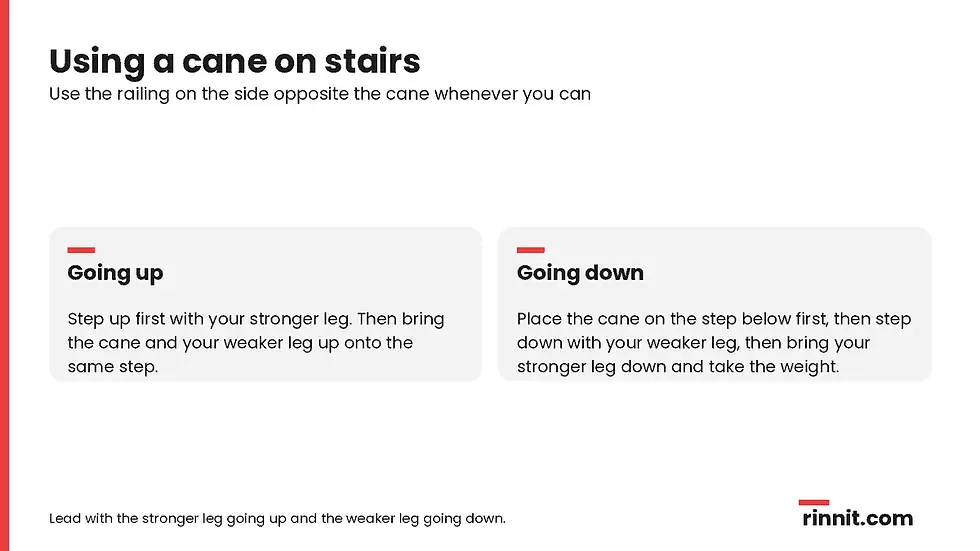
Up with the stronger leg, down with the weaker leg.
Going up stairs
Hold the railing with your free hand, if there is one.
Step up with your stronger leg.
Bring the cane and your weaker leg up onto the same step.
Going down stairs
Hold the railing with your free hand, if there is one.
Place the cane on the step below.
Step down with your weaker leg.
Bring your stronger leg down and take your weight onto it.
Sources: [1]
How do you sit down and stand up safely?
Do not use your cane to help you sit down or stand up. A cane is not built to take that kind of pushing force. Instead, use the chair armrest with your opposite hand to lower yourself down or push yourself up. [1]
What are the benefits and limits of a cane?
The main benefit of a cane is support for mild to moderate unsteadiness or discomfort while walking. It can help you stay independent and keep active. [1]
A cane does have limits. It offers less support than crutches or a walker, and it can safely support only about 25% of your body weight. If you need to put a lot of weight through a walking aid, or you lack the upper-body strength or upright posture to use a cane well, a different device may suit you better. [1]
Question | What to know |
How much support does a cane give? | Less than crutches or a walker |
How much weight can it safely take? | About 25% of your body weight |
Who may struggle with a cane? | People who need heavy support or lack upper-body strength or upright posture |
Sources: [1]
If you are recovering from joint surgery, our guides to Hip Replacement Surgery: Procedure, Recovery Time and Risks and Knee Replacement: Restoring Mobility and Quality of Life explain what recovery usually looks like.
How do you stay safe with a cane?
A few simple habits lower your risk of slipping or falling while you use a cane. [1]
Check the tip. Make sure the rubber tip has good tread and replace it when it wears down. Winter tips are available for icy ground.
Clear your walkways. Remove loose rugs, cords and spills, and avoid wet or freshly waxed floors.
Wear supportive shoes. Choose shoes with low, closed heels and non-slip soles, and double-knot your laces.
Get a proper fitting. A cane that is the wrong size, or used with the wrong technique, can increase strain and the chance of a fall.
Sources: [1]
When should you talk to a healthcare provider?
Talk to a healthcare provider, such as your doctor or a physical therapist, before you start using a cane. They can help you pick the right type, set the correct height and teach you safe technique. Check back with them if walking with the cane still feels unsteady, if you find yourself leaning on it heavily, or if your needs change, because you may need a device that gives more support. [1]
Conclusion
A cane is a simple tool that can make walking steadier and more comfortable, but it only works well when it fits and is used the right way. Hold it on the side opposite your weaker leg, set the handle at your wrist crease, move it together with your weaker leg and follow the up-with-the-stronger, down-with-the-weaker rule on stairs.
Pair good technique with a safe home, a sound cane tip and supportive shoes, and ask a physical therapist to check your fit so your cane helps you stay active and independent.
Keep learning: Read our guide to What is Knee Osteoarthritis? to understand one of the most common reasons people start using a cane, or see this patient guide on using a cane for more practical tips.
FAQ
How do I know what height my cane should be?
Stand upright in your usual shoes with your arms at your sides. The top of the cane handle should line up with the crease of your wrist, and your elbow should bend about 20 degrees when you hold the grip. [1]
Which hand should I hold my cane in?
Hold the cane in the hand opposite your weaker or injured leg. If neither leg is weaker, hold it in your non-dominant hand. [1]
How far from my body should I hold the cane?
Keep the cane at your side, about 4 to 6 inches (10 to 15 cm) from your leg, with your palm facing down on the handle. [1]
How do I walk with a cane?
Move the cane and your weaker leg forward together, lean on the cane as needed, then bring your stronger leg forward beside the cane and shift your weight onto it. Keep your posture upright and look ahead. [1]
How do I go up stairs with a cane?
Step up first with your stronger leg, then bring the cane and your weaker leg up onto the same step. Hold the railing on the side opposite the cane if you can. [1]
How do I go down stairs with a cane?
Place the cane on the step below first, then step down with your weaker leg, and finally bring your stronger leg down and take your weight onto it. [1]
What type of cane is best?
A standard single-point cane suits orthopedic problems such as arthritis or back pain. A tripod or quad cane gives more support and balance but is harder to walk with. A healthcare provider can help you choose. [1]
How much weight can a cane support?
A cane can safely support only about 25% of your body weight. If you need more support than that, crutches or a walker may be a better choice. [1]
Can I use my cane to help me stand up?
No. Do not use a cane to help you sit down or stand up. Use the chair armrest with your opposite hand instead. [1]
When should I replace my cane tip?
Replace the rubber tip when its tread is worn. Winter tips are available to give better grip on icy surfaces. [1]
Related Reading
Joint pain and walking: What is Knee Osteoarthritis?
Balance and nerve damage: Peripheral Neuropathy: Symptoms, Causes, and Treatment Options Explained
Preventing falls: Slip and Fall Injury: Types, Causes, Complications, Diagnosis, Treatment and Prevention — What You Need to Know
References
Cleveland Clinic. How To Use a Cane: Sizing, Safety, Training, Use & Stairs. Cleveland Clinic. Last updated April 19, 2024. https://my.clevelandclinic.org/health/procedures/how-to-use-a-cane
Jones A, Silva PG, Silva AC, et al. Impact of cane use on pain, function, general health and energy expenditure during gait in patients with knee osteoarthritis: a randomised controlled trial. Ann Rheum Dis. 2012;71(2):172-179. PMID 22128081. https://doi.org/10.1136/ard.2010.140178
Van Ginckel A, Hinman RS, Wrigley TV, et al. Effect of cane use on bone marrow lesion volume in people with medial tibiofemoral knee osteoarthritis: randomized clinical trial. Osteoarthritis Cartilage. 2019;27(9):1324-1338. PMID 31121294. https://doi.org/10.1016/j.joca.2019.05.004
Medical disclaimer
This article is for general education only and does not replace advice from a qualified healthcare professional. Talk to your doctor or physical therapist about your own needs before using a walking aid, and seek emergency care right away after a fall with severe pain, head injury or new weakness.



Comments