Broken Foot: Symptoms, Causes, and Treatment

Updated: 3 days ago
Medically reviewed by Dr. Baraa Alnahhal, MD · Last reviewed: October 2026

Quick answer
A broken foot is an injury to one or more bones in the foot, from a tiny crack to a break through the skin. It causes throbbing pain, swelling and bruising. Get help right away if the foot loses its shape, bone pokes through the skin or there is numbness. Treatment usually includes rest, ice and a cast or boot. [1] [2]
What the research says
According to PubMed:
Many small foot breaks do better with early movement than with long immobilization. A systematic review of fifth metatarsal base fractures (about 30% of metatarsal fractures) found that in one randomized trial, patients given functional therapy returned to work much sooner than those treated with immobilization (11 vs 28 days, p = 0.001), with otherwise similar outcomes; fractures in the farthest zone (zone III) were better treated with surgery. (Herterich et al., DOI).
Stress fractures take different amounts of time to heal depending on the bone. A meta-analysis of 76 studies covering 2,974 bone stress injuries found more than 90% of athletes returned to sport, with the longest return time for the tarsal navicular (127 days) and complication rates highest in the tarsal navicular and fifth metatarsal. (Hoenig et al., DOI).
Smoking is linked to slower bone healing. A systematic review of 12 observational studies of tibial shaft fractures found smoking was associated with higher rates of non-union and delayed union and longer time to union, although the difference reached statistical significance in only some of the individual studies. (Mahajan et al., DOI).
Study details are from PubMed abstracts.
What is a broken foot?
A broken foot means one or more of the bones in the foot are injured. A sudden fall or blow, or a heavy object dropped on the foot, is the most common way it happens. Fractures come in many degrees of severity. Some are tiny cracks in the bone. Others break more than one bone, and the most serious kinds come through the skin [1].
Treatment always depends on two things: where the bone breaks and how bad the break is. A badly broken foot bone may need surgery to put plates, rods, or screws into the broken pieces to hold them in place while they heal [2].

Key fact | What it means |
What it is | An injury to one or more of the bones in the foot [1] |
Who gets it | Anyone can be injured by a fall, a blow, or a heavy object dropped on the foot [1] |
Most common causes | Car accidents, falls, heavy weight impact, missteps, and overuse [1] |
Typical diagnosis | Physical exam plus X-ray; a bone scan, CT, or MRI when more detail is needed [2] |
Typical treatment | Ice, elevation, rest, a cast or boot, and an over-the-counter pain reliever [2] |
First step |
What are the symptoms of a broken foot?
A broken foot bone might cause some of these symptoms [1]:
Symptom | What you may notice |
Instant throbbing pain | Pain that starts right away after the injury [1] |
Activity-related pain | Pain that gets worse with activity and gets better with rest [1] |
Swelling | The foot or ankle looks puffy or enlarged [1] |
Bruising | Discoloration of the skin around the injury [1] |
Tenderness | The injured area hurts when touched [1] |
Deformity | A change in the typical shape of the foot [1] |
Trouble walking | Pain or difficulty putting weight on the foot [1] |
Open fracture | Bone sticking through the skin [1] |
Warning signs: when to see a doctor
See a healthcare professional if your foot has lost its shape, if the pain and swelling do not get better with self-care, or if the pain and swelling get worse over time. It is possible to walk on some fractures, so do not assume you do not need medical care just because you can still put weight on your foot [1].
What causes a broken foot?
The most common causes of a broken foot include [1]:
Cause | How it happens |
Car accidents | Crushing injuries from car accidents may cause breaks that need surgery to fix [1] |
Falls | Tripping and falling can break bones in the feet, and so can landing on the feet after jumping down from a height [1] |
Heavy weight impact | Dropping something heavy on the foot is a common cause of fractures [1] |
Missteps | A stumble can cause a twisting injury that breaks a bone, and stubbing a toe on furniture can break a toe [1] |
Overuse | Repeated force over time, such as running long distances, most often causes tiny cracks called stress fractures in the weight-bearing bones of the feet [1] |
Stress fractures deserve special attention because they behave differently from sudden breaks. They are tiny cracks in the weight-bearing bones of the feet, caused by repeated force or overuse over time. Running long distances is the most common cause. Stress fractures can also happen with regular use of a bone that has been weakened by a condition such as osteoporosis [1].
What are the risk factors for a broken foot?
You may be at higher risk of a broken foot or ankle if you [1]:
Risk factor | How it raises the risk |
High-impact sports | Stresses, direct blows, and twisting injuries in sports such as basketball, football, gymnastics, tennis, and soccer can cause foot bone breaks [1] |
Poor technique or equipment | Not warming up raises injury risk, and worn or ill-fitting shoes increase the risk of stress fractures and falls [1] |
Sudden activity increase | Suddenly boosting how long, hard, or often you exercise increases stress fracture risk, whether you are a trained athlete or just starting out [1] |
Certain jobs | Workplaces such as construction sites put you at risk of falling from a height or dropping something heavy on your foot [1] |
Cluttered or dark home | Walking around a cluttered or poorly lit house may lead to falls and foot injuries [1] |
Osteoporosis | Decreased bone density puts you at risk of injuries to your foot bones [1] |
Smoking | Smoking can increase the risk of osteoporosis, and healing after a break may take longer in people who smoke [1] |
What complications can a broken foot cause?
Complications of a broken foot bone are not common, but they may include [1]:
Complication | Why it happens |
Arthritis | Fractures that extend into a joint can cause arthritis years later. If your foot starts to hurt long after a break, see your healthcare professional [1] |
Bone infection (osteomyelitis) | If one end of the bone pokes through the skin in an open fracture, the bone may be exposed to bacteria that cause infection [1] |
Nerve or blood vessel damage | Trauma can injure or tear nerves and blood vessels. Seek help right away for numbness or poor blood flow, because lack of blood flow can cause a bone to die, called avascular necrosis [1] |
Compartment syndrome | This rare condition with foot fractures causes pain, swelling, numbness, and sometimes the inability to use the affected muscles of the foot [1] |
How is a broken foot diagnosed?
Your healthcare professional will look at your ankle, foot, and lower leg and check for tenderness. Moving your foot around can show your range of motion, and your professional might watch how you walk [2].
Imaging tests
To diagnose a broken foot, your healthcare professional might order one or more of these imaging tests [2].
Test | What it shows |
X-ray | Most foot fractures can be seen on X-rays, though stress fractures often do not show up until the break starts healing [2] |
Bone scan | A technician injects a small amount of radioactive material into a vein, and damaged bones, including stress fractures, show up as bright spots on the image. This can find breaks that do not show on X-rays [2] |
CT scan | X-ray techniques create detailed images of the bones from different angles, showing more detail about the injured bone and the soft tissues that surround it [2] |
MRI | Radio waves and a strong magnetic field create detailed images of the soft tissues in the foot and ankle, and can show breaks not seen on X-rays [2] |
How is a broken foot treated?
Treatments for a broken foot vary depending on which bone is broken and how bad the injury is [2].
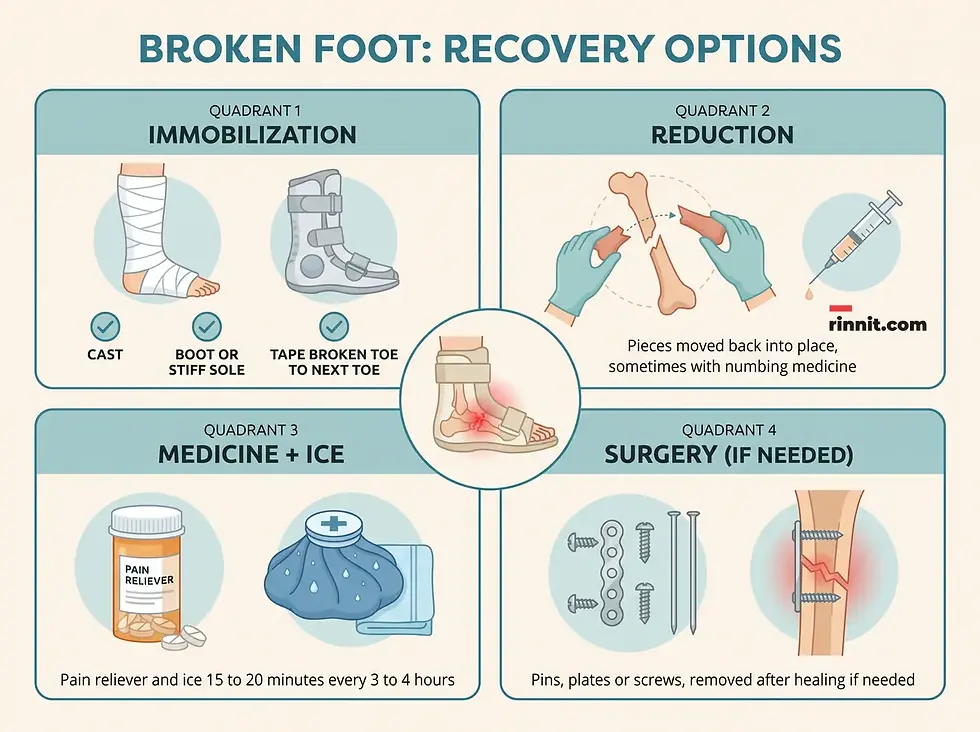
Medicines
Your healthcare professional may suggest a pain reliever available without a prescription, such as acetaminophen [2].
Therapy
After your bone heals, you need to restore the motion and strength of your foot and ankle. A physical therapist can teach you exercises to help you restore full motion and build strength [2].
Reduction and immobilization
If you have a displaced fracture, meaning the two ends of the fracture are not aligned, your healthcare professional may need to move the pieces back into place. This process is called reduction. You may need medicine to relax your muscles, calm you, or numb the area before this procedure [2].
Most often, a broken bone must be kept from moving so that it can heal. This is called immobilization, and a cast most often holds the foot in place. Minor foot fractures may need only a brace you can take off, or a boot or shoe with a stiff sole. A broken toe can be taped to the next toe, with a piece of gauze between them, to keep the broken toe still [2].
Surgery
In some cases, a surgeon who specializes in bones and joints, called an orthopedic surgeon, may use pins, plates, or screws to keep a bone in place while it heals. These materials may be removed after the break has healed, or if they stick out of the skin or cause pain [2].
What should you do for a broken foot before seeing a doctor?
If your injury is not bad enough for you to go to an emergency room, here are some things you can do at home until you can see your healthcare professional [2]:
Step | What to do |
Ice | Apply ice for 15 to 20 minutes at a time, every 3 to 4 hours, to lessen the swelling [2] |
Elevate | Keep your foot and ankle raised above the level of your heart to limit swelling [2] |
Rest | Do not put weight on your injured foot [2] |
Wrap | Lightly wrap the injury in a soft bandage that provides slight pressure [2] |
How can you prevent a broken foot?
These sports and safety tips may help prevent a broken foot bone [1]:
Wear proper shoes. Use hiking shoes on rough terrain, and choose the right athletic shoes for your sport. Replace athletic shoes when needed. Get rid of shoes as soon as the tread or heel wears out, or if the wear is not even. If you are a runner, replace your shoes every 300 to 400 miles [1].
Start slowly. That applies to a new fitness program and to every workout you do. Have a balanced fitness program. A balanced fitness program includes aerobic fitness to work your heart, strength training to build muscles, and movements that put your joints through their full range of motion, called flexibility [1].
Build bone strength. Get enough calcium and vitamin D. Calcium-rich foods include dairy products, leafy greens, and tofu. Ask your healthcare professional if you need to take vitamin D supplements. Use night lights. Many broken toes are the result of walking in the dark. Get rid of clutter in your home. Keeping clutter off the floor can help you avoid tripping and falling [1].
How should you prepare for a broken foot appointment?
You will likely seek treatment for a broken foot bone in an emergency room or urgent care clinic. If the pieces of broken bone are not lined up for healing, you may be referred to a doctor specializing in orthopedic surgery [2].
What you can do. You may want to write a list that includes your symptoms and how they began, other medical conditions you have, all the medicines, vitamins, and supplements you take including doses, and questions to ask the healthcare professional [2].
Questions to ask. Useful questions for a broken foot include: What tests do I need? What treatments are there, and which do you suggest? If I need a cast, how long will I need to wear it? Will I need surgery? How much will I need to limit my activities? Should I see a specialist? What pain medicines do you suggest [2]?
What to expect from your doctor. Your healthcare professional may ask how you injured yourself, whether your symptoms came on suddenly, whether you have injured your feet in the past, and whether you recently began an exercise program or started exercising more or harder [2].
Conclusion
A broken foot can happen to anyone, and the warning signs are usually easy to recognize: instant throbbing pain, swelling, bruising, and trouble putting weight on the foot. What surprises many people is that you can sometimes still walk on a broken foot, which is why any foot that has lost its shape or will not stop hurting deserves a professional look.
Most fractures heal well with simple care. Ice, elevation, rest, and a cast or walking boot handle the majority of cases, and only badly displaced breaks need surgery. Protecting your feet before an injury, through proper footwear and gradual increases in activity, is the best medicine of all.
Next steps: Learn to recognize the signs of a broken foot — instant throbbing pain, swelling, bruising, and trouble bearing weight — and see a healthcare professional promptly if the foot has lost its shape, pain and swelling are not improving, or you notice numbness.
Frequently asked questions
Can you walk on a broken foot?
Yes, it is possible to walk on some fractures. Being able to put weight on your foot does not mean the bone is fine, so do not skip medical care just because you can still stand or walk on it [1].
How long does a broken foot take to heal?
Healing time depends on which bone broke and how bad the break is. Most minor fractures need a cast or boot for several weeks, while badly broken bones that need surgery take longer, and smoking may slow healing further [1] [2].
How do I know if my foot is broken or just sprained?
A break often causes instant throbbing pain, visible swelling or bruising, and sometimes a change in the foot's shape. Because pain, swelling, and trouble bearing weight can happen with both breaks and sprains, an X-ray or other imaging test is the only way to know for sure [1] [2].
What should I do for a broken foot at home before seeing a doctor?
Apply ice for 15 to 20 minutes at a time every 3 to 4 hours, keep the foot raised above the level of your heart, avoid putting weight on it, and lightly wrap it in a soft bandage with slight pressure [2].
Will I need surgery for a broken foot?
Not always. Many broken feet heal with a cast, boot, or brace, and a broken toe can simply be taped to the next toe. Surgery with pins, plates, or screws is used when the broken pieces cannot be aligned without it [2].
This article is for general education and is not a substitute for professional medical advice, diagnosis, or treatment. Always consult a qualified healthcare professional about your individual situation.
Related Reading
Foot X-Ray: What It Shows, Why It's Done, What to Expect and Results explains the imaging test commonly used to diagnose this condition in the foot and ankle.
References
Mayo Clinic Staff. Broken foot - Symptoms and causes. Mayo Clinic. March 1, 2024. https://www.mayoclinic.org/diseases-conditions/broken-foot/symptoms-causes/syc-20355492
Mayo Clinic Staff. Broken foot - Diagnosis and treatment. Mayo Clinic. March 1, 2024. https://www.mayoclinic.org/diseases-conditions/broken-foot/diagnosis-treatment/drc-20355498
American Academy of Orthopaedic Surgeons. Toe and Forefoot Fractures. OrthoInfo. Accessed October 15, 2026. https://www.orthoinfo.org/diseases--conditions/toe-and-forefoot-fractures/
American Orthopaedic Foot & Ankle Society. Broken Foot or Toes (Forefoot & Toe Fractures) Symptoms & Causes. FootCareMD. Accessed October 15, 2026. https://www.footcaremd.org/foot-and-ankle-conditions/toes/broken-foot-toes
Herterich V, et al. Fifth Metatarsal Fracture–A Systematic Review of the Treatment of Fractures of the Base of the Fifth Metatarsal Bone. Dtsch Arztebl Int. 2021;118(35-36):587-594. PMID 34789369. https://doi.org/10.3238/arztebl.m2021.0231
Hoenig T, et al. Return to sport following low-risk and high-risk bone stress injuries: a systematic review and meta-analysis. Br J Sports Med. 2023;57(7):427-432. PMID 36720584. https://doi.org/10.1136/bjsports-2022-106328
Mahajan A, et al. Delayed Tibial Shaft Fracture Healing Associated with Smoking: A Systematic Review and Meta-Analysis of Observational Studies Conducted Worldwide. Int J Environ Res Public Health. 2021;18(19). PMID 34639529. https://doi.org/10.3390/ijerph181910228



Comments