Broken Leg: Symptoms, Causes, and Treatment

Updated: 3 days ago
Medically reviewed by Dr. Baraa Alnahhal, MD · Last reviewed: October 2026

Quick answer
A broken leg is a break or crack in the femur, tibia or fibula. It causes serious pain, especially when moving, plus swelling, bruising and sometimes a bent or twisted leg. A suspected thighbone fracture or any high-impact crash is an emergency. Milder breaks heal with a splint or cast, while complex fractures may need surgery. [1] [2]
What the research says
According to PubMed:
Most children's shinbone breaks heal in a cast. A meta-analysis of 11 studies (1,083 children with closed tibial shaft fractures) found about 75% were treated without surgery; the total complication rate was higher with flexible intramedullary nailing than with nonoperative care (24% vs 9%), and alignment had to be corrected surgically in 5% of those first treated without surgery. (Stenroos et al., DOI).
For adult thighbone fractures, the type of rod matters. A meta-analysis of 8 randomized trials (1,078 patients) found reamed intramedullary nailing was associated with shorter time to union (SMD −0.62), lower nonunion (OR 0.14), and fewer reoperations (OR 0.25) than unreamed nailing, without more blood loss or deaths. (Li et al., DOI).
Stress fractures heal at different speeds depending on the bone. A meta-analysis of 76 studies covering 2,974 bone stress injuries found more than 90% of athletes returned to sport, with the shortest return times for the back-inner part of the shinbone shaft (44 days) and the fibula (56 days), and higher complication rates for the front of the shinbone shaft. (Hoenig et al., DOI).
Study details are from PubMed abstracts.
What is a broken leg?
The leg contains three major bones. The femur (thigh bone) is the strongest bone in the body, and the tibia (shinbone) and fibula make up the lower leg. A broken leg — medically called a leg fracture — is a break or crack in any of them [1].
Common causes are falls, motor vehicle accidents, and sports injuries. How a broken leg is treated depends on where the injury sits and how serious the break is [1].
Key fact | What it means |
Most common causes | Falls, car or motorcycle crashes, contact sports [1] |
Strongest bone affected | The femur takes great force to break [1] |
Less obvious breaks | Tibia and fibula fractures, especially when the bone stays in place [1] |
Emergency triggers | High-impact crashes and suspected thighbone fractures [1] |
Typical healing tools | Splint, cast, crutches, pain relief, and sometimes surgery [2] |
What are the symptoms of a broken leg?
How obvious a broken leg looks depends on which bone is broken. A broken thighbone is usually unmistakable because of the severity of the injury. Breaks in the shinbone or fibula may be less obvious, especially if the injury is mild or the bone stays in place [1].
Watch for these symptoms [1]:
Serious pain, especially when moving the leg
Swelling around the injured area
Tenderness to the touch
Bruising
A bent or twisted leg, or a leg that looks shorter than before the injury
Inability to walk or put weight on the leg
Toddlers and young children who break a leg may start limping or simply stop walking, even if they cannot explain why. That unexplained limp is worth a prompt medical visit [1].
What broken leg warning signs need emergency care?
Some leg injuries cannot wait. Get emergency medical help right away if the leg injury happened during a high-impact accident, such as a car or motorcycle crash. And get emergency care right away if you suspect a thighbone fracture — a broken thighbone is a serious and potentially life-threatening injury [1].
Warning sign | Why it matters |
Injury from a car or motorcycle crash | High-impact forces can break all three leg bones [1] |
Suspected thighbone (femur) fracture | Serious, potentially life-threatening injury [1] |
Numbness or skin color change | Possible nerve or blood vessel damage [1] |
Bone piercing the skin | Open fracture with high infection risk [2] |
Severe pain and swelling that keeps worsening | Possible compartment syndrome — needs surgery [1] |
What causes a broken leg?
A broken leg can happen in many ways. The most common causes are listed below [1].
Cause | How it happens |
Falls | A simple fall can break one or both lower leg bones; a stronger impact is needed for the thighbone [1] |
Car or motorcycle accidents | A crash can break all three leg bones, especially if your knees hit the dashboard [1] |
Sports injuries | Contact sports cause falls, sudden twists, or direct hits from a hockey stick or another player [1] |
Child abuse | In children, a broken leg may signal abuse, especially if the injury happens before the child can walk [1] |
Overuse | Repeating the same movement (such as long-distance running) causes stress fractures — tiny cracks in weight-bearing bones [1] |
Stress fractures are more likely when the bone is already weakened by a condition such as osteoporosis [1].
What are the risk factors for a broken leg?
Certain activities and health conditions raise the odds of a leg fracture. Stress fractures typically result from doing the same movement over and over. They are more likely with activities such as running, gymnastics, ballet dancing, basketball, and marching. Contact sports such as hockey and football add risk from direct hits or falls [1].
People who never play sports can still develop stress fractures, especially with health conditions that weaken the bones [1].
Risk factor | How it raises the odds |
Repetitive activities | Running, gymnastics, ballet, basketball, marching [1] |
Contact sports | Hockey and football — direct hits and falls [1] |
Osteoporosis | Decreased bone density weakens the bone [1] |
Diabetes | Raises stress fracture risk [1] |
Rheumatoid arthritis | Weakens the bones [1] |
What complications can an untreated or serious broken leg cause?
Most broken legs heal well with proper care. But serious fractures — or breaks that are not treated quickly — can lead to complications [1].
Complication | What happens |
Knee or ankle pain | Nearby joints can hurt even when not directly injured [1] |
Bone infection (osteomyelitis) | An open fracture exposes bone to germs [1] |
Delayed or poor healing | Serious breaks, especially open shinbone fractures, heal slowly because of lower blood flow to the shinbone [1] |
Nerve or blood vessel damage | Causes numbness, skin color change, or poor circulation — get help right away [1] |
Compartment syndrome | Rare but serious pain and swelling in the muscles around the break; may require surgery [1] |
Osteoarthritis | A fracture in a joint or healing out of alignment can cause arthritis years later [1] |
Uneven leg length (children) | A break through a growth plate can make one leg grow shorter or longer [1] |
Compartment syndrome is more common after high-impact injuries such as car or motorcycle crashes. A growth plate is the area near the ends of a child's bones where bones grow [1].
How is a broken leg diagnosed?
Diagnosis starts with a physical exam. A healthcare professional checks the injured area for pain, swelling, an unusual shape, or an open wound [2].
X-rays typically show where the bone is broken and whether nearby joints are injured. When more detail is needed, a CT scan or MRI steps in. Stress fractures typically do not show up clearly on X-rays, so suspected stress fractures usually need a CT scan or MRI [2].

What are the treatment options for a broken leg?
Treatment depends on the type and location of the fracture. Stress fractures typically heal with rest and immobilization. Other fractures may need surgery for the best healing [2].
Six types of leg fractures
Fractures are identified by how the bone broke [2].
Type | What it means |
Open fracture | The bone pierces through the skin — serious, needs immediate treatment to prevent infection [2] |
Closed fracture | The broken bone does not pierce the skin [2] |
Incomplete fracture | The bone is cracked but not fully broken [2] |
Complete fracture | The bone is fully broken into two or more pieces [2] |
Displaced fracture | Fragments are not properly aligned — surgery may be needed [2] |
Greenstick fracture | The bone is cracked but not completely broken, like a green twig — common in children whose bones are softer [2] |
Setting the leg
Treatment typically begins in an emergency room or urgent care clinic. The care team examines the injury and uses a splint to keep the leg still and supported [2].
If the bone is out of place, the team may gently move the pieces back into the correct position before applying a splint or cast. This process is called reduction. A splint is often used first to allow swelling to go down. Once swelling improves, a cast is placed to hold the leg in position while it heals [2].
Immobilization
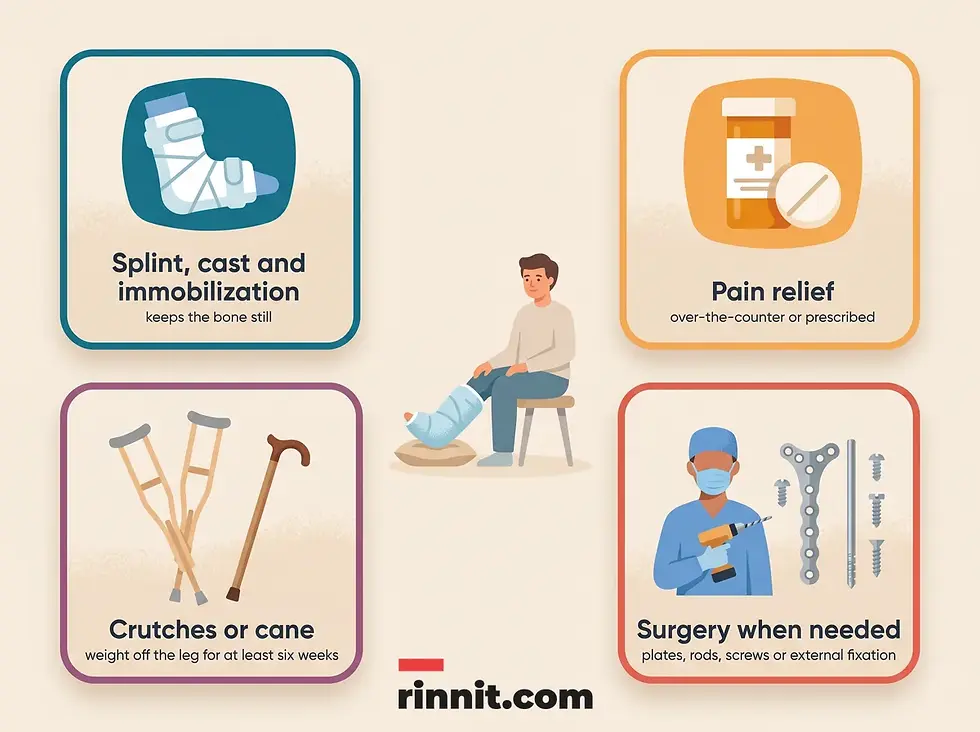
A broken bone must stay still to heal properly. A splint or cast keeps the bone from moving — this is called immobilization. You may need crutches or a cane to keep weight off the injured leg for at least six weeks [2].
Medications
An over-the-counter pain reliever such as acetaminophen (Tylenol, others) or ibuprofen (Advil, Motrin IB, others), or a combination of the two, can reduce pain and inflammation. For serious pain, a healthcare professional may prescribe stronger pain medicines [2].
Physical therapy
After the cast or splint comes off, physical therapy or exercises help lessen stiffness and get the leg moving again. Because the leg has not been used for a while, even muscles in uninjured areas may feel weak or tight. Rehab helps, but full recovery from a serious injury may take several months or longer [2].
Surgery and other procedures
Most broken bones heal with a cast or splint. Surgery is needed to hold the bones in position with metal plates, rods, or screws when certain conditions apply [2].
Surgery is more likely when... | Why |
There is more than one fracture | Multiple breaks are harder to stabilize [2] |
The fracture is unstable or out of alignment | Pieces must be realigned [2] |
Loose bone pieces could enter a joint | To protect the joint [2] |
Nearby ligaments are damaged | Extra stabilization is needed [2] |
The fracture goes into a joint | Joint involvement needs precise alignment [2] |
The injury is from crushing | Complex breaks need hardware [2] |
Some injuries are treated with external fixation: a metal frame outside the leg, attached to the bone with pins, keeps it stable while it heals. The frame is typically removed after about 6 to 8 weeks, with a small risk of infection around the surgical pins [2].
How can you prevent a broken leg?
A broken leg cannot always be prevented. But a few basic habits reduce the risk [1].
Prevention step | How it helps |
Build bone strength | Eat calcium-rich foods such as milk, yogurt, and cheese; ask your healthcare professional about calcium or vitamin D supplements [1] |
Wear proper athletic shoes | Choose the right shoes for your activity; replace them when the tread or heel is worn out or they wear unevenly [1] |
Cross-train | Mix running with swimming or biking to prevent stress fractures; alternate your direction on a sloped indoor track [1] |
How should you prepare for a broken leg appointment?
Depending on how serious the break is, you may be referred to an orthopedic surgeon for further evaluation and treatment [2].
Before your visit, make a list that includes details about your symptoms and the incident that caused them, information about past medical conditions, all the medicines and dietary supplements you take, and questions to ask your healthcare professional [2].
Useful questions to ask include: What tests are needed? What is the best course of action? Is surgery necessary? What are the alternatives to the primary treatment? What restrictions need to be followed? Should I see a specialist? What pain medicines do you recommend [2]?
Expect your healthcare professional to ask about how and when the injury occurred, other injuries or pain areas, past broken bones or an osteoporosis history, numbness or tingling in the injured area, whether you could stand and walk afterward, how serious the pain is, and what improves or worsens it. For injuries to children, the evaluation often includes routine questions to rule out intentional injury or child abuse [2].
Conclusion
A broken leg ranges from a tiny stress crack to a life-threatening thighbone fracture. The warning signs — serious pain with movement, swelling, bruising, deformity, and the inability to bear weight — are easy to recognize once you know them. Prompt imaging confirms the break, and treatment spans splinting, casting, and crutches to surgery with plates, rods, screws, or an external frame. With timely care and patience through months of recovery, most broken legs heal well.
Next steps: If you cannot bear weight after an injury, or the leg looks bent, twisted, or shorter, seek medical care right away. Go to the emergency room after a high-impact crash, if you suspect a thighbone fracture, or if there is numbness, a color change, or bone through the skin.
Frequently asked questions
Can you walk on a broken leg?
Sometimes, but it is risky. A milder break in the shinbone or fibula may allow partial weight-bearing, which is why some breaks go unrecognized. A thighbone fracture, however, usually makes walking impossible and is a medical emergency. If you cannot bear weight after an injury, get medical care right away [1].
How do you know if your leg is broken or just injured?
Look for serious pain that worsens with movement, swelling, tenderness, bruising, and a leg that looks bent, twisted, or shorter than before the injury. Only an X-ray can confirm a break. If you suspect a fracture — especially after a high-impact crash — seek emergency care [1] [2].
How long does a broken leg take to heal?
Immobilization with a splint or cast keeps the bone still, and you may need crutches or a cane for at least six weeks. After the cast comes off, physical therapy helps restore motion and strength. Full recovery from a serious injury may take several months or longer [2].
When does a broken leg need surgery?
Surgery with plates, rods, or screws is more likely when there is more than one fracture, the fracture is unstable or out of alignment, loose bone pieces could enter a joint, nearby ligaments are damaged, the break goes into a joint, or the injury came from crushing [2].
Why do stress fractures not show on X-rays?
Stress fractures are tiny cracks caused by repeated movement such as long-distance running, and they typically do not show up clearly on X-rays. If a stress fracture is suspected, a CT scan or MRI provides the detail needed to confirm it [2].
This article is for general education and is not a substitute for professional medical advice, diagnosis, or treatment. Always consult a qualified healthcare professional about your individual situation.
References
Mayo Clinic Staff. Broken leg - Symptoms and causes. Mayo Clinic. May 14, 2026. https://www.mayoclinic.org/diseases-conditions/broken-leg/symptoms-causes/syc-20370412
Mayo Clinic Staff. Broken leg - Diagnosis and treatment. Mayo Clinic. May 14, 2026. https://www.mayoclinic.org/diseases-conditions/broken-leg/diagnosis-treatment/drc-20370416
American Academy of Orthopaedic Surgeons. Tibial (shinbone) shaft fractures. OrthoInfo. Accessed October 14, 2026. https://www.orthoinfo.org/diseases--conditions/tibia-shinbone-shaft-fractures/
Centers for Disease Control and Prevention. Preventing falls and hip fractures. CDC. January 27, 2026. https://www.cdc.gov/falls/prevention/
Stenroos A, Puhakka J, Nietosvaara Y, et al. Treatment of closed tibia shaft fractures in children: a systematic review and meta-analysis. Eur J Pediatr Surg. 2020;30(6):483-489. PMID 31437858. https://doi.org/10.1055/s-0039-1693991
Li AB, Zhang WJ, Guo WJ, et al. Reamed versus unreamed intramedullary nailing for the treatment of femoral fractures: a meta-analysis of prospective randomized controlled trials. Medicine (Baltimore). 2016;95(29):e4248. PMID 27442651. https://doi.org/10.1097/MD.0000000000004248
Hoenig T, Eissele J, Strahl A, et al. Return to sport following low-risk and high-risk bone stress injuries: a systematic review and meta-analysis. Br J Sports Med. 2023;57(7):427-432. PMID 36720584. https://doi.org/10.1136/bjsports-2022-106328



Comments