Hip Revision Surgery: Why It's Done, What Happens, and How Recovery Works

Updated: 6 days ago
Written and medically reviewed by Dr. Baraa Alnahhal, MD · Last reviewed: October 2026 · How we review
Quick Answer: What is hip revision surgery?
Hip revision surgery is an operation that repairs or replaces an artificial hip joint after a hip replacement. It is done when the implant wears out, loosens, dislocates, becomes infected or is misaligned, or when the bone around it breaks. The surgeon replaces all or part of the old implant to relieve pain and restore movement. [1]
What the research says
More than half of hip replacements last 25 years. A pooled analysis of national joint registry data covering 215,676 hip replacements found that 57.9% were still working at 25 years, so many people will eventually need a revision. (Evans et al., Lancet, 2019) [2]
One-stage and two-stage infection revisions have similar reinfection rates when surgeons follow a clear plan. Across 14 studies and 1,429 patients, reinfection did not differ overall between the two approaches, but one-stage revision had higher reinfection (odds ratio 1.79) when no decision algorithm was used. (Qin et al., BMC Musculoskeletal Disorders, 2024) [3]
One-stage revision may give slightly better hip function. A review of 9 cohort studies (2,502 hips) found no difference in reinfection, while hip function scores were about 9 points higher after one-stage revision. (Lamo-Espinosa et al., Journal of the American Academy of Orthopaedic Surgeons, 2025) [4]
Key takeaways
Many artificial hips last 20 to 25 years or longer, depending on how much the joint is used. [1]
Wear and tear, loosening, dislocation, infection, a broken bone around the implant and poor alignment are the main reasons for revision. [1]
Most revisions take about two hours; severe infections may need two separate operations. [1]
Full recovery takes about six months, and physical therapy continues for about a year. [1]
Most revision surgeries reduce pain and improve range of motion, but success depends heavily on finishing rehabilitation. [1]
What is hip revision surgery?
Hip revision surgery is a procedure that repairs or replaces a prosthesis (artificial hip joint) that was placed during a previous hip replacement. [1]
The goal is simple: improve how the hip works and relieve pain. [1]
Hip revision surgery is not a common operation. [1]
Why would an artificial hip need revision surgery?
An artificial hip needs revision surgery when it is damaged, worn or no longer working properly, which can cause pain, discomfort and limited use of the hip. [1]
Like any mechanical part, a prosthesis does not last forever. Many artificial hips last 20 to 25 years or longer, and heavier use shortens that time. [1]

Reason | What it means |
Wear and tear | The implant parts wear down with normal daily use over the years |
Loosening | The implant is no longer firmly fixed to the bone |
Dislocation | The ball of the artificial joint slips out of its socket (learn about hip dislocation) |
Infection | Germs settle around the artificial joint |
Broken bone | A fracture forms in the bone around the prosthesis (learn about hip fractures) |
Alignment problems | The implant parts no longer line up correctly |
Source: [1]
Why is infection treated so seriously?
Infection around an artificial hip is treated seriously because it can weaken the muscles, tendons, ligaments and the hip bone itself. [1]
For this reason, a surgeon may recommend revision surgery to stop further damage, not only to relieve pain. [1]
How do you prepare for hip revision surgery?
Preparation for hip revision surgery starts about a month before the operation, when you meet your care team to talk through the procedure and its risks. [1]
At this visit, your team will:
Do a physical exam and take your medical history
Review all your medicines and supplements
Order tests such as blood work, a urine test, an EKG (heart tracing) and X-rays
Tell you which medicines are safe to keep taking and which to stop
Help you schedule physical therapy for after surgery [1]
Important: Do not stop any medicine on your own. Only stop a medicine when your provider says it is safe. [1]
How can you get your home ready?
You can get your home ready by making it easier and safer to move around while your hip heals. [1]
Home preparation | Why it helps |
Arrange help for the first few weeks | Daily tasks are harder early on |
Remove tripping hazards | Lowers the risk of a fall |
Move everyday items to waist or shoulder height | Avoids bending and reaching |
Set up a sleeping area on the main floor | Avoids stairs early in recovery |
Get an elevated toilet seat, shower seat and grabbing tool | Reduces strain on the new hip |
Quit or cut back on smoking | Supports healing |
Source: [1]
Why does dental care matter before surgery?
Dental care matters before hip revision surgery because germs from the mouth can cause an infection in the new joint. [1]
Your surgeon may ask you to have a dental cleaning and any cavities treated first. [1]
After surgery, you may need to wait three months before routine dental visits, unless there is an emergency. Ask your surgeon whether you need antibiotics before future dental work; most people with a joint replacement do not. [1]
What happens during hip revision surgery?
During hip revision surgery, the surgeon removes all or part of the artificial joint and replaces it with new parts. [1]
The operation takes about two hours. Your surgeon will give you a time estimate for your own case beforehand. [1]
When is hip revision done in two stages?
Hip revision is done in two stages when the hip has a more severe infection. [1]

Single-stage revision | Two-stage revision | |
Number of operations | One | Two |
Step 1 | Remove all or part of the old implant | Remove the artificial joint |
Step 2 | Place new implant parts in the same operation | Treat the infection with antibiotics |
Step 3 | Begin recovery | Once the infection clears, place a new hip joint |
When it is used | Standard revision | More severe infection |
Source: [1]
What is recovery like after hip revision surgery?
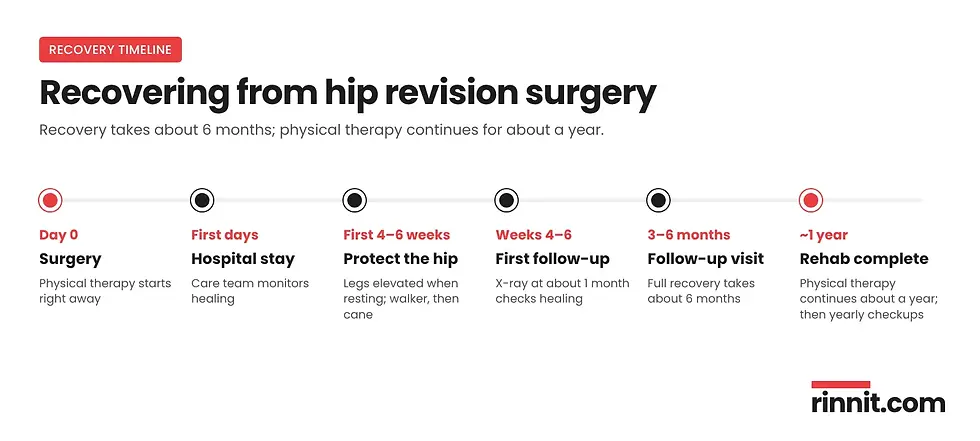
Recovery after hip revision surgery takes about six months, starting with a few days in hospital and continuing at home. [1]
During this time, you may limp and feel some pain. Everyday tasks such as getting into a car or climbing stairs will feel harder at first. [1]
What do you need to do at home?
At home, you will follow a care plan that protects the new hip and lowers the risk of complications. [1]
Take medicines for pain and to prevent blood clots as prescribed
Keep every appointment and physical therapy session
Elevate both legs on a pillow when resting, for four to six weeks
Exercise your legs as directed to reduce swelling
Use a walker first, then a cane once your doctor approves, until you can put full weight on the leg
Avoid stairs right after surgery, and use handrails once you start climbing them [1]
How long does physical therapy last?
Physical therapy after hip revision surgery starts right after the operation and continues in hospital and at home for about a year. [1]
Your therapist will track your strength, flexibility, standing and sitting. They will also tell you which activities are safe and when you can return to your normal routine. [1]
What is the follow-up schedule?
The follow-up schedule after hip revision surgery includes several visits in the first year, then a yearly check. [1]
When | What happens |
About 1 month | X-ray to check healing |
4–6 weeks | First follow-up visit |
3–6 months | Follow-up visit |
1 year | Follow-up visit |
Every year after | Annual check on the surgery anniversary |
X-rays are usually taken at most or all of these visits. [1]
What are the benefits and risks of hip revision surgery?
The main benefits of hip revision surgery are pain relief, better mobility and a return to normal activities. [1]
It can also improve the strength and coordination of the torso and leg. Most revision surgeries reduce pain and improve range of motion. [1]
Like any major operation, it also carries risks. Your surgeon will review your own risk level with you. [1]
Benefits | Possible risks |
Pain relief | Anesthesia complications affecting the lungs or heart |
Better mobility | Infection |
Stronger, better-coordinated torso and leg | Blood clots (pulmonary embolism) |
Return to normal activities | Scarring |
Improved range of motion | Nerve or blood vessel injury |
Joint weakness or instability | |
Need for another revision in the future |
Source: [1]
How successful is hip revision surgery?
Hip revision surgery is usually successful, as most procedures reduce pain and improve range of motion. [1]
Success depends heavily on you completing rehabilitation and physical therapy. Skipping exercises or appointments can slow or limit your recovery. [1]
When should you call your doctor after hip revision surgery?
You should call your doctor after hip revision surgery if you notice any sign of infection or a blood clot. [1]
Contact your provider if you have:
Increasing redness or skin colour changes near the incision
Severe pain or swelling
Drainage from the incision
New bumps or pimples near the wound
Any other concern about your recovery [1]
Contact your provider right away for calf pain, coughing, chest pain or trouble breathing, which can be signs of a blood clot. [1]
Conclusion
Hip revision surgery gives a worn, loose, infected or damaged artificial hip a second chance. The operation itself takes about two hours, but the real work happens afterward: months of physical therapy, careful home routines and regular X-ray checks. [1]
If your artificial hip has started to hurt, feels unstable or no longer moves the way it should, talk to your orthopedic surgeon. After surgery, attend every follow-up visit and keep up with physical therapy and strengthening exercises to regain your mobility. [1]
Keep learning with Rinnit: Explore our guides on hip arthritis, osteoporosis and bone strength, avascular necrosis and knee replacement, or learn how your joints work. Subscribe to Rinnit for clear, physician-reviewed health guides.
FAQ
What is hip revision surgery?
Hip revision surgery is an operation that repairs or replaces an artificial hip joint after a previous hip replacement. Its goal is to relieve pain and improve how the hip works.
How long does an artificial hip last before it needs revision?
Many artificial hips last 20 to 25 years or longer before they may need revision. How long it lasts depends on how much the joint is used.
What are the most common reasons for hip revision surgery?
The most common reasons for hip revision surgery are wear and tear, loosening, dislocation, infection, a broken bone around the implant and alignment problems. Each of these can cause pain and limit use of the hip.
How long does hip revision surgery take?
Hip revision surgery takes about two hours. If a severe infection is present, the treatment may be split into two separate operations.
How long is recovery after hip revision surgery?
Recovery after hip revision surgery takes about six months. Physical therapy continues in hospital and at home for about a year.
Will I need antibiotics before dental work after hip revision surgery?
Yes, you will need antibiotics before dental work after hip revision surgery. Routine dental visits are usually delayed for three months after surgery unless there is an emergency.
When should I call my doctor after hip revision surgery?
You should call your doctor after hip revision surgery if you notice increasing redness, severe pain or swelling, drainage from the incision, or new bumps near the wound. Calf pain, coughing, chest pain or trouble breathing also need a call right away.
What are the signs that a hip replacement may need revision?
Warning signs include new or worsening hip pain, a hip that feels loose or unstable, trouble walking or a change in leg length. See your surgeon if you notice these changes.
What is a two-stage hip revision?
When the hip has a more severe infection, the surgeon may remove the implant first and treat the infection. A new implant is placed in a second operation once the infection has cleared.
Is hip revision surgery harder than the first hip replacement?
Revision is usually more complex, because the surgeon must remove the old implant and may need to repair damaged bone. Recovery can take longer, so physical therapy is an important part of the plan.
Related Reading
Hip Replacement Surgery: Procedure, Recovery Time and Risks explains the first hip replacement operation and its recovery.
Periprosthetic Joint Infection (PJI): What Happens When an Artificial Joint Gets Infected covers how an infected artificial joint is found and treated.
Arthroplasty (Joint Replacement): Procedure, Types, and Recovery outlines the types of joint replacement and what recovery involves.
Hip Dislocation: Emergency Care, Symptoms, and Long-Term Recovery explains why a dislocated hip needs urgent care and how it heals.
References
Cleveland Clinic. Hip Revision Surgery: How To Prepare for Your Procedure. Cleveland Clinic. Last updated March 9, 2023. https://my.clevelandclinic.org/health/treatments/17104-hip-revision-surgery
Evans JT, Evans JP, Walker RW, et al. How long does a hip replacement last? A systematic review and meta-analysis of case series and national registry reports with more than 15 years of follow-up. Lancet. 2019;393(10172):647-654. PMID 30782340. https://doi.org/10.1016/S0140-6736(18)31665-9
Qin Y, Liu Z, Li L, et al. Comparative reinfection rate of one-stage versus two-stage revision in the management of periprosthetic joint infection following total hip arthroplasty: a meta-analysis. BMC Musculoskelet Disord. 2024;25(1):1056. PMID 39707249. https://doi.org/10.1186/s12891-024-08199-y
Lamo-Espinosa JM, Mariscal G, Gómez-Álvarez J, et al. One-Stage Versus Two-Stage Revision Surgery for Periprosthetic Hip Infection: An Updated Systematic Review and Meta-Analysis of Clinical Outcomes. J Am Acad Orthop Surg. 2025;33(7):e367-e379. PMID 39303283. https://doi.org/10.5435/JAAOS-D-24-00456
American Academy of Orthopaedic Surgeons. Revision Total Hip Replacement. OrthoInfo. Accessed October 31, 2026. https://www.orthoinfo.org/treatment/revision-total-hip-replacement
U.S. National Library of Medicine. Hip joint replacement. MedlinePlus. Last updated September 2, 2025. https://medlineplus.gov/ency/article/002975.htm
National Institute of Arthritis and Musculoskeletal and Skin Diseases. Hip Replacement Surgery. NIAMS. Last updated August 2023. https://www.niams.nih.gov/health-topics/hip-replacement-surgery
Medical disclaimer
This article is for general education only and does not replace advice from your doctor or surgeon. Always talk to a qualified healthcare professional about your own symptoms, test results and treatment options.



Comments