Herbst Appliance: How It Works, Who Needs One, and What to Expect

Updated: 6 days ago
Written and medically reviewed by Dr. Baraa Alnahhal, MD · Last reviewed: October 2026 · How we review
Quick Answer: What is a Herbst appliance?
A Herbst appliance is a usually fixed orthodontic device that holds the lower jaw forward to correct Class II bites such as a deep overbite, overjet or a small lower jaw. It works best in growing children and teens, usually ages 9 to 14, is often paired with braces, and is typically worn for about a year. [1]
What the research says
The Herbst appliance grows the lower jaw slightly more than a Twin Block appliance. A meta-analysis of 12 studies with 574 children found a 1.44 mm greater increase in lower jaw body length with the Herbst appliance, while overjet and overbite correction were similar for both devices. (Xu et al., BMC Oral Health, 2024) [2]
Compared with Class II elastics, the Herbst appliance added extra lower jaw length. A systematic review of 9 studies (298 growing patients) found a 1.5 mm greater increase in mandibular length and 1.6 mm greater ramus height with the Herbst appliance; both approaches corrected the molar relationship. (Matthaios et al., Journal of Clinical Medicine, 2022) [3]
The Herbst appliance does not appear to raise the risk of jaw joint disorders. A pooled analysis of 4 studies found no difference in temporomandibular disorder (TMD) rates before and after Herbst treatment (odds ratio 0.74; 95% CI 0.33–1.68). (Minervini et al., BMC Oral Health, 2024) [4]
Key takeaways
A Herbst appliance moves the lower jaw forward and brings the upper and lower teeth into alignment. [1]
It corrects some Class II malocclusions: deep overbite, overjet, an underdeveloped lower jaw or an overly prominent upper jaw. [1]
It works best before growth stops, which for most children is between ages 9 and 14. [1]
Most children adjust within one to two weeks and wear the appliance for about a year. [1]
Chewy, sticky and hard foods can break the device, so they are best avoided. [1]
A broken appliance needs an orthodontist visit; pain from a broken appliance needs care right away. [1]
Herbst appliance at a glance
Feature | What to know |
What it is | An orthodontic device that moves the lower jaw forward [1] |
Main use | Correcting some Class II malocclusions ("bad bites") [1] |
Best age | Children and teens still growing, usually 9 to 14 years [1] |
Use in adults | Rare; when used, usually to treat sleep apnea [1] |
Fixed or removable | Usually fixed until the orthodontist removes it; removable versions exist but are less common [1] |
Adjustment period | About one to two weeks [1] |
Average treatment time | About one year, depending on severity [1] |
Used with braces | Often — before braces or at the same time [1] |

What is a Herbst appliance?
A Herbst appliance is an orthodontic device that orthodontists use to move the lower jaw forward and line up the upper and lower teeth. [1]
It works best in children and teens who are still growing, which for most people means ages 9 to 14. [1] Orthodontists rarely use it in adults. When they do, it is usually to treat sleep apnea. [1]
Dental providers have used Herbst appliances for more than 100 years. In the right situation, the device is an effective, minimally invasive way to align a child's jaws. [1]
What bite problems does a Herbst appliance correct?
A Herbst appliance corrects some Class II malocclusions, which are bite problems where the upper and lower jaws or teeth do not meet as they should. [1]
Class II problem | What it means |
Overbite (deep bite) | Upper front teeth overlap the lower front teeth vertically more than they should [1] |
Overjet | Upper front teeth stick out past the lower front teeth more than they should [1] |
Underdeveloped lower jaw | The lower jaw is smaller than it ought to be [1] |
Overly prominent upper jaw | The upper jaw is larger than it should be compared with the lower jaw [1] |
Having one of these problems does not automatically mean a child needs a Herbst appliance. The orthodontist decides whether it fits the treatment plan. [1]
What are the parts of a Herbst appliance?
Every Herbst appliance has the same three basic parts, even though designs differ slightly. [1]
In most cases, the appliance stays in the mouth until the orthodontist removes it. Removable versions exist but are less common; a Herbst sleep apnea device is one example. [1]
The device is also far less noticeable than orthodontic headgear. Most people only see it when the wearer laughs or opens wide, which can help pre-teens who worry about looking different from their friends. [1]
How does a Herbst appliance work?
A Herbst appliance holds the lower jaw forward and puts slight backward pressure on the upper jaw. Over time, this steady force can bring both jaws into alignment and correct the bite. [1]
Most children also need braces. Some wear the Herbst appliance before getting braces, while others wear both at the same time. [1]
The appliance does not stop normal mouth movement. The wearer can still open and close the mouth normally but cannot move the lower jaw backward. [1]
How long does it take to get used to a Herbst appliance?
Most children adapt to a Herbst appliance within one to two weeks, after which the new jaw position feels normal. [1]
Think of it like wearing a new ring. At first you notice it constantly; after a while, you forget it is there. [1]
During the first few weeks, a child may notice: [1]
Slight discomfort
Some trouble eating for the first few days
Irritation on the inside of the cheeks
What can you eat with a Herbst appliance?
Soft foods for the first few days help a child adjust to chewing with a Herbst appliance, though this is not a strict requirement. [1]
After that, avoid foods that can break or damage the device and other orthodontic appliances: [1]

How do you clean a Herbst appliance?
Good oral hygiene is the best way to keep a Herbst appliance in good condition, because bacteria can hide in its small gaps. [1]
A dentist, dental hygienist or orthodontist can show a child how to clean around the appliance properly. [1] Steady cleaning also helps protect against problems such as gingivitis and tooth decay.
How long do you wear a Herbst appliance?
Most children wear a Herbst appliance for about one year. [1]
The exact time depends on several factors, including how severe the malocclusion is. Some children finish sooner, and others need longer. The orthodontist can give an estimate for each case. [1]
What are the pros and cons of a Herbst appliance?
A Herbst appliance can correct severe overbites and lower the chance of future surgery, while its main drawback is the short period of getting used to it. [1]
Pros | Cons |
Corrects severe overbites and other Class II malocclusions [1] | Slight discomfort during the first couple of weeks [1] |
Lowers the likelihood of future tooth extractions or other oral surgery [1] | Eating challenges for the first few days [1] |
Much less visible than orthodontic headgear [1] | Cheek irritation from the new appliance [1] |
Normal mouth opening and closing remain possible [1] | The lower jaw cannot move backward while it is in place [1] |
The main goal of any childhood orthodontic treatment is to reduce the need for more invasive procedures later, such as jaw surgery. [1]
Why does timing matter for a Herbst appliance?
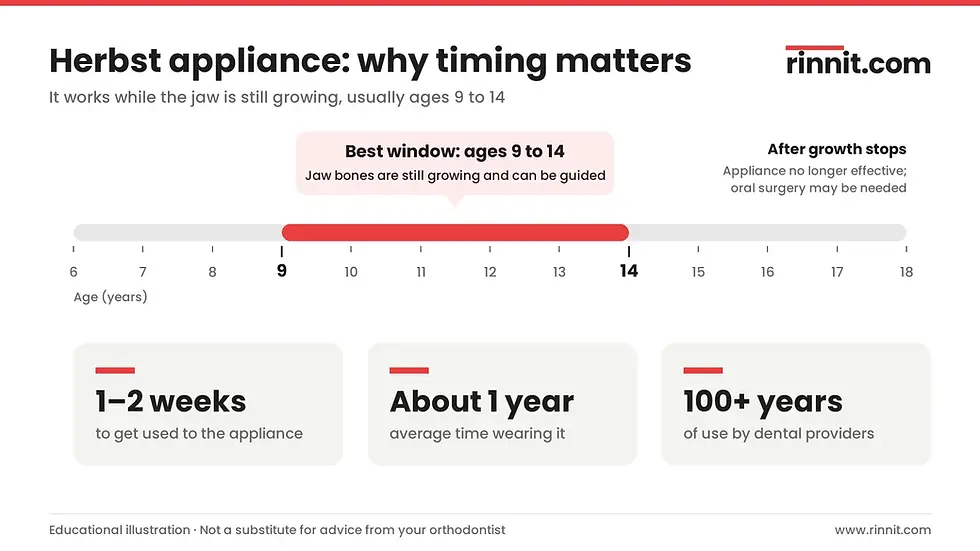
Timing matters because a Herbst appliance can only reshape the jaw while the bones are still growing; once growth stops, bones are much harder to move. [1]
For example, if a child has a severe overbite and the orthodontist expects a Herbst appliance to fix it, the jaw can be aligned while the child is young. After puberty, when bone growth ends, the appliance will no longer work, and oral surgery will likely be needed instead. [1]
Not every child who needs braces needs a Herbst appliance. The decision depends on the type of malocclusion and how severe it is. [1]
When should you call the orthodontist about a Herbst appliance?
Call the orthodontist whenever a Herbst appliance breaks or is damaged in any way, because a broken device can stall treatment. [1]
For injuries to the teeth themselves, see our guide to dental injuries and first aid.
Conclusion
A Herbst appliance is a time-tested, minimally invasive way to correct certain Class II bites by guiding the lower jaw forward while a child is still growing. It is most effective between about ages 9 and 14, usually stays in place for around a year, and often works alongside braces. Treating the bite during this growth window may spare a child from oral surgery later in life. [1]
The trade-offs are short-lived: a week or two of adjustment, some care with food, and careful daily cleaning. Not every child needs one, so the right next step is an honest conversation with an orthodontist about your child's bite.
Ready for your next step? Save or print this guide and bring it to your child's orthodontic visit, or find an orthodontic specialist near you. Then keep learning with our guides to overbite and temporomandibular disorders (TMD), and explore more trusted, plain-language health guides at Rinnit.com.
FAQ
What is a Herbst appliance used for?
A Herbst appliance is used to move the lower jaw forward and correct some Class II malocclusions, such as a deep overbite, overjet, a small lower jaw or an overly prominent upper jaw. It also helps align the upper and lower teeth. [1]
What age is best for a Herbst appliance?
A Herbst appliance works best in children and teens who are still growing, usually between ages 9 and 14. After puberty, when the bones stop growing, it is no longer effective. [1]
How long do you have to wear a Herbst appliance?
Most children wear a Herbst appliance for about one year. Some finish sooner and others need longer, depending on how severe the bite problem is. [1]
Does a Herbst appliance hurt?
A Herbst appliance may cause slight discomfort during the first couple of weeks, along with some cheek irritation. Most children adjust within one to two weeks. [1]
What foods should you avoid with a Herbst appliance?
Avoid chewy foods such as bagels and jerky, sticky foods such as caramel and gum, and hard foods such as nuts, popcorn and raw vegetables. These foods can break or damage the appliance. [1]
Can adults get a Herbst appliance?
Orthodontists rarely use a Herbst appliance in adults. When they do, it is usually to treat sleep apnea, often with a removable version. [1]
Do you still need braces with a Herbst appliance?
Most children need braces in addition to a Herbst appliance. They may wear the appliance before braces or at the same time as braces. [1]
What should you do if a Herbst appliance breaks?
If a Herbst appliance breaks, contact the orthodontist, because a broken device can stall treatment. If your child is in pain, call the orthodontist's emergency line or go to urgent care or an emergency room. [1]
How do I clean a Herbst appliance?
Brush carefully around the appliance and braces after every meal, and rinse with water. A water flosser or small interdental brush can help clean hard-to-reach spots.
Will a Herbst appliance affect my speech or eating?
Talking and chewing may feel strange for the first few days. Most people adjust within a week or two, and soft foods help at first.
Related Reading
Overbite: Symptoms, Causes, and Management Strategies explains overbite types, causes and treatment options.
Overjet (Buck Teeth): Symptoms, Causes, and Treatments explains overjet, or protruding upper teeth, and how it is corrected.
Orthodontics: Braces, Clear Aligners, Retainers, and What to Expect compares braces, clear aligners and retainers for straightening teeth.
Orthodontic Headgear: Types, Daily Wear Time, Side Effects, and Tips for Parents describes how orthodontic headgear guides jaw growth in children.
References
Cleveland Clinic. Herbst Appliance: Purpose, Benefits & What To Expect. Cleveland Clinic. Last updated July 30, 2024. https://my.clevelandclinic.org/health/treatments/herbst-appliance
Xu F, Fang Y, Sui X, et al. Comparison of Twin Block appliance and Herbst appliance in the treatment of Class II malocclusion among children: a meta-analysis. BMC Oral Health. 2024;24(1):278. PMID 38409017. https://doi.org/10.1186/s12903-024-04027-w
Matthaios S, Tsolakis AI, Haidich AB, et al. Dental and Skeletal Effects of Herbst Appliance, Forsus Fatigue Resistance Device, and Class II Elastics-A Systematic Review and Meta-Analysis. J Clin Med. 2022;11(23):6995. PMID 36498570. https://doi.org/10.3390/jcm11236995
Minervini G, Di Blasio M, Franco R, et al. Prevalence of temporomandibular disorders diagnosis in patients treated with Herbst appliance: a systematic review and meta-analysis. BMC Oral Health. 2024;24(1):137. PMID 38281907. https://doi.org/10.1186/s12903-023-03738-w
Medical disclaimer
This article is for general educational purposes only and does not replace professional medical or dental advice, diagnosis or treatment. Always ask your orthodontist, dentist or another qualified health professional about any questions you have regarding your or your child's teeth, bite or jaw.



Comments