Temporomandibular Disorders (TMD): Symptoms, Causes and Treatment

Updated: 3 days ago
Medically reviewed by Dr. Baraa Alnahhal, MD · Last reviewed: October 2026
Quick Answer: What is TMD?
Temporomandibular disorders are conditions affecting the jaw joints and surrounding muscles, causing pain, stiffness, sounds or problems with jaw movement. The two TMJs sit near the ears and help the jaw move for chewing and talking. With early diagnosis and appropriate treatment, TMD is often manageable and sometimes curable. [1]
What the research says
Jaw-joint disorders are common. A systematic review and meta-analysis of 21 studies found that the overall prevalence of temporomandibular joint disorders was about 31.1% in adults and older adults and 11.3% in children and adolescents. The most prevalent diagnosis was disc displacement with reduction, at 25.9% in adults and older adults and 7.4% in children and adolescents (Valesan et al., Clin Oral Investig, 2021). [2]
The evidence for occlusal splints is still inconclusive. A Cochrane review of 57 randomized trials with 2,846 participants found very low certainty evidence for all comparisons of occlusal splints with no treatment, placebo or other treatments. The authors concluded there was insufficient evidence to reach conclusions about how well occlusal interventions manage TMD symptoms, and called for larger, better-designed trials with long-term follow-up (Singh et al., Cochrane Database Syst Rev, 2024). [3]

Temporomandibular disorders, often called TMD, affect the joints in your jaw and the muscles around them. TMD can cause jaw pain, clicking, headaches, trouble chewing and difficulty moving your mouth.
You have two temporomandibular joints, or TMJs—one on each side of your face near your ears. They help you chew, talk and move your jaw.
TMD is common in adults and often starts between ages 20 and 40. It is treatable and rarely causes lasting problems, but persistent symptoms should be evaluated by a healthcare provider.
What are temporomandibular joints?
The temporomandibular joints connect jaw movement with everyday actions such as chewing, talking and opening the mouth. There is one joint on each side of the face, near the ears. [1]
TMD refers to problems involving these joints or the muscles around them. Many people use “TMJ” to describe the condition, but the medical term is temporomandibular joint dysfunction, abbreviated TMD. [1]
Term | Meaning |
TMJ | One temporomandibular joint; there is one on each side of the face |
TMD | Temporomandibular joint dysfunction or disorders involving the jaw joints and surrounding muscles |
Jaw muscles | Muscles around the joints that help move the jaw |
How common is TMD?
TMD is common. It affects up to 12 million people in the United States, mostly between ages 20 and 40. Females are twice as likely to have it. [1]
TMD is treatable and rarely causes lasting problems. Early care can make a meaningful difference in day-to-day symptoms. [1]
What are the symptoms of TMD?
TMD symptoms can affect the jaw, face, head, ears, teeth, neck and shoulders. Some people notice pain, while others mainly notice stiffness, sounds or changes in jaw movement.
Symptom area | Possible symptoms |
Jaw and face | Jaw pain or face pain |
Head | Headaches or migraines |
Movement | Jaw stiffness, locking or trouble opening and closing the mouth |
Jaw sounds | Clicking, popping or grinding sounds |
Ear area | Earaches or ringing |
Teeth | Tooth pain |
Neck and shoulders | Neck or shoulder pain |
If pain, clicking or stiffness does not go away, speak with a healthcare provider.
What causes TMD?
TMD can happen for many reasons, and causes may overlap. A provider may need time to identify which factors are contributing to symptoms.
Possible cause | How it may relate to TMD |
Jaw injury | A break or dislocation may affect the jaw joint |
Teeth grinding or clenching | Bruxism can place stress on the jaw and surrounding muscles |
Arthritis | Arthritis in the jaw can affect joint movement |
Misaligned bite | A bite that does not align properly may contribute to symptoms |
Stress-related tension | Stress can cause jaw tension |
What habits can make TMD worse?
Some everyday habits may increase jaw strain or worsen TMD symptoms. These include chewing pens, ice or nails; taking large bites; using teeth as tools; clenching during the day; sleeping on the stomach; and maintaining poor posture. [1]
Habit | Why it may matter |
Chewing pens, ice or nails | Adds repeated stress to the jaw |
Taking large bites | Requires wider jaw movement |
Using teeth as tools | Places force on the teeth and jaw |
Daytime clenching | Keeps the jaw muscles tense |
Sleeping on the stomach | May place pressure on the jaw |
Poor posture | Can contribute to strain around the neck and jaw |
TMD may lead to long-term pain, chewing problems or tooth damage from grinding. [1]
How is TMD diagnosed?
A healthcare provider examines how your jaw moves and looks for pain or stiffness. The evaluation may include a physical exam and imaging tests. [1]
During the exam, the provider may see how wide you can open your mouth, press around the jaw to check for tenderness and feel the joints as you open and close your mouth. [1]
Imaging may include dental X-rays, CT scans or MRIs. Early diagnosis can make treatment more effective. [1]
Diagnostic step | What the provider may assess |
Jaw opening | How wide you can open your mouth |
Tenderness | Whether pressing around the jaw causes pain |
Joint movement | How the joints feel as the mouth opens and closes |
Imaging | Bone, joint or surrounding structures through dental X-rays, CT scans or MRIs |
How is TMD treated?
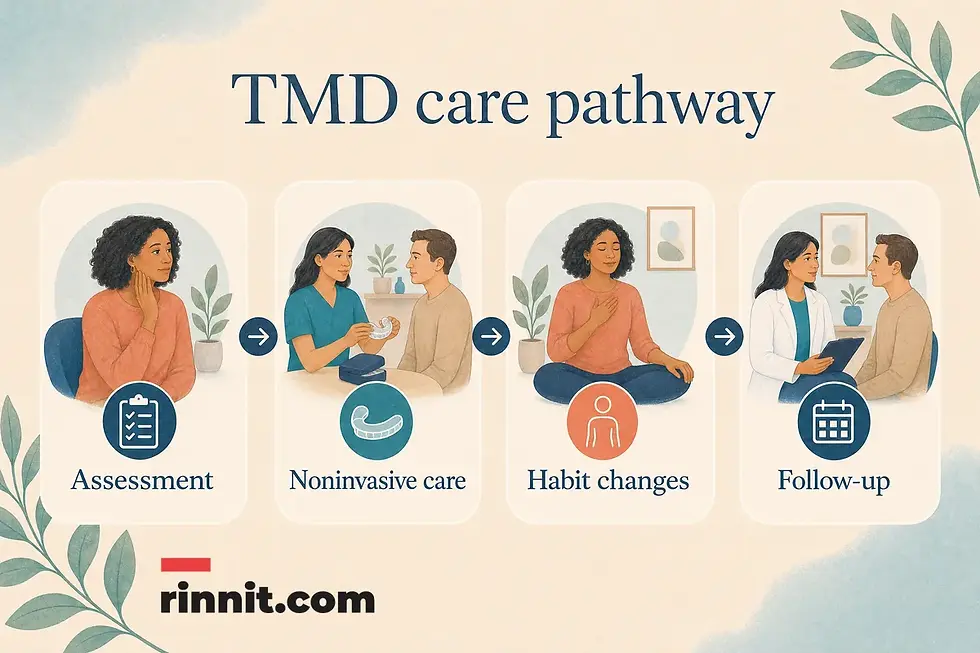
Treatment depends on what is causing symptoms and how severe they are. Most people start with noninvasive options. TMD care often combines self-care, medical devices and professional care. [1]
Medicines
Medicines may help ease pain, swelling or muscle tension. Options include acetaminophen for pain, NSAIDs such as ibuprofen or naproxen, muscle relaxers for clenching or grinding, and antidepressants to help with chronic pain. A healthcare provider should determine whether a medicine is appropriate for you. [1]
Mouth guards and splints
Custom mouth guards or splints may be used as part of treatment. Wearing a mouth guard is also suggested if you grind your teeth or play contact sports. A qualified provider can help determine what type of device is appropriate. [1]
Physical therapy and jaw exercises
Jaw exercises through physical therapy may improve movement. A provider may also suggest changing habits, such as avoiding hard foods or improving posture. [1]
Other non-surgical therapies
Other options include trigger-point injections such as dry needling or steroids, ultrasound therapy to relax muscles, and TENS, which uses gentle electrical currents to ease tension. [1]
Treatment group | Examples |
Medicines | Pain relievers, NSAIDs, muscle relaxers or antidepressants for chronic pain |
Devices | Custom mouth guards or splints |
Movement care | Jaw exercises and physical therapy |
Injections and therapies | Trigger-point injections, ultrasound therapy or TENS |
Habit changes | Avoiding hard foods, improving posture and reducing jaw strain |
Surgery
If other treatments do not help, a provider may suggest surgery. Options may include arthrocentesis to flush the joint, TMJ arthroscopy as a minimally invasive procedure, or open-joint surgery for more serious problems. [1]
Surgery is not the starting point for most people. A provider considers the cause, severity and response to other treatments before recommending it.
What can you do at home to support jaw health?
Jaw health with temporomandibular disorders (TMD) can be supported at home with a mouth guard, good posture, stress reduction and avoiding habits that strain the jaw. Use a mouth guard if you grind your teeth or play contact sports, sit and stand with good posture, and reduce stress with deep breathing or meditation. [1]
Changing habits may also help. Avoid chewing pens, ice or nails, taking very large bites, using your teeth as tools and clenching during the day. [1]
Do not start or stop medicines, devices or exercises based only on an online article. A qualified provider can help match self-care with the cause of your symptoms.
Can TMD cause long-term problems?
TMD can lead to long-term pain, chewing problems or tooth damage from grinding. Because causes often overlap, it may take time to find the right treatment. [1]
The outlook is generally positive. TMD can be short-term or last longer. Some people feel better in a week or two, while others may need ongoing care. With the right treatment, most people get relief and normal jaw movement. [1]
When should you seek care for jaw symptoms?
Talk with a healthcare provider if jaw pain, clicking or stiffness does not improve. A provider can help find the cause and suggest appropriate treatment.
Prompt evaluation is especially important when symptoms interfere with chewing or opening and closing the mouth, or when pain persists.
Conclusion: Persistent jaw symptoms deserve evaluation
TMD affects the jaw joints and surrounding muscles. It can cause pain, headaches, clicking, stiffness, locking, trouble chewing and changes in how the mouth opens or closes. [1]
Causes may include injury, grinding or clenching, arthritis, a misaligned bite and stress-related jaw tension. Most people begin with noninvasive care, and treatment may combine self-care, devices, professional therapy and medicines. Surgery is reserved for some problems that do not improve with other approaches. [1]
If jaw pain, clicking or stiffness continues, contact a qualified healthcare provider or dental professional for an evaluation. Rinnit.com is here to make complex health information easier to understand. [1]
Frequently Asked Questions
What is TMD?
Temporomandibular disorders are conditions affecting the jaw joints and surrounding muscles. They may cause pain, clicking, stiffness, trouble chewing or movement problems.
Is TMD the same as TMJ?
Many people call the condition “TMJ,” but TMJ is the name for the temporomandibular joint. The medical term for the disorder is temporomandibular joint dysfunction or TMD.
What are common TMD symptoms?
Symptoms may include jaw or face pain, headaches, jaw stiffness or locking, clicking or popping, trouble opening or closing the mouth, earaches or ringing, tooth pain, and neck or shoulder pain.
What causes TMD?
Possible causes include jaw injury, teeth grinding or clenching, arthritis in the jaw, a misaligned bite and stress-related jaw tension.
Can stress cause jaw pain?
Stress can cause jaw tension, which may contribute to TMD symptoms. Stress reduction through deep breathing or meditation is a suggested self-care step.
Can teeth grinding cause TMD?
Yes. Teeth grinding or clenching, also called bruxism, can contribute to TMD. A provider may discuss a mouth guard or other treatment options.
How is TMD diagnosed?
A provider examines jaw movement, tenderness and stiffness. Imaging may include dental X-rays, CT scans or MRIs.
What is the first treatment for TMD?
Most people start with noninvasive options. Depending on the cause and severity, care may include habit changes, mouth guards or splints, jaw exercises, physical therapy, medicines and other therapies.
Is surgery needed for TMD?
Surgery may be considered when other treatments do not help or when there are more serious problems. Options include arthrocentesis, arthroscopy or open-joint surgery.
How long does TMD last?
TMD can be short-term or last longer. Some people feel better in a week or two, while others need ongoing care. With appropriate treatment, most people get relief and normal jaw movement.
When should I see a healthcare provider?
Speak with a provider if jaw pain, clicking or stiffness does not go away, or if symptoms affect chewing or opening and closing the mouth.
Related guides
References
Cleveland Clinic. TMJ Disorders: Symptoms & Treatment. Cleveland Clinic. Updated July 22, 2025. https://my.clevelandclinic.org/health/diseases/15066-temporomandibular-disorders-tmd-overview
Valesan LF, Da-Cas CD, Réus JC, et al. Prevalence of temporomandibular joint disorders: a systematic review and meta-analysis. Clin Oral Investig. 2021;25(2):441-453. PMID 33409693. https://doi.org/10.1007/s00784-020-03710-w
Singh BP, Singh N, Jayaraman S, et al. Occlusal interventions for managing temporomandibular disorders. Cochrane Database Syst Rev. 2024;9(9):CD012850. PMID 39282765. https://doi.org/10.1002/14651858.CD012850.pub2
Medical disclaimer
This article is for general educational purposes and is not a substitute for professional medical advice, diagnosis or treatment. Always seek the advice of a qualified healthcare professional with any questions about a medical condition or treatment.



Comments