Extracorporeal Shock Wave Lithotripsy (ESWL): Procedure, Recovery, Risks and Results

Updated: 3 days ago
Written and medically reviewed by Dr. Baraa Alnahhal, MD · Last reviewed: November 2026 · How we review
Quick Answer: What is extracorporeal shock wave lithotripsy (ESWL)?
Extracorporeal shock wave lithotripsy (ESWL) is a noninvasive procedure that uses high-energy shock waves to break kidney stones into small pieces that can leave the body in the urine. It's often used for stones larger than 5 millimeters that cannot pass on their own. Success rates range from 30% to 90%, depending on the stone and your body. [1]
What the research says
A medicine that relaxes the urinary tract may help fragments pass after ESWL. A review of 40 randomized trials with 4,793 adults found that adding an alpha-blocker (most often tamsulosin) after shock wave lithotripsy may raise stone clearance from 69.3% to 80.4%, shorten the time to clear fragments by about 3.7 days and lower major adverse events, mostly emergency room visits or rehospitalizations, from 25.8% to 15.5%. The certainty of this evidence was low. (Oestreich et al., Cochrane Database of Systematic Reviews, 2020) [2]
For stones in the lower part of the kidney, ESWL clears fewer stones but causes fewer complications. An updated review of 24 randomized trials found that flexible ureterorenoscopy cleared stones more often than ESWL (risk ratio 1.19) and percutaneous nephrolithotomy cleared them more often still (risk ratio 1.42 compared with ESWL). Complications were fewer with ESWL, while ureterorenoscopy could lead to more unplanned procedures and retreatments. (MacLennan et al., European Urology, 2025) [3]
For stones under 1 centimeter, ESWL and flexible ureteroscopy work about equally well. A pooled analysis of 17 studies with 2,265 patients found that flexible ureteroscopy cleared stones more often overall, with lower retreatment rates, but there was no significant difference in stone-free rates for stones smaller than 1 cm, and no significant difference in complications. ESWL had a shorter operating time and hospital stay. (Lv et al., Frontiers in Surgery, 2022) [4]
Key takeaways
ESWL uses shock waves from outside the body to break up kidney stones so the pieces can pass in your urine. [1]
It is often used for stones larger than 5 mm (about 0.2 inch), stones that block urine flow and stones that cause severe pain. [1]
The procedure takes about an hour, and you usually go home the same day. [1]
Most people get back to their usual routine within a few days, but passing fragments can take days to weeks. [1]
Success rates range from 30% to 90%; if stone remains, a second ESWL or ureteroscopy may be needed. [1]
What is extracorporeal shock wave lithotripsy?
Extracorporeal shock wave lithotripsy (ESWL) is a noninvasive procedure that treats kidney stones. "Extracorporeal" means the shock waves come from a machine outside your body. High-energy shock waves are aimed at the stone and break it into tiny pieces, which then leave your body when you urinate. [1]
Kidney stones form when substances such as calcium build up to high levels in your urine. Stones can form in the kidneys and move into the ureters, the tubes that carry urine to the bladder. The pain of a kidney stone attack usually happens when a stone blocks urine from draining out of the kidney. [1]

Why is ESWL done?
Your provider may recommend ESWL to treat kidney stones that: [1]
Are larger than 5 mm (about the size of a pencil eraser) and cannot pass on their own
Block the flow of urine
Cause severe pain
When deciding whether ESWL is right for you, your provider considers: [1]
Stone size. ESWL works best on smaller stones.
Stone location. Success is more likely when the stone is in certain parts of the kidney or in the upper ureter.
Your health and medicines. Some conditions and medicines make ESWL less safe.
Your body type. Differences in anatomy can make ESWL less effective.
Sources: [1]
Who should not have ESWL?
Your provider may advise against ESWL if you: [1]
Are pregnant
Have an abdominal aortic aneurysm
Have a bleeding disorder, such as hemophilia
Need to take blood thinner medicines
Have obesity
Have a kidney infection or another urinary tract infection
Have kidney cancer
Have decreased kidney function
Have a spinal deformity, such as scoliosis
Have high blood pressure that is not controlled with medicine
How does ESWL compare with other stone treatments?
Because the shock waves come from outside your body, ESWL is noninvasive. It can help you pass stones without more invasive surgery. If ESWL does not fully clear a stone, your provider may suggest a second ESWL session or ureteroscopy, a minimally invasive way to remove the remaining stone. [1]
Studies comparing the options found that ureteroscopy and percutaneous nephrolithotomy (PCNL) clear stones more often in some situations, while ESWL tends to cause fewer complications and a shorter hospital stay. [3] [4] To learn more about the other procedures used for urinary stones, read our guides to laser lithotripsy, ureteroscopy, percutaneous nephrolithotomy (PCNL) and cystolitholapaxy for bladder stones.
How do you prepare for ESWL?
Before the procedure, your care team will check that ESWL is safe for you. [1]
Have blood tests. These check your kidney function and blood counts.
Have urine tests. These look for a urinary tract infection.
Review your medicines. Keep taking your usual medicines unless your provider tells you otherwise. Stop warfarin or other blood thinners only if your provider tells you to.
Stop eating and drinking as told. You will need to stop several hours before the procedure.
Arrange a ride home. Someone will need to drive you home afterward.
Sources: [1]
What happens during ESWL?
ESWL usually takes about an hour, depending on the size and number of stones and your overall health. [1]

You receive anesthesia. Options include general anesthesia (you are asleep), sedation (you are awake but drowsy) or regional anesthesia (you are awake but numb from the waist down). Some people have no anesthesia and take pain medicine beforehand.
You lie on a padded table on top of a water-filled cushion. Less often, you sit in a large tub of water.
X-ray or ultrasound imaging finds the stone and helps aim the shock waves.
Your care team may move you slightly to line up your body with the energy beams.
The machine sends thousands of shock waves through the water and into your body, aimed at the stone. If you are awake, you may hear a popping sound or feel a tapping along your side.
Sources: [1]
ESWL at a glance
Item | Typical detail |
Type of procedure | Noninvasive; shock waves come from outside the body |
Anesthesia | General, sedation or regional; some people have pain medicine only |
Imaging | X-ray or ultrasound |
Number of shock waves | Thousands |
How long it takes | About an hour |
Hospital stay | Usually none; outpatient, home the same day |
Success rate | 30% to 90% |
Sources: [1]
Does ESWL hurt?
With general or regional anesthesia, you should not feel pain during ESWL. Without anesthesia, most people report mild to moderate pain, rated 6 or lower on a scale of 0 to 10. About 30% report severe pain, rated 7 or higher. [1]
What happens after ESWL?
ESWL is usually an outpatient procedure. You spend a few hours in a recovery room and then go home the same day. [1]
You may still have pain as stone fragments pass. Your provider may prescribe tamsulosin (Flomax), which relaxes the muscles of the ureter and helps you pass the stone, and ketorolac (Toradol), a prescription pain reliever. You may also use over-the-counter pain medicine if your provider approves. Peeing may hurt for a few days. [1]
How long does recovery from ESWL take?
Most people return to their usual routine within a few days, but some side effects can last until all of the fragments have passed. [1]
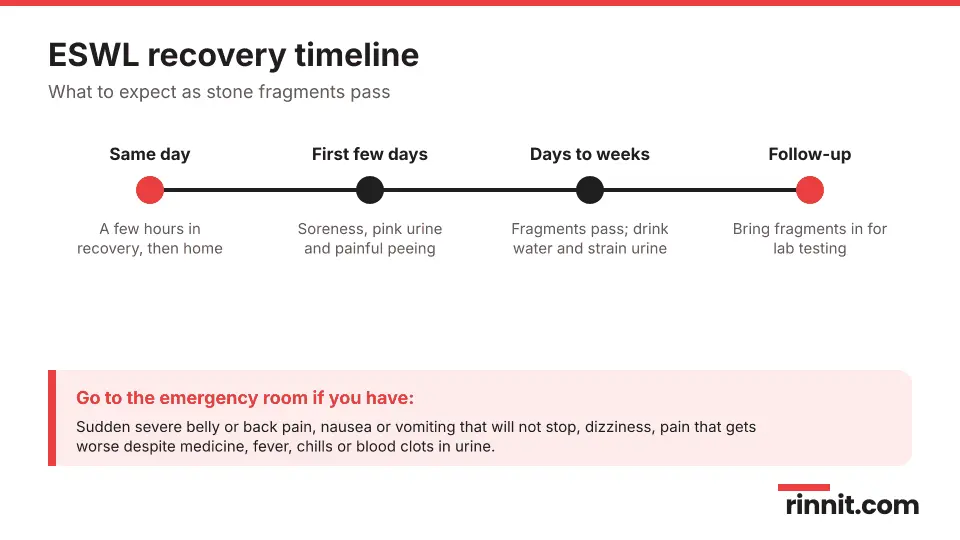
Common side effects: Soreness or stiffness near the treatment area, sometimes with slight bruising along your side, pink-tinged urine and painful urination. These usually go away within a few days.
Passing fragments: This can take several days to weeks. The pieces may look like sand, gravel or dust, and pain may come and go.
Fluids: Drink plenty of water to help fragments pass and to prevent constipation.
Collecting stones: Pee through the strainer your care team gives you, and keep any fragments in a specimen cup or plastic bag. Bring them to your follow-up visit or a lab for testing.
Sources: [1]
What are the risks of ESWL?
ESWL is generally a safe procedure, but complications can happen. [1]
Complication | What it means |
Blockage in the ureter | Stone fragments get stuck in the tube that carries urine from the kidney to the bladder |
Bleeding | Bleeding in or around the kidney |
Infection | An infection in the urinary tract or kidney |
Sources: [1]
How effective is ESWL?
Success rates for ESWL range widely, from 30% to 90%. How well it works depends on the size, location and type of stone, and on your body type. Success is more likely when the stone is in certain parts of the kidney or in the upper ureter. [1]
If ESWL does not fully clear the stone, your provider may recommend a second ESWL or ureteroscopy to remove what is left. [1]
When should you call your provider after ESWL?
Contact your provider with any questions before or after the procedure, including questions about your medicines or symptoms. [1]
Go to the emergency room if you have: [1]
Sudden, severe belly or back pain
Nausea or vomiting that does not go away
Dizziness or lightheadedness
Pain that gets worse even with pain medicine
Fever
Chills
Blood clots in your urine
Questions to ask your provider
Is ESWL a good choice for the size and location of my stone?
What type of anesthesia do you recommend?
Which medicines should I stop or change before the procedure?
What should I do if the stone does not fully clear?
How should I collect and bring in stone fragments?
Conclusion
Extracorporeal shock wave lithotripsy uses shock waves from outside the body to break kidney stones into pieces small enough to pass in your urine. It takes about an hour, usually lets you go home the same day and allows most people to return to their routine within a few days, although fragments can take days to weeks to pass. [1]
ESWL works best for smaller stones in certain locations, and success ranges from 30% to 90%. Its main risks are a blocked ureter, bleeding and infection. Knowing whether you are a good candidate, preparing well and watching for warning signs afterward help you get the best result. [1] [2]
Keep learning: Read our guides to ureteroscopy, laser lithotripsy and percutaneous nephrolithotomy (PCNL). For more on stone treatments, see the National Institute of Diabetes and Digestive and Kidney Diseases guide to treatment for kidney stones.
FAQ
What is extracorporeal shock wave lithotripsy?
ESWL is a noninvasive procedure that uses high-energy shock waves to break kidney stones into small pieces that pass out in your urine.
When is ESWL needed?
It is often used for stones larger than 5 mm that cannot pass on their own, stones that block urine flow and stones that cause severe pain.
How long does ESWL take?
The procedure usually takes about an hour, depending on the size and number of stones and your overall health.
Is ESWL painful?
With general or regional anesthesia, you should not feel pain. Without anesthesia, most people report mild to moderate pain, and about 30% report severe pain.
Will I need to stay in the hospital after ESWL?
Usually not. ESWL is an outpatient procedure, and you go home the same day after a few hours in the recovery room.
How do I prepare for ESWL?
You may have blood and urine tests, review your medicines with your provider, stop eating and drinking several hours before and arrange a ride home.
Does it hurt to pee after ESWL?
Peeing may hurt for a few days, and passing stone fragments can also be painful.
How long does it take to recover from ESWL?
Most people return to their usual routine within a few days, but passing all the fragments can take several days to weeks.
How effective is ESWL?
Success rates range from 30% to 90%, depending on the stone's size, location and type and your body type. A second ESWL or ureteroscopy may be needed.
When should I go to the emergency room after ESWL?
Go for sudden severe belly or back pain, nausea or vomiting that will not stop, dizziness, worsening pain, fever, chills or blood clots in your urine.
Related Reading
Learn more in our guide to Kidney Stones: Symptoms, Causes, and Treatment Guide.
Learn more in our guide to Cystine Stones (Cystinuria): What They Are, Symptoms, Causes, Diagnosis, Treatment and Outlook — What You Need to Know.
Learn more in our guide to Hyperoxaluria and Oxalosis: What High Oxalate Levels Do to Your Kidneys and the Full Treatment Pathway.
Learn more in our guide to Ureteral Obstruction: Symptoms, Causes, and Treatment.
Learn more in our guide to Hydronephrosis: What Causes Kidney Swelling, How It Is Found, and How It Is Treated.
References
Cleveland Clinic. Extracorporeal Shock Wave Lithotripsy: Procedure & Results. Cleveland Clinic. Last updated November 21, 2023. https://my.clevelandclinic.org/health/procedures/extracorporeal-shock-wave-lithotripsy-eswl
Oestreich MC, Vernooij RW, Sathianathen NJ, et al. Alpha-blockers after shock wave lithotripsy for renal or ureteral stones in adults. Cochrane Database Syst Rev. 2020;11(11):CD013393. PMID 33179245. https://doi.org/10.1002/14651858.CD013393.pub2
MacLennan S, Wiseman O, Smith D, et al. Updated Systematic Review and Meta-analysis of Extracorporeal Shock Wave Lithotripsy, Flexible Ureterorenoscopy, and Percutaneous Nephrolithotomy for Lower Pole Renal Stones. Eur Urol. 2025;88(3):231-239. PMID 40082136. https://doi.org/10.1016/j.eururo.2025.01.020
Lv G, Qi W, Gao H, et al. Safety and efficacy of extracorporeal shock wave lithotripsy vs. flexible ureteroscopy in the treatment of urinary calculi: A systematic review and meta-analysis. Front Surg. 2022;9:925481. PMID 36420414. https://doi.org/10.3389/fsurg.2022.925481
Medical disclaimer
This article is for general education only and does not replace advice from a qualified healthcare professional. Talk to your doctor about your own diagnosis and treatment, and seek emergency care right away for severe or sudden symptoms.



Comments