Hyperoxaluria and Oxalosis: What High Oxalate Levels Do to Your Kidneys and the Full Treatment Pathway

Updated: 2 days ago
Medically reviewed by Dr. Baraa Alnahhal, MD · Last reviewed: October 2026
Hyperoxaluria means too much oxalate in the urine. It comes in three forms — primary (genetic), enteric (intestine-related), and diet-related — and often announces itself as recurring kidney stones [1]. Left untreated, the excess oxalate can damage the kidneys and cause them to stop working, leading to oxalosis, when oxalate builds up throughout the body. Early urine testing, plenty of fluids, targeted medication, and diet changes can protect kidney function, and in some forms of the disease a liver transplant may be curative [2].
Quick Answer
Hyperoxaluria is a condition in which the urine contains too much oxalate, a chemical made by the body and found in some foods. It can be caused by a genetic change, intestinal diseases such as Crohn's disease, or a very high-oxalate diet. A kidney stone is often the first sign. Early treatment with fluids, medicines and diet changes is critical.
What the research says
Gastric bypass raises stone risk through oxalate. A meta-analysis of 12 observational studies found a pooled relative risk of kidney stones of 1.79 (95% CI 1.54 to 2.10) after Roux-en-Y gastric bypass, together with higher urine oxalate and calcium oxalate supersaturation and lower urine citrate and volume (Upala et al., Surg Obes Relat Dis, 2016 [3]).
Lumasiran lowers oxalate in primary hyperoxaluria type 1, and the effect lasts. In the extension of the ILLUMINATE-A randomized trial, patients who stayed on lumasiran (24 people) had their 24-hour urinary oxalate reduced by a mean of 66.9% at month 6 and 64.1% at month 12, and those who crossed over from placebo had a 57.3% reduction after 6 months. Kidney function (eGFR) stayed stable, and the most common side effects were mild, short-lived injection-site reactions (Hulton et al., Kidney Int Rep, 2022 [4]).
What Is Hyperoxaluria?
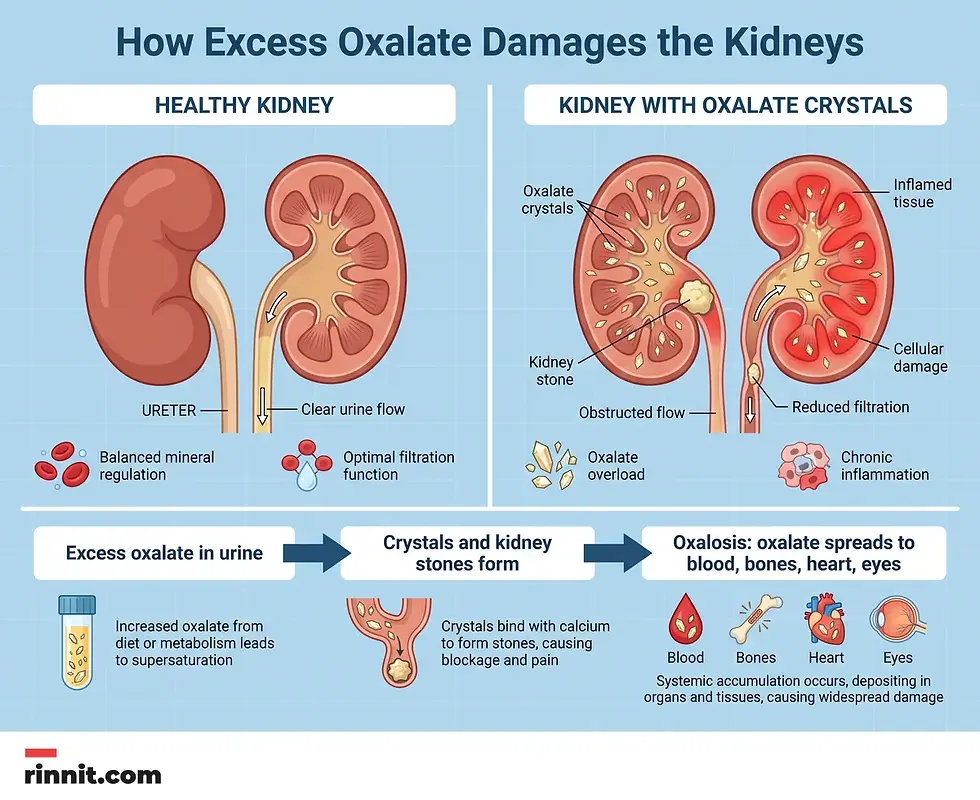
Hyperoxaluria (pronounced hi-pur-ok-suh-LU-ree-uh) happens when there is too much oxalate in your urine. Oxalate is a natural chemical the body makes. It is also found in some foods. On its own, oxalate is not dangerous, but when too much of it concentrates in the urine, it can combine with calcium to form kidney stones and crystals that damage the kidneys.
The long-term health of your kidneys depends on finding hyperoxaluria early and getting it treated quickly.
A related, more advanced condition is called oxalosis (ok-suh-LOW-sis). Oxalosis happens after the kidneys stop working well in people who have the primary and intestine-related causes of hyperoxaluria. Too much oxalate collects in the blood and then builds up in blood vessels, bones, and organs throughout the body.
Symptoms of Hyperoxaluria
Often, the first sign of hyperoxaluria is a kidney stone. Kidney stone symptoms can include:
Sharp pain in the back, side, lower stomach area, or groin.
Urine that looks pink, red, or brown due to blood.
A frequent urge to urinate.
Pain when urinating.
Not being able to urinate or urinating only a small amount.
Chills, fever, upset stomach, or vomiting.
Symptom | What It Means |
Sharp back, side, or groin pain | Typical kidney stone pain |
Pink, red, or brown urine | Blood in the urine from a stone |
Frequent urge to urinate | Irritation from stones or crystals |
Pain when urinating | Stone passing through the urinary tract |
Inability to urinate or very small output | Possible blockage — needs urgent care |
Chills, fever, upset stomach, vomiting | Signs of possible infection with a stone |
When to See a Doctor
Kidney stones are not common in children. Kidney stones that form in children and teenagers are likely to be caused by an underlying health problem, such as hyperoxaluria. For this reason, all young people with kidney stones should have a checkup, and that checkup should include a test that measures oxalate in the urine.
Adults who keep getting kidney stones should also be tested for oxalate in the urine. If you have had more than one stone, ask your doctor about a urine oxalate test rather than assuming the stones are an isolated event.
Causes: The Three Types of Hyperoxaluria
Hyperoxaluria happens when too much oxalate builds up in the urine. The three types differ in how the excess oxalate gets there.
Type | Cause | Who It Affects |
Primary hyperoxaluria | A rare inherited genetic change | Often presents in childhood through age 20; can cause failure even in babies |
Enteric hyperoxaluria | Intestine diseases that increase oxalate absorption | People with Crohn's disease, short bowel syndrome, or after gastric bypass |
Diet-related hyperoxaluria | Eating large amounts of high-oxalate foods | Anyone with a diet heavy in nuts, chocolate, tea, spinach, potatoes, beets, rhubarb |
Primary Hyperoxaluria
Primary hyperoxaluria is a rare inherited disease passed down in families. It is caused by a change in a gene. The liver does not make enough of a certain protein that prevents too much oxalate from being made, or the protein does not work as it should.
The body gets rid of excess oxalate through the kidneys, in urine. The extra oxalate can combine with calcium to form kidney stones and crystals, which can damage the kidneys and cause them to stop working.
With primary hyperoxaluria, kidney stones form early and most often cause symptoms from childhood through age 20. The kidneys of many people with primary hyperoxaluria stop working well by early to middle adulthood. Kidney failure can happen even in babies with this disease, while others may never have kidney failure at all.
Enteric Hyperoxaluria
Some intestine problems cause the body to absorb more oxalate from foods, increasing the amount of oxalate in the urine. Crohn's disease is one intestine problem that can lead to enteric hyperoxaluria. Another is short bowel syndrome, which can happen when parts of the small intestine are removed during surgery.
The mechanism behind this type is specific. Normally, oxalate combines with calcium in the gut and exits the body through stool. But some health problems make it hard for the small intestine to absorb fats from food. When that happens, calcium binds to the extra fat in the gut instead of to oxalate. This leaves oxalate free in the gut, where it is absorbed into the bloodstream and then filtered by the kidneys.
Roux-en-Y gastric bypass surgery can also lead to trouble absorbing fat in the gut, which raises the risk of hyperoxaluria.
Diet-Related Hyperoxaluria
Eating large amounts of foods high in oxalate can raise your risk of hyperoxaluria or kidney stones. These foods include nuts, chocolate, brewed tea, spinach, potatoes, beets, and rhubarb. It is important to stay away from high-oxalate foods if you have diet-related or enteric hyperoxaluria. Your doctor may also tell you to limit these foods if you have primary hyperoxaluria.
Risk Factors and Contributing Factors
Factor | How It Contributes |
Inherited gene change | Liver protein defect → excess oxalate production (primary type) |
Crohn's disease | Intestine inflammation → more oxalate absorption |
Short bowel syndrome | Less small intestine → fat malabsorption → free oxalate absorbed |
Roux-en-Y gastric bypass | Altered digestion → fat malabsorption → free oxalate absorbed |
High-oxalate diet | Direct excess oxalate intake from food |
Complications
Without treatment, primary hyperoxaluria can damage the kidneys. Over time the kidneys may stop working, which is called kidney failure. For some people, kidney failure is the first sign of the disease.
Symptoms of kidney failure include:
Urinating less than usual or not at all.
Feeling ill and tired.
Not feeling hungry.
Upset stomach and vomiting.
Pale, ashen skin or other skin color changes tied to anemia (a low number of red blood cells).
Swelling of the hands and feet.
Oxalosis happens if you have primary or enteric hyperoxaluria and your kidneys stop working well enough. The body can no longer get rid of the extra oxalate, so it starts building up — first in the blood, then in the eyes, bones, skin, muscles, blood vessels, heart, and other organs.
Late-stage oxalosis can cause health problems outside the kidneys, including:
Bone disease.
Anemia.
Skin ulcers.
Heart and eye problems.
In children, serious problems with development and growth.
Prevention and Who Should Get Tested
Everyone who keeps forming kidney stones should be evaluated for an underlying cause, and the single most important step is a urine oxalate test. Children and teenagers with any kidney stone should always be tested, because stones are uncommon at that age and usually signal a health problem such as hyperoxaluria.
For people with the enteric or diet-related forms, prevention centers on food choices: avoiding large amounts of high-oxalate foods, drinking enough fluids, and following the care team's dietary guidance after intestine surgery or gastric bypass.
How Hyperoxaluria Is Diagnosed
Diagnosis usually starts with a thorough physical exam and questions about your health history and eating habits. Tests to diagnose hyperoxaluria may include:
Test | What It Checks |
24-hour urine test | Measures oxalate and other substances in urine collected over 24 hours |
Blood test | Checks kidney function and oxalate levels in the blood |
Stone analysis | Determines what passed or removed kidney stones are made of |
Kidney X-ray, ultrasound, or CT scan | Looks for kidney stones or calcium oxalate buildup |
More tests may be needed to confirm the diagnosis and see how the disease has affected other parts of the body.
Additional Test | What It Checks |
DNA testing | Looks for the gene changes that cause primary hyperoxaluria |
Kidney biopsy | Checks for oxalate buildup in kidney tissue |
Echocardiogram | Checks for oxalate buildup in the heart |
Eye exam | Checks for oxalate deposits in the eyes |
Bone marrow biopsy | Checks for oxalate buildup in the bones |
Liver biopsy | Looks for enzyme (protein) deficiencies; needed only when genetic testing does not show the cause |
Because primary hyperoxaluria is inherited, siblings of an affected person are also at risk and should have tests. If a child has primary hyperoxaluria, parents planning more children may want genetic testing, and medical genetics counselors experienced with hyperoxaluria can help guide those decisions.

Treatment Options
Treatment depends on the type of hyperoxaluria you have, your symptoms, and how serious the disease is. How well you respond to treatment also helps the health care team decide how else to manage the condition.
Medicines That Reduce Oxalate
Medicine | How It Helps | For Whom |
Lumasiran (Oxlumo) | Lowers the level of oxalate | Children and adults with primary hyperoxaluria type 1 |
Vitamin B-6 (pyridoxine), prescription dose | Reduces oxalate in the urine | Some people with primary hyperoxaluria |
Oral phosphates and citrate | Keeps calcium oxalate crystals from forming | People forming crystals and stones |
Thiazide diuretics | Given depending on other unusual signs found in the urine | Selected patients |
Calcium supplement with meals | Helps oxalate bind to calcium in the gut and leave through stool | People with enteric hyperoxaluria |
Drinking Lots of Fluids
If your kidneys still work well, your doctor will likely tell you to drink more water or other fluids. This flushes the kidneys, prevents oxalate crystal buildup, and helps keep kidney stones from forming.
Diet Changes
Diet changes matter most if you have enteric or diet-related hyperoxaluria. Your health care team may suggest that you restrict foods high in oxalates, limit salt, and eat less animal protein and sugar. But diet changes may not help all people with primary hyperoxaluria. Follow your care team's suggestions.
Kidney Stone Management
Kidney stones are common in people with hyperoxaluria, but they do not always need to be treated. If large kidney stones cause pain or block urine flow, you may need to have them removed or broken up so they can pass in the urine.
Dialysis and Transplants
Depending on how serious the hyperoxaluria is, the kidneys may work less well over time. Dialysis takes over some of the work of the kidneys and may help, but it does not keep up with the amount of oxalate the body makes.
A kidney transplant or a combined kidney and liver transplant can treat primary hyperoxaluria. A liver transplant is the only treatment that might cure some types of primary hyperoxaluria.

Coping and Support
Living with a chronic condition that can lead to kidney failure is emotionally demanding. Because oxalosis and advanced hyperoxaluria often involve transplants, many people find peer support valuable. Connecting with others who have been through kidney or liver transplantation — in moderated patient communities and support groups — can provide practical answers and emotional support. A medical genetics counselor is also a valuable ally for families dealing with the inherited form of the disease.
Preparing for Your Appointment
For treatment of kidney stones linked to hyperoxaluria, you may start by seeing your primary care doctor. If you have large, painful kidney stones or stones that are damaging your kidneys, you may be referred to a specialist. This could include a urologist, who treats problems of the urinary tract, or a nephrologist, a kidney doctor.
What You Can Do Before the Visit
Preparation Step | Why It Helps |
Ask if anything is needed before the appointment | You may need to limit certain foods or drinks |
Write down all symptoms | Include those that seem unrelated |
Track 24-hour fluid intake and urine output | Directly relevant to oxalate concentration |
List all medicines, vitamins, and supplements with doses | Some supplements affect stone risk |
Bring a family member or friend | Helps you remember the discussion |
Write down questions | Makes the visit more productive |
Useful questions to ask include: What is the likely cause of my symptoms, and are there other possible causes? What kinds of tests might I need? Do I have kidney stones, what type are they, and how can I prevent them? What treatments might help? How can I manage other health problems together? Do I need follow-up visits? Are there educational materials or recommended websites?
What to Expect From Your Doctor
Your doctor may ask when you first noticed your symptoms, whether they happen all the time or only once in a while, how serious they are, what seems to ease them, what seems to make them worse, and whether anyone else in your family has had kidney stones.
Conclusion
Hyperoxaluria is a condition where excess oxalate in the urine leads to kidney stones and, without early treatment, can progress to kidney failure and oxalosis — when oxalate builds up throughout the body. The three forms (primary, enteric, and diet-related) each have a distinct mechanism and a distinct treatment approach. If you have had more than one kidney stone — or any kidney stone as a child or teenager — a simple urine oxalate test can identify whether this condition is the cause. Talk to your doctor about testing, and work with a urologist or nephrologist on a plan that protects your kidney function for the long term.
Ready to protect your kidney health? If you have recurring kidney stones, ask your doctor for a urine oxalate test and request a referral to a kidney specialist. Early evaluation is the single most important step in stopping hyperoxaluria before it damages your kidneys.
Frequently Asked Questions (FAQ)
What is hyperoxaluria?
Hyperoxaluria is a condition in which there is too much oxalate — a natural chemical the body makes that is also found in some foods — in the urine. Excess oxalate can combine with calcium to form kidney stones and crystals that damage the kidneys.
What are the symptoms of hyperoxaluria?
The first sign is often a kidney stone, causing sharp pain in the back, side, lower stomach, or groin; pink, red, or brown urine; a frequent urge to urinate; pain when urinating; trouble urinating; and sometimes chills, fever, upset stomach, or vomiting.
What causes hyperoxaluria?
There are three causes: a genetic change (primary hyperoxaluria), intestine diseases such as Crohn's disease or short bowel syndrome (enteric hyperoxaluria), and eating large amounts of high-oxalate foods.
Is hyperoxaluria inherited?
The primary form is a rare inherited disease caused by a gene change. The liver does not make enough of a protein that prevents excess oxalate production. Siblings of an affected person are also at risk and should be tested.
What foods are high in oxalate?
Foods high in oxalate include nuts, chocolate, brewed tea, spinach, potatoes, beets, and rhubarb. People with diet-related or enteric hyperoxaluria should avoid these, and some people with primary hyperoxaluria are also advised to limit them.
How is hyperoxaluria diagnosed?
Diagnosis uses a 24-hour urine test, blood tests, stone analysis, and kidney imaging (X-ray, ultrasound, or CT). DNA testing, kidney biopsy, echocardiogram, eye exam, bone marrow biopsy, and liver biopsy may be used to confirm the type and extent of disease.
What medicines treat hyperoxaluria?
Lumasiran (Oxlumo) lowers oxalate in primary hyperoxaluria type 1. Prescription vitamin B-6 (pyridoxine) helps some patients. Oral phosphates and citrate prevent crystal formation, thiazide diuretics may be used based on urine findings, and calcium supplements with meals help those with enteric hyperoxaluria.
Can hyperoxaluria cause kidney failure?
Yes. Without treatment, primary hyperoxaluria can damage the kidneys until they stop working. For some people, kidney failure is the first sign of the disease.
What is oxalosis?
Oxalosis occurs when kidneys stop working well in people with primary or enteric hyperoxaluria. The body can no longer eliminate excess oxalate, which builds up first in the blood and then in the eyes, bones, skin, muscles, blood vessels, heart, and other organs.
Can a liver transplant cure hyperoxaluria?
A liver transplant is the only treatment that might cure some types of primary hyperoxaluria. Kidney transplant or combined kidney and liver transplant can treat the disease.
Should children with kidney stones be tested for hyperoxaluria?
Yes. Kidney stones are uncommon in children, so stones in children and teenagers are likely caused by an underlying problem such as hyperoxaluria. Every young person with a kidney stone should have a checkup that includes a urine oxalate test.
Related Reading
Learn more in our guide to Extracorporeal Shock Wave Lithotripsy (ESWL): Procedure, Recovery, Risks and Results.
References
Mayo Clinic Staff. Hyperoxaluria and oxalosis - Symptoms and causes. Mayo Clinic. May 11, 2023. https://www.mayoclinic.org/diseases-conditions/hyperoxaluria/symptoms-causes/syc-20352254
Mayo Clinic Staff. Hyperoxaluria and oxalosis - Diagnosis and treatment. Mayo Clinic. May 11, 2023. https://www.mayoclinic.org/diseases-conditions/hyperoxaluria/diagnosis-treatment/drc-20352258
Upala S, Jaruvongvanich V, Sanguankeo A. Risk of nephrolithiasis, hyperoxaluria, and calcium oxalate supersaturation increased after Roux-en-Y gastric bypass surgery: a systematic review and meta-analysis. Surg Obes Relat Dis. 2016;12(8):1513-1521. PMID 27396545. https://doi.org/10.1016/j.soard.2016.04.004
Hulton SA, Groothoff JW, Frishberg Y, et al. Randomized clinical trial on the long-term efficacy and safety of lumasiran in patients with primary hyperoxaluria type 1. Kidney Int Rep. 2022;7(3):494-506. PMID 35257062. https://doi.org/10.1016/j.ekir.2021.12.001
Further reading: National Institute of Diabetes and Digestive and Kidney Diseases. Kidney Stones. National Institute of Diabetes and Digestive and Kidney Diseases. May 2017. https://www.niddk.nih.gov/health-information/urologic-diseases/kidney-stones; National Institute of Diabetes and Digestive and Kidney Diseases. Definition & Facts of Kidney Stones in Children. National Institute of Diabetes and Digestive and Kidney Diseases. May 2017. https://www.niddk.nih.gov/health-information/urologic-diseases/kidney-stones-children/definition-facts; American Kidney Fund. Primary hyperoxaluria (PH) and oxalate symptoms, causes and treatment. American Kidney Fund. May 29, 2025. https://www.kidneyfund.org/all-about-kidneys/other-kidney-diseases/primary-hyperoxaluria; Urology Care Foundation. Kidney (Renal) Failure. Urology Care Foundation. November 2024. https://www.urologyhealth.org/urologic-conditions/kidney-(renal)-failure.
Medical disclaimer
This article is for general informational purposes and is not a substitute for professional medical advice, diagnosis, or treatment. Always consult a qualified healthcare professional about any medical condition.



Comments