Evisceration of the Eye: Why It's Done, What Happens and How Recovery Works

Updated: 6 days ago
Written and medically reviewed by Dr. Baraa Alnahhal, MD · Last reviewed: October 2026 · How we review
Quick Answer: What is evisceration of the eye?
Evisceration is eye removal surgery that takes out the contents of one eye while leaving the white scleral shell and eye muscles in place. It treats severe infections, serious injuries, and painful blind eyes. Surgery usually takes about an hour, most people go home the same day, and a custom prosthetic eye is usually fitted 6–8 weeks later. [1]
What the research says
Removing an injured eye early did not clearly lower the risk to the other eye. A meta-analysis of 8 studies covering 7,500 patients with open-globe eye injuries found sympathetic ophthalmia (inflammation in the healthy eye) in 0.15% after repair versus 0.05% after early eye removal, with no evidence that early removal reduces this risk. (Patterson et al., Ophthalmology, 2024)
Implant exposure is uncommon, and the implant material matters. Pooling 35 case series with 3,805 patients, implant exposure occurred in about 2.6% with porous polyethylene implants, 5.4% with hydroxyapatite and 12% with bioceramic implants. (Schellini et al., Orbit, 2016)
No single factor reliably predicted implant exposure after evisceration. In a study of 93 eviscerated eye sockets, infection, a shrunken eye, prior surgery and porous implants showed only non-significant trends, and a larger implant was not a risk factor. (Gupta et al., Indian Journal of Ophthalmology, 2019)
Key takeaways
Evisceration removes what is inside the eye; the white outer wall (sclera) stays. [1]
It differs from enucleation, which removes the whole eye plus part of the optic nerve. [1]
Doctors usually suggest it only after other treatments haven't helped. [1]
Surgery takes about an hour and is usually done as outpatient care. [1]
Full recovery usually takes one to two months; a prosthetic eye is fitted after about 6–8 weeks. [1]
What does evisceration of the eye mean?
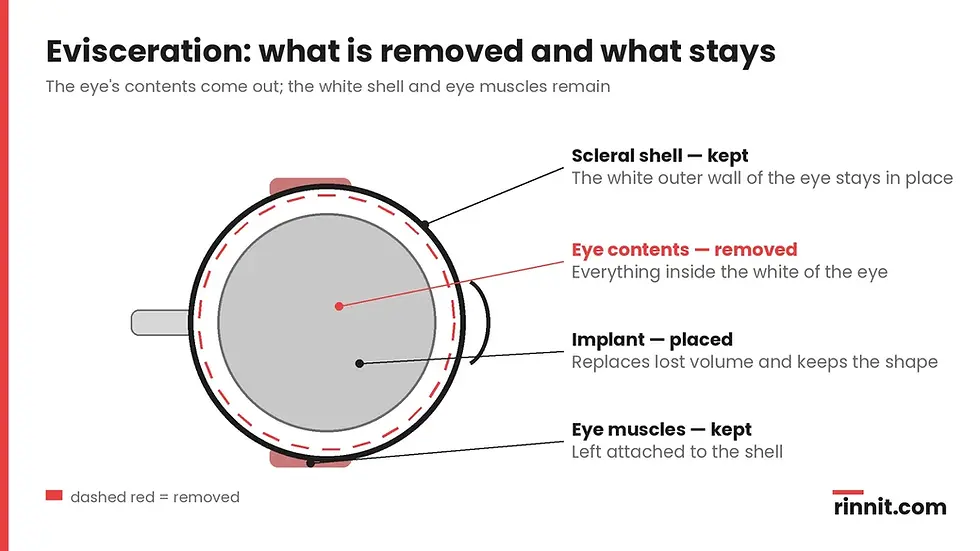
Evisceration of the eye means removing the eye's contents while keeping its outer shell in place. [1] In general medicine, the word "evisceration" describes removing the insides of something, especially organs. [1]
During this surgery, the surgeon keeps the scleral shell — part of the sclera, the white layer that wraps around the outside of the eyeball. [1] The eye muscles and other parts attached to the eye are also left intact. [1]
A permanent implant goes into the empty space so the eye socket keeps its shape. [1] You can choose a more permanent prosthetic eye once you have recovered. [1]
How is evisceration different from enucleation?
Evisceration removes only the inside of the eye, while enucleation removes the whole eye, including the white part and part of the optic nerve. [1]
Feature | Evisceration | Enucleation |
What is removed | The eye's contents | The entire eye |
White part of the eye (sclera) | Kept as a shell | Removed |
Eye muscles and attached parts | Left intact | — |
Optic nerve | — | Part of it is removed |
Implant and prosthetic eye | Implant placed; prosthetic eye later | — |
Dashes mark details not covered in this guide's source. [1]

Why would someone need evisceration?
An eye doctor may suggest evisceration to treat a serious eye infection, a severe injury, or an eye that has lost its sight and causes pain. [1] It is usually recommended only after other treatments have been tried. [1]
Common reasons include:
Reason | What it means |
Endophthalmitis or other serious infection | A severe infection inside the eye |
Severe eye injury | Damage too serious for the eye to recover |
End-stage eye | An eye that has shrunk and stopped working |
Painful sightless eye | A blind eye that keeps causing pain |
Cosmetic concerns | Appearance problems with a sightless eye |
Microphthalmia | An eye that is abnormally small |
[1]
You can read more about babies born with small or missing eyes in our guide to microphthalmia and anophthalmia. [1]
How should you prepare for evisceration?
Preparing for evisceration means reviewing your medicines, fasting before surgery, and arranging a ride home. [1]
Medicines: Tell your surgeon about every prescription, over-the-counter medicine and supplement you take. You may need to stop some, especially blood thinners. [1]
Fasting: Your surgeon will tell you when to stop eating and drinking. You will probably need to fast for several hours. [1]
Transport: You won't be able to drive yourself home after the operation. [1]
Ocularist visit: Your surgeon may suggest meeting an ocularist — a technical artist who designs and makes prosthetic eyes — before surgery. [1]
What happens during evisceration surgery?
Evisceration surgery usually takes about an hour and is done under anesthesia so you feel no pain. [1] General anesthesia, which puts you to sleep, is common. [1] Local anesthesia that numbs the area around the eye is another option, usually with a sedative. [1] Learn more in our guide to anesthesia types and recovery.
During the operation, your surgeon will: [1]
Separate the eye's contents from the sclera.
Remove the eye's contents.
Insert an implant to replace the lost volume in the eye socket.
Cover the implant with tissue from the eye socket.
Place a conformer — a contact-lens-like piece that fills the socket until a prosthetic eye is ready.
Temporarily sew the eyelid shut to protect the socket while it heals.
Apply a pressure bandage to protect the area, prevent bleeding and reduce inflammation.
What are the benefits and risks of evisceration?
Evisceration is a safe, effective way to remove damaged eye tissue, relieve pain and protect your health and remaining vision. [1] It can also improve appearance, because a prosthesis can usually be customized to match your other eye or your personal preferences. [1]
Like any surgery, evisceration carries risks: [1]
Infection
Bleeding
Implant problems, including needing the implant removed
Scarring
Damage to the eyelid or tissue around the eye socket
In pooled research, implant exposure ranged from about 2.6% to 12%, depending on the implant material. [3]
What is recovery like after evisceration?
Recovery after evisceration usually takes one to two months. [1] Most people go home the same day, after the care team checks that they have woken safely from anesthesia and that their pain is controlled. [1]
Your care team will prescribe pain medicine, plus antibiotics if your eye was infected. [1] Over-the-counter pain relievers such as acetaminophen may be allowed. [1] Your surgeon may ask you to avoid NSAIDs, because they can thin your blood and raise bleeding risk. [1]
When | What usually happens |
Surgery day | About one hour of surgery; usually home the same day |
About 1 week | Follow-up visit; pressure bandage removed and healing checked |
Several weeks | Avoid intense physical activity and swimming |
6–8 weeks | Socket healed enough for prosthetic eye fitting |
1–2 months | Usual recovery period; surgeon confirms when to resume all activities |
[1]
You may also be told not to bend over or lift anything above a set weight limit. [1]

When can you get a prosthetic eye after evisceration?
A prosthetic eye is usually fitted six to eight weeks after evisceration, once the tissue in the eye socket has recovered enough. [1] Your ocularist fits it after your surgeon says it's safe to have one made. [1]
Prosthetic eyes can usually be customized to match your other eye or your personal style. [1] For details on how they are made, fitted and cared for, see our complete guide to prosthetic eyes.
When should you call your surgeon after evisceration?
Call your surgeon right away if you notice signs of infection, bleeding or uncontrolled pain after evisceration. [1] Warning signs include: [1]
Fever
Discharge, especially yellow or green
Excessive bleeding
Pain in the eye socket or head that medicine doesn't relieve
The implant falls out
Pain in your other eye
Nausea and vomiting
Conclusion
Evisceration removes the inside of a damaged or painful eye while keeping its white shell and muscles, and a custom prosthetic eye can follow once the socket heals. [1] Surgery is short, usually done the same day, and most people recover within one to two months. [1] Knowing what to expect at each step makes it easier to prepare and to spot warning signs early.
Next step: Save or print this guide and bring it to your appointment, so you can ask your surgeon about your implant, your recovery plan and when to meet your ocularist. For more eye health guides, explore our articles on the sclera and prosthetic eyes.
Further reading: Evisceration — EyeWiki (American Academy of Ophthalmology) · Enucleation & Evisceration — American Society of Ophthalmic Plastic and Reconstructive Surgery
FAQ
What is evisceration of the eye?
Evisceration is surgery that removes the contents of one eye but leaves the white of the eye in place. The eye muscles stay attached, and an implant fills the space so the socket keeps its shape.
How is evisceration different from enucleation?
Evisceration keeps the white scleral shell of the eye, while enucleation removes the whole eye, including the white part and part of the optic nerve.
Why would a doctor recommend evisceration?
Doctors may recommend evisceration for a serious eye infection such as endophthalmitis, a severe eye injury, an end-stage eye, a painful blind eye, cosmetic concerns with a sightless eye, or microphthalmia. It is usually suggested after other treatments haven't helped.
How long does evisceration surgery take?
Evisceration usually takes about an hour. It is usually an outpatient procedure, so most people can go home the same day.
How long does it take to recover from evisceration?
Recovery usually takes one to two months. You'll need to avoid intense physical activity and swimming for several weeks, and your surgeon will tell you when you can return to all your usual activities.
When can I get a prosthetic eye after evisceration?
A prosthetic eye is usually fitted six to eight weeks after surgery, once the eye socket has healed enough. An ocularist designs and fits it to match your other eye or your personal style.
What are the risks of evisceration?
Risks include infection, bleeding, implant problems (including needing the implant removed), scarring, damage to the eyelid or socket tissue, conjunctival cysts and pyogenic granuloma.
When should I call my surgeon after evisceration?
Call your surgeon right away for fever, yellow or green discharge, excessive bleeding, pain not relieved by medicine, an implant that falls out, pain in your other eye, or nausea and vomiting.
Will I be asleep during evisceration surgery?
Most people have general anesthesia and are fully asleep. Some have local numbing medicine with a sedative. Your surgeon will explain which type is right for you.
Is there pain after evisceration?
Some pain, swelling and bruising around the eye socket are common for several days. Your surgeon will prescribe or recommend pain medicine. Call them for pain that gets worse or does not ease with medicine.
Related Reading
Enucleation: Why Eye Removal Surgery Is Done, How It Works, and What Recovery Looks Like explains removal of the whole eye and how it differs.
A Comprehensive Guide to Prosthetic Eyes: Restoration and Care covers how prosthetic eyes are made, fitted and cared for.
Open Globe Injury Guide: Emergency Steps to Save Your Sight describes serious eye injuries that may lead to eye surgery.
Blindness: The Complete Loss of Vision That Affects About 1 Million Americans — and What Medicine Can and Cannot Fix explains the causes of vision loss and available support.
References
Cleveland Clinic. Evisceration Surgery: What It Is & Why It’s Done. Cleveland Clinic. Last updated January 6, 2026. https://my.clevelandclinic.org/health/treatments/25029-evisceration
Patterson TJ, Kedzierski A, McKinney D, et al. The risk of sympathetic ophthalmia associated with open-globe injury management strategies: a meta-analysis. Ophthalmology. 2024;131(5):557-567. PMID 38086434. https://doi.org/10.1016/j.ophtha.2023.12.006
Schellini S, Jorge E, Sousa R, et al. Porous and nonporous orbital implants for treating the anophthalmic socket: a meta-analysis of case series studies. Orbit. 2016;35(2):78-86. PMID 26928263. https://doi.org/10.3109/01676830.2016.1139591
Gupta R, Hari P, Khurana B, et al. Risk factors for orbital implant exposure after evisceration: a case control study of 93 patients. Indian J Ophthalmol. 2019;67(7):1148-1151. PMID 31238431. https://doi.org/10.4103/ijo.IJO_1813_18
Medical disclaimer
This article is for general education and does not replace advice from your eye surgeon or doctor. Always follow the instructions your own care team gives you, and seek urgent care if you notice any of the warning signs above.



Comments