Blindness: The Complete Loss of Vision That Affects About 1 Million Americans — and What Medicine Can and Cannot Fix

Updated: 4 days ago
Medically reviewed by *Dr. Baraa Alnahhal, MD*. Last reviewed October 13, 2026. This content is for educational purposes and is not medical advice.

TL;DR
Blindness is the inability to see or a lack of vision, with the most severe cases meaning the eye cannot detect even light, and no eyeglasses, contact lenses, eye drops, or surgery can correct it. About 1 million people in the United States are blind today, and experts expect that number to double by 2050. Some causes are treatable or preventable, such as infections, cataracts, and vitamin A deficiency, while others, including injuries and genetic conditions, cannot be reversed. Sudden vision loss is always a medical emergency that needs immediate care. Even when blindness cannot be cured, visual rehabilitation, low-vision training, and support services help people keep as much independence and quality of life as possible.
Quick Answer
Blindness is the inability to see or a lack of vision; in its most severe form the eye cannot detect light. About 1 million Americans are blind. Some forms are treatable with medication, cataract surgery or other procedures, and many cases are preventable. Sudden vision loss, eye pain, flashes, new floaters or a vision-affecting accident need immediate medical help.
What the research says
Much blindness is treatable or preventable. A systematic review of 28 studies in Arab countries found a pooled blindness prevalence of 4.65% (95% CI 3.26% to 6.04%), well above the global average of 0.55%, with cataracts (29% to 66.2% of cases), diabetic retinopathy, glaucoma, and uncorrected refractive errors among the main causes, along with barriers such as cost and limited access to eye care (Alsolami and Alqarni, Res Dev Disabil, 2025).
Trachoma is tied to hygiene. A meta-analysis of 16 studies in low-income countries found a pooled active trachoma prevalence of 21.1% among children aged 1 to 9, and showed that having a latrine and a clean child face were significantly linked to lower trachoma, supporting the focus on sanitation and face washing against the leading infectious cause of blindness (Berhanu et al., PLoS One, 2025).
Vision loss affects mental health too. A meta-analysis of irreversible vision loss found depression in 21% of 76,561 patients (95% CI 17% to 26%), reaching 48% in people with diabetic retinopathy, and anxiety in 22% of 25,616 patients, which is why emotional support is part of care (Shah et al., Int J Psychiatry Med, 2025).
What Is Blindness?
Blindness means the inability to see or a lack of vision. In the most severe cases, a person cannot even detect light. By definition, blindness cannot be corrected with eyeglasses, contact lenses, eye drops, other medical therapy, or surgery. When vision loss happens suddenly, it is a medical emergency that requires immediate help.
What does “legal blindness” mean?
Legal blindness is a specific measurement used to decide who qualifies for certain services and protections. A person is legally blind when their central vision is 20/200 in their best-seeing eye even when corrected with glasses or contact lenses.
What does 20/200 actually mean? It means you must stand ten times closer to an object to see it as clearly as a person with normal 20/20 vision, or the object must be ten times larger. A person is also legally blind if their field of vision (the total area you can see without moving your eyes, including to the sides, above, and below) is severely reduced to less than 20 degrees.
Legal blindness is not the same as total blindness. Many legally blind people still see light, shapes, or even large objects; they just cannot see them clearly at a normal distance.
What Are the Different Types of Blindness?
Blindness is not one single condition. Several distinct types exist, each with its own causes and outlook.
Type | What it means | Key facts |
|---|---|---|
Partial blindness (low vision) | You still have some vision | Often called “low vision”; glasses or treatment may still help |
Complete blindness | Cannot see or detect light | Very rare; nothing can correct it |
Congenital blindness | Poor vision you are born with | Caused by inherited eye and retinal conditions or non-inherited birth defects |
Legal blindness | Vision limited to 20/200 corrected, or field of vision under 20 degrees | A measurement for services, not a description of what you see |
Nutritional blindness | Vision loss from vitamin A deficiency | Ongoing deficiency damages the front of the eye (xerophthalmia) and weakens night vision |
Color blindness | Colors perceived differently; not traditional blindness | Can be inherited or acquired; achromatopsia means seeing only black, white, and gray |
Preventable (avoidable) blindness | Blindness in people with a treatable disease who never received care | Examples: untreated diabetes or high blood pressure damaging the eyes |
How common is blindness?
About 1 million people in the United States are blind today, and experts expect that number to double by 2050. Many more people have low vision that falls short of blindness. Worldwide, an estimated 43 million people live with blindness. The condition can happen to anyone.
What Are the Symptoms of Blindness?
How symptoms look depends on how vision is being lost. Complete blindness means a total lack of vision: the eye cannot detect light. When vision loss develops over time instead of all at once, the warning signs tend to build gradually.
Symptom | What it feels like |
|---|---|
Blurry vision | Objects, text, and faces look soft, smeared, or out of focus |
Eye pain | Aching, burning, or pressure in or around the eye |
Floaters and flashers | Spots, cobweb shapes, or light flickers drifting through your field of vision |
Light sensitivity (photophobia) | Normal light feels painfully bright |
Sudden vision loss or black spots | Vision disappears quickly or dark spots appear without warning |
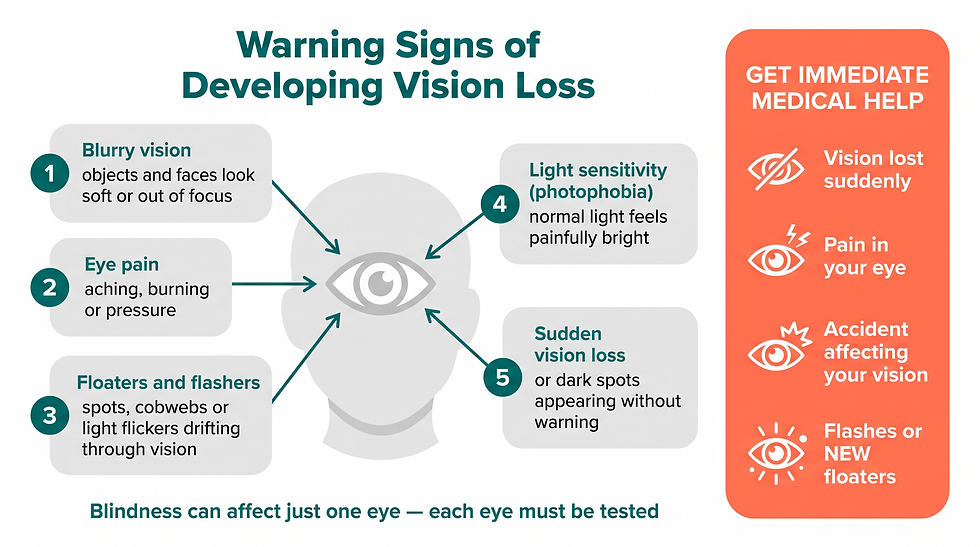
When sudden changes strike, treat them as emergencies. Get immediate medical help if you lose vision suddenly, have pain in your eye, have an accident that affects your vision, or notice flashes or new floaters. Time matters: some causes of sudden vision loss are reversible only if treated fast.
What Causes Blindness?
Blindness comes from three broad groups of causes: injuries, infections, and non-infectious diseases. Some affect one eye; others affect both.
Eye injuries
Trauma to the eye usually affects only one eye. Common injury causes include chemical burns, exposure to toxins, fights, fireworks, industrial accidents (including falls), motor vehicle crashes, and sports.
Infections
Infections of and around the eye can damage vision severely enough to cause blindness. Ten are commonly listed: trachoma, cytomegalovirus, endophthalmitis, histoplasmosis, keratitis (including acanthamoeba keratitis), rubella, shingles, syphilis, toxoplasmosis, and uveitis.
Trachoma deserves special mention. It is the leading cause of preventable blindness in the world. That is why some governments and societies are working to make medicines more available across large areas of the globe: a major chunk of global blindness does not have to happen.
Non-infectious diseases
The largest group of causes comes from diseases that slowly damage the eye, retina, optic nerve, or the brain's vision centers.
Cause | How it leads to blindness |
|---|---|
Retinitis pigmentosa | Inherited group of conditions that break down the retina's light-reacting cells; night vision goes first, then peripheral vision |
Age-related macular degeneration (AMD) | Damages the macula that controls central vision; reading and faces become very difficult while peripheral vision often stays intact |
Retinopathy of prematurity | In premature babies, blood vessels grow where they should not; scar tissue damages the retina |
Cataracts | Cloud the eye's lenses, blurring vision and reducing contrast; without surgery, advanced cataracts can lead to blindness |
Diabetes-related retinopathy | Diabetes damages the eye's blood vessels; mild at first, blindness with progression or no treatment |
Glaucoma | Damages the optic nerve; vision loss starts at the edges and can end in blindness at advanced stages |
Leber hereditary optic neuropathy | An inherited condition causing gradual vision loss; affects males more than females |
Anophthalmia | Born without one or both eyes |
Microphthalmos | Born with very small eyes that may not work as well, or at all |
Stroke | Reduces or blocks blood flow to the brain's visual areas, such as the occipital lobe or visual tract |
Cancer | Tumors of the eye itself (retinoblastoma) or orbital tumors behind the eye |
Nutritional deficiencies | A poor diet starves the eyes of vitamin A, B vitamins, and other minerals and vitamins needed for healthy vision |
How Is Blindness Diagnosed?
Because blindness can affect just one eye, providers test each eye separately. Diagnosis rests on a thorough eye exam plus two standard measurements.
The Snellen test reads lines of letters that get smaller down the page and measures central vision, known as visual acuity. This is the test behind the 20/200 legal-blindness number. Visual field testing measures everything you can see at once: not just straight ahead, but to the sides, above, and below without moving your eyes. A field of vision narrowed to under 20 degrees qualifies as legal blindness even if central vision is sharp.
How Is Blindness Treated?
Treatment depends entirely on the cause and how much damage has occurred. Some forms of blindness respond to medications or glasses. In other cases, when the eyes are missing or completely damaged, there is no way to restore sight. Instead, visual rehabilitation focuses on enhancing whatever visual function remains: low-vision training, therapy, and low-vision devices aimed at meeting your visual goals and improving quality of life.
Treatment | What it fixes |
|---|---|
Medication (anti-infective drugs) | Blindness caused by infections |
Cataract surgery | Cataracts; successful in most cases |
Corneal transplant | A scarred cornea replaced with a donor cornea |
Retinal surgery | Damaged retinal tissue repaired with surgery and/or laser |
Vitamin supplements | Vitamin A can reverse the vision loss of xerophthalmia; vitamin B or D supplements help vision loss from a poor diet |
What Is the Outlook for Someone Who Is Blind?
If you are completely or partially blind, there are options. It helps to learn as much as you can about your specific condition. Blindness affects your life and the lives of your family and friends: it touches mobility, the ability to care for yourself or others, employment, and even how you relax and have fun. Some of these challenges are even more pressing for older adults.
Ask your eye doctor about coping with low or no vision and about services that can help. These commonly include education, emotional health support, skills training, technology training, and recreational options.
How Can You Reduce Your Risk of Blindness?
You cannot prevent every type of blindness. But many cases are preventable, and the checklist below lays out a clear personal action list.
Area | What to do |
|---|---|
Eye care | Have regularly scheduled eye exams on your provider's schedule; contact an eye care provider with any vision change or eye problem; wear your prescription glasses and contact lenses when needed |
Chronic disease | Keep blood sugar stable if you have diabetes; manage blood pressure if you have hypertension |
Protection | Wear protective gear when working, riding a motorcycle, or playing contact sports; wear sunglasses |
Lifestyle | Eat a healthy, well-rounded diet; get enough exercise; achieve a healthy weight; know your family health history; quit smoking or never start |
Contact lens hygiene | Always wash hands before handling contacts; follow instructions on how often to replace them |

What is the bottom line on blindness?
Blindness is a spectrum: from low vision that still lets you see light and shapes, to legal blindness measured at 20/200, to the rare complete loss of even light detection. About 1 million Americans live with it today, and infections like trachoma remain the world's leading preventable cause. Some forms can be treated with medication, surgery, or vitamins; others cannot. What you can always control is the front half of the story: regular eye exams, chronic disease management, protective eyewear, and immediate care when vision changes suddenly. If your sight is changing, do not wait it out. Reach out to a healthcare provider today.
Explore more eye health guides and prevention resources at Rinnit.com to help protect your vision.
Frequently Asked Questions
What exactly counts as blindness?
Blindness is the inability to see or a lack of vision. In its most severe form, the eye cannot detect light. By definition, it cannot be corrected with eyeglasses, contact lenses, eye drops, or surgery.
Can someone who is blind still see light or color?
Often, yes. Complete blindness is very rare. Many people with significant vision loss still detect light, shapes, or motion. Legal blindness, defined as 20/200 corrected central vision or a visual field under 20 degrees, leaves most people with partial sight.
What does 20/200 vision actually mean?
20/200 vision means you must stand ten times closer to an object, or the object must be ten times larger, for you to see it as clearly as someone with normal 20/20 vision, even with your best glasses or contacts.
How many people are blind in the United States?
About 1 million Americans are blind, and experts expect that number to double by 2050. Many more people have low vision.
How common is blindness around the world?
An estimated 43 million people live with blindness worldwide. Trachoma remains the leading cause of preventable blindness globally.
Is legal blindness the same as total blindness?
No. Legal blindness is a measurement threshold (20/200 corrected vision or under 20 degrees of visual field) used to qualify for services. Most legally blind people retain some vision.
What is congenital blindness?
Poor vision present at birth. It comes from inherited eye and retinal conditions or from non-inherited birth defects.
Can poor nutrition make you blind?
Yes. Vitamin A deficiency causes nutritional blindness. If it continues, it damages the front surface of the eye (xerophthalmia) and weakens the retinal cells you need for seeing at night and in dim light. Vitamin B and vitamin D deficiencies also harm vision.
What is color blindness?
A condition where colors are perceived differently than usual, not blindness in the traditional sense. It can be inherited or acquired from disease or damage in the retina or optic nerve. In achromatopsia, a person sees only black, white, and shades of gray.
What is preventable blindness?
Blindness in people who have a treatable disease but never receive care, often because they lack access to eye care and healthcare. Untreated diabetes-related retinopathy and hypertensive retinopathy are the classic examples.
Which infections can cause blindness?
Trachoma (the leading preventable cause worldwide), cytomegalovirus, endophthalmitis, histoplasmosis, keratitis including acanthamoeba keratitis, rubella, shingles, syphilis, toxoplasmosis, and uveitis.
How do eye injuries cause blindness?
Trauma usually affects one eye. Chemical burns, toxins, fights, fireworks, industrial accidents and falls, motor vehicle crashes, and sports injuries can all damage the eye permanently.
Can diabetes really make you blind?
Yes, if it goes untreated. Diabetes-related retinopathy damages the blood vessels inside the eye. It is often mild at first but can progress to blindness without treatment, which is why blood sugar control and regular eye exams are critical.
What treatments actually exist for blindness?
Anti-infective medication for infection-caused blindness, cataract surgery (successful in most cases), corneal transplants for scarred corneas, retinal surgery or laser for damaged retinal tissue, and vitamin A, B, or D supplements for diet-related vision loss. When the eyes are missing or completely damaged, visual rehabilitation helps people make the most of remaining vision.
When should I go to the ER for a vision problem?
Seek immediate medical help if you lose vision suddenly, have pain in your eye, have an accident that affects your vision, or notice flashes or new floaters in your vision.
Related Reading
Glaucoma: The Silent Threat to Vision, and How Early Treatment Can Protect Your Sight
Cataracts: Symptoms, Causes, Diagnosis and Treatment — What You Need to Know: the most common reversible cause of vision loss
Diabetic Retinopathy: Symptoms, Causes, Diagnosis & Treatment — Complete Guide: protecting your eyes from diabetes damage
Sources
Cleveland Clinic. Blindness. Cleveland Clinic. November 14, 2022. https://my.clevelandclinic.org/health/diseases/24446-blindness
American Academy of Ophthalmology. Endophthalmitis. EyeWiki. July 21, 2026. https://eyewiki.aao.org/Endophthalmitis
American Foundation for the Blind. Key Definitions of Statistical Terms. American Foundation for the Blind. March 2026. https://www.afb.org/research-and-initiatives/statistics/key-definitions-statistical-terms
American Optometric Association. Low Vision and Vision Rehabilitation. American Optometric Association. Accessed October 14, 2026. https://www.aoa.org/healthy-eyes/caring-for-your-eyes/low-vision-and-vision-rehab
Centers for Disease Control and Prevention. Vision and Eye Health. CDC. May 15, 2024. https://www.cdc.gov/vision-health/index.html
National Eye Institute. Uveitis. National Eye Institute. December 4, 2024. https://www.nei.nih.gov/learn-about-eye-health/eye-conditions-and-diseases/uveitis
Alsolami AS, et al. Prevalence, causes, and barriers of severe visual impairment and blindness in Arab countries: A systematic review and meta-analysis. Research in Developmental Disabilities. 2025;164:105074. PMID 40633432. https://doi.org/10.1016/j.ridd.2025.105074
Berhanu L, et al. Association between presence of latrine and unclean child face on the prevalence of active trachoma among children aged 1 to 9 years in low-income setting: A systematic review and meta-analysis. PLoS One. 2025;20(8):e0330077. PMID 40773502. https://doi.org/10.1371/journal.pone.0330077
Shah N, et al. Depression and Anxiety in Patients With Irreversible Vision Loss: Meta-Analysis and Systematic Review. International Journal of Psychiatry in Medicine. 2025;61(5):574-602. PMID 41061694. https://doi.org/10.1177/00912174251382653
Medical Disclaimer
This article is for general information only and is not a substitute for professional medical advice, diagnosis, or treatment. Always seek the advice of a qualified healthcare provider with questions about a medical condition. Sudden vision loss is a medical emergency; seek immediate care.


Comments