Diabetic Retinopathy: Symptoms, Causes, Diagnosis & Treatment — Complete Guide

Updated: 6 days ago
Medically reviewed by Dr. Baraa Alnahhal, MD · Last reviewed: October 2026
Quick Answer
Diabetic retinopathy is a diabetes complication that damages blood vessels in the retina, the light-sensitive tissue at the back of the eye. Risk rises the longer diabetes lasts and the harder blood sugar is to control. Early stages often have no symptoms, so a yearly dilated eye exam matters. Good diabetes control and early detection can slow vision loss.
What the research says
Eye injections beat laser at preventing complications, but the vision gain is small. A systematic review and network meta-analysis of 14 randomized trials (3 of aflibercept, 5 of bevacizumab, 6 of ranibizumab) found anti-VEGF injections were slightly better than panretinal laser at protecting vision up to 2 years (about 3.6 letters on an eye chart) and clearly better at preventing macular edema (relative risk 0.29, 95% CI 0.18–0.49) and vitreous hemorrhage (relative risk 0.77, 95% CI 0.61–0.99); the authors judged the vision benefit unlikely to be clinically meaningful. (Simmonds et al., Health Technol Assess, 2025) [3]
A second network meta-analysis points the same way. Across 28 randomized trials with 6,450 patients, anti-VEGF therapy improved best-corrected vision by 3.39 more letters than laser at 12 months (95% CI 1.85–4.93), reduced central retinal thickness more (−24.50 µm, 95% CI −39.03 to −9.97), and caused fewer adverse events; the authors concluded these findings support anti-VEGF drugs as first-line treatment for vision-threatening disease. (Chen et al., Diabetes Res Clin Pract, 2025) [4]
Screening programs work better with quality-improvement interventions. A Cochrane review of 66 randomized trials found that across 56 studies (329,164 participants), quality-improvement interventions raised eye-screening attendance by 12 percentage points compared with usual care (risk difference 0.12, 95% CI 0.10–0.14; low-certainty evidence). (Lawrenson et al., Cochrane Database Syst Rev, 2018) [5]
TL;DR
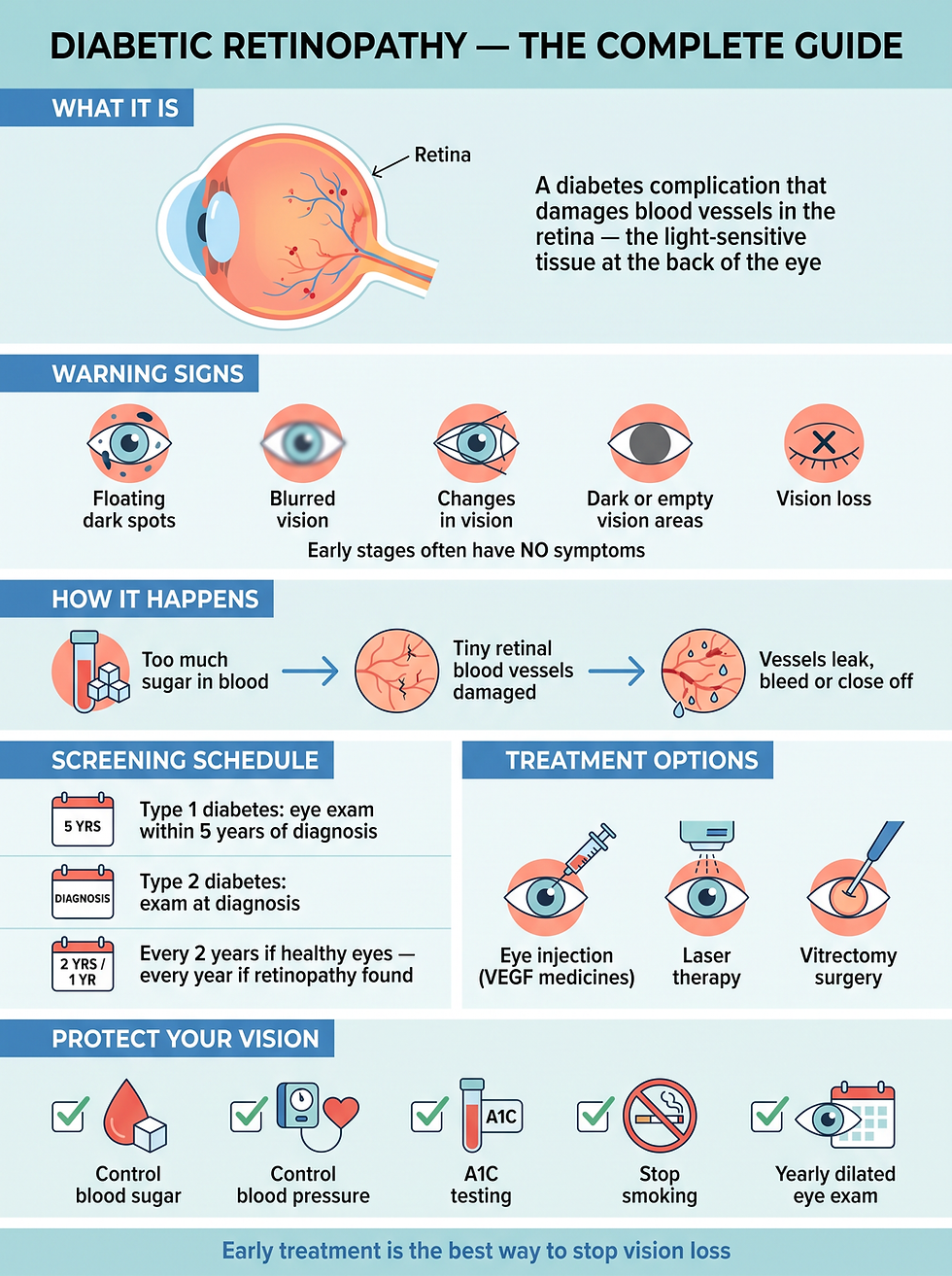
What it is: Damage to the retinal blood vessels caused by high blood sugar from type 1 or type 2 diabetes.
Main symptoms: Floaters, blurred vision, dark or empty areas in vision, and vision loss — but early stages are often silent.
Two stages: Nonproliferative (vessels bulge and leak) and proliferative (new fragile vessels grow and bleed).
Diagnosis: Dilated eye exam, OCT imaging, and fluorescein angiography.
Treatment: Blood sugar control, eye injections, laser therapy, and vitrectomy surgery — aimed at stopping worsening.
Outlook: Treatment slows the disease but is not a cure; regular eye exams remain essential.
At a Glance
Aspect | Summary |
What it is | A diabetes complication that damages blood vessels in the retina |
Who gets it | Anyone with type 1 or type 2 diabetes |
Key warning signs | Floaters, blurred vision, dark or empty vision areas, vision loss |
Two main types | Nonproliferative (NPDR) and proliferative (PDR) diabetic retinopathy |
Main cause | Too much sugar in the blood damaging tiny retinal blood vessels |
Highest risks | Long-standing diabetes, poorly managed blood sugar, high blood pressure |
How it is found | Dilated eye exam, OCT scan, fluorescein angiography |
Treatment options | Blood sugar control, eye injections, laser therapy, vitrectomy |
Can it be prevented | Not always — but good diabetes care and yearly eye exams greatly reduce risk |
What Is Diabetic Retinopathy?
The retina is the light-sensitive tissue lining the back of the eye. It captures light and sends it to the brain so you can see. The retina depends on tiny blood vessels for oxygen and nutrients.
Diabetic retinopathy (die-uh-BET-ik ret-ih-NOP-uh-thee) develops when too much sugar in the blood slowly damages these tiny vessels. Over time, the damaged vessels cut off the retina's blood supply.
It can develop in anyone with type 1 or type 2 diabetes. The risk grows the longer someone has diabetes and the harder it is to keep blood sugars in range. It can also develop during or because of gestational diabetes (diabetes that starts in pregnancy).
At first, the condition may cause no symptoms or only mild vision problems. Left unchecked, it can lead to blindness — especially when diabetes or other health problems are poorly managed.

Diabetic Retinopathy Symptoms: What to Watch For
Many people notice nothing in the early stages. This silent start is exactly why screening matters. As the condition worsens, symptoms may include:
Symptom | What You Notice |
Floaters | Spots or dark strings drifting in your sight |
Blurred vision | Details look fuzzy or out of focus |
Vision changes | Sight fluctuates or shifts |
Dark or empty areas | Blank patches or shadows in your field of vision |
Vision loss | Progressive reduction in what you can see |
When to See an Eye Doctor
Contact a medical professional right away if your vision changes suddenly or becomes blurry, spotty, or hazy.
If you have diabetes, get a yearly dilated eye exam with an eye care professional — even if your vision seems perfectly fine. If you are pregnant and have gestational diabetes or diabetes that started before pregnancy, your care team may recommend additional eye exams throughout the pregnancy, since pregnancy can make retinopathy develop or worsen.
What Causes Diabetic Retinopathy?
Over time, too much sugar in the blood damages the tiny blood vessels that nourish the retina, cutting off its blood supply. In advanced stages, the eye tries to grow new blood vessels to compensate. These new vessels do not develop correctly and can leak or bleed easily.
There are two types of diabetic retinopathy:
Type | What Happens |
Nonproliferative diabetic retinopathy (NPDR) | The more common form. No new blood vessels grow. The walls of retinal vessels weaken, tiny bulges stick out and may leak fluid and blood into the retina, and larger vessels swell and become irregular. The condition progresses from mild to severe as more vessels are damaged. |
Proliferative diabetic retinopathy (PDR) | The more severe form. Damaged vessels close off, triggering the growth of new, irregular blood vessels that can leak into the vitreous — the clear, jellylike fluid filling the center of the eye. |
Macular Edema
Sometimes retinal vessel damage leads to a fluid buildup called edema in the macula — the center of the retina responsible for sharp central vision. When macular edema affects vision, treatment may be needed to reduce swelling and prevent lasting vision loss. It can occur in both types of diabetic retinopathy.
Risk Factors
Anyone who has diabetes can develop diabetic retinopathy. The risk increases with:
Having diabetes for a long time
Poorly managed blood sugar levels
High blood pressure
High cholesterol
Pregnancy
Tobacco use
Being Black, Latino, or Native American
Complications: What Can Happen Without Treatment
Irregular blood vessel growth in the proliferative stage can lead to serious vision problems:
Complication | What Happens |
Vitreous hemorrhage | Weak new vessels leak blood into the vitreous. A small bleed may look like a few dark spots; a severe bleed can fill the vitreous cavity and block vision completely. The blood usually clears within weeks or months, and vision often returns — unless the retina itself is damaged. |
Retinal detachment | Scar tissue from new vessel growth can pull the retina away from the back of the eye, causing floaters, light flashes, missing vision areas, or severe vision loss. |
Glaucoma | New vessels grow on the iris (the colored front of the eye) and block fluid from draining, raising pressure that damages the optic nerve. |
Blindness | Diabetic retinopathy, macular edema, glaucoma, or a combination can cause complete vision loss, especially when health problems are poorly managed. |
Can Diabetic Retinopathy Be Prevented?
You cannot always prevent it, but regular eye exams, good management of blood sugar and blood pressure, and early treatment of vision problems can help stop vision loss. Six habits reduce your risk:
Manage your diabetes. Build healthy eating and physical activity into daily life. Aim for at least 150 minutes of moderate aerobic activity (such as walking) each week, and take diabetes medicines or insulin as directed.
Monitor your blood sugar. Check and record it several times a day — more often when ill or stressed. Ask your care team how often you need to test.
Ask about a hemoglobin A1C test. Also called the glycosylated hemoglobin test, it shows your average blood sugar for the 2–3 months before the test. Ask what your personal A1C goal should be.
Manage blood pressure and cholesterol. Healthy food, regular exercise, and losing excess weight help; sometimes medicine is needed too.
Stop tobacco use. Ask a professional to help you quit — smoking raises the risk of many diabetic complications, including retinopathy.
Pay attention to vision changes. Seek care right away if vision suddenly changes, becomes blurry, spotty, or hazy.
Remember: diabetes doesn't always lead to vision loss. Managing diabetes well can help stop problems before they start.
How Is Diabetic Retinopathy Diagnosed?
Test | What It Does |
Dilated eye exam | Drops widen your pupils so the eye care professional can see inside the eye and check for irregularities. Near (reading) vision may blur for several hours afterward. |
Optical coherence tomography (OCT) | Cross-sectional images show the retina's anatomy and thickness, revealing how much fluid has leaked into retinal tissue. Repeat OCT exams later check whether treatment is working. |
Fluorescein angiography | After dilation, a dye is injected into a vein in your arm. Pictures track the dye as it circulates through the eye's blood vessels, pinpointing vessels that are closed, broken, or leaking. |
Diabetic Retinopathy Treatment
Treatment depends on the type and severity, and its goal is to slow or stop the condition from getting worse.
Early retinopathy (mild or moderate NPDR): Treatment may not be needed right away. Your eye care professional watches your eyes closely and decides if and when treatment is needed. Work with your diabetes doctor to improve blood sugar management — good control usually slows the worsening.
Advanced retinopathy (PDR): Treatment is needed, and macular edema is often treated too. A retina specialist guides the timing. The main options:
Treatment | How It Works | What to Expect |
Eye injections | Vascular endothelial growth factor (VEGF) inhibitors are injected into the vitreous to stop new vessel growth and reduce fluid buildup. Three FDA-approved drugs for macular edema: ranibizumab (Lucentis), aflibercept (Eylea), faricimab (Vabysmo); bevacizumab (Avastin) is often used off-label. | Topical anesthesia; possible burning, tearing, or pain for about 24 hours; risks include pressure buildup and infection. Injections must be repeated and are sometimes combined with laser therapy. |
Laser therapy (photocoagulation) | Laser beams burn or shrink irregular vessels or treat retina areas with poor blood flow, stopping or slowing leakage. | Done in an office or clinic; often needs more than one session; blurry vision for about a day; some loss of outer or night vision is possible afterward. |
Vitrectomy | A surgical procedure in which small tools are inserted through the sclera (white of the eye) into the vitreous cavity to remove blood from hemorrhages and treat retinal detachments and scar tissue. | Performed in a surgery center or hospital with local or general anesthesia. |
An Important Caveat
Treatment can slow or stop the worsening of diabetic retinopathy, but it is not a cure. Because diabetes is a lifelong condition, future retinal damage and vision loss are still possible. Even after treatment, you will need regular eye exams — and possibly added treatment later.
Alternative Medicine
Some alternative therapies might help people with diabetic retinopathy, but more research is needed to confirm they are effective and safe. Always tell your healthcare team about herbal or vitamin supplements — they can affect other medicines or cause problems in surgery, such as excessive bleeding. Most importantly, do not delay standard treatments to try unproven therapies. Early treatment is the best way to stop vision loss.
Coping and Support
The thought of possibly losing your sight can be frightening. Talking to a therapist or joining a support group can help — ask your eye care professional for referrals.
If you have already lost vision, ask about low vision products, such as magnifiers, and services that make daily living easier.
Preparing for Your Eye Appointment
The American Diabetes Association recommends the following screening schedule:
Situation | Recommended Timing |
Type 1 diabetes | Eye exam within five years of being diagnosed |
Type 2 diabetes | First eye exam at the time of diagnosis |
No retinopathy found initially | Complete dilated exam at least every two years |
Any level of retinopathy | Eye exams at least annually |
Pregnancy (with gestational diabetes or existing diabetes) | Exam before pregnancy or in the first trimester; close monitoring during pregnancy and a check for 12 months after giving birth |
What You Can Do Before Your Visit
Write a summary of your diabetic history — diagnosis date, diabetes medicines now and in the past, recent average blood sugar levels, and your last few A1C readings.
List all medications, vitamins, and supplements you take, including dosages.
List your symptoms, even ones that seem unrelated to your eyes.
Bring a family member or friend. They can help remember what you're told — and drive you home after your eyes are dilated.
List your questions. Good ones to ask:
How is diabetes affecting my vision?
Do I need other tests?
Is this health problem short term or long lasting?
What treatments are available, and which do you suggest?
What side effects might I expect from treatment?
I have other health problems — how can I best manage them together?
If I manage my blood sugar well, will my eye problems improve?
What do my blood sugar goals need to be to protect my eyes?
Can you suggest services for people with visual damage?
Don't be afraid to ask other questions you have.
What to Expect From Your Eye Care Professional
Your eye care professional will likely ask: Do you have eye complaints such as blurred vision or floaters? How long have you had them? How well are you controlling your diabetes in general? What was your last A1C? Do you have other health problems, such as high blood pressure or high cholesterol? Have you had eye surgery?
Frequently Asked Questions
Can diabetic retinopathy cause blindness?
Yes, if it is not managed. Diabetic retinopathy, macular edema, and glaucoma — alone or combined — can lead to complete vision loss, especially when diabetes and other health problems are poorly controlled. Early detection and treatment are the strongest protections against blindness.
Does diabetic retinopathy show symptoms early on?
Often it does not. Some people have no symptoms in the early stages at all. As the condition worsens, floaters, blurred vision, dark or empty areas in vision, and vision loss may develop — which is why yearly dilated eye exams are essential even when vision seems fine.
What is the difference between nonproliferative and proliferative diabetic retinopathy?
Nonproliferative retinopathy (NPDR) — the more common form — involves weakened, bulging, leaking blood vessels without new growth. Proliferative retinopathy (PDR) is the more severe stage, in which closed-off vessels trigger fragile new vessels that can leak, bleed into the vitreous, or trigger glaucoma and retinal detachment.
How is diabetic retinopathy treated?
Mild cases may only need close monitoring and better blood sugar control. Advanced cases are treated with eye injections (VEGF inhibitor medicines), laser therapy (photocoagulation), or vitrectomy surgery. These treatments slow or stop the worsening but are not a cure, so regular eye exams must continue.
How often should people with diabetes get eye exams?
The American Diabetes Association recommends an exam within five years of a type 1 diagnosis and at diagnosis for type 2. With no retinopathy, a dilated exam every two years is advised; with any retinopathy, at least annually. People with diabetes who are pregnant should be examined in the first trimester and monitored through pregnancy and for 12 months after birth.
What is diabetic macular edema?
Diabetic macular edema is a fluid buildup in the macula — the center of the retina responsible for sharp central vision. It results from damaged retinal blood vessels leaking fluid, and it can occur in both types of diabetic retinopathy. If it affects vision, treatment is needed to reduce swelling and prevent lasting vision loss.
Can losing weight or quitting smoking help with diabetic retinopathy?
Yes. Healthy eating, regular exercise, and losing excess weight help manage blood pressure and cholesterol — key drivers of retinal vessel damage. Quitting tobacco matters too, because smoking increases the risk of many diabetic complications, including retinopathy.
Conclusion
The main lessons of this guide:
Diabetic retinopathy is silent at first. Early stages often have no symptoms, so a yearly dilated eye exam is your best defense — never wait for vision to blur.
Blood sugar control is the foundation. Managing diabetes, blood pressure, and cholesterol, plus quitting tobacco, slows or prevents the vessel damage that drives the disease.
Effective treatments exist at every stage. From monitoring to eye injections, laser therapy, and vitrectomy, options can stop or slow vision loss — but treatment is not a cure, and follow-up exams remain essential.
This guide has walked you through the symptoms, causes, stages, risk factors, diagnosis, and treatment of diabetic retinopathy, with practical steps you can take today to protect your sight. If you found it useful, keep reading: our guide to diabetic nephropathy explains how diabetes can affect another vital organ — the kidneys.
Your Next Steps
Share your thoughts — Have questions or experiences with diabetic eye disease? Leave a comment below.
Stay updated — Sign up on rinnit.com for new complete health guides delivered to you.
Disclaimer: This content is provided for informational purposes only and is not a substitute for professional medical advice, diagnosis, or treatment. Always seek the advice of your physician or other qualified health provider with any questions you may have regarding a medical condition.
References
Mayo Clinic Staff. Diabetic retinopathy - Symptoms & causes. Mayo Clinic. August 13, 2025. https://www.mayoclinic.org/diseases-conditions/diabetic-retinopathy/symptoms-causes/syc-20371611
Mayo Clinic Staff. Diabetic retinopathy - Diagnosis & treatment. Mayo Clinic. August 13, 2025. https://www.mayoclinic.org/diseases-conditions/diabetic-retinopathy/diagnosis-treatment/drc-20371617
Simmonds M, et al. Anti-VEGF drugs compared with laser photocoagulation for the treatment of diabetic retinopathy: a systematic review and meta-analysis. Health Technol Assess. 2025;29(23):17-88. PMID 39673354. https://doi.org/10.3310/PCGV5709
Chen KY, et al. Which treatment modality offers the best outcomes for diabetic retinopathy? A systematic review and network meta-analysis. Diabetes Res Clin Pract. 2025;227:112379. PMID 40701389. https://doi.org/10.1016/j.diabres.2025.112379
Lawrenson JG, et al. Interventions to increase attendance for diabetic retinopathy screening. Cochrane Database Syst Rev. 2018;1(1):CD012054. PMID 29333660. https://doi.org/10.1002/14651858.CD012054.pub2


Comments