Understanding Pyogenic Granuloma: Symptoms, Causes, and Treatments

Updated: 2 days ago
Medically reviewed by Dr. Baraa Alnahhal, MD · Last reviewed: October 17, 2026
Pyogenic granuloma is a noncancerous, raised skin tumor made of abnormal blood vessels. [1] It usually appears as a rapidly growing pink or red bump that bleeds easily, and it is linked to hormonal changes, minor injuries, and certain medications. [1] Treatment typically involves removal procedures such as surgical excision or cryotherapy. [1]
Quick Answer
Pyogenic granuloma, also known as lobular capillary hemangioma, is a common, noncancerous skin growth made of abnormal blood vessels. [1] These small, fleshy bumps often grow rapidly and bleed easily. [1] The cause is unknown, but they are linked to pregnancy hormones, minor skin injuries and certain medications. [1] Treatment usually involves surgical removal or topical therapies, as they rarely resolve alone.
What the research says
Pyogenic granulomas in pregnancy usually show up late and bleed. A systematic review of 29 pregnant patients with nasal lobular capillary hemangioma (23 studies) found that 62% were diagnosed in the third trimester, all presented with nosebleeds, 48% were treated with surgical excision after delivery, and recurrence was 11% (Lozano-Burga et al., Ear, Nose & Throat Journal, 2026 [2]).
These lesions can come back after removal. In a single-center study of 34 sinonasal lobular capillary hemangiomas, 13 of the 31 patients with follow-up (42%) had a local recurrence, and those with recurrence were significantly older (Smith et al., Head and Neck Pathology, 2013 [3]).
Surgical excision remains the most reliable treatment. A systematic review of 14 studies and 498 cases of pyogenic granuloma after eyelid surgery concluded that topical corticosteroids and timolol may work in selected cases, but surgical excision is the most reliable option and allows laboratory confirmation of the diagnosis (Cheung and Cheung, Cureus, 2026 [4]).
What Is Pyogenic Granuloma?
A pyogenic granuloma is a benign, raised tumor that develops on the skin or mucous membranes, such as the lining of the mouth or nose. [1] Despite its name, the condition is not actually "pyogenic" (pus-producing) nor is it a true granuloma (a cluster of immune cells). Instead, medical professionals more accurately refer to it as a lobular capillary hemangioma. This term reflects its true nature as a collection of abnormal blood vessels that form a fleshy, protruding mass.
These growths are delicate and prone to oozing or bleeding even with minimal contact. They can appear in individuals of any age, though they are particularly prevalent in children, young adults, and pregnant women. [1] When occurring during pregnancy, the condition is sometimes referred to as granuloma gravidarum or an epulis gravidarum. [1]
Feature | Pyogenic Granuloma Details |
Common Names | Lobular capillary hemangioma, granuloma of pregnancy [1] |
Nature | Noncancerous (benign) blood vessel tumor [1] |
Typical Size | A few millimeters to about half an inch [1] |
Common Sites | Face, fingers, toes, lips, tongue, and gums [1] |
Key Symptom | Rapid growth and frequent, easy bleeding [1] |

What are the symptoms of pyogenic granuloma and how is it identified?
The primary symptom of a pyogenic granuloma is the appearance of a small, fleshy bump that grows quickly over a few weeks. These lesions often start as pink or red spots and can mature into reddish-brown or purple tumors. Visually, they have been described as resembling ground beef due to their texture and color. [1] A distinctive feature often seen at the base of the growth is a scaly, white "collar". [1]
These tumors can be attached to the skin in two ways: by a thin, stalk-like structure (pedunculated) or directly to the surface (sessile). [1] While the surface may initially appear smooth, it often becomes bumpy or crusty over time. [1] Because they are composed of a dense network of abnormal capillaries, even a slight bump can cause significant bleeding or oozing.
What causes pyogenic granuloma and who is at risk?
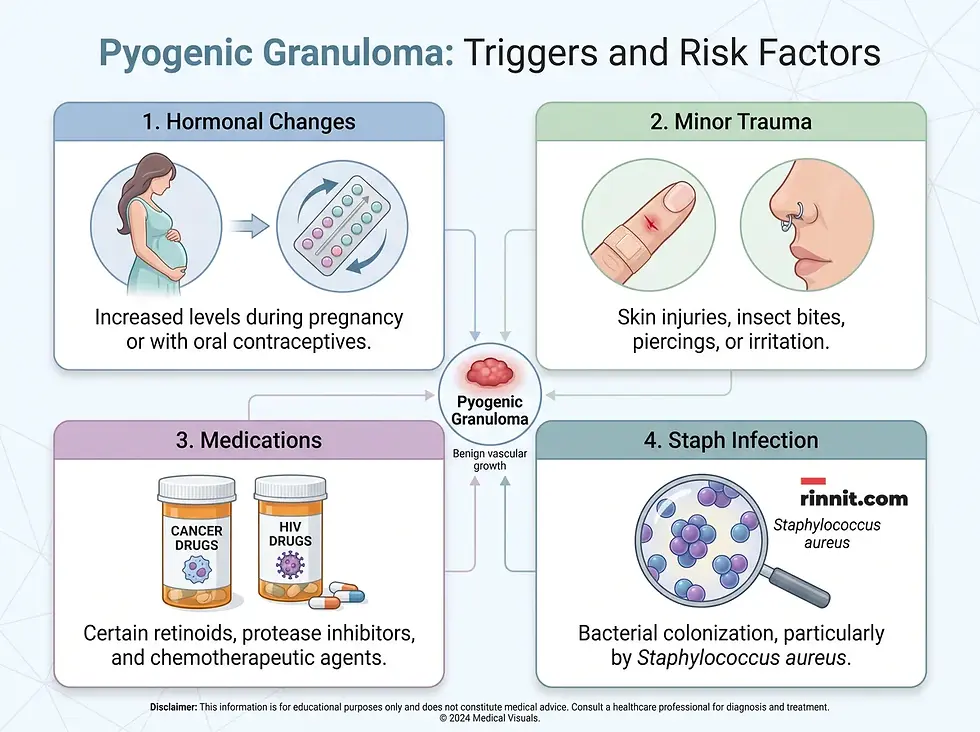
The exact trigger for pyogenic granuloma is unknown, but it is linked to hormonal changes, minor skin trauma or irritation, Staphylococcus aureus infection and certain medications. [1] Hormonal fluctuations are a major factor, explaining why the condition is so common during pregnancy or among those using hormonal birth control. Minor trauma or irritation to the skin or mucous membranes, such as a new piercing or poor oral hygiene, can also stimulate their development. Infection with the bacteria Staphylococcus aureus has also been noted alongside these lesions. [1]
Certain medications have also been linked to the emergence of these lesions. [1] These include:
Antineoplastics: Drugs used in cancer treatment.
Antiretrovirals: Often prescribed for HIV management.
Immunosuppressants: Medications that lower the body's immune response.
Retinoids: Vitamin A compounds used for various skin conditions.
How is pyogenic granuloma diagnosed?
Diagnosing a pyogenic granuloma typically involves a physical examination and a review of the patient's medical history. [1] A healthcare provider will often ask about recent injuries to the area, current medications, and whether the patient is pregnant. [1] In most cases, the visual appearance and rapid growth are sufficient for a diagnosis.
If the diagnosis is uncertain, a provider may perform a biopsy. This involves taking a small sample of the tissue to be examined under a microscope. [1] This ensures that the growth is benign and rules out other potential skin conditions that may mimic its appearance.
How is pyogenic granuloma managed and treated?
The management of pyogenic granuloma depends on the patient's circumstances. For pregnant women, the lesions often resolve spontaneously after delivery. [1] However, for most other cases, medical intervention is required to remove the growth and prevent recurrence, which can be as high as 40%.
Treatment Type | Method | Description |
Topical Therapy | Chemicals/Creams | Application of silver nitrate, phenol, or imiquimod cream [1] |
Freezing | Cryotherapy [1] | Using liquid nitrogen to freeze and destroy the tissue |
Scraping | Curettage & Cautery [1] | Scraping the lesion and sealing the base with heat |
Laser | Laser Treatment [1] | Using targeted light energy to destroy the abnormal vessels |
Surgery | Surgical Excision [1] | Cutting the lesion out for complete removal |

Conclusion and Next Steps
Pyogenic granulomas are harmless but can be a significant nuisance due to their tendency to bleed. While they are not contagious and do not become cancerous, they require careful monitoring. If you notice a rapidly growing, bleeding bump on your skin, consulting a healthcare professional is essential for proper diagnosis and removal. Keeping the area bandaged and avoiding picking at the lesion can help prevent secondary infections while awaiting treatment.
Frequently Asked Questions
Is a pyogenic granuloma cancerous?
No, it is a benign tumor made of blood vessels and does not turn into cancer.
Why does my pyogenic granuloma bleed so easily?
A pyogenic granuloma is composed of abnormal, delicate blood vessels that break easily with minor irritation.
Will it go away on its own?
Pyogenic granulomas associated with pregnancy often disappear after delivery, but most others require treatment.
Are these growths contagious?
No, pyogenic granulomas cannot be spread from person to person.
What happens if I pick at the lesion?
Picking can cause heavy bleeding and increases the risk of a bacterial infection.
Can children get pyogenic granulomas?
Yes, they are common in children, particularly around age six.
What is the recurrence rate?
Even after treatment, they can return in the same spot or elsewhere in up to 40% of cases.
Does removal leave a scar?
Yes, surgical or procedural removal can sometimes leave a small scar on the skin.
What medications can cause this?
Antineoplastics, antiretrovirals, immunosuppressants, and retinoids are all linked to the condition.
What should I do if I see signs of infection?
Contact a healthcare provider immediately if you notice pus, red streaks, or increasing pain.
References
Cleveland Clinic. Pyogenic Granuloma. Cleveland Clinic. April 15, 2022. https://my.clevelandclinic.org/health/diseases/22717-pyogenic-granuloma
Lozano-Burga Y, Diaz-Arocutipa C. Nasal lobular capillary hemangioma during pregnancy: a systematic review. Ear, Nose & Throat Journal. 2026;105(9):566-572. PMID 38345001. https://doi.org/10.1177/01455613241230218
Smith SC, Patel RM, Lucas DR, et al. Sinonasal lobular capillary hemangioma: a clinicopathologic study of 34 cases characterizing potential for local recurrence. Head and Neck Pathology. 2013;7(2):129-134. PMID 23184353. https://doi.org/10.1007/s12105-012-0409-9
Cheung I, Cheung D. Postoperative eyelid pyogenic granuloma: a systematic review of clinical features, surgical associations, and management. Cureus. 2026;18(5):e108239. PMID 42245883. https://doi.org/10.7759/cureus.108239
Medical disclaimer
The information provided in this article is for educational purposes only and should not be used as a substitute for professional medical advice, diagnosis, or treatment. Always seek the advice of your physician or other qualified health provider with any questions you may have regarding a medical condition.



Comments