Episiotomy: Why It's Done, Types, Risks, and Recovery

Updated: 6 days ago
Written and medically reviewed by Dr. Baraa Alnahhal, MD · Last reviewed: October 2026 · How we review

Quick Answer: What is an episiotomy?
An episiotomy is a small cut made in the perineum, the area between the vaginal opening and anus, to widen the opening during vaginal birth. It is no longer routine and is used only when needed, such as fetal distress or forceps or vacuum delivery. Dissolvable stitches repair it, and healing takes about one month. [1]
What the research says
Using episiotomy only when needed means fewer severe tears. A review of 12 randomized trials (6,177 women) found that a selective policy led to about 30% fewer women with severe perineal or vaginal trauma than routine episiotomy (RR 0.70; 8 trials, 5,375 women), with no clear difference in long-term painful sex or urinary leakage. (Jiang et al., Cochrane Database Syst Rev, 2017)
Episiotomy is linked to hidden anal sphincter injury in first births. Pooling 21 studies, episiotomy use was associated with higher odds of anal sphincter injury seen on ultrasound (OR 1.85), and 26% of women had this injury after a first vaginal birth. (Packet et al., Ultrasound Obstet Gynecol, 2023)
A continuous stitch may hurt less than separate stitches. A meta-analysis of 55 trials on repairing tears and episiotomies found continuous suturing lowered pain in the first 24 hours compared with interrupted stitches, while the stitch material itself did not change pain. (Grumitt et al., Eur J Obstet Gynecol Reprod Biol, 2025)
Key takeaways
An episiotomy is a planned cut to widen the vaginal opening during birth. [1]
It is done case by case, not as a routine part of labor. [1]
The two main cuts are median (straight down) and mediolateral (angled). [1]
Most people heal in about a month; pain usually eases within a few weeks. [1]
Call your provider for worsening pain, pus, fever, or bleeding from the cut. [1]
Episiotomy at a glance
Question | Short answer |
What is it? | A small cut in the perineum to widen the vaginal opening during birth |
When is it done? | Only when needed, usually as the baby's head is crowning |
Is it painful during the cut? | Numbing medicine or an existing epidural blocks the pain |
How is it repaired? | With stitches that dissolve on their own |
Healing time | About one month, shorter or longer for some people |
Normal pain window | Soreness for the first couple of weeks; rarely beyond 3–4 weeks |
What is an episiotomy?
An episiotomy is a procedure in which your pregnancy care provider makes a small cut to widen your vaginal opening during vaginal childbirth. [1]
The cut is made in the perineum, the area between the vaginal opening and the anus. [1]
It can help your baby come out more easily. Sometimes the perineum tears on its own as the baby is born. This is called a perineal tear. [1]
After birth, any cut or tear is closed with stitches that dissolve by themselves. [1]
Why is an episiotomy no longer routine?
An episiotomy is no longer routine because studies found it does not prevent severe tears and may even cause worse tearing. [1]
It also does not prevent urine or bowel leakage any better than a natural tear. [1]
In 2006, U.S. obstetric guidelines advised against routine episiotomy, meaning a cut made automatically without checking whether it is truly needed. Providers now prefer to let the perineum tear naturally, if at all. [1]
Providers still use the procedure when it is the safest choice for you or your baby. [1]
When is an episiotomy necessary?
An episiotomy is necessary only when your provider judges it to be the safest option, and that decision is made case by case. There is no general rule. [1]
Common situations include:
If you are worried about needing one, raise it at a prenatal visit before labor starts. [1]
How is an episiotomy done?
An episiotomy is done as your baby is crowning, when the baby's head is at the vaginal opening. Your provider explains why it is needed and asks for your consent first. [1]

The process usually follows four steps: [1]
Numbing. You get anesthesia so you do not feel pain. If you already have an epidural, you may not need more. If not, a local anesthetic is injected into the perineum.
The cut. Your provider supports the perineum and uses special scissors to make a single, deep cut during a contraction. The length varies, and the tissue can tear further after the cut.
Delivery. You deliver your baby, followed by the placenta.
Repair. Your provider closes the tissue with dissolvable stitches, checks how far the tear extends, and looks for complications.
The exact steps can vary depending on why the episiotomy is needed. [1]
What are the types of episiotomy?
The two main types of episiotomy are median (midline) and mediolateral, and they differ in direction, ease, and risk. [1]
Feature | Median (midline) | Mediolateral |
Direction of cut | Straight down from the vaginal opening toward the anus | Angled away from the opening at about 45 degrees |
Ease of making the cut | Easier | Harder |
Risk of extending into the anal sphincter and rectum | Higher | Lower |
Blood loss | — | Can be greater |
Discomfort during recovery | — | Can be greater |
What are the benefits and risks of an episiotomy?
The main benefit of an episiotomy is that, in certain situations, it lowers the risk of a severe natural tear or allows a baby who needs to be born quickly to be delivered faster. If you have one, it is because it is safest for you or your baby. [1]
Possible complications include: [1]
Bleeding
Infection
Injury to the anal sphincter and rectum
Trouble controlling bowel movements (fecal incontinence)
Trouble controlling urine (urinary incontinence)
Weakened support muscles (pelvic floor dysfunction)
A sagging pelvic organ (prolapse)
An abnormal opening between the rectum and vagina (rectovaginal fistula)
Scarring
The wound reopening (wound dehiscence)
A longer recovery
These same complications can also happen with a natural perineal tear. [1]
What happens after an episiotomy?
After an episiotomy, your care team checks your stitches regularly in the postpartum room, looking for problems such as infection or bleeding. [1]
They will tell you what type of tear you had and how to care for it in the hospital and at home. [1]
You will usually receive witch hazel pads and perineal cold packs for pain, plus medicines that keep your stool soft. [1]
With a larger third- or fourth-degree tear, you may need a urinary catheter to pee while in the hospital. [1]
How long does it take to heal after an episiotomy?
Healing after an episiotomy takes about one month, but it can be shorter or longer depending on the degree of the cut and how your body heals. Natural tears usually heal in about the same time. [1]
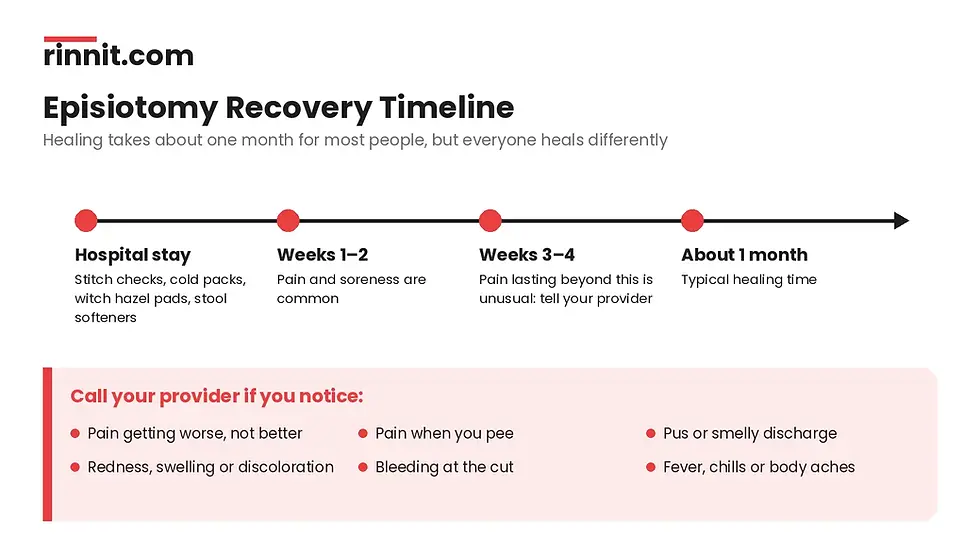
Time after birth | What to expect |
Hospital stay | Stitch checks for bleeding or infection; pads, cold packs, and stool softeners given |
First couple of weeks | Pain and soreness are common |
Weeks 3–4 | Pain lasting beyond this point is unusual — tell your provider |
About one month | Typical healing time for most people |
Pain differs from person to person. Your provider can recommend pain pills and tell you whether your pain level is normal for your type of episiotomy. [1]
Some discomfort during sex is possible once you are cleared for intercourse. [1]
How can I help my episiotomy heal at home?
You can help your episiotomy heal at home with simple steps that ease pain, reduce swelling, and keep the area clean. [1]
Home care step | How it helps |
Witch hazel pads | Ease irritation |
Donut pillow or waffle cushion | Takes pressure off the area when sitting |
Laxative or stool softener (as advised) | Makes bowel movements easier |
Sitz baths, twice a day | Soothe and clean the area |
Peri bottle after using the toilet | Cleans gently instead of wiping |
Ice pack or perineal cold pack | Reduces swelling and soreness |
Over-the-counter pain reliever (as advised) | Eases pain |
Numbing spray | Calms pain and itching |
You will need these steps for a few weeks. Your team may also suggest a pelvic floor therapist. [1]
Do not use tampons, have sex, or put anything into your vagina until your provider says it is OK. Ask your midwife or obstetrician which activities to avoid while you recover. [1]
When should I call my provider after an episiotomy?
You should call your pregnancy care provider after an episiotomy if any of these happen: [1]
Pain keeps getting worse instead of better
It hurts to pee
Smelly discharge or pus comes from the cut
The skin around the cut is red, swollen, or discolored
The cut is bleeding
You have a fever, chills, or body aches
Emotional healing matters too. If a difficult birth experience is causing you distress, reach out to a mental health professional. [1]
Conclusion
An episiotomy is a targeted tool, not a routine step of birth. Providers now save it for moments when speed or a safer delivery matters, such as fetal distress or an instrument-assisted birth. Most people heal in about a month with simple home care, and clear warning signs tell you when to call for help. If you are concerned about needing one, talk with your provider before your due date, and lean on loved ones while you recover and care for your newborn. [1]
Next step: Keep learning with our guides on the three stages of labor, vaginal tears during childbirth, and postpartum lochia — and bring your questions to your next prenatal visit.
FAQ
What is an episiotomy?
An episiotomy is a small cut in the perineum that widens the vaginal opening during vaginal birth. It is repaired with dissolvable stitches after delivery.
Why is an episiotomy done?
An episiotomy is done when the baby needs to be delivered quickly, when forceps or vacuum are used, or when there is a risk of a large tear toward the anus. Providers decide case by case.
Is an episiotomy better than a natural tear?
An episiotomy is not better as a routine practice. It does not prevent severe tears and may cause worse tearing, so providers prefer a natural tear unless a cut is truly needed.
What are the two types of episiotomy?
The two types of episiotomy are median, a straight cut toward the anus, and mediolateral, a cut angled at about 45 degrees. The median cut carries a higher risk of reaching the anal sphincter.
Does an episiotomy hurt?
An episiotomy itself should not hurt because numbing medicine or an epidural is used. Soreness is common for the first couple of weeks afterward.
How long does an episiotomy take to heal?
An episiotomy takes about one month to heal, though this can be shorter or longer. Pain lasting more than three to four weeks is unusual and should be reported.
When can I have sex after an episiotomy?
You can have sex after an episiotomy only once your provider says it is OK. Some discomfort is possible at first.
When should I call a doctor after an episiotomy?
You should call your doctor after an episiotomy if pain worsens, peeing hurts, the cut leaks pus or smells, looks red or swollen, bleeds, or you develop a fever or chills.
How can I ease pain while an episiotomy heals?
Cold packs, warm sitz baths, a squeeze bottle of water when you pee and pain relievers your provider approves can all help. A stool softener can make bowel movements more comfortable.
Can I lower my chance of needing an episiotomy?
Perineal massage in the last weeks of pregnancy and warm compresses during pushing may lower the risk of tearing. Talk with your provider about your birth preferences.
Further reading
Related Reading
Sitz Bath: How to Take One, Benefits and Uses explains how a warm sitz bath eases pain and helps healing.
References
Cleveland Clinic. Episiotomy: Purpose, Procedure, Risks & Recovery. Cleveland Clinic. Last updated June 8, 2026. https://my.clevelandclinic.org/health/treatments/22904-episiotomy
Jiang H, Qian X, Carroli G, et al. Selective versus routine use of episiotomy for vaginal birth. Cochrane Database Syst Rev. 2017;2(2):CD000081. PMID 28176333. https://doi.org/10.1002/14651858.CD000081.pub3
Packet B, Page AS, Cattani L, et al. Predictive factors for obstetric anal sphincter injury in primiparous women: systematic review and meta-analysis. Ultrasound Obstet Gynecol. 2023;62(4):486-496. PMID 37329513. https://doi.org/10.1002/uog.26292
Grumitt G, Man R, Vance JL, et al. Outcomes of suture material, suture technique and tissue adhesives for repair of childbirth-related perineal trauma: A systematic review and meta-analysis. Eur J Obstet Gynecol Reprod Biol. 2025;312:114086. PMID 40460549. https://doi.org/10.1016/j.ejogrb.2025.114086
Medical disclaimer
This article is for general education and does not replace advice from your doctor, midwife, or other qualified healthcare provider. Always speak with your care team about your own pregnancy, delivery, and recovery. If you have heavy bleeding, fever, or severe pain after birth, seek medical care promptly.



Comments