Understanding Vaginal Delivery

Updated: 3 days ago
Medically reviewed by Dr. Baraa Alnahhal, MD · Last reviewed: October 2026
Vaginal delivery is the most common and generally preferred method of childbirth, involving the delivery of a baby through the birth canal [1]. Occurring typically between 37 and 42 weeks of pregnancy, this method offers significant health advantages, such as a shorter recovery time for the mother and improved immune and respiratory health for the baby [1]. The process consists of three distinct stages: labor, birth, and the delivery of the placenta [1]. While complications like prolonged labor or vaginal tears can occur, medical teams are equipped to manage these risks to ensure a safe outcome for both mother and child [1].
Quick Answer: What is vaginal delivery?
Vaginal delivery is giving birth through the vagina, which accounts for approximately 80% of births worldwide [1]. Providers favor it for its low-risk profile and benefits such as faster maternal healing and the transfer of beneficial bacteria to the newborn [1]. It involves cervical opening, pushing and birth, then delivery of the placenta, typically within a few hours to a day [1].
What the research says
Warm compresses on the perineum likely reduce severe tears. A Cochrane review of 17 randomised trials (13,695 participants) found that a warm compress during the pushing stage likely reduces third- or fourth-degree tears (RR 0.46; 95% CI 0.27-0.79; 3 studies; moderate-certainty evidence) and perineal pain (mean difference -0.81; 95% CI -1.18 to -0.44; 1 study), although the authors judged the overall evidence for perineal techniques to be very uncertain (Dwan et al., Cochrane Database of Systematic Reviews, 2024) [2].
Epidurals ease labor pain without raising the cesarean rate. A Cochrane review of 40 trials (over 11,000 women) found that epidural analgesia gave lower pain scores and far less need for additional pain relief than opioids, with no difference in cesarean section rates (RR 1.07; 95% CI 0.96-1.18); assisted vaginal birth was more frequent overall (RR 1.44; 95% CI 1.29-1.60) but not in trials after 2005 (RR 1.19; 95% CI 0.97-1.46) (Anim-Somuah et al., Cochrane Database of Systematic Reviews, 2018) [3].
The microbiome link is consistent in direction, but the evidence is still weak. A systematic review of 11 studies (5,309 infants) found consistent reductions in gut microbial diversity and in Bacteroides and Bifidobacterium after caesarean birth or perinatal antibiotic exposure, but pooled differences in bacterial abundance were not statistically significant (mean difference 3.44%; 95% CI -2.00 to 8.89) and certainty of evidence was very low (Singleton et al., BMJ Paediatrics Open, 2026) [4].
Types of Vaginal Delivery
Healthcare providers categorize vaginal births based on the level of intervention required during the process [1]. While most births are spontaneous, some may require medical assistance to ensure the safety of the mother and infant.

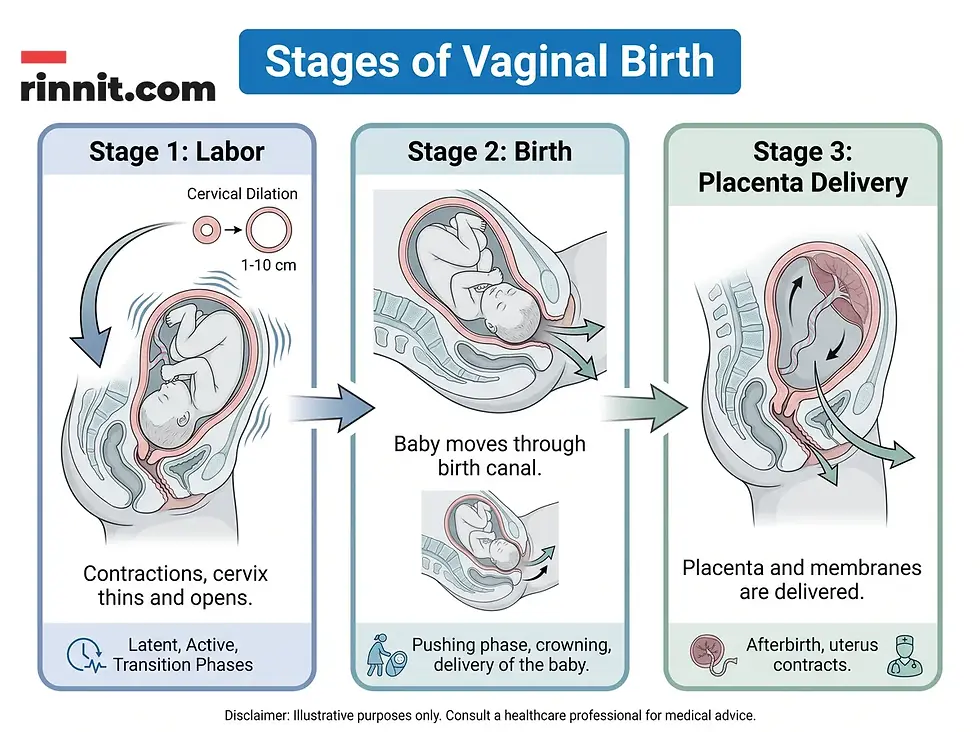
The Three Stages of Childbirth
The journey of vaginal birth is divided into three functional stages, each with specific physical markers and timeframes.
Stage One: Labor: This is the longest phase, where uterine contractions work to thin (efface) and open (dilate) the cervix to 10 centimeters [1]. This stage typically lasts between 12 and 19 hours on average [1].
Stage Two: Birth: Once the cervix is fully dilated, the mother begins the pushing phase. With the help of strong contractions, the baby is guided through the birth canal. This stage can take up to four hours [1].
Stage Three: Placental Delivery: After the baby is born, the provider will request a few more pushes to expel the placenta. This final stage is usually completed within 30 minutes [1].
Benefits and Risks
Vaginal delivery is widely considered the safest option for low-risk pregnancies [1], providing unique biological advantages that surgical alternatives do not offer.
Health Advantages
For the mother, vaginal birth typically results in a significantly shorter recovery period and reduces the likelihood of complications in future pregnancies [1]. Infants benefit from the passage through the birth canal, which helps clear fluid from their lungs and exposes them to beneficial vaginal bacteria that support the development of their gut microbiome and immune system.
Potential Complications
Despite its benefits, certain risks may arise during the process. Prolonged labor, where the cervix stops dilating, may require the administration of oxytocin to progress [1]. Other risks include irregular fetal heart rates due to cord compression, excessive bleeding (hemorrhage), or vaginal tears that occur during the pushing phase [1].

Recovery and Postpartum Care
Healing from a vaginal delivery is a gradual process that varies for every individual. Call 911 or get emergency care for bleeding that soaks through a pad in an hour or less or large clots, chest pain, trouble breathing, a seizure or thoughts of harming yourself or your baby; call your provider promptly for a fever of 100.4°F (38°C) or higher, a severe headache or vision changes, or a painful, swollen leg. Most women experience soreness, bruising, and swelling in the vaginal area for the first one to two weeks [1]. Cold compresses and cooling pads are often recommended to manage initial discomfort [1].
Bleeding: It is normal to experience lochia (blood and discharge) for up to six weeks, with active bleeding typically subsiding after two weeks [1].
Physical Activity: Healthcare providers generally advise waiting at least six weeks, or until the postpartum checkup, before resuming sexual intercourse [1].
Long-term Healing: While the initial soreness fades quickly, full postpartum recovery can take several months [1] as the body adjusts to its pre-pregnancy state.
Conclusion
Vaginal delivery remains the gold standard for childbirth due to its natural progression and long-term health benefits for both the mother and the newborn. While the experience is unique for every parent, understanding the stages of labor and the recovery process can help families prepare for a successful and healthy birth experience.
Frequently Asked Questions
What is a vaginal delivery?
A vaginal delivery is the birth of a baby through the vagina, which is the most common and preferred method of childbirth.
How long does a vaginal birth take?
On average, labor lasts 12 to 19 hours, while the pushing phase can take up to 4 hours, followed by 30 minutes for placental delivery.
What are the benefits for the baby?
Babies born vaginally have a lower risk of breathing issues and a stronger immune system due to exposure to beneficial bacteria.
Is vaginal delivery painful?
Most women experience pain during labor and birth, but various medical and non-medical options are available for pain management.
When is a C-section preferred over a vaginal birth?
A C-section may be necessary if the baby is in a breech position, if there are placental issues, or if the health of the mother or baby is at risk.
How long is the recovery period?
Initial soreness usually lasts 1-2 weeks, while full postpartum recovery can take several months.
What is induced labor?
Induced labor is when healthcare providers use medications or other methods to start labor artificially.
Can I have a vaginal birth after a previous C-section?
Many women can successfully have a vaginal birth after a cesarean (VBAC), depending on their medical history and the reason for the prior C-section.
What is lochia?
Lochia is the normal vaginal discharge and bleeding that occurs for several weeks after giving birth.
How can I reduce the risk of vaginal tearing?
Discussing techniques with your provider and following pushing instructions during birth can help minimize the risk of tears.
Related Reading
Understanding the Three Stages of Labor walks through what happens in each of the three stages of labor.
Understanding Vaginal Tears During Childbirth: Grades, Recovery, and Care explains perineal tear grades, healing time and care after birth.
Episiotomy: Why It's Done, Types, Risks, and Recovery covers why an episiotomy is done and how the cut heals.
Understanding Lochia: Your Guide to Postpartum Recovery describes normal postpartum bleeding and the warning signs to watch for.
References
Cleveland Clinic. Vaginal Delivery. Cleveland Clinic. Last updated July 8, 2026. https://my.clevelandclinic.org/health/body/23097-vaginal-delivery
Dwan K, Fox T, Lutje V, et al. Perineal techniques during the second stage of labour for reducing perineal trauma and postpartum complications. Cochrane Database of Systematic Reviews. 2024;10(10):CD016148. PMID 39465967. https://doi.org/10.1002/14651858.CD016148
Anim-Somuah M, Smyth RM, Cyna AM, et al. Epidural versus non-epidural or no analgesia for pain management in labour. Cochrane Database of Systematic Reviews. 2018;5(5):CD000331. PMID 29781504. https://doi.org/10.1002/14651858.CD000331.pub4
Singleton H, Mantzouratou A, Maqsood R, et al. Impact of mode of birth and perinatal antibiotics on infant gut microbiota and health: a systematic review and meta-analysis. BMJ Paediatrics Open. 2026;10(1). PMID 42398974. https://doi.org/10.1136/bmjpo-2025-004170
Medical disclaimer
The information provided in this article is for educational purposes only and should not be used as a substitute for professional medical advice, diagnosis, or treatment. Always seek the advice of your physician or other qualified health provider with any questions you may have regarding a medical condition.



Comments