Painful Intercourse (Dyspareunia): Causes, Diagnosis, and Treatment Explained

Updated: 2 days ago
Medically reviewed by Dr. Baraa Alnahhal, MD · Last reviewed: September 2026
TL;DR
Painful intercourse — medically called dyspareunia (dis-puh-ROO-nee-uh) — is lasting or recurrent genital pain that occurs just before, during, or after sex. It can happen for reasons ranging from structural problems to psychological concerns, and many people experience it at some point in their lives. Where the pain occurs usually points to the cause: entry pain is often linked to lubrication problems, injury, vaginismus, or structural differences, while deep pain is typically tied to conditions like endometriosis, fibroids, or pelvic inflammatory disease. Treatments focus on the underlying cause — from lubricants, position changes, and longer foreplay to topical estrogen, prescription medicines, desensitization therapy, and counseling — and treatment can restore comfortable, fulfilling intimacy.
Quick Answer
What is dyspareunia? Lasting or recurrent genital pain that occurs just before, during or after sex; it is common, has many possible causes, and is treatable.
What does the pain feel like? Pain at entry (penetration), pain with every penetration including tampon use, deep pain during thrusting, burning or aching pain, or throbbing pain lasting hours after sex.
What causes entry pain? Not enough lubrication (low estrogen after menopause, childbirth or breastfeeding, or medicines like antidepressants and antihistamines), injury or irritation, infections, vaginismus, or structural differences present at birth.
What causes deep pain? Conditions such as endometriosis, pelvic inflammatory disease, fibroids, ovarian cysts, or cystitis; scarring from pelvic surgery; and changes from radiation or chemotherapy.
How is it treated? By treating the underlying cause — lubricants and longer foreplay at home, topical estrogen or prescription medicines such as ospemifene or prasterone for low estrogen, desensitization therapy, and counseling or sex therapy.
What is dyspareunia?
Painful intercourse can happen for reasons that range from structural problems to psychological concerns. Many people have painful intercourse at some point in their lives.
The medical term for painful intercourse is dyspareunia (dis-puh-ROO-nee-uh). It is lasting or recurrent genital pain that occurs just before, during or after sex.
If you are having painful intercourse, talk with your healthcare professional. Treatments focus on the cause and can help stop or ease this common problem.

Painful intercourse symptoms
If you have painful intercourse, you might feel one or more of the following:
Pain only at sexual entry, called penetration
Pain with every penetration, including putting in a tampon
Deep pain during thrusting
Burning pain or aching pain
Throbbing pain lasting hours after sex
What causes painful intercourse?
Physical causes of painful intercourse differ depending on whether the pain happens at entry or with deep thrusting. Emotional factors can be linked to many types of painful intercourse.
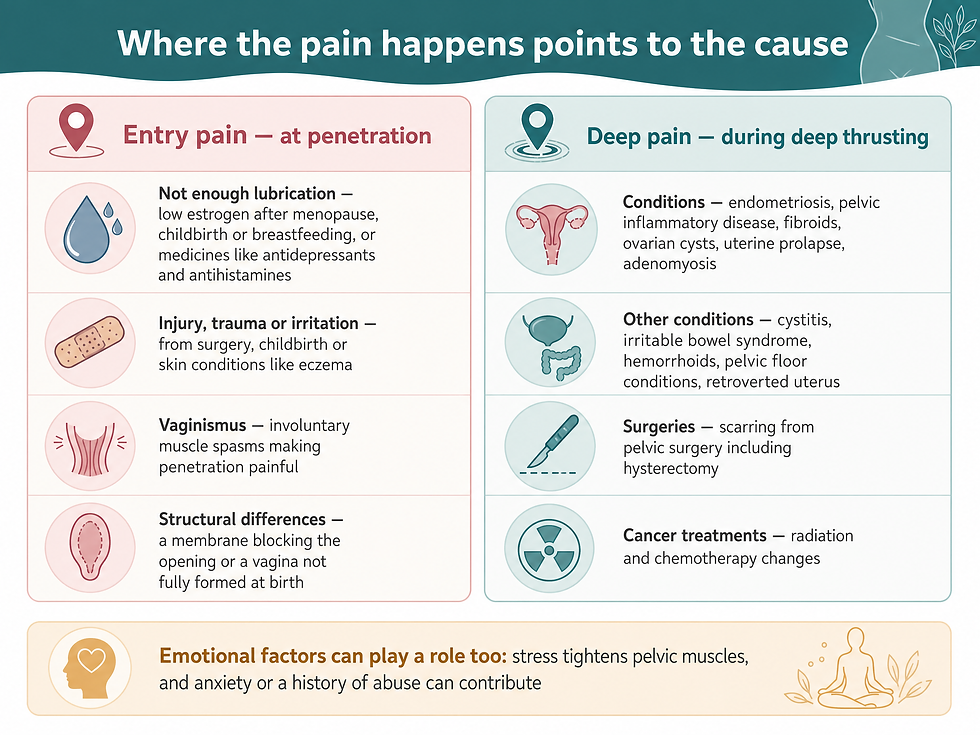
Entry pain — pain during penetration
Not enough lubrication. This is often the result of not enough foreplay. A drop in estrogen levels after menopause or childbirth or during breastfeeding also can be a cause.
Certain medicines can affect sexual desire or arousal, which can decrease lubrication and make sex painful. Those medicines include antidepressants, high blood pressure medicines, sedatives, antihistamines and certain birth control pills.
Injury, trauma or irritation. This includes injury or irritation from an accident, pelvic surgery, female circumcision or a cut made during childbirth to enlarge the birth canal, called an episiotomy.
Inflammation, infection or skin disorders. An infection in the genital area or urinary tract can cause painful intercourse. Eczema or other skin problems in the genital area also can be the cause.
Vaginismus. These involuntary spasms of the muscles of the vaginal wall can make penetration painful.
A problem present at birth. Not having a fully formed vagina, called vaginal agenesis, or having a membrane that blocks the vaginal opening, called an imperforate hymen, could cause painful intercourse.
Deep pain — pain during deep thrusting
Deep pain usually occurs with deep penetration. It might be worse in certain positions.
Cause category | What's involved |
Illnesses and conditions | Endometriosis, pelvic inflammatory disease, uterine prolapse, retroverted uterus, uterine fibroids, cystitis, irritable bowel syndrome, pelvic floor conditions, adenomyosis, hemorrhoids, ovarian cysts |
Surgeries or medical treatments | Scarring from pelvic surgery, including hysterectomy; cancer treatments such as radiation and chemotherapy that can cause changes making sex painful |
Emotional factors
Emotions are deeply intertwined with sexual activity, so they might play a role in sexual pain.
Psychological issues. Anxiety, depression, concerns about physical appearance, fear of intimacy or relationship problems can contribute to a low level of arousal and resulting discomfort or pain.
Stress. Your pelvic floor muscles tend to tighten in response to stress in your life, which can contribute to pain during intercourse.
History of sexual abuse. Not everyone with dyspareunia has a history of sexual abuse, but if you have been abused, it can play a role.
There is also a painful cycle at work: initial pain can lead to fear of recurring pain, making it difficult to relax, which can lead to more pain. You might start avoiding sex if you associate it with the pain.
Risk factors
Many factors can raise the risk of painful intercourse. They include illnesses, surgeries and other medical treatments, and mental health issues.
How painful intercourse is diagnosed
A medical evaluation for dyspareunia usually consists of three components.
A thorough medical history. Your healthcare professional might ask when your pain began, where it hurts, how it feels and whether it happens with every sexual partner and every sexual position. They also might ask about your sexual history, surgical history and history of childbirth. Don't let embarrassment stop you from answering truthfully — these questions provide clues to the cause of your pain.
A pelvic exam. Your healthcare professional can check for symptoms of skin irritation, infection or anatomical problems, and might try to locate your pain by applying gentle pressure to your genitals and pelvic muscles. A visual exam of the vagina using an instrument called a speculum may also be part of the evaluation. Some people with painful intercourse also have pain during a pelvic exam — you can ask to stop the exam if it is too painful.
Other tests. If your healthcare professional suspects certain causes of painful intercourse, you might have a pelvic ultrasound.
Treatment options
Treatment options vary depending on the cause of the pain.
Medications
If an infection or medical condition contributes to your pain, treating the cause might resolve your problem. Changing medicines that can cause lubrication problems also might eliminate your symptoms.
For many postmenopausal women, painful intercourse is caused by too little lubrication resulting from low estrogen levels. Often, low estrogen levels can be treated with topical estrogen applied directly to the vagina.
The Food and Drug Administration approved the medicine ospemifene (Osphena) to treat moderate to severe dyspareunia in women who have problems with vaginal lubrication. Ospemifene acts like estrogen in the vaginal lining. Drawbacks include possible hot flashes and a risk of stroke, blood clots and cancer of the lining of the uterus (the endometrium).
Another medicine to relieve painful intercourse is prasterone (Intrarosa), a capsule you place inside the vagina daily.
Other therapies
Desensitization therapy. For this therapy, you learn vaginal relaxation exercises that can ease pain.
Counseling or sex therapy. If sex has been painful for some time, you might have a negative emotional response to sexual stimulation even after treatment. If you and your partner have avoided intimacy because of painful intercourse, you might also need help improving communication with your partner and restoring sexual intimacy. Talking to a counselor or sex therapist may help resolve these issues.
Cognitive behavioral therapy also can be helpful in changing negative thought patterns and behaviors.

Lifestyle and home remedies
To help with pain during sex, you and your partner could try to:
Change positions. If you have sharp pain during thrusting, try different positions, such as being on top. In this position, you might be able to regulate penetration to a depth that feels good to you.
Communicate. Talk about what feels good and what doesn't. If you need your partner to go slow, say so.
Don't rush. Longer foreplay can help stimulate your natural lubrication. You might reduce pain by delaying penetration until you feel fully aroused.
Use lubricants. A personal lubricant can make sex more comfortable. Try different brands until you find one you like.
Coping and support
Until vaginal penetration becomes less painful, you and your partner might find other ways to be intimate. Sensual massage, kissing and mutual masturbation offer alternatives to intercourse that might be more comfortable, more fulfilling and more fun than your regular routine.
Preparing for your appointment
Talking with your healthcare professional is the first step in resolving painful intercourse. Your primary healthcare professional might diagnose and treat the problem or refer you to a specialist.
What you can do. To get ready for the conversation, make a list of your sexual problems — including when they began, how often and under what conditions they happen — your key medical information, including conditions being treated, all medicines, vitamins or other supplements you take with doses, and your questions.
Questions worth asking include: what could be causing the problem, which lifestyle changes might improve the situation, what treatments are available, and which books or websites are recommended.
What to expect from your doctor. Expect questions about how long you have had painful intercourse, where the pain is felt, whether it occurs every time or only in certain situations, your relationship with your partner, whether nonsexual activities cause pain, how much distress you feel, whether you have vaginal irritation, itching or burning, and your history of gynecological conditions or surgery.
Bottom line
Painful intercourse is common — and it is not something you have to live with. The most important clue is where the pain occurs: entry pain usually points to lubrication, injury, or muscle-spasm causes, while deep pain usually points to an underlying pelvic condition that deserves treatment in its own right.
Because treatments focus on the cause, getting an accurate diagnosis matters more than pushing through the discomfort. Home measures — lubricants, longer foreplay, position changes, and honest communication — genuinely help many people, and medical options from topical estrogen to desensitization therapy and counseling cover the rest of the spectrum. What holds most people back is embarrassment, not the lack of a solution.
Your next step: Book an appointment with your primary healthcare professional — embarrassment will not change the answers that lead to relief, but honest answers will. In the meantime, try a personal lubricant, extend your foreplay before penetration, and talk with your partner about positions and pace. And until penetration becomes comfortable, remember that massage, kissing and other forms of intimacy keep closeness alive along the way.
This article covers information current as of its medical sources dated February 16, 2024. Always consult a qualified healthcare provider for diagnosis and treatment decisions.
Frequently Asked Questions
Is it normal to feel pain during sex?
Pain with every sex act is not something you should have to accept as normal — but it is common, and many people experience painful intercourse at some point in their lives. The medical term is dyspareunia, and it has many treatable causes, from inadequate lubrication to underlying pelvic conditions. If you have recurrent pain during sex, talk with your healthcare professional.
What's the difference between entry pain and deep pain?
Entry pain happens at penetration (including tampon use) and is often linked to insufficient lubrication, injury or irritation, infections, vaginismus, or structural differences. Deep pain occurs during deep thrusting, may be worse in certain positions, and is usually tied to conditions such as endometriosis, fibroids, pelvic inflammatory disease, cystitis, or scarring from pelvic surgery.
Can menopause cause painful intercourse?
Yes. For many postmenopausal women, painful intercourse is caused by too little lubrication resulting from low estrogen levels. A drop in estrogen after menopause, childbirth or during breastfeeding can reduce lubrication. Low estrogen levels can often be treated with topical estrogen applied directly to the vagina, or with medicines such as ospemifene or prasterone.
What medicines can make sex painful?
Certain medicines can affect sexual desire or arousal, decreasing lubrication and making sex painful. These include antidepressants, high blood pressure medicines, sedatives, antihistamines and certain birth control pills. If you suspect a medicine is involved, ask your healthcare provider whether an alternative is possible — do not stop prescription medication on your own.
Does counseling actually help with painful sex?
It can. If sex has been painful for some time, you might develop a negative emotional response to sexual stimulation even after the physical cause is treated. Stress tightens pelvic floor muscles, and pain can create a fear-of-pain cycle that causes people to avoid sex. Counseling, sex therapy, and cognitive behavioral therapy can help break that cycle, improve partner communication, and restore sexual intimacy.
What can my partner and I try at home?
Longer foreplay can stimulate natural lubrication, and delaying penetration until you feel fully aroused might reduce pain. A personal lubricant can make sex more comfortable — try different brands. If sharp pain occurs during thrusting, changing positions (such as being on top) lets you regulate the depth of penetration. Talk openly about what feels good, and explore massage, kissing and other forms of intimacy in the meantime.
References
This article was prepared for general information only and is not a substitute for professional medical advice.
Comments