
Endovascular Aneurysm Repair (EVAR): Procedure, Recovery, Risks and Benefits

Updated: 6 days ago
Written and medically reviewed by Dr. Baraa Alnahhal, MD · Last reviewed: October 2026 · How we review
Quick Answer: What is endovascular aneurysm repair?
Endovascular aneurysm repair (EVAR) is a minimally invasive procedure that treats an abdominal aortic aneurysm from inside the artery. Through small punctures in the groin, a doctor guides a fabric-and-metal stent graft into the aorta to re-line the bulge and prevent rupture. Most people stay in hospital a few days and need lifelong imaging follow-up. [1][3]
What the research says
EVAR sharply lowers the risk of dying around the time of surgery. A meta-analysis of 4 randomized trials and 7 matched studies (106,243 patients) found perioperative death was about 61% lower after EVAR than after open repair (risk ratio 0.39). The early edge did not last: mortality was slightly higher after EVAR at 2–6 years (HR 1.15) and similar after 6 years. (Yokoyama et al., J Vasc Surg, 2020) [2]
Late problems are why follow-up never stops. In a 15-year trial of 1,252 patients, EVAR lowered early deaths, but beyond 8 years open repair had lower aneurysm-related mortality, mainly from late sac rupture (13 deaths, 7%, vs 2 deaths, 1%). The authors call for lifelong surveillance. (Patel et al., Lancet, 2016) [3]
Long-term survival can be similar to open surgery. In a trial of 881 patients followed for up to 14 years, 68.0% of the EVAR group and 70.0% of the open-repair group died (HR 0.96), a non-significant difference, but more EVAR patients needed secondary procedures. (Lederle et al., N Engl J Med, 2019) [4]
Key takeaways
EVAR repairs an abdominal aortic aneurysm from inside the blood vessel, without a large incision. [1]
A stent graft (fabric over a metal mesh frame) becomes a new channel for blood and takes pressure off the bulge. [1]
It suits large or fast-growing aneurysms, people who cannot have open surgery, and people with healthy artery tissue near the aneurysm. [1]
Recovery is faster than open surgery: a few days in hospital, back to work in about a month for most people. [1]
Endoleaks and new aneurysms can appear years later, so regular imaging is essential. [1][3]
What is endovascular aneurysm repair (EVAR)?
Endovascular aneurysm repair (EVAR) is a minimally invasive procedure used to manage abdominal aortic aneurysms. [1]
The aorta is the largest artery in your body. It carries blood from your heart to the rest of your organs. [1]
An aneurysm is a bulge in a weak part of the artery wall. When it forms in the belly section of the aorta, it is called an abdominal aortic aneurysm (AAA). [1]
EVAR repairs the bulge using small punctures and specialized instruments instead of a large surgical cut. [1]

Why is endovascular aneurysm repair done?
Endovascular aneurysm repair is done to stop an abdominal aortic aneurysm from bursting, which is a life-threatening event. [1]
Blood constantly pushes against a weak spot in the aortic wall. Over time, this force makes the wall balloon outward. [1]
If the aneurysm bursts, blood flow to your organs is disrupted. Life-threatening complications can follow within minutes. [1]
EVAR lowers this risk by placing a new tube inside the aneurysm. This tube, called a stent graft, is made of fabric with a metal mesh frame. Blood flows through the graft instead of pressing on the weak wall. [1]
Who is a candidate for endovascular aneurysm repair?
People with an aortic aneurysm may be candidates for EVAR, but not every aneurysm needs treatment. [1]
Your doctor may consider EVAR if you:
Have a large aneurysm, or a smaller one that is growing quickly
Do not qualify for open surgery with a large incision
Have healthy blood vessel tissue near the aneurysm, so the graft can seal well [1]
Factor | Why it matters for EVAR |
Aneurysm size | Large aneurysms carry a higher risk of bursting |
Growth speed | A fast-growing smaller aneurysm may also need repair |
Fitness for open surgery | EVAR is an option when a large incision is too risky |
Nearby artery health | Healthy tissue lets the graft form a tight seal |
How is EVAR different from FEVAR and TEVAR?
EVAR, FEVAR and TEVAR are all repairs done from inside the artery; they differ by where the aneurysm sits and the shape of the graft. [1]
FEVAR (fenestrated endovascular aneurysm repair) treats complex aneurysms near the points where arteries branch off the aorta to supply organs in the belly. Think of the aorta as a tree trunk with branches. FEVAR uses a graft with small openings, and extra stent grafts pass through those openings into the branch arteries. [1]
TEVAR (thoracic endovascular aneurysm repair) treats aneurysms in the chest. It is especially suited to the descending aorta, the part that runs down through the chest toward the belly. Learn more in our thoracic aortic aneurysm guide. [1]
Procedure | Area treated | Graft design |
EVAR | Abdomen (belly) | Standard tube shape, no openings |
FEVAR | Abdomen, near branch arteries | Graft with small openings for branch stent grafts |
TEVAR | Chest, especially the descending aorta | Graft placed in the chest aorta |
Aneurysms very close to the heart, in the aortic root or ascending aorta, usually need open surgery instead. [1]
What happens during an endovascular aneurysm repair procedure?
During endovascular aneurysm repair, a doctor reaches the aneurysm through the arteries in your groin and opens a stent graft inside it. [1]
Anesthesia. You receive medicine to help you relax or fall asleep, so you feel no discomfort. Read more about types of anesthesia and recovery. [1]
Groin access. Needles are passed through the skin into the femoral arteries near your groin. [1]
Catheter guided in. A thin tube (catheter) holding a folded, expandable stent graft travels through your arteries to the aneurysm. Real-time imaging guides each movement. [1]
Graft opened. The stent graft expands into place. Its wire frame forms a tight seal that holds the graft and keeps blood out of the aneurysm. [1]
Catheter removed. Once the graft is in place, the catheter is taken out. [1]
Small dressing. The punctures are so small that stitches are not needed. A bandage covers them while they heal. [1]

What are the benefits of EVAR compared with open surgery?
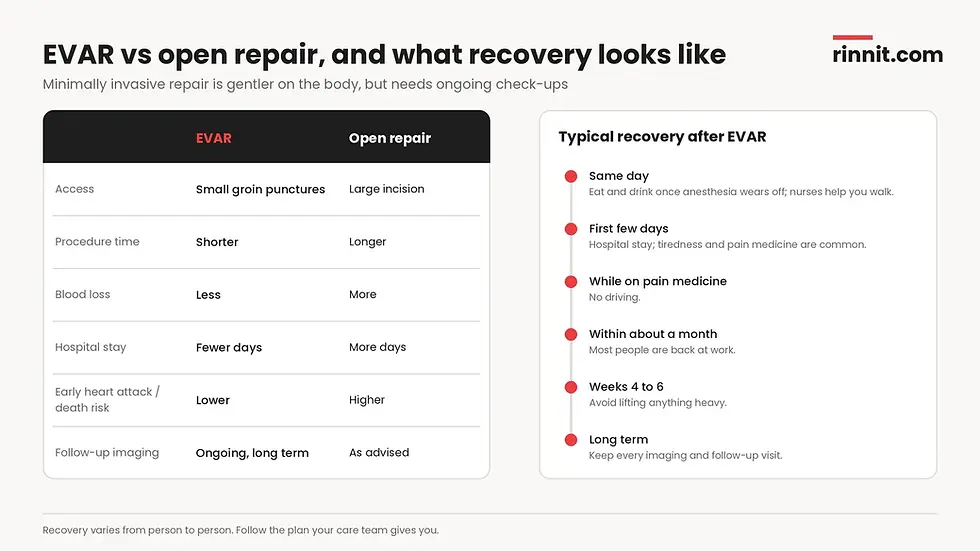
The main benefit of EVAR is that it is gentler on the body than open surgery, with a shorter hospital stay and faster recovery. [1]
Outcome | EVAR | Open repair |
Incision | Small groin punctures | Large incision |
Procedure time | Shorter | Longer |
Blood loss | Less | More |
Discomfort during recovery | Less | More |
Days in hospital | Fewer | More |
Return to daily activities | Quicker | Slower |
Risk of heart attack or death around the procedure | Lower | Higher |
Research supports the early advantage, while also showing that long-term results depend on careful follow-up. [2][3][4]
What are the risks of endovascular aneurysm repair?
Endovascular aneurysm repair is a safe procedure with a high success rate, but complications can still happen. [1]
Possible complication | What it means |
Endoleak | Blood keeps filling the aneurysm sac after the repair |
Blood clots | Clots can form and block blood flow (learn about blood clots) |
Deep vein thrombosis (DVT) | A clot in a deep leg vein (full DVT guide) |
Heart attack | Reduced blood flow to the heart muscle (heart attack guide) |
Infection | Germs entering at the puncture sites or graft |
Kidney failure | The kidneys stop filtering blood properly |
Bleeding | Blood loss at the access site or inside the body |
Source: [1]
What is recovery like after EVAR?
Recovery after EVAR takes days to months, and most people spend only a few days in hospital. [1]
You can usually eat and drink soon after the anesthesia wears off. Nurses help you get out of bed and walk as soon as it is safe. [1]
At home, you may tire easily and need pain medicine for a few days. [1]
Time after EVAR | What to expect |
Same day | Eating, drinking and first walk with nurse support |
First few days | Hospital stay; tiredness and short-term pain medicine |
While taking pain medicine | Do not drive |
Within about a month | Most people return to work |
Weeks 4 to 6 | Avoid lifting anything heavy |
Long term | Keep every imaging and follow-up appointment |
Source: [1]
Why is follow-up imaging needed after EVAR?
Follow-up imaging is needed after EVAR because problems with the graft, such as endoleaks, can appear even years after a successful repair. [1]
A new aneurysm can also develop later. Regular scans help your care team decide whether more treatment is needed. [1]
Long-term trials show that late sac rupture and repeat procedures are more common after EVAR than after open repair, which is why surveillance is recommended for life. [3][4]
You can also protect your aorta and heart with healthy habits, such as regular exercise and eating less salt. Keeping blood pressure under control also helps. [1]
For a deeper technical overview, see this clinical review of EVAR [5] and this patient guide to endovascular AAA repair [6].
When should you call a doctor after EVAR?
Call your doctor after EVAR if you notice signs of a blood clot, bleeding or a problem with the graft. [1]
Swelling, pain or cool skin in your legs (possible DVT)
Dizziness or fainting
Pain in your back, chest or belly
A rapid or pounding heartbeat (palpitations)
Redness in your groin or other leg pain [1]
Seek emergency care right away for sudden, severe pain in your back, chest or belly, or if you faint. Sudden tearing chest or back pain can also signal an aortic dissection.
Conclusion
EVAR offers a less invasive way to repair an abdominal aortic aneurysm than traditional open surgery. It means smaller wounds, a shorter hospital stay and a faster return to daily life. [1]
The repair does not end at discharge. Lifelong check-ups, a heart-healthy lifestyle and quick action on warning signs keep your stent graft working well. [1][3]
Next step: If you or a loved one has been told you have an aortic aneurysm, write down your questions and bring them to your next appointment. Start with our complete abdominal aortic aneurysm guide to understand screening, size thresholds and every treatment option, then share this article with anyone facing the same decision.
FAQ
What is EVAR surgery?
EVAR is a minimally invasive repair of an abdominal aortic aneurysm. A stent graft is guided through small groin punctures and opened inside the aorta to re-line the bulge and lower the risk of rupture. [1]
How long does it take to recover from EVAR?
Most people stay in hospital for a few days and return to work within about a month. Heavy lifting should be avoided for four to six weeks, and you should not drive while taking pain medicine. [1]
Is EVAR safer than open surgery?
EVAR carries a lower risk of heart attack or death around the time of the procedure than open surgery. Over the long term, survival is broadly similar, but repeat procedures are more common after EVAR. [1][2][4]
What is an endoleak after EVAR?
An endoleak is when blood continues to fill the aneurysm sac after the stent graft is placed. It can appear even years after the procedure, which is why regular imaging is needed. [1]
Does EVAR need stitches?
No. The punctures in the groin are so small that stitches are not needed, and a bandage covers them while they heal. [1]
What is the difference between EVAR and TEVAR?
EVAR treats aneurysms in the abdomen, while TEVAR treats aneurysms in the chest. TEVAR is especially suited to the descending aorta. [1]
Who is not a good candidate for EVAR?
EVAR may not suit people whose artery tissue near the aneurysm is not healthy enough for the graft to seal. Aneurysms in the aortic root or ascending aorta, close to the heart, usually need open surgery instead. [1]
When should I call my doctor after EVAR?
Call your doctor if you have leg swelling or pain, dizziness or fainting, back, chest or belly pain, a rapid heartbeat, or redness in your groin. Sudden severe pain or fainting needs emergency care. [1]
Will I be asleep during EVAR?
EVAR can be done under general anesthesia, regional anesthesia or local numbing medicine with a sedative. Your care team will choose the safest option for you.
How often will I need scans after EVAR?
You will need regular imaging, such as CT scans or ultrasounds, for the rest of your life to check the stent graft. Your surgeon will set your schedule, and keeping every appointment is important.
Related Reading
Open Aneurysm Surgery: Procedure, Recovery and Outlook explains open aneurysm surgery.
References
Cleveland Clinic. Endovascular Aneurysm Repair (EVAR). Cleveland Clinic. Last updated March 13, 2022. https://my.clevelandclinic.org/health/treatments/22291-endovascular-aneurysm-repair
Yokoyama Y, Kuno T, Takagi H. Meta-analysis of phase-specific survival after elective endovascular versus surgical repair of abdominal aortic aneurysm from randomized controlled trials and propensity score-matched studies. J Vasc Surg. 2020;72(4):1464-1472.e6. PMID 32330598. https://doi.org/10.1016/j.jvs.2020.03.041
Patel R, Sweeting MJ, Powell JT, et al. Endovascular versus open repair of abdominal aortic aneurysm in 15-years' follow-up of the UK endovascular aneurysm repair trial 1 (EVAR trial 1): a randomised controlled trial. Lancet. 2016;388(10058):2366-2374. PMID 27743617. https://doi.org/10.1016/S0140-6736(16)31135-7
Lederle FA, Kyriakides TC, Stroupe KT, et al. Open versus endovascular repair of abdominal aortic aneurysm. N Engl J Med. 2019;380(22):2126-2135. PMID 31141634. https://doi.org/10.1056/NEJMoa1715955
England A, Mc Williams R. Endovascular aortic aneurysm repair (EVAR). Ulster Med J. 2013;82(1):3-10. PMID 23620623. https://pubmed.ncbi.nlm.nih.gov/23620623/
Society for Vascular Surgery. Endovascular Repair of Abdominal Aortic Aneurysms. Vascular.org. Accessed October 31, 2026. https://vascular.org/patients-and-referring-physicians/conditions/endovascular-repair-abdominal-aortic-aneurysms
Medical disclaimer
This article is for general education only and is not a substitute for professional medical advice, diagnosis or treatment. Always talk to a qualified healthcare provider about your own condition and treatment options. If you have sudden severe pain in your chest, back or belly, or you faint, seek emergency care immediately.



Comments