Endoscopic Submucosal Dissection (ESD): Procedure, Recovery and Risks

Updated: 6 days ago
Written and medically reviewed by Dr. Baraa Alnahhal, MD · Last reviewed: October 2026 · How we review
Quick Answer: What is endoscopic submucosal dissection?
Endoscopic submucosal dissection (ESD) is a minimally invasive endoscopic procedure that removes precancerous or cancerous growths from the lining of the esophagus, stomach, small intestine or colon in one piece, without skin incisions. It usually takes one to three hours, most people return to work in about five days, and complications such as bleeding or perforation are rare. [1][2]
What the research says
ESD works safely outside Asia, too. In 692 patients treated at 10 North American centers, growths were removed in one piece 91.5% of the time; bleeding occurred in 2.3% and perforation in 2.9%, and only 1 patient (0.14%) needed surgery for a complication. (Draganov et al., Gastroenterology, 2021)
For early stomach cancer, ESD beats EMR on complete removal. Across 18 studies of 6,723 patients, ESD had about 9 times the odds of one-piece removal and about 82% lower odds of local recurrence than EMR, but a higher perforation risk and a longer procedure. (Tao et al., BMJ Open, 2019)
For large flat colon growths, regrowth was far lower after ESD. In 12 studies covering 3,062 lesions, ESD removed growths in one piece 95% of the time vs. 42.8% with EMR, and recurrence was 0.5% vs. 15.9%. (Zhao et al., Rev Esp Enferm Dig, 2020)
Key takeaways
ESD removes growths from the inner layers of the digestive tract through an endoscope, with no cuts on the skin. [1]
The aim is to remove the growth in a single piece so the lab can study it completely. [1]
The procedure usually takes 1 to 3 hours, under general anesthesia or monitored sedation. [1]
Mild bloating, cramping or a sore throat for a day or two is common; serious complications are rare. [1]
Most people are back at work in about five days and see their doctor again at about two weeks. [1]
What is endoscopic submucosal dissection (ESD)?
Endoscopic submucosal dissection is a minimally invasive procedure that removes irregular tissue from the gastrointestinal (GI) tract using a long, flexible tube with a camera called an endoscope. [1]
A gastroenterologist, a doctor who specializes in digestive diseases, passes the endoscope through the mouth or the anus. The route depends on which part of the digestive tract needs treatment. [1]
Small surgical tools then travel through the endoscope to reach and remove the growth. Because no incisions are made, recovery is usually faster and less painful than after open surgery. [1]
What conditions does endoscopic submucosal dissection treat?
Endoscopic submucosal dissection treats precancerous or cancerous growths, such as lesions, polyps or tumors, that sit in the superficial layers of the digestive tract. [1]
Condition | Where it is | Related guide |
Barrett's esophagus (precancerous lesions) | Lower esophagus | |
Esophageal cancer (early) | Esophagus | |
Stomach cancer (early) | Stomach | |
Small intestine and duodenal cancer | Small intestine | |
Colorectal cancer (early) | Colon and rectum |
[1]
Specialist guidelines recommend ESD as the treatment of choice for most superficial squamous cell growths of the esophagus and superficial stomach growths. [5]
How is ESD different from endoscopic mucosal resection (EMR)?
ESD and endoscopic mucosal resection (EMR) are both minimally invasive, but ESD can treat growths that reach deeper into the lining and aims to remove them in one piece. [1]
EMR treats growths in the mucosa, the inner membrane lining the digestive tract. The doctor injects fluid under the growth and cuts it away with a metal loop. [1]
ESD treats growths on the mucosa and those that grow deeper into it. The doctor uses an electrical knife to dissect the growth free in a single piece. [1]
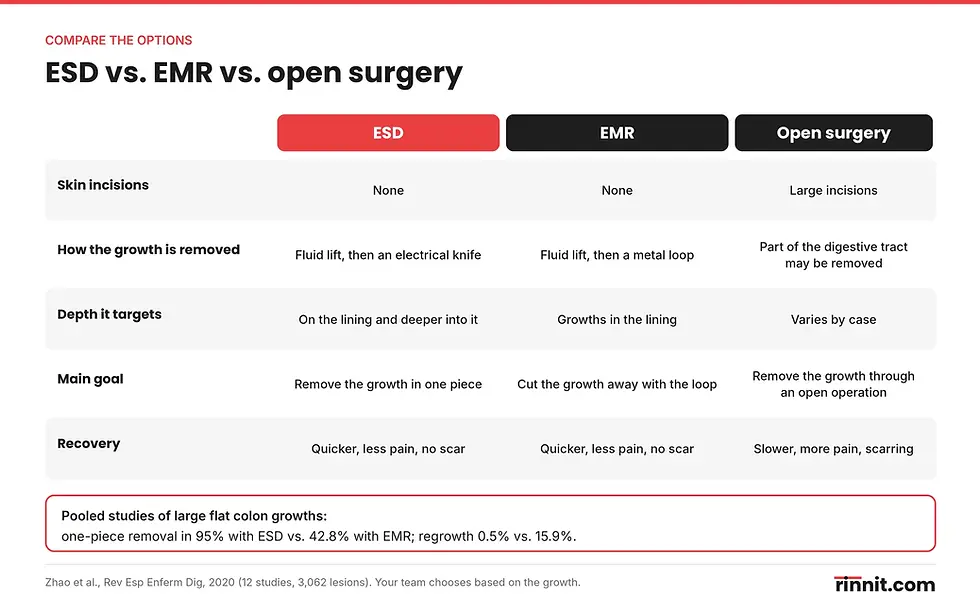
Feature | ESD | EMR | Open surgery |
Skin incisions | None | None | Large incisions |
Removal tool | Electrical knife after fluid lift | Metal loop after fluid lift | Surgical removal |
Growths treated | On the lining and deeper into it | In the lining | Varies by case |
Removal goal | One single piece | Cut away with the loop | May remove part of the digestive tract |
Recovery | Quicker, less pain, no scar | Quicker, less pain, no scar | Slower, more pain, scarring |
[1][4]
Learn how smaller growths are handled in our colon polyps guide and stomach polyps guide.
How do you prepare for endoscopic submucosal dissection?
Preparation for endoscopic submucosal dissection depends on which part of the digestive tract is treated, and your care team will give you specific instructions. [1]
Area treated | What preparation usually involves |
Upper GI tract (esophagus, stomach, small intestine) | No eating or drinking for several hours beforehand |
Lower GI tract (colon and rectum) | A bowel prep with laxatives to empty the colon |
[1]
A bowel prep lets the doctor see the inside of the colon and rectum clearly. You will also need someone to drive you home afterward. [1]
What happens during the ESD procedure?
During endoscopic submucosal dissection, the doctor marks the growth, lifts it with fluid and removes it with an electrical knife while you are asleep or deeply relaxed. [1]
You receive either general anesthesia or monitored anesthesia care, where an anesthesiologist keeps you comfortable and relaxed. [1]

The doctor then:
Inserts the endoscope through the mouth (upper GI) or anus (lower GI).
Guides it to the irregular growth.
Marks the location of the tumor with a tool passed through the scope.
Injects a special fluid under the tumor so it lifts away from the tissue around it.
Removes the tumor with a high-frequency electrical knife.
[1]
How long does endoscopic submucosal dissection take?
Endoscopic submucosal dissection usually takes about one to three hours. [1]
What happens after endoscopic submucosal dissection?
After endoscopic submucosal dissection, the removed tissue goes to a laboratory and you rest in a recovery room while the anesthesia wears off. [1]
A pathologist, a doctor who studies body tissue, checks the sample for signs of disease. [1]
You may go home the same day or stay one night in the hospital. Arrange a ride, because the full effects of anesthesia can take up to 24 hours to wear off. [1]
What are the side effects of ESD?
The side effects of ESD are usually mild to moderate and last a day or two, depending on the area treated. [1]
Bloating
Cramping
Extra gas and gas pain
Nausea or vomiting
Sore throat
A small amount of blood in your stool is not unusual, but it should stop within 24 hours. [1]
What are the benefits of endoscopic submucosal dissection?
The main benefit of endoscopic submucosal dissection is that the growth is removed without large incisions or removing part of the digestive tract. [1]
Benefit compared with open surgery | Why it matters |
Less pain | Easier first days at home |
Lower risk of complications | Fewer problems after the procedure |
No scarring | No visible scar on the skin |
Quicker recovery | Faster return to normal life and work |
[1]
What are the risks of endoscopic submucosal dissection?
The risks of endoscopic submucosal dissection are uncommon but include bleeding, a hole in the digestive tract wall and scarring in the esophagus. [1]
Bleeding. Occurred in 2.3% of cases in a large North American study. [2]
Gastrointestinal perforation (a tear in the wall). Occurred in 2.9% of cases in the same study. [2]
Esophageal scarring, which can narrow the swallowing tube. Read more in our esophageal strictures guide. [1]
Compared with EMR, ESD carries a higher perforation risk, so the choice depends on the growth and the team's experience. [3]
How long does it take to recover from endoscopic submucosal dissection?
Most people return to work about five days after endoscopic submucosal dissection, though those with physically active jobs may need longer. [1]
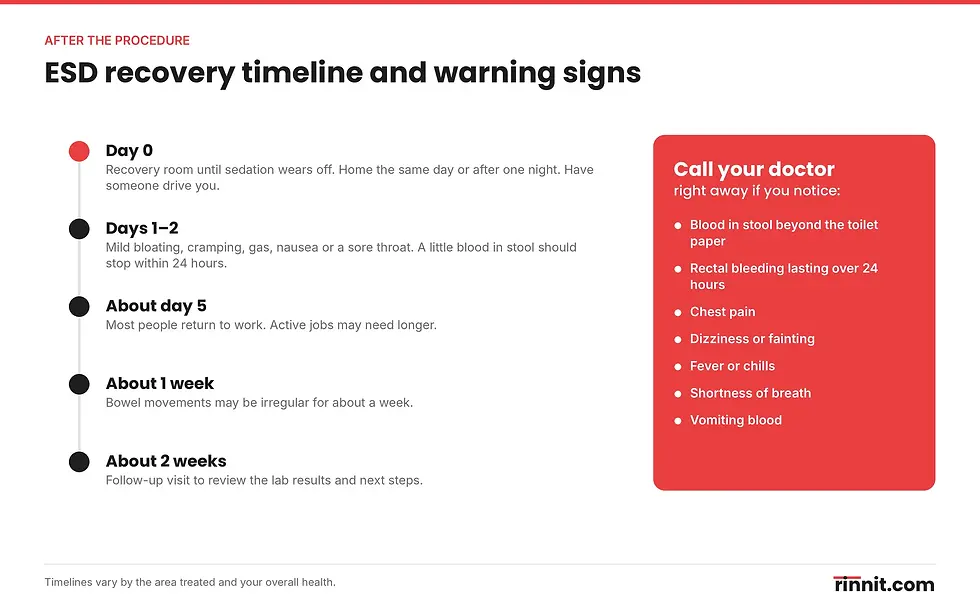
Time after ESD | What to expect |
Day 0 | Recovery room; home the same day or after one night |
Days 1–2 | Mild bloating, cramping, gas, nausea or sore throat |
About day 5 | Most people return to work |
About 1 week | Bowel movements may stay irregular |
About 2 weeks | Follow-up visit to discuss results |
[1]
What is the success rate of endoscopic submucosal dissection?
Endoscopic submucosal dissection is a highly successful procedure, and some studies report that tumors grow back in only about 1% of people. [1]
In a large prospective study, overall recurrence was 5.8% at an average follow-up of about 13 months, and one-piece removal was achieved in 91.5% of cases. [2]
What follow-up care is needed after ESD?
Follow-up after ESD usually means a visit with your gastroenterologist about two weeks later to review the lab results and decide whether you need more treatment. [1]
If the lab shows high-risk features, such as deeper invasion or growth into blood or lymph vessels, specialists recommend full staging and discussion of further treatment. After a curative removal, scheduled surveillance endoscopy is recommended. [5]
When should you call your doctor after endoscopic submucosal dissection?
Call your gastroenterologist right away after endoscopic submucosal dissection if you notice any sign of a complication. [1]
Blood in your stool that is more than a streak on the toilet paper
Rectal bleeding or blood in stool lasting more than 24 hours
Chest pain
Dizziness or fainting
Fever or chills
Shortness of breath
Vomiting blood
[1]
Is endoscopic submucosal dissection a major surgery?
Endoscopic submucosal dissection is not a major open surgery; it is a minimally invasive procedure with no large incisions. [1]
Conclusion
Endoscopic submucosal dissection lets doctors remove precancerous and early cancerous growths from the esophagus, stomach, small intestine and colon in one piece, without cutting the skin. Recovery is usually quick, serious complications are uncommon, and research shows lower regrowth than EMR for many growths. [1][3][4]
If you have been told you need ESD, bring this guide to your appointment and ask your gastroenterologist how big the growth is, which layer it reaches, and what your follow-up plan will be.
Have questions about a digestive condition? Explore more plain-language, physician-reviewed guides in our Diseases & Conditions library and share this article with someone preparing for their procedure.
FAQ
What is endoscopic submucosal dissection?
Endoscopic submucosal dissection is a minimally invasive procedure that removes precancerous or cancerous growths from the digestive tract lining through an endoscope. It needs no skin incisions and aims to remove the growth in one piece. [1]
What conditions is ESD used for?
ESD is used for growths linked to Barrett's esophagus and for early esophageal, stomach, small intestine and colorectal cancers. Your doctor decides based on the growth's size and depth. [1]
How long does the ESD procedure take?
ESD usually takes about one to three hours. You are under general anesthesia or monitored sedation during the procedure. [1]
Is ESD better than EMR?
ESD removes growths in one piece more often and has lower recurrence than EMR in pooled studies. It carries a higher perforation risk and takes longer, so the best choice depends on the growth. [3][4]
What are the risks of endoscopic submucosal dissection?
The main risks of ESD are bleeding, perforation of the digestive tract wall and scarring of the esophagus. These complications are rare. [1]
How long is recovery after ESD?
Most people return to work about five days after ESD. Bowel movements may be irregular for about a week. [1]
When should I seek urgent care after ESD?
Seek urgent care after ESD if you have heavy blood in your stool, bleeding beyond 24 hours, chest pain, fainting, fever, shortness of breath or vomiting blood. [1]
Is endoscopic submucosal dissection painful?
Endoscopic submucosal dissection is done under anesthesia or sedation, so you should be comfortable during it. Afterward, mild cramping, bloating or a sore throat may last a day or two. [1]
How do I prepare for endoscopic submucosal dissection?
You will need to stop eating and drinking for several hours before the procedure, and you may need a bowel prep if the colon is treated. Tell your doctor about all your medicines, especially blood thinners, and plan for a ride home.
What can I eat after ESD?
Many people start with clear liquids and move to soft foods over the next few days. Your doctor will give you a diet plan based on where the growth was removed.
Related Reading
Endoscopic Mucosal Resection (EMR): Procedure, Recovery and Risks explains how small growths are removed from the digestive tract lining.
Stomach Cancer (Gastric Cancer): Symptoms, Risk Factors, and Treatment Options Explained covers stomach cancer symptoms, risk factors and treatment options.
Colon Polyps: Complete Guide to Symptoms, Causes, and Treatment describes colon polyp types and why they are removed.
Upper Endoscopy (EGD): Purpose, Procedure, Preparation and Recovery explains the camera test used to examine the upper digestive tract.
References
Cleveland Clinic. Endoscopic Submucosal Dissection (ESD): Procedure & Recovery. Cleveland Clinic. Last updated September 19, 2023. https://my.clevelandclinic.org/health/treatments/21091-endoscopic-submucosal-dissection-esd-for-esophageal-and-gastric-cancer
Draganov PV, Aihara H, Karasik MS, et al. Endoscopic Submucosal Dissection in North America: A Large Prospective Multicenter Study. Gastroenterology. 2021;160(7):2317-2327.e2. PMID 33610532. https://doi.org/10.1053/j.gastro.2021.02.036
Tao M, Zhou X, Hu M, et al. Endoscopic submucosal dissection versus endoscopic mucosal resection for patients with early gastric cancer: a meta-analysis. BMJ Open. 2019;9(12):e025803. PMID 31874864. https://doi.org/10.1136/bmjopen-2018-025803
Zhao HJ, Yin J, Ji CY, et al. Endoscopic mucosal resection versus endoscopic submucosal dissection for colorectal laterally spreading tumors: a meta-analysis. Rev Esp Enferm Dig. 2020;112(12):941-947. PMID 33207885. https://doi.org/10.17235/reed.2020.6681/2019
Pimentel-Nunes P, Libânio D, Bastiaansen BAJ, et al. Endoscopic submucosal dissection for superficial gastrointestinal lesions: European Society of Gastrointestinal Endoscopy (ESGE) Guideline – Update 2022. Endoscopy. 2022;54(6):591-622. PMID 35523224. https://doi.org/10.1055/a-1811-7025
Medical disclaimer
This article is for general education and does not replace advice from your own doctor. Always talk with a qualified healthcare professional about your diagnosis and treatment options.



Comments