Endoscopic Mucosal Resection (EMR): Procedure, Recovery and Risks

Updated: 6 days ago
Written and medically reviewed by Dr. Baraa Alnahhal, MD · Last reviewed: October 2026 · How we review
Quick Answer: What is endoscopic mucosal resection?
Endoscopic mucosal resection (EMR) is a minimally invasive procedure that removes early cancers and precancerous growths from the mucosa, the inner lining of the digestive tract, using an endoscope passed through the mouth or anus. It takes about 30 to 60 minutes under anesthesia, needs no incisions, and most people return to work the next day. [1]
What the research says
Large colon polyps are usually cleared without surgery. A review of 50 studies covering 6,442 patients with colorectal polyps 20 mm or larger found that only 8% needed surgery because endoscopic removal was not curative. Perforation occurred in 1.5% of polyps and bleeding in 6.5%; when a polyp grew back (13.8% of patients under surveillance), repeat endoscopic treatment worked in 90.3%. (Hassan et al., Gut, 2016) [3]
For Barrett's esophagus growths, EMR clears dysplasia in most patients. Pooled data from 47 studies showed EMR achieved complete eradication of dysplasia in 94% of cases, with local recurrence in 6%, perforation in 0.1% and narrowing (stricture) in 8%. Mean procedure time was 22 minutes for EMR versus 113 minutes for endoscopic submucosal dissection. (Radadiya et al., Endoscopy, 2024) [4]
Cold-snare EMR lowers complications for smaller colon polyps. In 8 randomized trials with 1,466 patients, cold-snare EMR cut the risk of perforation (risk ratio 0.11) and delayed bleeding (risk ratio 0.46) compared with hot-snare EMR, and was faster for polyps 20 mm or smaller; hot-snare EMR was faster for polyps larger than 20 mm. (Liu et al., Scand J Gastroenterol, 2026) [5]
Key takeaways
EMR removes small tumors and precancerous lesions from the inner lining of the esophagus, stomach, small intestine, colon and rectum. [1]
The doctor works through an endoscope, so there is no cut on the belly and no scar. [1]
The procedure usually lasts 30 to 60 minutes, and you need someone to drive you home. [1]
Mild bloating, cramping, gas, nausea or a sore throat for a day or two is common. [1]
Serious complications are rare but include bleeding, a tear in the digestive tract and scarring that narrows the esophagus. [1]
A follow-up endoscopy within 12 weeks checks that all the irregular tissue is gone. [1]
Endoscopic mucosal resection at a glance
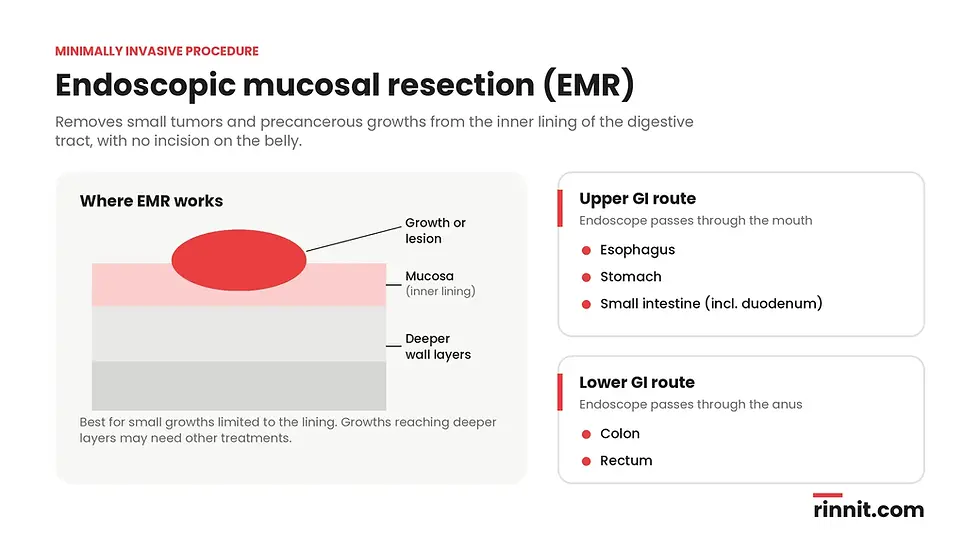
EMR targets growths that sit in the inner lining (mucosa) of the digestive tract.
Feature | Details |
What it is | Minimally invasive removal of irregular tissue from the digestive tract lining [1] |
Main uses | Early-stage cancer and precancerous lesions or polyps in the mucosa [1] |
Who performs it | A gastroenterologist (a doctor who specializes in digestive diseases) [1] |
Route | Mouth for the upper GI tract; anus for the lower GI tract [1] |
Anesthesia | Conscious sedation or general anesthesia [1] |
Duration | About 30 to 60 minutes [1] |
Return to work | Usually the next day [1] |
Follow-up | Repeat endoscopy within 12 weeks [1] |
What conditions does endoscopic mucosal resection treat?
Endoscopic mucosal resection treats early-stage cancers and precancerous growths that are limited to the mucosa, the inner membrane lining the gastrointestinal (GI) tract. [1]
Doctors commonly use EMR for:
Barrett's esophagus, which can cause precancerous lesions in the esophagus
Esophageal cancer at an early stage
Stomach cancer at an early stage
Small intestine cancer, including duodenal cancer
Colorectal cancer at an early stage [1]
Large colorectal polyps are the most common reason for EMR. The technique is used to remove flat or sessile (broad-based) lesions. [2] Learn more about how polyps form in our colon polyps guide and our stomach polyps guide.
Who is a candidate for endoscopic mucosal resection?
You may be a candidate for endoscopic mucosal resection if you have a small tumor or precancerous lesion confined to the inner lining of the digestive tract. [1]
Larger growths, or tumors that have grown into deeper layers of the GI wall, may need a different approach:
If the growth is… | Possible treatment |
Small and limited to the mucosa | Endoscopic mucosal resection [1] |
Larger, or needing removal in one piece, but still near the surface | Endoscopic submucosal dissection (ESD) [1] |
Larger or more advanced | Surgery, chemotherapy or radiation therapy [1] |
Your gastroenterologist decides based on the size, type and depth of the growth. For some lesions, referral to a doctor with advanced endoscopy training is part of that decision. [2]
How do you prepare for endoscopic mucosal resection?
Preparation for endoscopic mucosal resection depends on which part of the digestive tract will be treated, and your gastroenterologist will give you specific instructions. [1]
Area treated | What preparation usually involves |
Upper GI tract (esophagus, stomach, small intestine) | No eating or drinking for several hours before the procedure [1] |
Lower GI tract (colon and rectum) | A bowel prep, which uses laxatives to clean out the colon so the doctor can see clearly [1] |
Plan ahead for the ride home. Anesthesia effects can take up to 24 hours to wear off completely, so you should not drive yourself. [1]
What happens during endoscopic mucosal resection?
During endoscopic mucosal resection, a gastroenterologist passes an endoscope — a long, flexible tube with a camera — to the irregular tissue and removes it with small instruments. [1]

The four main steps of endoscopic mucosal resection.
First, you receive anesthesia so you stay calm and comfortable. This may be general anesthesia, which puts you to sleep, or conscious sedation, which keeps you awake but leaves you with no memory of the procedure. [1]
Then the gastroenterologist:
Inserts the endoscope through your mouth (upper GI) or anus (lower GI).
Guides the endoscope to the irregular tissue.
Threads surgical instruments through the endoscope.
Removes the tissue by suctioning it, injecting a solution or cutting it out with an electric wire. [1]
The procedure usually takes about 30 to 60 minutes. [1]
What techniques do doctors use for EMR?
The standard approach is hot-snare EMR: the doctor injects fluid under the lesion and then removes it with an electrocautery wire loop (snare). Alternatives include cold-snare EMR, which does not use electric current, and underwater EMR. [2]
What happens after endoscopic mucosal resection?
After endoscopic mucosal resection, you rest in a recovery room while the anesthesia wears off, and the removed tissue is usually sent to a laboratory. [1]
A pathologist (a doctor who studies body tissue) examines the sample for signs of disease. The results guide whether you need further exams or treatment. [1]
What are the benefits of endoscopic mucosal resection compared with open surgery?
The main benefit of endoscopic mucosal resection is that it removes precancerous or cancerous tissue before it can grow and spread, without large incisions or removing part of the digestive tract. [1]
Endoscopic mucosal resection | Open surgery | |
Incisions | None from outside the belly | Large incisions |
Recovery | Faster | Slower |
Pain | Less | More |
Complication risk | Lower | Higher |
Scarring | No scarring | Scarring from incisions |
Comparison based on [1].
What are the side effects and risks of endoscopic mucosal resection?
Endoscopic mucosal resection commonly causes mild to moderate side effects for a day or two, while serious complications are rare. [1]
Common, short-lived side effects (depending on the area treated):
Bloating
Cramping
Excess gas and gas pain
Nausea or vomiting
Sore throat [1]
Rare complications:
Gastrointestinal perforation (a hole or tear in the digestive tract)
Scarring in the esophagus that leads to esophageal strictures [1]
Post-polypectomy coagulation syndrome is another recognized adverse event after EMR in the colon. [2] Residual or recurrent growth is also possible with any EMR technique, which is why follow-up matters. [2]
How long does recovery from endoscopic mucosal resection take?
Recovery from endoscopic mucosal resection is usually quick, and most people can return to work the day after the procedure. [1]

What a typical recovery after EMR looks like.
Timeframe | What to expect |
Same day | Rest in the recovery room; someone must drive you home [1] |
Day 1–2 | Possible bloating, cramping, gas, nausea or sore throat [1] |
Next day | Most people return to work [1] |
First several days | You may need a liquid diet while your digestive tract heals [1] |
Within 12 weeks | Follow-up endoscopy to confirm all irregular tissue is gone [1] |
What follow-up care is needed after EMR?
Follow-up after endoscopic mucosal resection usually means a repeat endoscopy with your gastroenterologist within 12 weeks. [1] The doctor checks the treated area and may recommend more exams or treatment depending on the findings. [1] Regular surveillance after EMR matters because some people are at higher risk of the growth coming back. [2]
When should you call a doctor after endoscopic mucosal resection?
Call your gastroenterologist right away after endoscopic mucosal resection if you notice any of these warning signs: [1]
Blood in your stool
Chest pain
Dizziness or fainting
Fever or chills
Shortness of breath (dyspnea)
If symptoms are severe or sudden, go to the nearest emergency department.
Is endoscopic mucosal resection major surgery?
Endoscopic mucosal resection is not major surgery; it is a minimally invasive procedure that does not involve the large incisions of open surgery. [1] Because there is no surgical wound to heal, most people get back to normal activities much faster. [1]
Conclusion
Endoscopic mucosal resection gives doctors a way to remove early cancers and precancerous growths from the digestive tract without a single incision. It is short, usually done as a same-day procedure, and most people return to work the next day. The key steps for you are simple: follow your preparation instructions, arrange a ride home, watch for warning signs in the first days, and keep your follow-up endoscopy appointment.
If you have been told you need EMR, write down your questions — the size and location of your growth, which anesthesia you will get, and when you will get your lab results — and bring them to your gastroenterologist.
Keep learning: explore more clear, doctor-reviewed digestive health guides in our Diseases & Conditions library, starting with colon polyps and colon cancer.
FAQ
What is endoscopic mucosal resection used for?
Endoscopic mucosal resection is used to remove early-stage cancers and precancerous growths from the inner lining of the digestive tract. It treats lesions linked to Barrett's esophagus and early cancers of the esophagus, stomach, small intestine and colon or rectum. [1]
Are you awake during an EMR procedure?
You may be asleep or lightly sedated during EMR. Some people receive general anesthesia, while others get conscious sedation, which keeps them awake but leaves no memory of the procedure afterward. [1]
How long does endoscopic mucosal resection take?
Endoscopic mucosal resection usually takes about 30 to 60 minutes. You then rest in a recovery room until the anesthesia wears off. [1]
What can I eat after endoscopic mucosal resection?
You may need to follow a liquid diet for several days after endoscopic mucosal resection while your digestive tract heals. Follow the specific diet instructions your gastroenterologist gives you. [1]
How soon can I go back to work after EMR?
Most people can return to work the day after EMR. Plan for someone to drive you home on the day itself, because anesthesia effects can last up to 24 hours. [1]
What are the risks of endoscopic mucosal resection?
Complications of endoscopic mucosal resection are rare but include bleeding, gastrointestinal perforation and scarring that narrows the esophagus. Mild bloating, cramping, gas, nausea or a sore throat for a day or two is more common. [1]
Is endoscopic mucosal resection the same as surgery?
Endoscopic mucosal resection is a minimally invasive procedure, not major open surgery. The doctor works through an endoscope, so there are no large incisions and recovery is faster. [1]
When should I go to the doctor after EMR?
Call your gastroenterologist right away if you have blood in your stool, chest pain, dizziness or fainting, fever or chills, or shortness of breath after EMR. These can be signs of a complication. [1]
How do I prepare for endoscopic mucosal resection?
You will need to stop eating and drinking for several hours before the procedure. For the colon or rectum, you will also need a bowel prep. Tell your doctor about all your medicines, especially blood thinners, and arrange a ride home.
When will I get my EMR biopsy results?
The removed tissue goes to a lab, and results usually come back within several days to a couple of weeks. Your doctor will explain what they mean and whether you need more treatment.
Related Reading
Endoscopic Submucosal Dissection (ESD): Procedure, Recovery and Risks explains how larger growths are removed in one piece.
Colon Polyps: Complete Guide to Symptoms, Causes, and Treatment covers colon polyp types, risks and removal.
Upper Endoscopy (EGD): Purpose, Procedure, Preparation and Recovery describes the camera test of the esophagus, stomach and small intestine.
Colonoscopy: Purpose, Prep, Procedure, Results and Risks explains how a colonoscopy finds and removes polyps.
References
Cleveland Clinic. Endoscopic Mucosal Resection: What It Is, Procedure & Recovery. Cleveland Clinic. Last updated August 20, 2023. https://my.clevelandclinic.org/health/treatments/21148-endoscopic-mucosal-resection
Thiruvengadam SS, Fung BM, Barakat MT, et al. Endoscopic Mucosal Resection: Best Practices for Gastrointestinal Endoscopists. Gastroenterol Hepatol (N Y). 2022;18(3):133-144. PMID 35506001. https://pubmed.ncbi.nlm.nih.gov/35506001/
Hassan C, Repici A, Sharma P, et al. Efficacy and safety of endoscopic resection of large colorectal polyps: a systematic review and meta-analysis. Gut. 2016;65(5):806-820. PMID 25681402. https://doi.org/10.1136/gutjnl-2014-308481
Radadiya D, Desai M, Patel H, et al. Endoscopic submucosal dissection and endoscopic mucosal resection for Barrett's-associated neoplasia: a systematic review and meta-analysis of the published literature. Endoscopy. 2024;56(12):940-954. PMID 38942058. https://doi.org/10.1055/a-2357-6111
Liu Y, Lu Y, Liu K, et al. Efficacy and safety of cold snare and hot snare endoscopic mucosal resection in the removal of colorectal polyps: a systematic review and meta-analysis based on RCT studies. Scand J Gastroenterol. 2026;61(9):922-933. PMID 42489425. https://doi.org/10.1080/00365521.2026.2694743
Medical disclaimer
This article is for general education only and does not replace advice from your doctor. Always talk with a qualified healthcare provider about your own diagnosis, treatment options and recovery plan. If you think you are having a medical emergency, contact your local emergency services right away.



Comments