Embolization Procedure: How It Works, Types, Risks, and Recovery

Updated: 6 days ago
Written and medically reviewed by Dr. Baraa Alnahhal, MD · Last reviewed: October 2026 · How we review
Quick Answer: What is embolization?
Embolization is a minimally invasive procedure that blocks a specific blood vessel by placing a substance inside it through a thin catheter. It is used to stop excessive bleeding, close abnormal vessel connections, and cut off blood supply to tumors. An interventional radiologist performs it, and most people return to daily activities within a week. [1]
What the research says
Embolization almost always works technically for lower gut bleeding. A meta-analysis of 58 studies with 2,262 patients found a technical success rate of 97.7% and a clinical success rate of 75.0%. Rebleeding occurred in 17.3% of patients and major complications in 4.3%. (Sun et al., Eur J Med Res, 2026) [2]
Results are similar for upper and lower gut bleeding treated with glue or coils. Pooling 37 studies, clinical success was 73.0% for upper GI bleeding and 76.5% for lower GI bleeding, with major complications in 3.5% and 10.0% of patients. (Matsumoto et al., Sci Rep, 2024) [3]
For fibroids, embolization trades fewer early complications for more repeat treatments. In 13 studies (4 randomized trials), uterine artery embolization had fewer early complications than myomectomy (OR 0.44) but higher reintervention (OR 1.84) and hysterectomy (OR 4.04) rates at four years. (Peng et al., Sci Rep, 2024) [4]
Key takeaways
Embolization stops blood flow through a chosen vessel using coils, foam, glue, particles, balloons, or sclerosing liquids. [1]
It treats bleeding, vascular malformations, aneurysms, fibroids, and some tumors almost anywhere in the body. [1]
The procedure uses a small skin puncture at the wrist, groin, or neck instead of a large incision. [1]
Most people stay in the hospital for at least one night and resume daily activities within a week. [1]
Pain at the puncture site is common for a few days; fever, nausea, and vomiting can signal post-embolization syndrome. [1]
What is an embolization procedure?
An embolization procedure is a minimally invasive treatment that blocks or closes a specific blood vessel. [1] Blocking the vessel stops blood from flowing to an area where it is causing harm.
Most embolizations are planned (elective). Some are emergencies, such as uncontrolled bleeding after an injury, and must be done right away. [1]
Depending on the condition and the material used, embolization can give temporary or permanent relief. [1] It works in three main ways:
Closing abnormal connections between blood vessels.
Cutting off vessels that feed tumors and other abnormal growths.
Stopping or preventing excessive bleeding. [1]
What conditions does embolization treat?
Embolization treats bleeding and blood-vessel problems in nearly every part of the body, from the brain to the pelvis. [1]
Body area | Conditions treated with embolization |
Brain and head | Brain aneurysms, arteriovenous malformations (AVMs), frequent nosebleeds (epistaxis) |
Digestive tract | Gastrointestinal bleeding from stomach (peptic) ulcers or diverticulosis |
Uterus | Uterine fibroids, long or heavy menstrual bleeding |
Abdomen | Overactive spleen; retroperitoneal hematoma (bleeding behind the abdominal wall lining) |
Organs after trauma | Injuries to the spleen, liver, and lungs |
Male reproductive system | Varicocele (swollen veins in the scrotum) |
Anywhere in the body | Vascular malformations, cancers and tumors that bleed |
Source: [1]
If you are reading about a specific condition, these guides explain it in more depth: brain aneurysm, nosebleeds, gastrointestinal bleeding, peptic ulcer disease, and heavy menstrual bleeding.
How does an embolization procedure work?
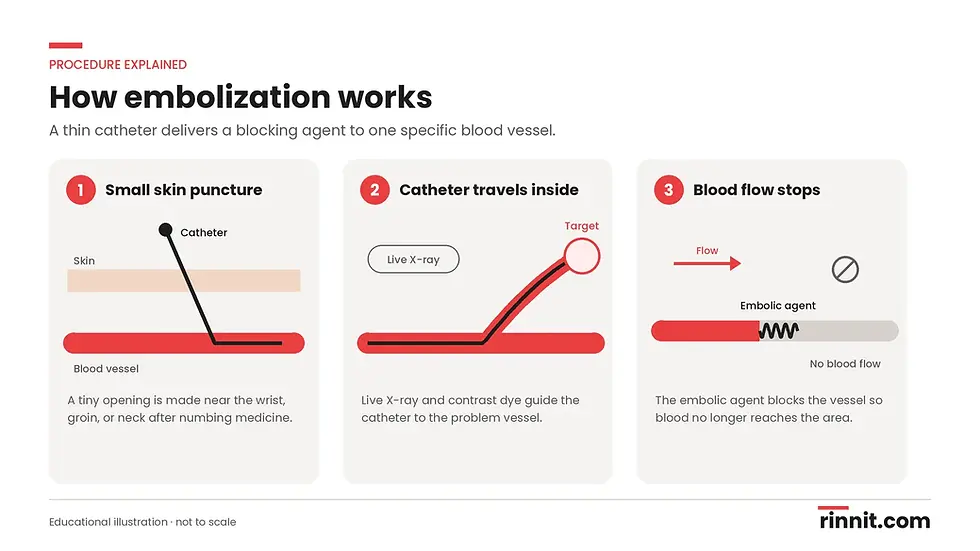
An embolization procedure works by delivering tiny particles or objects, called embolic agents, into a blood vessel through a long, thin tube called a catheter. [1]
The catheter enters through a small puncture in the skin. It then travels along the blood vessel until its tip reaches the treatment area. Instruments at the catheter tip allow the doctor to place the embolic agent exactly where it is needed. [1]
Who performs embolization?
An interventional radiologist performs embolization. [1] This specialist uses real-time imaging and catheters to move through the body's blood vessels and deliver tests and treatments without open surgery.
What types of embolic agents are used in embolization?
Embolic agents used in embolization include balloons, gelatin foam, liquid glue, sclerosing liquids, metallic coils, and particles. [1] The choice depends on your medical needs and the type of blood vessel being treated. [1]
Embolic agent | What it is | How it works |
Balloons | Tiny balloons placed inside a vessel | Block the vessel temporarily or permanently |
Gelatin foam | Sponge-like gelatin material | Blocks flow, then dissolves after a few days |
Liquid glue | Adhesive that hardens quickly | Seals abnormal vessels |
Liquid sclerosing agents | Substances such as alcohol | Destroy tissue on contact so abnormal vessels close |
Metallic coils | Tiny stainless steel and platinum devices | Placed in a precise spot to block the vessel |
Particulate agents | Spheres of various sizes | Permanently block small vessels |
Source: [1]

What are the different embolization techniques?
Embolization techniques differ by the condition being treated and how the embolic agent is placed. [1]
Technique | What it does | Typically used for |
Chemoembolization | Delivers embolic agents plus high-dose chemotherapy into vessels feeding a tumor | Cancers that start in or spread to the liver |
Radioembolization | Delivers embolic agents plus radiation therapy into vessels feeding a tumor | Cancers that start in or spread to the liver |
Sac packing | Packs multiple coils into the treatment area | Aneurysms |
Sandwich technique | Places agents before and after the abnormal tissue to remove it from circulation completely | Abnormal vessel segments |
Stent-assisted coiling | Uses a hollow mesh tube to hold coils in place so they don't migrate | Aneurysms |
Particle embolization | Reduces or stops blood flow with particles | Benign (noncancerous) tumors |
Source: [1]
Embolization for fibroids has its own detailed guide: uterine artery embolization.
How do you prepare for embolization?
Preparing for embolization usually involves imaging tests and a review of your medications. [1]
Imaging: Your care team checks blood flow and the vessels near the treatment area with an ultrasound, CT scan, or MRI. [1]
Medications: You may need to stop certain medicines, such as blood thinners, before the procedure. [1] Only stop a medication when your care team tells you to.
What happens during an embolization procedure?
During an embolization procedure, the interventional radiologist guides a catheter to the problem vessel under live X-ray imaging and releases an embolic agent to stop blood flow. [1] The steps are:
Sedation and numbing. You receive mild sedation to help you relax, and medicine is injected to numb the puncture site. [1]
Skin puncture. A small puncture is made near your wrist, groin, or neck. [1]
Catheter placement. The catheter is passed through the puncture and advanced to the treatment area. [1]
Imaging guidance. Fluoroscopy (live X-ray) lets the doctor see the vessels and instruments. [1]
Contrast dye. A special dye injected through the catheter gives a clearer view of the vessel and blood flow. [1]
Embolic agent delivery. The agent is released, and the doctor confirms that blood flow to the area has stopped. [1]
Finishing up. The catheter is removed and the puncture is covered with a bandage. No stitches or large incisions are needed. [1]
Does embolization hurt?
Embolization should not be painful during the procedure because of the sedation and numbing medicine. [1] You may feel a slight pinch from the numbing needle, pressure as the catheter goes in, and a warm sensation when the contrast dye is injected. [1]
How many embolization procedures will I need?
One embolization procedure is enough for many conditions. [1] A large venous malformation may need a staged approach, with one or more treatments every few weeks. [1]
What are the benefits of embolization?
The main benefits of embolization are fast bleeding control, a small puncture instead of an incision, and a quick return to normal life. [1]
It quickly controls abnormal bleeding and has a high success rate. [1]
It is gentler on the body than open surgery, with minimal blood loss. [1]
Most people resume daily activities within a week. [1]
What are the risks of embolization?
The risks of embolization depend mainly on where the procedure is done and which embolic agent is used. [1] Possible complications include:
Risk | What it means |
Puncture-site bruising or bleeding | Bleeding or a bruise where the catheter went in |
Allergic reaction | A reaction to the contrast dye |
Agent misplacement or migration | The embolic agent lands in, or moves to, the wrong vessel |
Infection | Including sepsis, which can be life-threatening |
Air embolism | An air bubble blocks a blood vessel |
Nerve damage | Neuropathy near the treated area |
Soft tissue necrosis | Tissue death, especially when more than one vessel is blocked |
Stroke or blindness | Possible if agents used in the head migrate |
Source: [1]
For a detailed medical review of these complications, see this peer-reviewed overview of embolization complications.
What is recovery like after embolization?
Recovery after embolization usually means at least one night in the hospital, a few days of rest at home, and a return to daily activities within about a week. [1]
How will I feel after embolization?
Most people have pain at the puncture site that lasts a few days. [1]
Some people develop post-embolization syndrome, which causes fever, nausea, and vomiting. It can follow any embolization but is more common after uterine artery embolization. [1]
Other side effects depend on the treated area:
Head or brain: Embolization of vessels in the head may cause a mild headache. [1]
Uterus: Uterine artery embolization may cause cramping. [1]
What happens in the hospital?
Most people stay in the hospital for at least one night and receive pain medicine to stay comfortable. [1]
What should I do at home?
At home, rest and limit physical activity for a few days. [1] Your puncture site decides which everyday movements to avoid:
Puncture site | What to avoid at first |
Groin | Going up or down stairs |
Wrist | Repetitive motions such as writing or typing |
Any site | Strenuous activity, such as lifting heavy objects |
Source: [1]
Helpful habits during recovery:
Take short daily walks. Walking helps prevent constipation from sedatives and blood clots. [1]
Ice the puncture site to relieve swelling. [1]
Keep the wound clean. [1]

When should you call your doctor after embolization?
Call your doctor after embolization if you notice signs of a blood clot, bleeding, infection, or breathing trouble. [1] Specifically, get in touch if you have:
Redness or swelling in your groin (possible blood clot).
Difficulty breathing.
Excessive bleeding.
Nausea and vomiting that make it hard to keep food or fluids down.
A painful or fast-growing lump near the puncture site.
Fever or warmth near the treatment area (possible infection). [1]
Difficulty breathing or heavy bleeding can be an emergency. Call your local emergency number right away.
Conclusion
Embolization lets doctors stop dangerous bleeding, close abnormal vessels, and cut off the blood supply to tumors through a small skin puncture instead of open surgery. [1] Recovery is usually short, but knowing the warning signs matters just as much as knowing the benefits.
If embolization has been suggested for you or a family member, write down your questions and bring them to your next appointment. Ask which embolic agent will be used, where the puncture will be, and how long you should expect to stay in the hospital.
Keep learning: Explore our health library for clear, research-backed guides on the conditions embolization treats, and share this guide with anyone preparing for the procedure.
FAQ
What is embolization in simple terms?
Embolization is a procedure that blocks a specific blood vessel from the inside using a thin tube called a catheter. Blocking the vessel stops blood from reaching an area where it is causing bleeding or feeding a growth.
Is embolization considered surgery?
Embolization is a minimally invasive procedure, not open surgery. It uses a small skin puncture at the wrist, groin, or neck instead of a large incision, and no stitches are needed.
How long does it take to recover from embolization?
Most people resume daily activities within a week after embolization. Many stay in the hospital for at least one night, then rest and limit physical activity for a few days at home.
Is embolization painful?
Embolization is usually not painful during the procedure because of sedation and numbing medicine. Afterward, most people have pain at the puncture site that lasts a few days.
What is post-embolization syndrome?
Post-embolization syndrome is a reaction after embolization that causes fever, nausea, and vomiting. It can happen after any embolization but is more common after uterine artery embolization.
What conditions can embolization treat?
Embolization can treat brain aneurysms, arteriovenous malformations, frequent nosebleeds, gastrointestinal bleeding, uterine fibroids, heavy menstrual bleeding, varicocele, bleeding from injuries, and tumors that bleed.
Is embolization permanent?
Embolization can be temporary or permanent depending on the embolic agent. Gelatin foam dissolves after a few days, while particulate agents permanently block small vessels.
When should I call a doctor after embolization?
Call a doctor after embolization if you have difficulty breathing, excessive bleeding, groin redness or swelling, a painful or growing lump near the puncture site, fever, or vomiting that stops you keeping fluids down.
Will I be awake during embolization?
Many people get numbing medicine and a sedative to stay relaxed and comfortable, while some need general anesthesia. Your care team will tell you which type you will have.
How long does an embolization procedure take?
It depends on the area being treated and how complex the vessels are. Some procedures take less than an hour, while others take several hours.
Related Reading
Uterine Artery Embolization: Effective Relief for Fibroids and Bleeding explains how embolization shrinks fibroids and eases heavy bleeding.
Chemoembolization (TACE): How It Works, Who It's For, Risks and Recovery describes how embolization delivers chemotherapy directly to liver tumors.
Brain AVM (Arteriovenous Malformation): Symptoms, Causes, and Treatment covers tangled brain blood vessels and how they are treated.
Angiogram: What It Shows, How It's Done, Risks and Recovery explains the X-ray blood vessel test used to guide embolization.
References
Cleveland Clinic. Embolization Procedure: Definition, Purpose & Types. Cleveland Clinic. Last updated July 14, 2022. https://my.clevelandclinic.org/health/treatments/23512-embolization-procedure
Sun Q, Cheng J, Zhang X, et al. Efficacy and safety of transcatheter arterial embolization for lower gastrointestinal bleeding: a systematic review and meta-analysis of 58 clinical trials. Eur J Med Res. 2026;31(1):33. PMID: 41331785. https://doi.org/10.1186/s40001-025-03605-0
Matsumoto T, Yoshimatsu R, Shibata J, et al. Transcatheter arterial embolization of nonvariceal gastrointestinal bleeding with n-butyl cyanoacrylate or coils: a systematic review and meta-analysis. Sci Rep. 2024;14(1):27377. PMID: 39521898. https://doi.org/10.1038/s41598-024-79133-4
Peng J, Wang J, Shu Q, et al. Systematic review and meta-analysis of current evidence in uterine artery embolization vs myomectomy for symptomatic uterine fibroids. Sci Rep. 2024;14(1):19252. PMID: 39164326. https://doi.org/10.1038/s41598-024-69754-0
Medical disclaimer
This article is for general educational purposes only and does not replace professional medical advice, diagnosis, or treatment. Always talk to a qualified healthcare provider about your own health and before making any medical decision. If you think you are having a medical emergency, call your local emergency number immediately.



Comments