Electroejaculation: Purpose, Procedure and Results

Updated: 2 days ago
Written and medically reviewed by Dr. Baraa Alnahhal, MD · Last reviewed: November 2026 · How we review
Quick Answer
Electroejaculation is a way to collect sperm from people who can't ejaculate because of a spinal cord injury, nerve damage or another condition. A urologist places a probe in the rectum next to the prostate and sends mild electrical pulses that trigger ejaculation. The sperm can be used for IUI or IVF, or frozen for later.
What the research says
It reliably collected sperm after spinal cord injury: in 230 electroejaculations in 47 men with spinal cord injury over 21 years, an ejaculate was obtained in 98.7% and moving sperm in 73.5%, and 14 of 17 couples trying IVF achieved pregnancy (Soeterik TF et al., International Journal of Urology, 2017) [2]
Results were similar without spinal injury: electroejaculation combined with ICSI gave pregnancy rates of 20% in men with psychogenic anejaculation and 22.7% in men with spinal cord injury (Gat I et al., Fertility and Sterility, 2012) [3]
Key takeaways
Electroejaculation collects sperm when a person can't ejaculate.
Mild electrical pulses stimulate the prostate.
Sperm can be used for IUI or IVF or frozen.
It's a same-day procedure, often under anesthesia.
Mild soreness for a few days is common.
What is electroejaculation?
It helps people with anejaculation become biological parents. Providers may first try penile vibratory stimulation. Sources: [1]
Who it's for
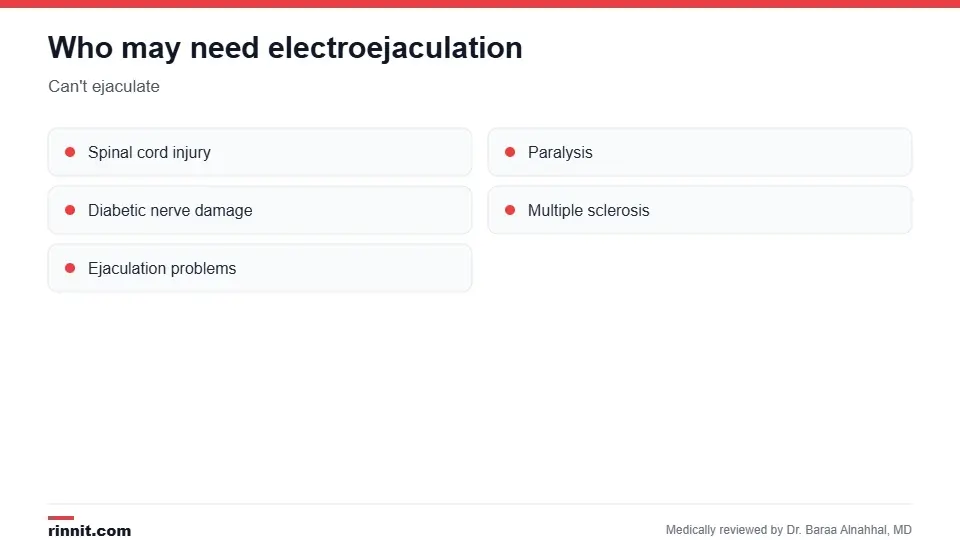
Vibratory stimulation may be tried first.
Spinal cord injury or paralysis.
Diabetic nerve damage.
Multiple sclerosis.
Erectile or ejaculation problems. Sources: [1]
What happens during the procedure

It's done the same day by a urologist.
You usually get general anesthesia, unless you have no feeling below the waist.
A catheter empties your bladder, and medicine is placed to protect sperm.
A lubricated probe is placed in your rectum next to the prostate.
Mild electrical pulses, one to two seconds each, slowly increase in strength.
Ejaculation usually happens after two to three cycles, and semen is collected. Sources: [1]
What happens to the sperm
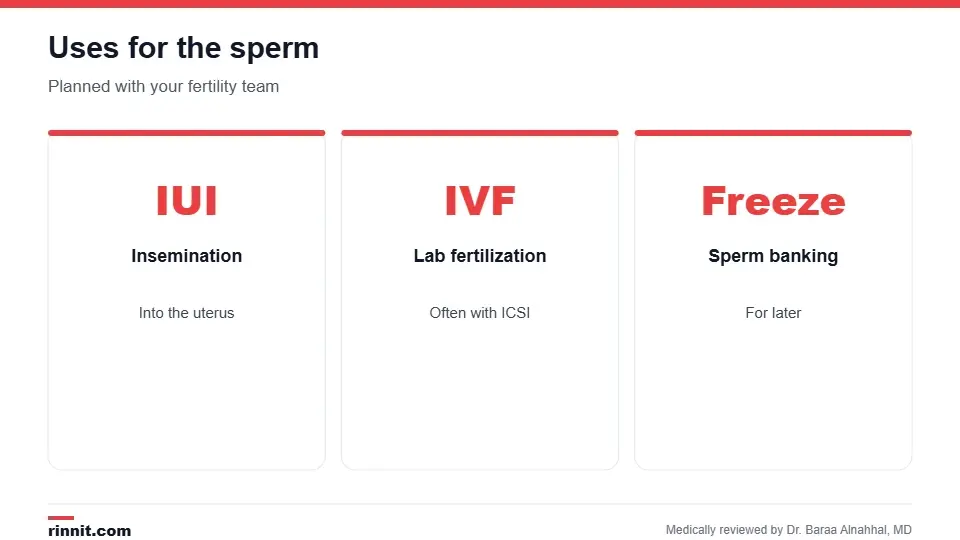
Your fertility team plans the next step.
A semen analysis checks the sperm.
Sperm banking for later use.
Testicular sperm extraction if no usable sperm is found and you agreed beforehand. Sources: [1, 2, 3]
Risks
A rise in heart rate and blood pressure in people with spinal cord injury, which is monitored.
Rarely, burns from the probe.
Urinary tract infection. Sources: [1]
Recovery
Expect mild pain and discomfort for a few days.
Painful urination is common; call if it lasts more than three days.
Over-the-counter pain relievers can help.
Arrange a ride home. Sources: [1]
When to call your provider
Blood in your urine or rectal bleeding.
Trouble urinating or frequent urges.
Fever or chills.
Nausea and vomiting.
Painful urination lasting more than three days. Sources: [1]
Conclusion
Electroejaculation gives people who can't ejaculate a reliable way to collect sperm and start a family. A fertility team helps plan the best use of the sample.
Keep learning: read about male infertility and IVF.
Frequently asked questions
What is electroejaculation?
Using mild electrical pulses to trigger ejaculation and collect sperm.
Who needs it?
People who can't ejaculate due to spinal cord injury or nerve problems.
Does it hurt?
It's usually done under anesthesia.
Who performs it?
A urologist.
How long does it take?
It's a same-day procedure.
What is the sperm used for?
IUI, IVF or freezing for later.
Does it work?
It collects a sample in most cases.
What are the risks?
Blood pressure spikes in spinal injury, rare burns and UTIs.
Is recovery painful?
Mild soreness and painful urination for a few days.
Can sperm be frozen?
Yes, through sperm banking.
Related Reading
Anejaculation: What It Is, Why It Happens, and How Biological Fatherhood Is Still Possible being unable to ejaculate.
Male Infertility: Causes, Symptoms, Tests, and Treatments Explained male infertility.
Sperm Banking: How It Works, Who Needs It, and What to Expect freezing sperm.
Spinal Cord Injury Guide: Symptoms, Causes, Diagnosis, and Treatment spinal cord injury.
References
Cleveland Clinic. Electroejaculation: Purpose, Procedure & Results. Cleveland Clinic. Last updated August 12, 2022. https://my.clevelandclinic.org/health/treatments/23997-electroejaculation
Soeterik TF, Veenboer PW, Oude-Ophuis RJ, et al. Electroejaculation in patients with spinal cord injuries: a 21-year, single-center experience. International Journal of Urology. 2017;24(2):157-161. PMID 27862365. https://doi.org/10.1111/iju.13249
Gat I, Maman E, Yerushalmi G, et al. Electroejaculation combined with intracytoplasmic sperm injection in patients with psychogenic anejaculation yields comparable results to patients with spinal cord injuries. Fertility and Sterility. 2012;97(5):1056-1060. PMID 22365077. https://doi.org/10.1016/j.fertnstert.2012.01.129
Medical disclaimer
This article is for general education only and does not replace advice from a qualified healthcare professional. Talk to your doctor about your own diagnosis and treatment, and seek emergency care right away for severe or sudden symptoms.



Comments