Sperm Banking: How It Works, Who Needs It, and What to Expect

Updated: 6 days ago
Written and medically reviewed by Dr. Baraa Alnahhal, MD · Last reviewed: October 2026 · How we review
Quick Answer: What is sperm banking?
Sperm banking is collecting, freezing and storing sperm in a special facility so you can use it later to have biological children. A tested semen sample is frozen in liquid nitrogen at -196 °C and stays usable for many years. People often bank sperm before cancer treatment or a vasectomy, after age 40, or with a low sperm count. [1]
What the research says
Frozen sperm leads to real pregnancies in men with cancer. A review of 69 studies covering 23,178 men who froze sperm found a pooled pregnancy rate of 28% and a delivery rate of 20%. ICSI gave the best results, with a 34% pregnancy rate per cycle. (Li et al., Human Reproduction Open, 2024) [2]
Frozen sperm works about as well as fresh sperm in IVF. In a study comparing 447 women using frozen sperm with 31,039 using fresh sperm, sperm movement dropped from 82% to 76% after thawing. But live birth rates (40.3% vs 42.4%) and birth defect rates (0.0% vs 0.8%) were not meaningfully different. (Xie et al., Frontiers in Endocrinology, 2024) [3]
Long storage doesn't lower pregnancy chances. Across 119,558 stored samples, the share of sperm surviving thawing fell from about 86% to 74% after 15 years. Still, pregnancy rates after insemination stayed steady at about 22–23% whether sperm had been stored for 5, 10, or 15 years. (Huang et al., Fertility and Sterility, 2019) [4]
Key takeaways
Sperm banking freezes your sperm so you keep the option of biological children later.
Banking sperm does not delay cancer or other medical treatment.
Each sample should ideally be given at least 48 hours after your last ejaculation.
Babies conceived with frozen sperm are as healthy as those conceived naturally.
There's no recovery time. You can go straight back to work or school.
What is sperm banking?
Sperm banking is a process that collects, freezes, and stores your sperm cells in a special healthcare facility called a sperm bank.
Sperm are reproductive cells made in the testicles. Each time you ejaculate, you release about 300 million sperm in your semen.
Freezing these cells "pauses" them. When you're ready to have a child, the sperm can be thawed and used in fertility treatment.
Doctors first froze semen in dry ice in 1953. Liquid nitrogen has been used since 1963, and the process is now routine. [1]
Who should consider sperm banking?
Sperm banking makes sense when something in your life could make it hard to have a baby through sex later on. Choosing to bank sperm is a personal decision.

Reason | Why it matters |
Cancer | Testicular cancer, Hodgkin lymphoma, and leukemia carry a high risk of male infertility. |
Certain treatments | Chemotherapy, orchiectomy (testicle removal), and gender affirmation surgery can sharply lower sperm numbers or stop sperm production. |
Age | Sperm quality tends to decline in men aged 40 and older. |
Low sperm count | Even a small number of good-quality sperm can work with IVF and ICSI (injecting one sperm directly into an egg). |
Frequent travel | Your partner's fertile window lasts from five days before ovulation to one day after. Frozen sperm helps if you're away at that time. |
Military deployment | Dangerous service can injure the reproductive organs. |
Vasectomy | Some people change their minds about having children after this form of birth control. |
[1]
If you're married or in a committed relationship, it helps to involve your partner in the decision. If you're under 18, talk it over with your parents or guardians.
When should you bank your sperm?
The best time to bank sperm is before any treatment that could harm fertility. With a serious illness, you may need to decide quickly, so raise it with your doctor early. [1]
Samples should be collected before chemotherapy or radiation starts, because sperm collected after treatment begins may have more genetic damage; if treatment has already started, ask your doctor. These treatments can damage the genetic material in developing sperm, but mature sperm resist that damage. [1] Read more about how cancer treatments affect fertility in men.
In general, it's worth talking to your doctor about sperm banking any time after puberty if something might make it hard to have children later.
Will sperm banking delay my treatment?
No. Banking sperm won't delay the start of your medical treatment. [1] Here's how timing usually works:
Your testicles make sperm all the time, but levels need time to build back up after each ejaculation.
For the best sperm count, give each sample at least 48 hours after your last sexual activity (sex or masturbation).
You may need to give several samples, each 48 hours apart.
If your treatment schedule is tight, 24 hours between samples is often enough.
How does sperm banking work?
Sperm banking works in five steps: screening tests, giving a semen sample, labeling and testing, freezing, and a post-thaw check before long-term storage. [1]
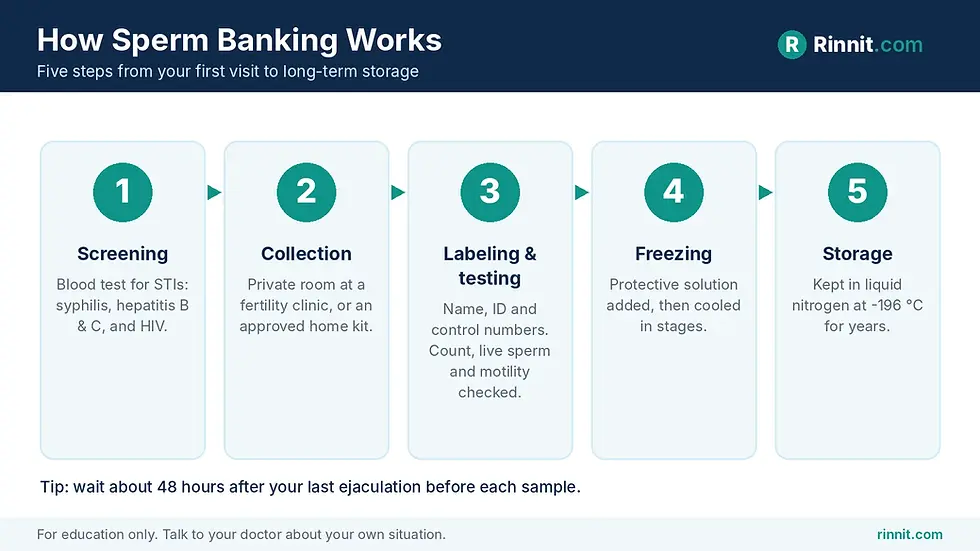
Step 1: Screening tests
Before banking, you'll have a blood test to check for sexually transmitted infections (STIs), including:
Syphilis
Hepatitis B
Hepatitis C
HIV
A thin needle draws a small amount of blood from a vein in your arm. You'll feel a slight pinch, but it's not usually painful. The sample then goes to a lab for testing.
Step 2: Giving your semen sample
You'll visit a fertility clinic. A staff member will take you to a private room and give you a special container, usually a small plastic jar with a screw-top lid. Some clinics also offer special collection condoms.
In the privacy of the room, you'll masturbate and collect your semen in the container. A few things can harm your sample:
Avoid this | Why | What to do instead |
Regular store-bought condoms | They can damage sperm, and many contain spermicide. | Use a clinic-provided collection condom. |
Lubricants, including saliva | They can damage or slow down sperm. | Ask the clinic for an approved, sperm-safe lubricant. |
Sex toys not cleared by the clinic | Some may damage sperm or limit the sample. | Check with your doctor first. |
Can I collect my sample at home?
You may be able to collect your sample at home with a home sperm-banking kit, mailed discreetly with step-by-step instructions. Some people find it hard to give a sample outside the comfort of home, and that's normal. You'll usually need to:
Drop the sample at the fertility clinic within a few hours.
Keep it as close to body temperature as possible on the way.
You can't freeze sperm at home. Freezing needs a special facility and precise steps.
Step 3: Labeling and testing
Your sample is carefully labeled with:
Your name
Your patient ID number
An internal control number (an extra unique number for accurate identification)
The date
The clinic may also copy your photo ID for your file. These steps keep your sample correctly identified and confidential at every stage.
A small part of your sample is tested before freezing, much like a semen analysis:
What's checked | What it tells your doctor |
Total sperm count | How many sperm are in the sample |
Number of live sperm | How many sperm are alive |
Motility | The percentage of sperm that are moving |
Step 4: Freezing
The rest of the sample is split into small amounts, mixed with a protective solution called a cryopreservative, and placed in small containers called cryovials.
Freezing starts right away and happens in stages, so the sperm aren't damaged by a sudden drop in temperature. [1]

Stage | Temperature | Where | Purpose |
1 | -29 °C (-20 °F) | Freezer | Prevents sperm dying from a sudden extreme drop in temperature |
2 | -66 °C (-86 °F) | Liquid nitrogen vapor | Deeper cooling for about two hours |
3 | -196 °C (-321 °F) | Liquid nitrogen tank | Permanent long-term storage |
Step 5: Post-thaw check and storage
Between 24 and 48 hours after freezing, a small portion is thawed to see what percentage of sperm survived. Higher-quality samples generally recover better after thawing.
Using the before-and-after results, your doctor can advise:
How many samples you should bank for the best chance of pregnancy.
Whether intrauterine insemination (IUI) or in vitro fertilization (IVF) is likely the better option for you.
How do you use your banked sperm later?
You use your banked sperm by giving your fertility clinic advance notice and completing a release form. [1] When you're ready for fertility treatment:
Tell your fertility clinic at least four weeks in advance.
You (or your legally appointed executor) fill out a release form.
The clinic releases the sample for your treatment.
What are the benefits and risks of sperm banking?
The main benefit of sperm banking is protecting your chance of biological children, while the main challenges are giving a sample, cost and inherited-risk worries. [1]
Benefits | Possible challenges |
Protects your chance of having biological children if treatment, illness, or life changes affect fertility. | Some men can't give a sample through masturbation because of erectile dysfunction, delayed ejaculation, or inability to ejaculate. |
Frozen sperm does not raise the risk of conditions present at birth. Babies are as healthy as those conceived through sex. | Costs vary, and there may be yearly storage fees. Insurance coverage differs. |
Properly stored samples don't deteriorate, even after many years. | If your cancer or condition runs in families, there may be worries about passing it on. |
What if I can't produce a sample?
If masturbation isn't possible, your doctor may suggest surgical sperm retrieval, where sperm are collected directly from the reproductive tract.
Can cancer be passed on to my children?
A few types of cancer can run in families. Your doctor can tell you if yours is one of them.
If you have a cancer type or condition that runs in families, a genetic counselor can explain the real risks to your future children.
How much does sperm banking cost?
The cost of freezing a sample varies between clinics, and there may be annual storage fees on top. Check with your insurance provider to see what's covered.
What is recovery like after sperm banking?
Sperm banking has no recovery period. You can go back to work or school right after giving your sample. [1]
The only timing rule is to wait about 48 hours between samples if you're giving more than one.
What happens to banked sperm if you die?
Banked sperm is handled by a legally appointed executor, such as a partner, family member, or trusted friend, so it's wise to name one when you bank. [1] After your death, that person can:
Withdraw your samples from the sperm bank.
Ask the bank to destroy your samples, if that's your wish.
Your partner may want to use your banked sperm to have children, so make your wishes clear in writing.
Conclusion
Sperm banking is a simple, safe way to protect your future fertility. It takes a blood test, one or more private sample collections, and careful freezing, with no recovery time and no delay to medical treatment.
If you're facing cancer treatment, planning a vasectomy, getting older, or dealing with a low sperm count, banking sperm now keeps your options open later. You may feel self-conscious about the process, but fertility teams handle it every day and are there to help.
Talk to your doctor or a fertility clinic about sperm banking before starting any treatment that could affect your fertility. For more clear, research-backed health guides, explore the Rinnit.com health library and bring this article to your next appointment.
FAQ
What is sperm banking?
Sperm banking is collecting, freezing, and storing sperm in a special facility so it can be used later to have biological children through fertility treatment.
How long can sperm be frozen?
When stored correctly in liquid nitrogen, sperm doesn't deteriorate even after many years. Studies show stable pregnancy rates with sperm stored up to 15 years.
Does sperm banking hurt?
No. The only needle involved is a routine blood test for STIs, which causes a slight pinch. Giving the sample itself is painless.
Should I bank sperm before chemotherapy?
Yes, ideally before treatment starts. Samples are best collected before treatment starts, because sperm collected after chemotherapy or radiation begins may have more genetic damage.
Will banking sperm delay my cancer treatment?
No. Sperm banking won't delay your treatment. If time is short, samples can be given 24 hours apart instead of 48.
How many samples do I need to bank?
It depends on your sperm quality. Your doctor uses test results from before and after freezing to recommend the right number of samples for you.
Are babies from frozen sperm healthy?
Yes. Using frozen sperm doesn't increase the risk of birth conditions. These babies are as healthy as babies conceived through sex.
Can I freeze my sperm at home?
No. Freezing requires a special facility. But you may be able to collect your sample at home with a clinic kit and drop it off within a few hours.
How do I use my frozen sperm later?
Tell your fertility clinic at least four weeks before you need it, and complete a release form. It can then be used for IUI or IVF.
What happens to my sperm if I die?
A legally appointed executor can withdraw your samples or ask the bank to destroy them, based on your wishes.
Related Reading
Electroejaculation: Purpose, Procedure and Results explains electroejaculation.
References
Cleveland Clinic. Sperm Banking: Collection, Freezing, Storage & Benefits. Cleveland Clinic. Last updated January 26, 2026. https://my.clevelandclinic.org/health/treatments/17493-sperm-banking
Li Q, Lan QY, Zhu WB, et al. Fertility preservation in adult male patients with cancer: a systematic review and meta-analysis. Hum Reprod Open. 2024;2024(1):hoae006. PMID 38389980. https://doi.org/10.1093/hropen/hoae006
Xie Q, Jiang X, Zhao M, et al. Effect of freezing and thawing on ejaculated sperm and subsequent pregnancy and neonatal outcomes in IVF. Front Endocrinol (Lausanne). 2024;15:1408662. PMID 39736859. https://doi.org/10.3389/fendo.2024.1408662
Huang C, Lei L, Wu HL, et al. Long-term cryostorage of semen in a human sperm bank does not affect clinical outcomes. Fertil Steril. 2019;112(4):663-669.e1. PMID 31371041. https://doi.org/10.1016/j.fertnstert.2019.06.008
Medical disclaimer
This article is for general education only and is not a substitute for professional medical advice, diagnosis or treatment. Always talk with a qualified healthcare provider or fertility specialist about your own situation.



Comments